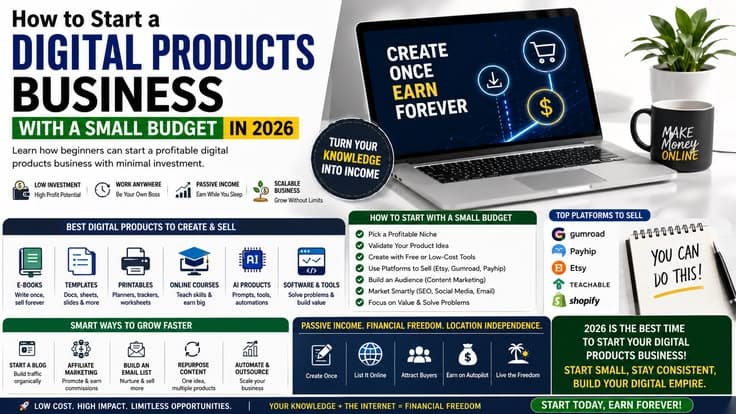
How to Start a Digital Products Business with a Small Budget in 2026
Imagine building a business that works for you while you sleep. No warehouse, no shipping costs, no inventory headaches, and no need for a large startup investment. This is the reality of selling digital products online — and in 2026, it has never been more accessible to ordinary people starting from scratch.
The global digital products market is massive and growing. E-books and audiobooks generate over $26 billion in annual revenue. The software as a service (SaaS) market has crossed $300 billion. Online gaming exceeds $225 billion. Music and video streaming combined represent hundreds of billions more. Behind every one of these numbers is the same fundamental business model: create something once, sell it infinitely, automate the delivery, and keep the profit.
This guide covers everything a beginner needs to know to build a digital products business from the ground up — with as little as fifty dollars or even nothing — including what digital products are, the 75 best product ideas organized by niche, how to start with low investment, how to earn through blogging and website advertising, how affiliate marketing works, and a complete step-by-step roadmap from your first idea to your first online sale.
What Is a Digital Product? The Simple Explanation
A digital product is any asset that exists in digital form, delivers real value to the buyer, and is distributed online without any physical shipping. Unlike a physical product — a book, a piece of clothing, a phone — a digital product never runs out of stock, never costs money to ship, and can be sold to thousands of people simultaneously without any additional production cost.
The distinction between digital products and digital goods is worth understanding. Digital goods are simple downloadable files — wallpapers, ringtones, audio clips, photos. Digital products are interactive or educational assets that solve a specific problem or teach a specific skill — an ebook on personal finance, a Canva template pack for social media, a spreadsheet for tracking expenses, an online course on coding, or an AI prompt library for content creators. Digital products deliver interactive value; digital goods are just files.
The three qualities that make a strong digital product are: a clear value proposition aimed at solving one specific problem, an interactive or educational component, and a revenue-generating capability through one-time purchases, subscriptions, or licensing. Once those three boxes are checked, you have a digital product worth building.
| Category | Annual Revenue (2025) | Growth Direction | Best For Beginners? |
|---|---|---|---|
| E-books and Audiobooks | $26.04 Billion | Growing steadily | Yes — Low barrier to entry |
| Online Gaming | $225.28 Billion | Fast growing | Requires technical skills |
| Music Streaming | $47.06 Billion | Growing | Requires musical talent |
| Video Streaming | $157.71 Billion | Growing | Moderate — Content creation skills |
| SaaS (Software as a Service) | $300 Billion | Fast growing | Requires development skills |
| Templates and Printables | Multi-billion and growing | Fast growing | Yes — No coding needed |
| Online Courses | Multi-billion and growing | Fast growing | Yes — Any expertise qualifies |
| AI Prompt Packs and Tools | Emerging category | Explosive growth | Yes — New and low competition |
Why Digital Products Are the Best Low-Budget Business Idea
The most compelling reason to build a digital products business is the economics. When you sell a physical product for ten dollars, you subtract the cost of manufacturing, packaging, shipping, returns, and storage. Your margin might be two or three dollars. When you sell a digital product for ten dollars, your margin is nine dollars and eighty cents. The only costs are the platform fee and the occasional payment processing charge. You keep almost everything.
Scalability is the second major advantage. A single Canva template pack, once created, can be sold to one person or one million people without any additional work on your part. An ebook you write this month can generate income three years from now while you are doing something else entirely. This is what true passive income looks like — not a get-rich-quick scheme, but a genuine business model where the work you do today continues paying you long into the future.
The startup cost is the third advantage. Most successful digital product businesses start with a free Canva account, a free Gumroad or Payhip storefront, and a free social media account to drive traffic. The total investment to get your first product live and generating sales can genuinely be zero dollars. If you choose to invest fifty dollars, you can purchase a domain name, a basic website theme, and a month of premium Canva to create higher-quality products — still one of the lowest startup costs of any profitable business model in history.
75 Best Digital Products to Sell Online in 2026 — Organized by Niche
The most common mistake beginners make is trying to sell everything to everyone. The digital products that consistently outsell everything else are hyper-specific — they solve one particular problem for one particular type of person. Here are the 75 best digital product ideas for 2026, organized by creator niche so you can find the category that matches your existing knowledge and skills.
Finance and Money Management (Products 1–10)
Personal finance is one of the most evergreen niches online. People are always looking for tools to manage their money better, get out of debt, and build savings habits — and they will pay for well-organized, easy-to-use resources that help them do it.
Budget trackers in Google Sheets or Excel format are the most consistently bestselling finance digital products. A clean, beginner-friendly spreadsheet where users can enter their income and expenses and automatically see their savings rate is worth five to fifteen dollars on Etsy and can sell thousands of copies. Savings challenge kits that guide users through a 30-day challenge with checklists and trackers are popular gifts and impulse purchases. Debt payoff calculators using both snowball and avalanche methods help users visualize their path to debt freedom. Creator income trackers for freelancers and content creators who need to manage irregular income, invoices, and tax estimates fill a very specific gap that mainstream accounting software does not address. Weekly money journals with reflection prompts help users build financial mindset habits rather than just tracking numbers. Investing starter kits that simplify the basics of index funds, ETFs, and compounding in beginner-friendly language sell extremely well as people try to understand personal investing without the jargon. Tax preparation checklists for self-employed individuals reduce the anxiety of tax season into a manageable, step-by-step process. Financial goals vision boards and affirmation decks tap into the motivational side of personal finance and sell well on platforms where lifestyle content thrives.
Health, Fitness, and Wellness (Products 11–20)
Fitness and wellness remain among the highest-spending niches globally. People invest in their health when they are motivated, and the right digital product delivered at the right moment can convert that motivation into a sale.
Seven-day jumpstart challenges with daily workouts, meal guidance, and mindset prompts give buyers immediate value and a clear starting point. Weekly meal planners with grocery lists and macro counts serve both fitness beginners and experienced athletes looking for more organized approaches to nutrition. Bodyweight workout guides for home training — organized by difficulty level with clear exercise descriptions — address the enormous segment of people who want to train without a gym membership. Thirty-day wellness journals that combine habit tracking, gratitude prompts, and daily reflection help users build sustainable health routines rather than just completing a single challenge. Gut health meal plans, anti-inflammatory recipe collections, and targeted nutrition guides for specific goals such as muscle gain or hormone balance all sell well when marketed to the right audience through social media content that demonstrates real knowledge.
Productivity and Organization (Products 21–30)
In the age of AI and information overload, productivity is a growing obsession. People spend money on tools that help them focus, organize their lives, and feel in control of their time.
Notion templates are among the fastest-selling digital products on every major marketplace right now. Life organizer dashboards, student study hubs, business operating systems for freelancers, and ADHD organization boards — there is a market for each of these and the competition, while growing, is still nowhere near saturation for well-designed, niche-specific templates. Digital planners that are hyperlinked PDFs compatible with apps like GoodNotes on the iPad are another major category, particularly popular with students, teachers, and productivity enthusiasts. Burnout recovery workbooks that guide overwhelmed professionals through a structured reset process address a growing mental health and work-life balance concern. AI prompt libraries for busy people — organized collections of ChatGPT prompts that help users plan their week, draft emails, summarize documents, or brainstorm content — are a brand-new category with enormous growth potential and virtually no direct competition at the specific niche level. Time audit spreadsheets and goal-setting template packs round out this category with practical, immediately usable tools.
Business and Marketing (Products 31–40)
Small business owners and freelancers represent a highly motivated, financially capable audience that spends on tools and resources that save them time and help them grow.
Sales page templates with fill-in-the-blank copy prompts are among the highest-priced digital products in this category, regularly selling for thirty to one hundred dollars each because the buyer understands exactly how much revenue a better sales page can generate. Niche clarity workbooks help new entrepreneurs narrow their focus and define their value proposition. Lead magnet builder kits with Canva templates and swipe files help creators build their email lists. DM sales script bundles teach the right conversational approach to converting social media followers into paying customers without feeling pushy. Newsletter starter kits with welcome sequences, subject line formulas, and content calendar templates help business owners build email audiences from scratch. Client onboarding template packages — including welcome emails, intake forms, contracts, and offboarding sequences — are valuable to any service provider who works with multiple clients simultaneously.
Career and Professional Development (Products 41–50)
Job seekers, career changers, and professionals looking to grow are all willing to pay for resources that give them a concrete advantage in competitive situations.
Resume and cover letter templates for specific industries consistently rank among the top sellers on Etsy and Gumroad. Interview preparation kits with mock questions, frameworks for structuring answers, and confidence-building checklists address the specific anxiety of job interviews with practical tools. LinkedIn profile optimization guides teach professionals how to rewrite their bios and experience sections to attract recruiters and inbound opportunities. Salary negotiation scripts help candidates ask for more money confidently without damaging the relationship with a potential employer. Career change workbooks guide people through the emotional and practical process of pivoting industries. Elevator pitch frameworks help professionals communicate their value concisely in networking situations.
Education and Teaching Resources (Products 51–60)
Teachers, tutors, homeschooling parents, and students are all active buyers of educational digital products. This is a particularly strong niche because buyers have a clear, immediate need and purchase decisions happen quickly.
Subject-specific cheat sheets condensed into clean, easy-to-review PDFs are high-volume, low-price sellers — the kind of product someone buys impulsively the night before an exam. Exam preparation bundles with mock tests, answer keys, and review guides for specific grade levels or standardized tests provide high perceived value at a moderate price point. Study planners and academic goal trackers help students organize their semester around specific outcomes. Classroom resource packs with printable worksheets, games, and activity sheets sell to teachers who are constantly looking for supplemental materials that save them preparation time. Interactive flashcard decks for language learning, science terms, or historical events are always in demand and quick to create with tools like Canva.
Relationships and Personal Growth (Products 61–68)
The relationship and personal development niche covers dating, communication, emotional intelligence, attachment styles, and couple's tools — all areas where people actively seek guidance and are comfortable spending money on resources that promise meaningful improvement.
Boundaries workbooks that help individuals define their personal limits and script difficult conversations address one of the most searched personal development topics online. Conversation starter card decks for couples, families, or friend groups promote connection and sell well as gifts. Attachment style explanation guides packaged as accessible PDF workbooks turn complex psychological concepts into immediately usable self-knowledge. Relationship reset challenges as five to seven-day guided programs help couples reconnect with intentional daily activities. Dating profile revamp guides that walk singles through writing better bios and screening more effectively fill a specific gap in a high-interest niche.
AI-Powered Digital Products (Products 69–75)
This is the newest and fastest-growing category in the entire digital products space, and it is still dramatically under-saturated. AI-enhanced products help buyers use artificial intelligence tools more effectively and efficiently.
ChatGPT prompt packs organized by profession or use case — content creators, real estate agents, teachers, coaches, fitness trainers — give buyers immediately usable AI workflows without them having to figure out prompting on their own. Midjourney prompt libraries for specific aesthetics or industries help visual creators generate consistent, high-quality AI imagery. AI workflow guides that show non-technical professionals how to integrate AI tools into their specific job functions are among the highest-perceived-value products you can create right now. AI business setup checklists that walk new entrepreneurs through selecting and configuring the right AI tools for their specific business model reduce overwhelm and provide clear direction. ChatGPT templates for specific tasks — customer service emails, social media captions, product descriptions, job application cover letters — give buyers plug-and-play starting points for their most common writing tasks.
| Niche Category | Product Range | Easiest to Create | Highest Earning Potential | Best Platform |
|---|---|---|---|---|
| Finance and Money | 1–10 | Budget tracker spreadsheet | Investing starter kit course | Etsy, Gumroad |
| Health and Fitness | 11–20 | 7-day challenge checklist | 30-day workout program | Gumroad, Instagram |
| Productivity | 21–30 | Notion template | AI prompt library | Etsy, Gumroad, Whop |
| Business and Marketing | 31–40 | Email swipe file pack | Sales page template bundle | Gumroad, Shopify |
| Career Development | 41–50 | Resume template | Interview prep + negotiation bundle | Etsy, LinkedIn |
| Education | 51–60 | Subject cheat sheet | Exam prep bundle + course | Etsy, Teachable |
| Relationships | 61–68 | Conversation starter cards | Relationship reset program | Gumroad, Instagram |
| AI Products | 69–75 | ChatGPT prompt pack | AI workflow guide + course | Gumroad, Whop, Payhip |
How to Start a Digital Products Business Step by Step
Starting a digital products business does not require a business degree, a large budget, or years of experience. It requires clarity about who you want to help, the willingness to create something useful for them, and the discipline to market it consistently. Here is the complete roadmap from idea to first sale.
Step 1: Choose Your Niche and Validate Your Idea
The most common reason digital product businesses fail before they start is choosing too broad a topic. Do not try to sell productivity tools to everyone. Instead, sell a specific productivity system to overwhelmed college students, or burned-out marketing managers, or stay-at-home parents managing a household. The more specific your target audience, the easier it is to find them, speak to them clearly, and convert them into buyers.
Validation means confirming that people will actually buy your product before you spend significant time creating it. The fastest way to validate is to offer a simple version of your product as a pre-sale at a discounted price. Post about it on social media, in relevant Facebook groups, or through a simple landing page. If you get even three pre-orders, you have enough validation to build the full product. If nobody responds, adjust your idea and try again before investing weeks of creation time.
Step 2: Create Your First Product
The tools required to create most digital products are free or very low cost. Canva has a free tier that is genuinely sufficient for creating professional-looking templates, ebooks, planners, and printables. Notion is free for personal use and is the standard tool for building the productivity system templates that sell so well on Etsy and Gumroad. Google Docs and Google Sheets are completely free and create files that buyers can use immediately without any special software. For audio products, Audacity is a free, professional-grade recording and editing tool.
Your first product does not need to be your best product. It needs to be useful, specific, and honest. A twelve-page ebook that genuinely solves one specific problem will outsell a two-hundred-page ebook that tries to cover everything. Start small, get the product live, and improve based on customer feedback.
Step 3: Set Up Your Storefront
You have three primary options for where to sell your digital products, each with different advantages depending on your goals and current situation.
Etsy is the most recommended starting point for most beginners because it has built-in traffic — millions of active buyers are already searching for digital products on the platform every day. You do not need to bring your own audience. The platform charges a small listing fee and takes a commission on each sale, but the exposure to an existing buying audience makes this the fastest path to a first sale. Etsy is particularly strong for templates, planners, printables, and design assets.
Gumroad and Payhip are simpler, lower-friction platforms that are better for creators who plan to drive their own traffic from social media or a blog. Both have free tiers and make it extremely easy to upload a product, set a price, and share a link. Gumroad takes a transaction fee on each sale; Payhip offers a free plan with a higher percentage fee that decreases as you grow.
Shopify is the right choice if you plan to build a serious brand with a custom website, run advertising campaigns, and scale to significant monthly revenue. The monthly cost is higher, but the control over branding, customer data, and marketing integrations justifies the investment once your business is generating consistent sales.
Step 4: Market Your Products
The most overlooked aspect of a digital products business is marketing. Creating the product is only half the work. The other half is getting it in front of people who need it and trust you enough to buy from you.
Pinterest is one of the most underutilized marketing channels for digital product sellers. Pins have a much longer shelf life than Instagram or TikTok posts — a well-optimized pin can drive traffic for months or years after it is first published. Create vertical graphics showcasing your templates, planners, or ebook covers with clear text overlays describing the benefit, link directly to your product page, and pin consistently using relevant keywords.
Short-form video on TikTok, Instagram Reels, and YouTube Shorts is the fastest way to reach new audiences with zero advertising budget. Show your products in action — walk through how to use a Notion template, demonstrate how a budget spreadsheet works, or share a page from your ebook. Process videos and before-and-after demonstrations convert extremely well because they give potential buyers confidence that the product delivers on its promise.
Building an email list from day one is the most valuable long-term marketing investment you can make. Offer a free mini-version of your product — a single template, a checklist, or a one-page guide — in exchange for an email address. Once you have a list, you can promote new products, run limited-time offers, and build a relationship with potential buyers that is not dependent on any social media algorithm.
| Platform | Best For | Built-In Traffic | Fees | Ease of Setup | Recommended For |
|---|---|---|---|---|---|
| Etsy | Templates, printables, planners, design assets | Yes — Very High | $0.20 listing + 6.5% transaction | Very Easy | First-time sellers |
| Gumroad | Ebooks, courses, AI products, software | Low — Drive own traffic | 10% on free, 0% on paid plans | Very Easy | Social media creators |
| Payhip | All digital products | Low — Drive own traffic | 5% on free, lower on paid | Easy | Bloggers and email marketers |
| Shopify | Building a brand store | No — Drive own traffic | $29-79/month + transaction fees | Moderate | Scaling an established business |
| Teachable / Kajabi | Video courses, memberships | Low — Drive own traffic | Free tier available; paid plans from $29+ | Moderate | Course creators and coaches |
| Whop | Communities, software, subscriptions | Some — Growing marketplace | 3% transaction fee | Easy | Community-based products |
| Amazon KDP | Ebooks and low-content books | Yes — Very High | Royalty share model (35-70%) | Moderate | Writers and authors |
Ebooks vs Templates vs Courses: Which Makes the Most Money?
This is the question every new digital product creator eventually asks. The honest answer is that the best-performing product type is the one that best matches your skills and the specific problem you are solving for your audience. But each category does have meaningful differences in creation time, price ceiling, and scalability.
Ebooks are the most accessible starting point. A well-researched, well-organized ebook on a specific topic can be created in a weekend using Google Docs and formatted with Canva. Price points typically range from five to twenty-nine dollars for shorter guides and up to forty-nine dollars for comprehensive, long-form content. The main challenge is that ebooks require your writing skills to be evident and your topic to be specific enough that buyers cannot simply find the same information for free with a Google search. The best-selling ebooks solve a problem that has lots of Google results but no single, comprehensive, organized solution — the kind of information that exists in scattered form across dozens of websites but has never been synthesized into one useful guide.
Templates are the fastest to create and the most consistent sellers on platforms like Etsy. A single Notion template or Canva social media kit can take two to four hours to create and sell for eight to twenty-nine dollars. The advantage of templates is their repeatability — once you understand what your audience needs, you can create multiple variations and build a catalogue of thirty to one hundred templates that collectively generate significant monthly passive income. The challenge is that the template market on Etsy is increasingly competitive, so differentiation through niche specialization and high-quality design is essential.
Online courses have the highest price ceiling by a significant margin. A well-structured course on a genuinely valuable skill can sell for one hundred to five hundred dollars or more, which means even a small number of sales generates meaningful revenue. The challenge is that courses require significantly more creation time — video recording, editing, structuring the curriculum, writing support materials — and the barrier to entry for buyers is higher because they are committing to more time and more money. The most profitable course business models combine a low-priced digital product (like an ebook or template) that introduces buyers to your teaching, followed by an upsell to a premium course for those who want more depth.
| Factor | Ebooks | Templates | Online Courses |
|---|---|---|---|
| Creation Time | Weekend to 2 weeks | 2–8 hours per product | Several weeks to months |
| Tools Required | Google Docs, Canva | Canva, Notion, Google Sheets | Camera, editing software, course platform |
| Typical Price Range | $5 – $49 | $7 – $49 | $47 – $997+ |
| Passive Income Potential | High — Once written, sells indefinitely | Very High — Fast to create, sell repeatedly | Very High — Premium price, recurring if membership |
| Competition Level | Moderate — Niche topics win | High on Etsy — Niche wins | Moderate — Quality and trust win |
| Best Platform | Amazon KDP, Gumroad, Payhip | Etsy, Gumroad, Creative Market | Teachable, Kajabi, Udemy |
| Audience Required? | No — Platforms provide traffic | No — Etsy provides traffic | Preferred — Trust is important |
| Beginner Friendly? | Very Yes | Very Yes | Moderate — Higher production requirements |
| Updates Required? | Occasionally | Rarely | Yes — Especially technical topics |
Can Blogging Still Make Money in 2026?
Yes — but the path to blogging income is more competitive and requires more strategic thinking than it did five or ten years ago. The bloggers who are thriving in 2026 are not the ones who write about everything for everyone. They are niche authority builders — people who choose one specific topic, publish consistently excellent content optimized for search engines, and monetize through multiple channels simultaneously.
The blogging income model has three main pillars: display advertising revenue that grows proportionally with traffic, affiliate marketing commissions from recommending products and services your readers genuinely need, and digital product sales to the audience you build through your content. A blog that generates ten thousand monthly visitors might earn fifty to one hundred dollars per month from display ads alone. The same blog with well-placed affiliate links to relevant products could earn five hundred to two thousand dollars per month. Add a digital product — even a simple fifteen-dollar ebook or template pack — and you have a business that generates meaningful passive income from a single website.
The key to blogging success in 2026 is choosing a niche with commercial intent — topics where people are actively looking for solutions and are willing to spend money. Personal finance blogs monetize extremely well because readers are already motivated to improve their situation. Technology and software review blogs generate high affiliate commissions because the products they recommend have large affiliate programs. Health and wellness blogs with specific focus areas — gut health, strength training for beginners, sleep optimization — attract motivated audiences who buy products and courses. Travel blogs monetize through credit card and booking affiliates. The niches that struggle are those where readers want entertainment but not solutions — gossip, celebrity news, general interest topics — because those audiences are not in a buying mindset.
The Four Stages of Building a Blogging Income
Stage one is foundation building. This is the first three to six months, where you publish consistently, build your initial content library, and focus entirely on search engine optimization without expecting significant income. Most blogs earn very little in this period, and that is normal. Stage two is traffic growth, where your content begins ranking in search results and monthly visitors start climbing toward the ten thousand to fifty thousand per month threshold that unlocks more meaningful advertising revenue and affiliate income. Stage three is monetization optimization, where you add affiliate partnerships, optimize your best-performing content, and launch your first digital product. Stage four is scaling, where you systematize your content production, grow your email list, and diversify your income streams across multiple products and affiliate programs.
Affiliate Marketing for Beginners — How to Earn Commissions
Affiliate marketing is one of the most powerful income streams available to anyone with an online presence — a blog, a YouTube channel, a social media account, or an email list. The model is simple: you recommend products or services that genuinely help your audience, include a unique tracking link in your content, and earn a commission every time someone makes a purchase through your link. You never handle the product, never deal with customer service, and never manage inventory. You create content about things you already know and use, and you get paid when your recommendations lead to sales.
The key to sustainable affiliate income is recommending only products you genuinely use and believe in. Audiences can detect inauthentic recommendations, and nothing destroys reader trust faster than promoting something purely for a high commission that turns out to be low quality. The most successful affiliate marketers build their entire content strategy around one or two core products or services that perfectly serve their audience, earn high commissions, and that they can promote naturally across dozens of different pieces of content.
How to Start Affiliate Marketing with No Audience
The biggest misconception about affiliate marketing is that you need a massive existing audience to earn meaningful income. While a larger audience always helps, many affiliate marketers generate their first commissions within the first few months by choosing the right niche, creating search-optimized content, and being very specific about who they are trying to reach.
The starting point is choosing a niche — a specific topic where you have genuine knowledge and where commercial products exist that your audience needs. A fitness niche might promote workout equipment, nutrition supplements, or fitness apps. A personal finance niche might promote budgeting tools, investment platforms, or financial courses. A technology niche might promote software subscriptions, online courses, or productivity tools. Pick a niche you can create content about consistently and where you can authentically recommend relevant products.
The second step is choosing affiliate programs. Amazon Associates is the most accessible starting point because nearly any product in the world is available on Amazon and the approval process is straightforward. The commission rates are lower than specialized programs, but the brand recognition means higher conversion rates. Specialized affiliate networks like ShareASale, Impact, and Commission Junction host thousands of programs across every niche, many with commissions of twenty to fifty percent — far higher than Amazon's typical rate. SaaS products often offer the highest commissions because the companies value recurring customers and will pay thirty to fifty percent of monthly subscription fees as ongoing commissions to affiliates who bring them customers.
| Program | Best For | Commission Rate | Cookie Duration | Ease of Approval | Payment Method |
|---|---|---|---|---|---|
| Amazon Associates | Physical products, general audience | 1–10% depending on category | 24 hours | Very Easy | Bank transfer, gift card |
| ShareASale | Software, fashion, home, finance tools | 5–50% varies by merchant | 30–90 days | Easy | PayPal, bank transfer |
| Impact | SaaS, tech, courses, finance | 10–50% varies by merchant | 30–90 days | Moderate | PayPal, bank transfer |
| Shopify Affiliate Program | Entrepreneurship and e-commerce audience | Up to $150 per referral | 30 days | Moderate | PayPal |
| Teachable Affiliates | Education and online course audience | 30% recurring commission | 90 days | Easy | PayPal |
| Canva Affiliates | Designers, creators, marketers | Up to $36 per Pro referral | 30 days | Easy | PayPal |
| Notion Affiliates | Productivity and business audience | 50% first year revenue | 90 days | Easy | Stripe |
How to Earn from Website Advertising
Display advertising is the original online business model — and despite claims that it is dying, it continues to generate billions of dollars annually for website owners and bloggers who have built consistent traffic. The basic model is straightforward: you place an advertising network's code on your website, the network fills your ad slots with relevant advertisements, and you earn money based on the number of impressions your ads receive or the number of clicks they generate.
Google AdSense is the most accessible starting point for new website owners. The application process is relatively simple, approval typically takes a few days to a week, and the network works with virtually any niche. AdSense uses a combination of cost-per-click and cost-per-thousand-impressions pricing, and earnings vary significantly by niche — finance and insurance content earns dramatically more per click than general entertainment content because advertisers in those industries have higher customer lifetime values and can afford higher advertising costs.
The earnings potential from display advertising scales directly with traffic. A website generating one thousand monthly visitors might earn five to twenty dollars per month from AdSense. Ten thousand monthly visitors might generate fifty to two hundred dollars. One hundred thousand monthly visitors — achievable within one to two years of consistent content creation in a well-chosen niche — can generate five hundred to three thousand dollars per month from advertising alone, more if you qualify for premium networks.
Premium advertising networks like Mediavine and Raptive (formerly AdThrive) pay significantly more per impression than AdSense, but they require minimum traffic thresholds. Mediavine requires fifty thousand monthly sessions. Raptive requires one hundred thousand monthly page views. Reaching these thresholds takes time, but for niche websites in high-value categories, qualifying for these networks can increase advertising revenue by three to five times compared to AdSense for the same traffic volume.
| Network | Traffic Minimum | Average RPM | Best For | Ease of Approval |
|---|---|---|---|---|
| Google AdSense | No minimum | $1–$15 per 1,000 views | New websites, any niche | Easy |
| Media.net | No minimum | $1–$10 per 1,000 views | English-language sites, finance topics | Easy-Moderate |
| Ezoic | None (AI optimization tier) | $5–$25 per 1,000 views | Growing sites, any niche | Moderate |
| Mediavine | 50,000 sessions/month | $15–$50 per 1,000 views | Lifestyle, food, finance, travel niches | Selective |
| Raptive (AdThrive) | 100,000 page views/month | $20–$60 per 1,000 views | High-quality content sites | Selective |
| Adsterra | No minimum | Varies by ad format | International traffic, various niches | Easy |
Affiliate Marketing vs Digital Products: Which Online Business Model Is Better?
Both affiliate marketing and selling your own digital products are excellent online business models. The right choice depends on where you are starting from, what resources you have, and what kind of business you want to build.
Affiliate marketing is faster to start and requires no product creation. You can publish your first piece of affiliate content today with no upfront investment and potentially earn your first commission within weeks. However, your income is dependent on other companies' decisions — they can change commission rates, discontinue programs, or change product features without any notice to you. You also earn a fraction of the value you generate: if you recommend a two-hundred-dollar software subscription and earn twenty percent commission, you get forty dollars from a sale that delivered two hundred dollars of value.
Selling your own digital products is slower to start — you need to create the product before you can sell it — but the economics are significantly more favorable. When you sell a twenty-dollar ebook, you keep eighteen dollars after platform fees. When you sell a fifty-dollar template pack, you keep most of it. You control the product, the pricing, the customer experience, and the long-term direction of the business. The relationship with your buyer is direct, which means you can ask for feedback, update the product based on real customer insights, and build loyalty that drives repeat purchases.
The most successful online business builders combine both models. They create digital products that serve their specific audience, and they also recommend relevant tools and services through affiliate partnerships that complement their own products. A personal finance blogger might sell their own budgeting spreadsheet template and also recommend the budgeting app, the brokerage platform, and the financial book that their audience uses alongside it. This combined approach maximizes revenue from each piece of content and each visitor.
How to Build a Passive Income Website from Scratch
A passive income website — sometimes called a niche site or authority site — is a website built around a specific topic that earns money through advertising, affiliate links, and digital product sales without requiring your active presence to generate income each day. Once built and ranked, a good niche site earns money while you sleep, travel, or work on other projects.
Choosing the right niche is the foundation of everything. The ideal niche has three characteristics: genuine search demand (people are actively searching for information on Google), commercial intent (some of the searchers are looking to buy products or services), and moderate competition (you can realistically rank for relevant keywords without competing directly against massive established websites in your first year). Personal finance sub-niches like debt payoff strategies, side hustle ideas, or budgeting for young families consistently meet all three criteria. Health sub-niches like specific diet approaches, workout methods for specific populations, or natural wellness topics also perform well. Technology niches focused on specific software categories, how-to guides, or comparisons of tools that serve specific professions are excellent because the advertisers in these niches pay high rates.
Building a passive income website requires three things: a domain name and web hosting (approximately ten to fifteen dollars per year for a domain, three to ten dollars per month for basic hosting), a content management system (WordPress is free and powers forty percent of the entire internet), and consistently published, well-researched, search-engine-optimized content. The content is the most time-consuming part, but it is also the most durable asset you will build — a well-written article that ranks on the first page of Google can generate traffic and income for years without any additional work.
| Component | Free Option | Paid Option | Recommended Choice | Monthly Cost |
|---|---|---|---|---|
| Website Platform | WordPress.com (limited) | WordPress.org (self-hosted) | WordPress.org | $0 (software is free) |
| Domain Name | Free subdomain on free platforms | Custom .com domain | Custom .com domain | ~$1/month ($12/year) |
| Web Hosting | None for self-hosted | Shared hosting | Hostinger or SiteGround | $3–$10/month |
| Theme/Design | Free WordPress themes | Premium theme | Free theme is sufficient to start | $0 |
| Email Marketing | Mailchimp (up to 500 subscribers) | ConvertKit or MailerLite | Start free, upgrade when growing | $0 to start |
| Content Creation Tool | Google Docs | SurferSEO, Semrush | Google Docs to start | $0 |
| Digital Product Creation | Canva Free, Google Sheets | Canva Pro ($15/month) | Free version is sufficient to start | $0 |
| Total Minimum Cost | Approximately $3–$12 per month for hosting and domain | $3–$12/month | ||
Digital Products That Require No Coding — Perfect for Beginners
One of the most common barriers people cite when considering a digital products business is the assumption that technical skills are required. This is simply not true. The vast majority of bestselling digital products require no coding, no technical expertise, and no specialized software beyond tools that anyone can learn in an afternoon.
Canva is the single most powerful tool in a non-technical digital product creator's toolkit. It is a free, browser-based design tool with thousands of templates that can be used as starting points for social media template packs, ebook covers, planner pages, worksheets, digital art, resume templates, presentation decks, and dozens of other products. The free version is genuinely capable enough to create professional, marketable products. Canva Pro adds additional elements and fonts that can elevate your designs, but many successful digital product sellers generate thousands of dollars monthly using only the free version.
Notion is the second essential tool for no-code digital product creators. It is a free productivity and knowledge management app that allows you to build beautifully organized databases, planners, wikis, and dashboards. Notion templates — which are pre-built organizational systems that buyers can duplicate into their own Notion workspace — are among the highest-converting, most consistent-selling digital products on platforms like Etsy and Gumroad. Creating a Notion template requires no coding: you simply build the system you wish you had when you were starting out, document how to use it, and list it for sale.
Google Sheets and Microsoft Excel spreadsheet templates require no coding — just formula knowledge, which is a skill anyone can learn from YouTube tutorials in a few hours. Budget trackers, expense logs, investment calculators, project management dashboards, and content calendars are all high-demand products that can be created entirely within these free tools and sold to thousands of buyers who want the functionality without having to build it themselves.
AI tools have created an entirely new category of no-code digital products — AI prompt packs and workflow guides. These products require nothing more than a knowledge of how to use ChatGPT, Midjourney, or other AI tools effectively. A well-organized collection of thirty to fifty prompts for a specific profession or use case, packaged as a PDF with clear instructions and examples, can sell for fifteen to forty-nine dollars and requires nothing beyond a word processor and basic formatting skills to create.
From Zero to First Online Sale: Your Complete Roadmap
The gap between having an idea and making your first sale is where most aspiring digital product entrepreneurs get stuck. Here is the clearest, most direct path from zero to your first transaction.
Week one is about research and decision-making. Spend this week identifying the specific problem you will solve, the specific person who has that problem, and the specific product format that best delivers the solution. Browse Etsy for bestsellers in your niche — look for products with hundreds or thousands of reviews, understand what people are buying and why, and identify how you can create something similar but more specific or higher quality for a distinct sub-segment of that market.
Week two is product creation. Set a firm deadline — your product must be ready to list by the end of this week. Use Canva, Notion, Google Docs, or whatever tool best fits your product type. Keep the scope small and focused. A ten-page PDF guide or a single Notion template is enough for your first product. Do not let perfectionism prevent you from finishing.
Week three is storefront setup and launch. Create your Etsy or Gumroad account, write a clear product title that includes your main keyword, write a benefit-focused product description that explains exactly what the buyer gets and how it helps them, create three to five attractive mockup images using Canva (search for free mockup templates), set your price, and publish. Your product is live.
Week four and beyond is marketing. Share your product on Pinterest, create content on Instagram or TikTok showing it in use, mention it in any relevant Facebook groups or online communities you are part of, and start building your email list with a free mini-version of the product. Your first sale will come — and when it does, use the momentum to create your second product, then your third, building a catalogue that collectively generates consistent passive income over time.
| Week | Focus Area | Key Actions | Expected Outcome |
|---|---|---|---|
| Week 1 | Research and Planning | Browse Etsy bestsellers, identify niche, choose product type, validate idea | Clear product concept with validated demand |
| Week 2 | Product Creation | Create product using Canva, Notion, or Google tools; write instructions; create PDF | Finished, polished digital product ready to sell |
| Week 3 | Storefront Setup and Launch | Create Etsy or Gumroad account, write title and description, create mockup images, set price, publish | Live product listing visible to potential buyers |
| Week 4 | Marketing and Traffic | Share on Pinterest, create social content, post in relevant communities, set up free lead magnet | First traffic to your product listing |
| Month 2 | Optimization and Scale | Review analytics, create second product, respond to customer feedback, start email list | Growing sales and product catalogue |
| Month 3+ | Building Passive Income | Add affiliate links, grow email list, launch blog, create bundle offers | Multiple income streams from one business |
How to Start an Online Business Without Inventory
The digital products business model is inherently inventory-free, but it is worth understanding the full landscape of online businesses that require no physical products, no warehousing, and no shipping logistics. This gives you a broader menu of options to choose from based on your skills and interests.
Dropshipping allows you to sell physical products online without ever holding inventory yourself. When a customer places an order in your online store, you purchase the item from a third-party supplier who ships it directly to the customer. Your profit is the difference between your selling price and the supplier's cost. While this involves physical products, you as the store owner never touch them. The main challenge with dropshipping is finding reliable suppliers, managing customer expectations around shipping times, and differentiating your store in a competitive market.
Print-on-demand is a model where you design graphics for apparel, accessories, home goods, and stationery, and a print-on-demand partner like Printful or Printify manufactures and ships the item only when a customer orders it. You pay the base cost, keep the profit margin, and never manage inventory. This model bridges the creative skills of digital product creators with the tangible appeal of physical merchandise.
Freelancing and service-based businesses offer another completely inventory-free path to income. Writing, graphic design, social media management, SEO consulting, virtual assistance, video editing, and web development are all skills that can be sold as services online with zero upfront investment. The trade-off compared to digital products is that freelancing is not passive — you exchange time for money directly. However, freelancing generates immediate income that can fund the creation of more scalable digital product assets over time.
| Business Model | Startup Cost | Passive Income? | Skills Required | Time to First Income | Income Ceiling |
|---|---|---|---|---|---|
| Digital Products (Etsy/Gumroad) | $0–$50 | Yes — High | Basic design or writing | 1–4 weeks | Unlimited |
| Blogging + Affiliate Marketing | $15–$100/year | Yes — High | Writing, basic SEO | 3–12 months | Unlimited |
| Freelancing (Upwork/Fiverr) | $0 | No — Time for money | Any marketable skill | Days to weeks | Moderate (time-limited) |
| Online Tutoring | $0 | No | Academic or professional expertise | Days to weeks | Moderate |
| Print on Demand | $0 (use Printful free) | Partial | Graphic design | Weeks to months | High |
| Dropshipping | $50–$300 | Partial | Marketing, product research | Weeks to months | High |
| YouTube + Ads/Affiliate | $0 (smartphone camera) | Yes — Growing | Video creation, editing | 6–18 months | Very High |
Best Digital Products to Sell on Pinterest — The Overlooked Traffic Source
Pinterest is one of the most underutilized marketing channels for digital product sellers, and the sellers who understand this advantage are generating substantial passive income from the platform with no advertising spend. Unlike Instagram or TikTok where content disappears from feeds within hours or days, a single high-quality pin can drive traffic to your product listing or blog for months or years after it is published because Pinterest functions more like a search engine than a social media platform.
The types of digital products that perform best on Pinterest align with the visual nature of the platform and the intent of its users. Printable planners and organizational tools — particularly those with beautiful, aesthetic designs — are among the top-performing categories because Pinterest users actively search for planning inspiration. Canva template packs that showcase a specific visual style attract designers and content creators who browse Pinterest for design inspiration. Recipe ebooks and meal planning guides match perfectly with Pinterest's massive food and wellness audience. Wedding and event planning digital tools — invitation templates, seating chart planners, wedding budget trackers — connect with one of Pinterest's largest and most commercial audiences. Financial planning printables, study planners, and home organization templates also generate consistent Pinterest traffic because users frequently search for these resources on the platform.
The Pinterest marketing strategy for digital product sellers involves creating multiple pins for each product — different designs, different copy angles, different color schemes — and publishing them consistently across relevant boards. Use keyword-rich descriptions that include the specific search terms your target buyer would use. Link pins directly to your product listing on Etsy or Gumroad. Over time, as your pins accumulate saves and engagement, they distribute themselves organically to new audiences who share your buyers' interests, creating a self-reinforcing traffic system that grows with minimal ongoing effort.
Frequently Asked Questions About Starting a Digital Products Business
Can I start a digital products business with no money?
Yes. You can create a digital product using free tools like Canva, Google Docs, or Notion, list it for free on Gumroad or Payhip, and market it through free social media accounts on Instagram, Pinterest, or TikTok. The only thing required is time, effort, and the willingness to learn. Many successful digital product businesses started with zero financial investment.
How long does it take to make money selling digital products?
The timeline varies significantly depending on the platform, the quality of your product, and how actively you market it. On Etsy, where there is built-in traffic, some sellers make their first sale within days. On platforms where you drive your own traffic from social media or a blog, the first sale might take several weeks to a couple of months. Most sellers who commit to consistent marketing see meaningful income within three to six months of their first product launch.
What are the best digital products to sell in Pakistan?
The most accessible digital products for Pakistani entrepreneurs are those that can be created and sold entirely online without any dependence on local infrastructure. Canva template packs, Notion templates, ebooks on topics like freelancing, finance, or digital marketing, AI prompt libraries, and educational printables all sell well internationally from Pakistan. Platforms like Etsy, Gumroad, and Payhip accept international sellers, and payment can be received through platforms like Payoneer, which is widely available in Pakistan.
How much can I earn from website advertising?
Website advertising income is directly proportional to traffic. As a rough guide, a website generating ten thousand monthly page views might earn twenty to one hundred dollars per month from Google AdSense depending on niche and audience location. With one hundred thousand monthly page views and a premium ad network, the same content could generate one thousand to five thousand dollars per month. Finance, insurance, and business niches earn significantly more per visitor than entertainment or general interest niches because advertisers in high-value industries pay more per click.
Is affiliate marketing better than selling digital products?
Neither model is universally better — they serve different strengths and work best when combined. Affiliate marketing is faster to start and requires no product creation. Digital products give you higher margins and full control over your business. The most successful online entrepreneurs combine both, selling their own digital products to their audience while also earning affiliate commissions from recommending the complementary tools and services their audience needs.
| Revenue Stream | Time to First Dollar | Monthly Income at 6 Months | Monthly Income at 2 Years | Passive Level | Investment Required |
|---|---|---|---|---|---|
| Digital Products (Etsy) | Days to weeks | $50–$500 | $500–$5,000+ | High | $0–$50 |
| Digital Products (Own Site) | Weeks to months | $100–$1,000 | $1,000–$10,000+ | Very High | $50–$200 |
| Affiliate Marketing (Blog) | 1–6 months | $50–$500 | $1,000–$20,000+ | Very High | $50–$200/year |
| Website Display Advertising | 3–12 months | $10–$200 | $500–$5,000+ | Very High | $50–$200/year |
| Freelancing | Days to weeks | $500–$3,000 | $2,000–$10,000+ | Low (active income) | $0 |
| Online Courses | Months | $200–$2,000 | $2,000–$50,000+ | High | $100–$500 |
| Combined Strategy (all above) | Varies | $500–$3,000 | $5,000–$50,000+ | Very High | $100–$500 |
Final Thoughts: Building Your Digital Income, One Product at a Time
The digital products business model is not a shortcut to overnight wealth. It is a patient, compounding strategy that rewards consistency, specificity, and genuine value creation. The entrepreneurs who build significant passive income from digital products are the ones who start with a specific audience, solve a specific problem, publish consistently, and resist the temptation to chase every new trend before they have mastered the fundamentals of one.
Your starting point does not have to be perfect. Your first Notion template does not need to be the most beautiful template ever created on the platform. Your first ebook does not need to be a hundred pages. Your first Pinterest pin does not need to have professional photography. It needs to be real, specific, and useful — and you need to publish it rather than endlessly preparing to publish it.
The digital economy is still in its early stages. Artificial intelligence is creating entirely new categories of products that barely existed three years ago. The global appetite for online learning, productivity tools, and creative assets continues to grow year after year. The entry barrier has never been lower, the tools have never been more powerful, and the global audience has never been larger. The only thing standing between you and your first digital product sale is the decision to start, the commitment to create something genuinely useful, and the patience to build an audience and a catalogue over time.
Start with one product. Serve one specific person with one specific solution. List it on one platform. Market it through one channel. Learn from that experience, and build the next one. That is the entire blueprint — and it works.
Explored Topics
Related Insight
View All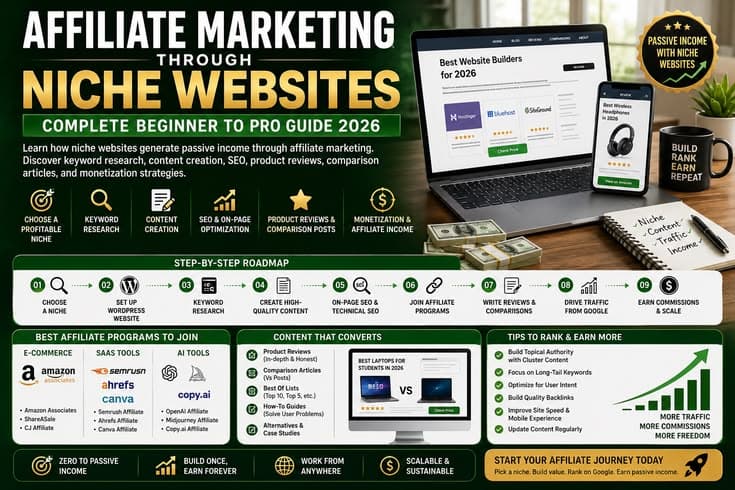
Affiliate Marketing Through Niche Websites: Complete Beginner to Pro Guide 2026
Learn how niche websites generate passive income through affiliate marketing. Discover keyword research, content creation, SEO, product reviews, comparison articles, and monetization strategies. This complete guide covers everything from choosing a profitable niche and setting up your WordPress blog to joining the best affiliate programs — including Amazon Associates, SaaS tools, and AI affiliate programs — writing high-converting product reviews, ranking on Google, building topical authority, and scaling to consistent monthly passive income. Whether you want to start affiliate marketing with a blog, do affiliate marketing without YouTube, or build a full authority niche website, this step-by-step roadmap will take you from zero to earning your first commissions and beyond.
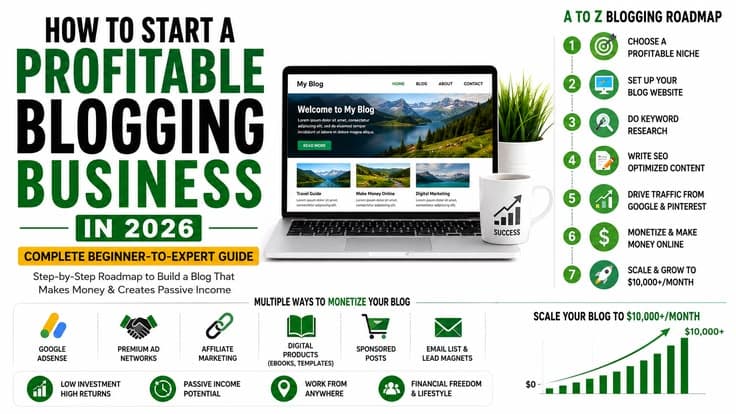
How to Start a Profitable Blogging Business in 2026: Complete Beginner-to-Expert Guide
Want to build a profitable blogging business in 2026 but don't know where to start? This complete A-to-Z guide covers everything a beginner needs to go from zero to income. Learn how to choose a profitable niche, set up your blog website, do keyword research, write SEO-optimized content, drive traffic from Google and Pinterest, monetize with Google AdSense and premium ad networks, earn through affiliate marketing, sell digital products like ebooks and templates, and scale your blog to $10,000 per month. Whether you are a complete beginner or someone who already has a blog and wants to grow it, this step-by-step blogging roadmap will show you exactly how to turn your blog into a real online business that generates passive income for years to come.
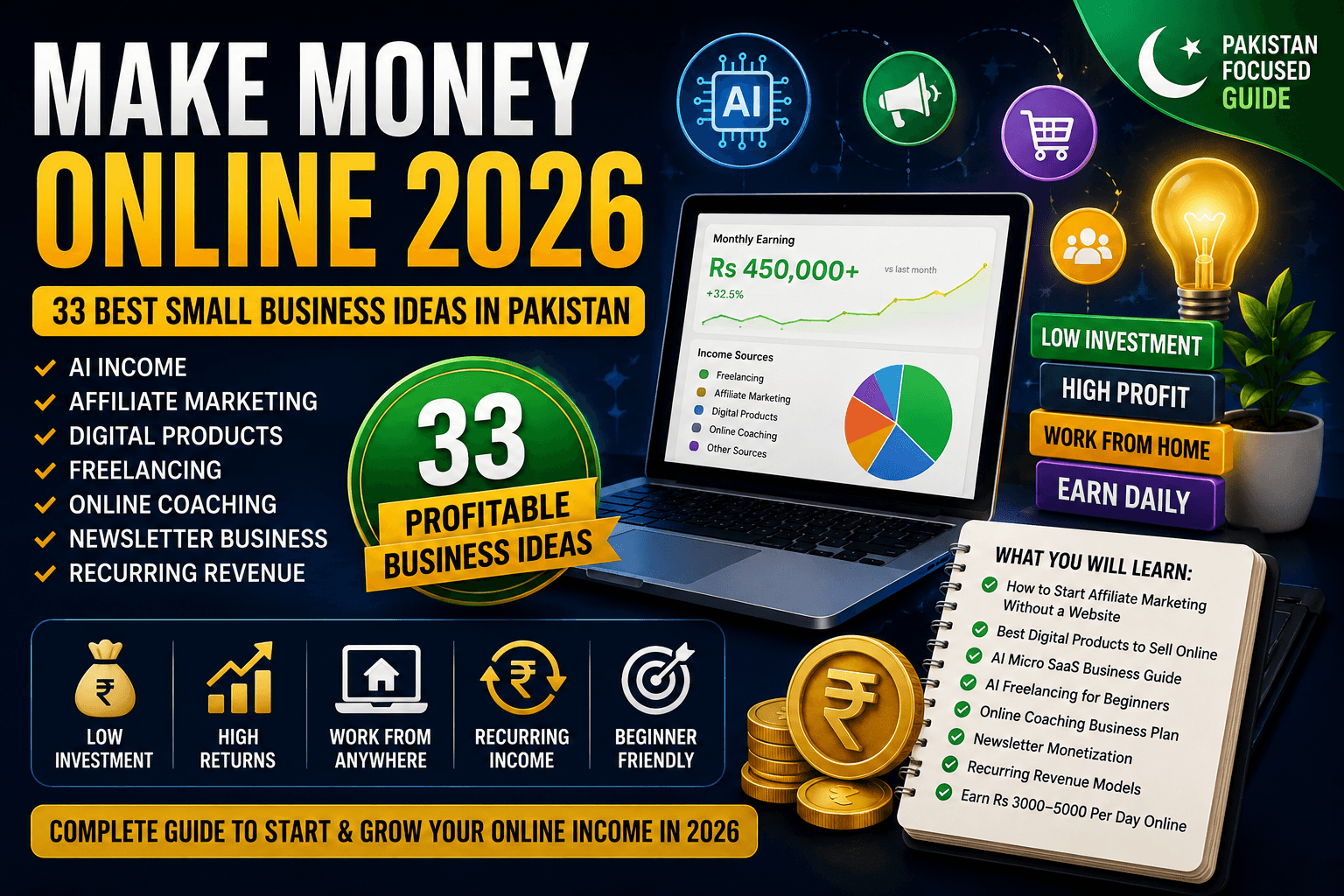
Make Money Online 2026 — 33 Best Small Business Ideas in Pakistan, AI Income, Affiliate Marketing, Digital Products, Freelancing, Online Coaching, Newsletter Business & Recurring Revenue Complete Guide
Complete guide to making money online in Pakistan 2026: 33 profitable small business ideas with low investment, how to start affiliate marketing without a website, best digital products to sell online, AI micro SaaS business guide, AI freelancing for beginners, online coaching business plan, newsletter monetization, recurring revenue models, how to start a niche blog in Pakistan, best digital products that sell automatically, and how to earn Rs 3000–5000 per day online from Pakistan.