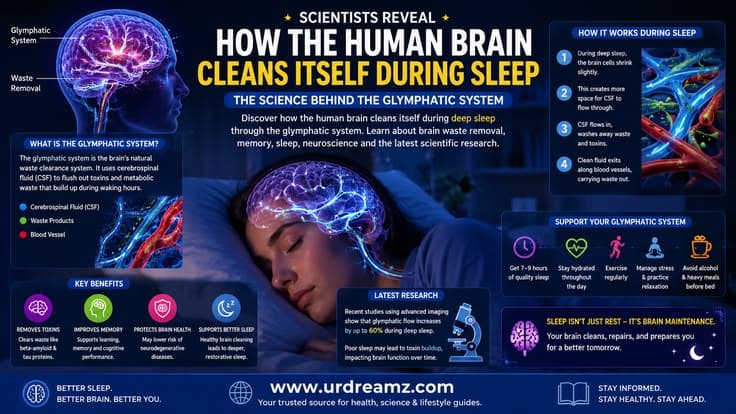
Scientists Reveal How the Human Brain Cleans Itself During Sleep: The Science Behind the Glymphatic System
When you fall asleep, it feels like your brain simply switches off for the night. In reality, the opposite is happening. The moment you slip into deep sleep, your brain activates a remarkable overnight maintenance system that flushes out the metabolic waste built up from a full day of thinking, learning, and moving. Neuroscientists call this the glymphatic system, and understanding how it works is changing the way researchers think about memory, brain aging, and diseases like Alzheimer's. This guide explains, in plain English, exactly how the brain cleans itself during sleep, why deep sleep matters so much for brain health, and what current science actually says about brain detox claims.
1. What Is the Glymphatic System?
The glymphatic system is the brain's own built-in waste-clearance network. Its name is a blend of "glial" - referring to the support cells of the nervous system - and "lymphatic," because the system performs a job similar to the body's lymphatic system, just built specifically for the brain. It was only formally identified and named by researchers around 2012, which makes it one of the more recent major discoveries in modern neuroscience.
The human brain makes up roughly two percent of total body weight, yet it consumes about twenty percent of the body's total energy. All of that non-stop electrical and chemical activity produces metabolic byproducts and waste proteins that build up between brain cells throughout the day. Left unchecked, this waste would eventually interfere with normal brain function. The glymphatic system exists to prevent exactly that, and it turns out that it does the vast majority of its work while you are asleep.
2. How Does the Brain Clean Itself During Sleep?
So how does the brain actually clean itself at night? The process centers on a fluid called cerebrospinal fluid, or CSF, and a subtle but important physical change that happens in brain tissue during deep sleep.
While you are awake, your brain cells are tightly packed together, leaving very little room for fluid to move freely between them. Once you enter deep, slow-wave sleep, brain cells shrink slightly, opening up more space in between them. Cerebrospinal fluid then flows through these enlarged spaces in much greater volume than during waking hours, washing through the tissue like a nightly rinse cycle. As it moves, this fluid picks up metabolic waste products and toxic proteins that have accumulated between neurons and carries them away to be cleared from the brain entirely.
This is why so many long-tail searches for "how does the brain clean itself" and "brain cleaning process" point to the same underlying answer: it is largely a sleep-dependent process, and it depends heavily on reaching deep, uninterrupted sleep rather than just any period of rest.
3. Cerebrospinal Fluid (CSF): The Brain's Cleaning Fluid
Cerebrospinal fluid is a clear fluid that surrounds and cushions the brain and spinal cord. Beyond simple physical protection, CSF plays a central role in brain cleaning, nutrient delivery, and pressure regulation inside the skull.
| Function of CSF | Why It Matters |
|---|---|
| Cushioning and protection | Absorbs shock and protects delicate brain tissue from impact |
| Waste removal | Carries metabolic waste and toxic proteins out of brain tissue during the glymphatic cleaning process |
| Nutrient transport | Helps circulate nutrients and chemical signals throughout the nervous system |
| Pressure regulation | Maintains stable pressure inside the skull and spinal canal |
| Interaction with the blood-brain barrier | Works alongside this barrier to keep harmful substances out of brain tissue while still allowing fluid exchange |
CSF volume and flow through brain tissue increase substantially during deep sleep compared to waking hours, which is one of the clearest pieces of evidence linking sleep quality directly to how efficiently the brain can clear out its own waste.
4. Glymphatic System vs Lymphatic System: What's the Difference?
It's easy to confuse the glymphatic system with the body's general lymphatic system, since the names are so similar and they perform a related job. The lymphatic system is a body-wide network of vessels, nodes, and organs - including the spleen, thymus, and tonsils - that manages fluid balance, absorbs fats, and defends the body against infection through white blood cells. The glymphatic system, on the other hand, is specific to the brain and central nervous system, and it relies on cerebrospinal fluid rather than traditional lymph vessels, since the brain has no conventional lymphatic vessels of its own.
| Feature | Lymphatic System | Glymphatic System |
|---|---|---|
| Location | Throughout the entire body | Brain and central nervous system only |
| Main fluid | Lymph | Cerebrospinal fluid (CSF) |
| Main job | Immune defense, fluid balance, fat absorption | Clearing metabolic waste from brain tissue |
| Key structures | Lymph nodes, spleen, thymus, tonsils | Perivascular spaces, astrocytes (support cells) |
| When most active | Continuously, day and night | Primarily during deep, slow-wave sleep |
| Discovery | Understood for centuries | Formally described and named around 2012 |
5. REM vs Non-REM Sleep: Which Stage Cleans the Brain?
Not all sleep is equal when it comes to brain cleaning. Sleep moves through repeating ninety-to-120-minute cycles that alternate between non-REM and REM sleep, and each stage plays a different role.
| Sleep Stage | Main Role | Notable Features |
|---|---|---|
| N1 (light sleep) | Transition from wakefulness to sleep | Lasts only a few minutes; very easy to wake from |
| N2 (light sleep) | Memory processing begins | Heart rate and breathing slow; short bursts of brain activity called sleep spindles appear |
| N3 (deep / slow-wave sleep) | Physical restoration and brain cleaning | The stage most closely linked to active glymphatic clearance; tissue repair and immune support also peak here |
| REM sleep | Mental restoration | Brain activity resembles wakefulness; vivid dreaming, emotional processing, and memory consolidation occur; muscles are temporarily paralyzed |
Non-REM sleep, and specifically the deep N3 stage, makes up roughly seventy-five to eighty percent of total sleep time and is where the glymphatic system does most of its clearing work. REM sleep, which makes up the remaining twenty to twenty-five percent and usually begins about ninety minutes after falling asleep, is more focused on consolidating memories and processing emotional experiences from the day. In short, deep non-REM sleep is largely the brain's cleaning shift, while REM sleep is more like its memory-filing and emotional-processing shift - both matter, but for different reasons.
6. Why Deep Sleep Is So Important for Brain Health
Given everything above, it becomes clear why sleep researchers keep repeating the same message: deep sleep is not optional downtime, it is active maintenance. During deep sleep, three major processes overlap and reinforce each other - waste clearance through the glymphatic system, physical tissue repair, and the early stages of memory consolidation. Interrupting or shortening deep sleep doesn't just make you feel tired the next day; it directly reduces the time your brain has to complete its nightly cleaning cycle.
This is also why sleep quality often matters more than raw sleep duration. Someone who sleeps eight hours but wakes up frequently may spend far less actual time in deep, slow-wave sleep than someone who sleeps a slightly shorter but more uninterrupted night, and the glymphatic system benefits far more from consistency and depth than from the number on the clock alone.
7. Sleep Deprivation, Beta-Amyloid and Brain Disease Risk
One of the most closely watched areas of glymphatic research involves a protein called beta-amyloid. Beta-amyloid is a normal metabolic byproduct that the brain produces throughout the day, and under healthy conditions the glymphatic system helps clear it out during sleep. Several studies have found that when sleep is repeatedly cut short, beta-amyloid and other waste proteins can build up more than usual in brain tissue.
This buildup matters because beta-amyloid accumulation is one of the hallmark features researchers associate with Alzheimer's disease. Because of this connection, a growing body of research has explored links between chronic sleep deprivation and increased risk for memory decline, reduced cognitive performance, and neurodegenerative conditions such as Alzheimer's, dementia, and even Parkinson's disease.
It's important to be precise here: current evidence shows a strong association between poor sleep and these risks, not definitive proof that poor sleep alone directly causes these diseases. Alzheimer's, dementia, and Parkinson's are influenced by many factors, including genetics, age, and overall health, and researchers are still actively studying exactly how much of a role sleep-related waste clearance plays compared to everything else. This article is for general educational purposes and is not medical advice - anyone with concerns about memory loss, cognitive decline, or a neurological condition should speak with a qualified healthcare professional.
8. How Sleep Improves Memory and Learning
Brain cleaning is only part of the overnight story. Sleep - especially the combination of deep non-REM sleep and REM sleep - also plays a central role in memory consolidation, which is the process of converting short-term, fragile memories into more stable, long-term ones. During sleep, the brain appears to replay and strengthen the neural connections formed during the day's learning, while also clearing out some of the metabolic clutter that could otherwise interfere with that process.
This helps explain why students and professionals who consistently shortchange their sleep often notice reduced focus, slower learning, and patchier memory the next day. It also explains why "pulling an all-nighter" to study is generally a poor strategy - the brain needs the sleep itself to properly file away and reinforce what was just learned, not just the waking hours spent reviewing material.
9. Circadian Rhythm: Your Body's Internal Clock
None of this happens randomly - it's coordinated by your circadian rhythm, the roughly 24-hour internal biological clock that regulates when you feel alert and when you feel sleepy. The circadian rhythm is influenced heavily by light exposure, which is why bright screens and artificial light late at night can delay the release of melatonin, the hormone that signals to your body that it's time to wind down.
A disrupted circadian rhythm - caused by irregular sleep schedules, night shift work, jet lag, or excessive evening screen time - can reduce both the amount and the quality of deep sleep you get, which in turn reduces the time available for glymphatic clearance. Common circadian rhythm sleep disorders include delayed sleep phase syndrome and shift work sleep disorder, both of which chronically push deep sleep out of alignment with the body's natural rhythm.
- Keep a consistent sleep and wake time, including on weekends
- Get natural daylight exposure earlier in the day to reinforce your body clock
- Dim screens and bright lights for at least an hour before bed
- Keep the bedroom cool, dark, and quiet to support uninterrupted deep sleep
10. Brain Detox: Myth vs Scientific Reality
"Brain detox" is a phrase that gets searched constantly, but it's worth being precise about what it actually means in scientific terms. In medical and neuroscience literature, the accurate term is glymphatic clearance or brain waste removal - a naturally occurring, sleep-driven process, not a product you buy or a special diet you follow for a few days. There is currently no strong scientific evidence that specific "detox teas," detox drinks, or most detox supplements meaningfully boost this natural process beyond what healthy sleep, hydration, and lifestyle habits already provide.
That said, certain everyday habits are genuinely, evidence-backed ways to support the brain's natural waste-clearance system - they just aren't a quick "detox" in the marketing sense.
| Habit | How It Supports Brain Health |
|---|---|
| Consistent, adequate sleep | Most adults need roughly seven to nine hours a night to allow full glymphatic clearance cycles |
| An anti-inflammatory diet | Steady intake of protein, healthy fats, antioxidants, and omega-3 fatty acids supports overall brain function |
| Regular exercise | Associated with improved brain plasticity and healthy blood flow, which supports glymphatic activity |
| Staying hydrated | Even mild dehydration has been linked to reduced concentration and slower thinking |
| Limiting alcohol, tobacco and unnecessary toxin exposure | Reduces the overall burden the brain has to process and clear |
| Managing chronic stress | Long-term stress has been linked to shrinkage in brain regions tied to memory and learning |
As for supplements marketed specifically as "brain detox" products, the evidence base is currently thin, and claims should be treated with healthy skepticism rather than taken at face value. If you're considering any supplement for brain health, it's worth discussing it with a doctor first rather than relying on marketing claims alone.
11. Everyday Habits That Quietly Drain Brain Function
Just as some habits support brain health, others work against it in small but cumulative ways. Recognizing these patterns is often the first step toward protecting long-term cognitive performance.
| # | Habit | Effect on the Brain |
|---|---|---|
| 1 | Skipping breakfast | Deprives the brain of steady early fuel |
| 2 | Excessive screen time | Contributes to mental fatigue and reduced focus |
| 3 | Chronic lack of sleep | Reduces memory, alertness, and overall cognitive function |
| 4 | Ongoing chronic stress | Linked to shrinkage in brain regions tied to learning and memory |
| 5 | Constant multitasking | Lowers productivity and fragments concentration |
| 6 | High-sugar diets | Associated with impaired memory and slower brain function |
| 7 | Dehydration | Even mild levels can measurably impair thinking |
| 8 | Sedentary lifestyle | Reduces blood flow and oxygen delivery to the brain |
| 9 | Persistent negative self-talk | May reinforce pessimistic thought patterns over time |
| 10 | Social isolation | Associated with a higher risk of cognitive decline |
| 11 | Poor posture | Can reduce energy levels and mental clarity |
| 12 | Cluttered environments | Adds distraction and reduces sustained focus |
| 13 | Frequent loud noise exposure | May gradually affect auditory processing |
| 14 | Excess caffeine, especially late in the day | Can disrupt sleep quality and contribute to mental fog |
12. What Neuroscience Research Is Still Exploring
The glymphatic system was only formally identified around 2012, which makes this one of the more actively evolving areas of modern neuroscience research. Ongoing studies are investigating exactly how astrocytes - the star-shaped support cells that help regulate fluid movement around blood vessels in the brain - control glymphatic flow, how the system changes with age, and whether specific interventions could meaningfully enhance waste clearance in people at higher risk of cognitive decline.
Because this field is still developing, some claims circulating online outpace what has actually been confirmed in rigorous, peer-reviewed research. The safest approach for readers is to treat foundational findings - like the existence of the glymphatic system and its link to deep sleep - as well-supported, while treating more specific claims about supplements, exact percentages, or guaranteed disease prevention with appropriate caution until backed by strong, replicated evidence.
13. A Reflection: Sleep as a Quiet, Universal Wonder
Beyond the biology, it's worth pausing on just how strange it is that something as ordinary as falling asleep triggers one of the most sophisticated maintenance systems in the human body - one that operates without any conscious effort or awareness on our part. Many cultural, philosophical, and religious traditions have long described sleep as far more than simple rest. In Islamic tradition, for example, the Quran describes sleep in Surah Al-Naba as a form of repose granted to human beings, and in Surah Ar-Rum it is described among the signs worth reflecting on, alongside the cycle of night and day. Scholars have traditionally read these verses as pointing to sleep as a restorative mercy rather than as a literal scientific description of any specific biological mechanism.
Modern neuroscience obviously doesn't set out to confirm or interpret scripture, and the glymphatic system was discovered through laboratory research, not religious study. Still, many people find it meaningful that something described across so many traditions as a profound, almost sacred necessity turns out, under a microscope, to be exactly that: an intricate, essential process happening every single night, whether we're aware of it or not.
14. Frequently Asked Questions
How does the brain clean itself during sleep?
During deep, slow-wave sleep, brain cells shrink slightly, creating more space for cerebrospinal fluid to flow through brain tissue. This fluid flushes out metabolic waste and toxic proteins that build up during waking hours, in a process known as glymphatic clearance.
What is the glymphatic system?
The glymphatic system is the brain's dedicated waste-clearance network, discovered and named around 2012. It uses cerebrospinal fluid, rather than traditional lymph vessels, to remove metabolic waste from brain tissue, and it is most active during deep sleep.
Is brain detox real?
The brain does have a real, natural waste-clearance process - the glymphatic system - but this is different from commercial "brain detox" products. There's currently limited scientific evidence that detox teas, drinks, or most supplements meaningfully enhance this natural process beyond good sleep and healthy lifestyle habits.
Does poor sleep increase the risk of Alzheimer's disease?
Research has found an association between chronic sleep deprivation and increased buildup of beta-amyloid, a protein linked to Alzheimer's disease. This is a well-documented association, though sleep is one of many contributing factors, and it should not be treated as a sole cause. Anyone concerned about memory or cognitive decline should consult a healthcare professional.
Which sleep stage cleans the brain the most?
Deep, slow-wave non-REM sleep (specifically stage N3) is most closely associated with active glymphatic clearance, while REM sleep plays a bigger role in memory consolidation and emotional processing.
How much deep sleep do adults need?
Most adults need roughly seven to nine hours of total sleep per night to get an adequate amount of deep, restorative sleep, though individual needs can vary.