The Hormone Control Center: How the Hypothalamus–Pituitary Axis Regulates the Entire Human Body
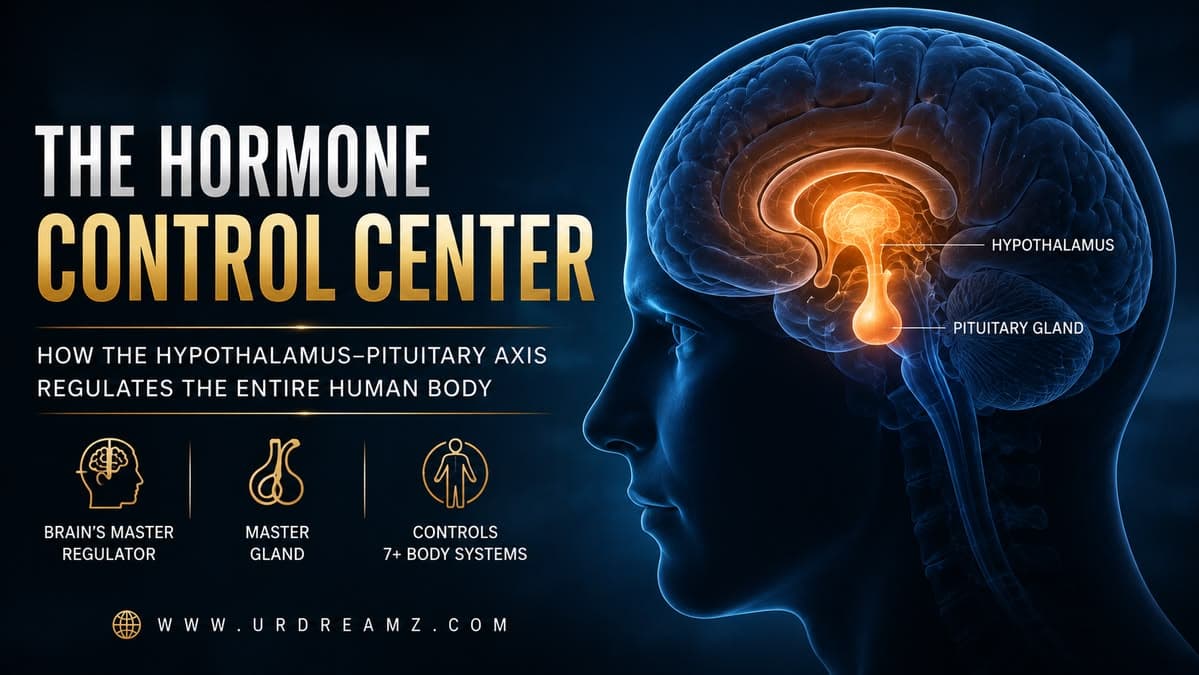
Deep inside the brain sit two remarkably small structures with an outsized job: the hypothalamus, roughly the size of an almond, and the pituitary gland, no bigger than a pea, weighing somewhere between 0.5 and 1 gram. Together, these two structures form a command-and-control partnership that governs nearly every major regulatory system in the human body — growth, reproduction, stress response, metabolism, childbirth, and even how concentrated your urine is on a given day. This guide walks through exactly how this partnership works, how signals travel between them, and how they orchestrate seven distinct, essential body systems.
By the end of this guide, a single, unifying picture should come into focus: nearly every major hormonal event in the human body, from a child's growing bones to a mother's labor contractions, traces back to the exact same starting point — a signal issued from this one small structure at the base of the brain.
1. Two Tiny Structures, One Massive Job
Tucked deep within the brain are two structures responsible for controlling nearly every hormonal process in the human body: the hypothalamus, roughly the size of an almond, and the pituitary gland, sitting just below it, no larger than a pea and weighing somewhere between 0.5 and 1 gram. Despite their small physical size, this pair effectively runs the body's entire hormonal command structure.
It is genuinely remarkable that structures this small carry this much regulatory weight. Neither the hypothalamus nor the pituitary gland is visible or physically imposing in any way — a surgeon operating nearby could easily overlook the pituitary gland's tiny, pea-sized presence if not specifically looking for it. Yet damage or disease affecting either structure can ripple outward to disrupt growth, fertility, mood, metabolism, and water balance all at once, precisely because so many separate hormonal pathways all originate from, or pass directly through, this same compact anatomical neighborhood.
2. The Hypothalamus: The Master Regulator
The hypothalamus is often referred to as the "Master Regulator" of the body. It sits at the very top of the hormonal chain of command, issuing the initial signals that ultimately drive nearly every major hormonal process discussed throughout this guide, from growth to reproduction to how the body responds to stress.
Beyond issuing hormonal signals, the hypothalamus also continuously receives an enormous amount of incoming information from the rest of the body and brain — signals about blood temperature, blood sugar levels, hydration status, and even emotional and sensory input arriving from other brain regions. It processes all of this incoming information and translates it into the specific outgoing hormonal signals covered in this guide, functioning less like a simple switch and more like a constantly monitoring control room, adjusting its output signals moment to moment based on the body's changing internal conditions.
3. The Pituitary Gland: The Master Gland
Sitting just below the hypothalamus, the pituitary gland has earned the nickname "Master Gland." While the hypothalamus issues the initial orders, the pituitary gland is the structure that actually translates many of those orders into hormones released into the bloodstream, which then travel throughout the body to their final destination organs and glands.
The pituitary gland sits inside a small, protective bony pocket at the base of the skull called the sella turcica, positioned directly beneath the hypothalamus and connected to it by a thin stalk of tissue. This physical arrangement — hypothalamus above, connecting stalk in between, pituitary gland cradled just below — is what allows the extremely short, direct communication routes described throughout this guide, whether via the specialized blood vessels of the portal system or via direct nerve fibers.
4. Two Lobes, Two Very Different Jobs
The pituitary gland is not a single, uniform structure — it is divided into two distinct lobes, each with a fundamentally different relationship to the hypothalamus above it: the Anterior Pituitary and the Posterior Pituitary. Understanding the difference between these two lobes is essential to understanding how the entire system actually functions.
It is easy to assume, at first glance, that both lobes work identically, simply relaying whatever signal the hypothalamus sends down to them. In reality, these two lobes are almost like two separate glands sharing the same physical location, each with a completely different embryological origin, a different mode of communication with the hypothalamus, and a different relationship to hormone manufacturing itself. The next several sections unpack exactly how different these two lobes really are.
5. The Anterior Pituitary (Adenohypophysis)
The front lobe of the pituitary gland is called the Anterior Pituitary, also known in medical terminology as the Adenohypophysis. This lobe receives signals from the hypothalamus and, in response, manufactures and releases its own distinct set of hormones — the hormones themselves are actually produced within this lobe, triggered by the incoming hypothalamic signal.
The term "adeno" refers to a gland, reflecting the fact that this lobe develops embryologically from glandular tissue, genuinely distinct in origin from the posterior lobe discussed next. This lobe accounts for the majority of the pituitary gland's overall mass and is responsible for producing the five separate hormones covered later in this guide — Growth Hormone, LH, FSH, ACTH, Prolactin, and TSH — each triggered by its own specific, matching releasing hormone arriving from the hypothalamus above.
6. The Posterior Pituitary (Neurohypophysis)
The rear lobe of the pituitary gland is called the Posterior Pituitary, also known as the Neurohypophysis. Unlike the anterior lobe, this structure does not manufacture any hormones of its own. Instead, it functions purely as a storage site for two specific hormones that are actually produced elsewhere — directly within the hypothalamus itself.
The term "neuro" in Neurohypophysis is a genuine clue to this lobe's true nature — rather than being a true glandular structure like the anterior lobe, the posterior pituitary is better understood as an extension of the hypothalamus's own nerve tissue, reaching downward. The hormone-producing nerve cells whose fibers extend into the posterior lobe actually have their cell bodies located up in the hypothalamus; the posterior lobe itself is simply the physical endpoint of those long nerve fibers, functioning as a release site rather than a manufacturing site.
7. The Hypophyseal Portal System: A Dedicated Blood Highway
The connection between the hypothalamus and the anterior pituitary runs through a specialized network of blood vessels called the Hypophyseal Portal System. This dedicated vascular network exists in exactly this one location in the body, and its specific purpose is to allow the hypothalamus to send hormonal signals directly and efficiently down to the anterior pituitary through the bloodstream, without those signals first having to circulate through the entire body's general blood supply.
A "portal system" in general anatomy refers to any arrangement where blood travels from one capillary bed, into a connecting vein, and then into a second capillary bed, without first passing through the heart in between. This hypophyseal portal system works the same way: blood first passes through a fine capillary network at the base of the hypothalamus, where hypothalamic releasing hormones are secreted directly into that blood, and then travels down a short connecting vessel straight into a second capillary network inside the anterior pituitary itself. This design is remarkably efficient — it means hypothalamic hormones reach their target cells in the anterior pituitary in extremely high, concentrated amounts, since the blood carrying them has not yet been diluted by mixing with the body's much larger general circulation.
8. Two Signals, Two Delivery Methods
The hypothalamus communicates with the pituitary gland's two lobes through two entirely different delivery methods. To the anterior pituitary, it sends signals via this specialized hypophyseal portal blood system. To the posterior pituitary, by contrast, it communicates directly through nerve fibers rather than blood vessels — a fundamentally different transmission route reflecting the fundamentally different relationship between the hypothalamus and each respective lobe.
This dual-communication design also explains a real difference in speed. Nerve-based signaling, as used with the posterior lobe, is essentially instantaneous — an electrical impulse travels down the nerve fiber and triggers immediate hormone release from the storage site, making it well-suited to situations that require a fast, on-demand response, such as the sudden trigger for labor contractions or a rapid adjustment in water retention. Blood-based signaling through the portal system, as used with the anterior lobe, is comparatively slower, since it involves diffusion of hormone into blood, transit through the connecting vessel, and then a fresh round of hormone synthesis at the anterior pituitary — but this slower route is well-suited to the anterior lobe's five hormonal systems, none of which typically require an instantaneous, split-second response the way labor or acute dehydration might.
9. Made-to-Order vs Made-and-Stored
This distinction in delivery method reflects a deeper functional difference. In the posterior lobe, two specific hormones — ADH (Antidiuretic Hormone) and Oxytocin — are actually manufactured up in the hypothalamus itself, then transported down through nerve fibers to the posterior pituitary, where they are simply held in storage until needed. In the anterior lobe, by contrast, hormones are both triggered by an incoming hypothalamic signal and actually manufactured on-site within the anterior pituitary itself — a genuine "made-to-order" production process, rather than simple storage.
A helpful analogy is the difference between a restaurant kitchen that cooks each dish fresh only after an order comes in, versus a warehouse that keeps a batch of pre-made product ready to ship the moment a request arrives. The anterior pituitary behaves like the kitchen — GHRH, GnRH, CRH, PRH, and TRH each arrive as an "order," and the anterior lobe cooks up a freshly synthesized hormone in response. The posterior pituitary behaves like the warehouse — oxytocin and ADH are already made and sitting in storage, waiting only for the signal to release what is already there.
10. The Seven Systems Under Hypothalamic Control
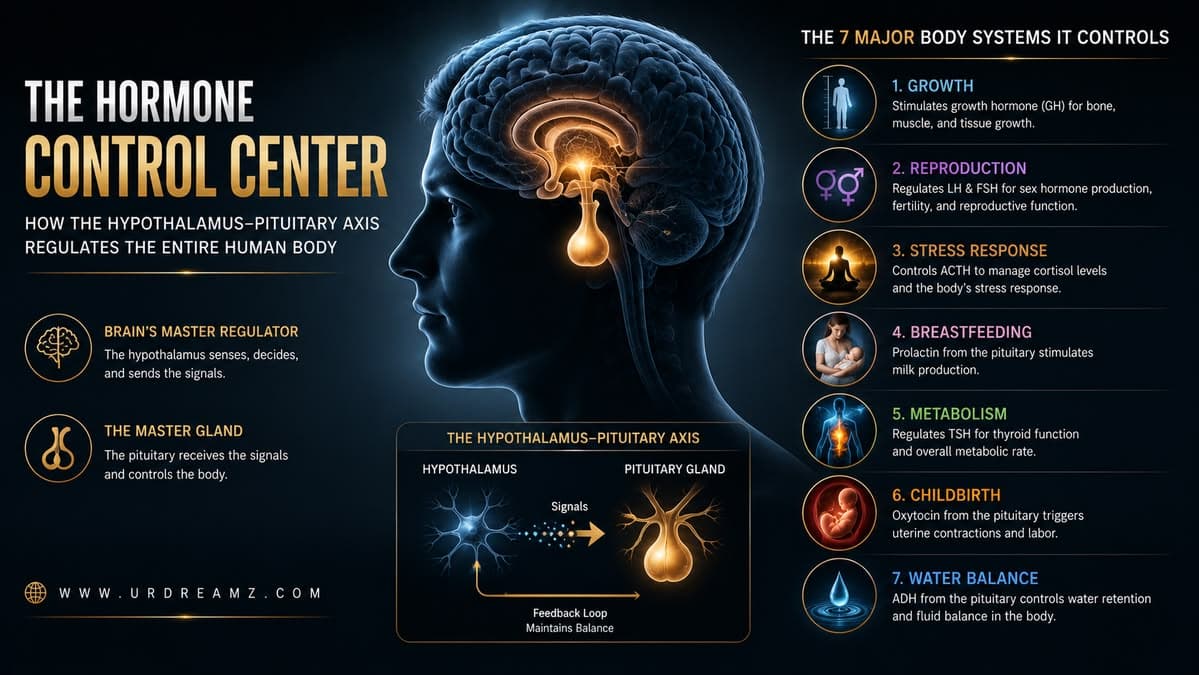
Through this dual-lobe partnership with the pituitary gland, the hypothalamus ultimately governs seven major regulatory systems throughout the entire body: growth, reproductive cycles, the stress response, breastfeeding and milk production, hunger and metabolism, childbirth, and water balance. Each of these systems follows its own distinct hormonal pathway, detailed one by one below.
11. System 1: Body Growth
The first major system under hypothalamic control is body growth. This process begins with the hypothalamus releasing a hormone called GHRH (Growth Hormone-Releasing Hormone).
Growth is one of the most visibly dramatic outcomes of this entire hormonal partnership, unfolding gradually over years rather than happening in a single dramatic event. GHRH release from the hypothalamus is not constant — it follows its own rhythm, typically peaking during deep sleep, which is part of why adequate, high-quality sleep is so consistently emphasized as important for healthy growth in children and adolescents, and why growth hormone-related therapies in a clinical setting are sometimes timed around natural sleep patterns.
12. From GHRH to Growth Hormone
Once GHRH reaches the anterior pituitary via the hypophyseal portal system, it triggers the release of Growth Hormone (GH), which enters the bloodstream and travels throughout the body — with a particularly important stop at the liver.
Growth Hormone does not act solely through its liver-mediated IGF-1 pathway — it also has some direct effects on tissue throughout the body on its own. However, its most significant, well-documented influence on skeletal growth in children and adolescents happens specifically through this indirect route via the liver, which is why IGF-1 levels are often measured clinically as a more stable, reliable indicator of a person's overall growth hormone activity than measuring GH directly, since GH itself is released in short pulses that fluctuate considerably throughout the day.
13. The Liver's Role: Converting GH to IGF-1
Upon reaching the liver, Growth Hormone triggers the production of a second hormone called IGF-1 (Insulin-like Growth Factor 1). Both GH and IGF-1 then travel together through the bloodstream toward the body's long bones, where the actual work of physical growth takes place.
14. The Epiphyseal Growth Plates
At the ends of the body's long bones sit specialized structures called epiphyseal growth plates. GH and IGF-1 act directly on these plates, driving the process of bone lengthening and growth throughout childhood and adolescence. Once the body reaches its genetically determined mature height, these growth plates gradually close and become far less responsive to further stimulation — which is why height growth naturally stops once this process concludes.
The closure of the growth plates is a genuinely permanent structural change — once a plate has fully closed, typically sometime in the later teenage years, no amount of additional Growth Hormone or IGF-1 will reopen it or restart height growth at that location. This is precisely why height increase becomes biologically impossible in adulthood regardless of diet, exercise, or hormone supplementation, even though the same GH-IGF-1 pathway remains fully active throughout adult life, simply redirected toward the hypertrophic growth of other tissue rather than bone lengthening, as discussed further below.
15. Hyperplasia: Growing in Number
The specific type of growth occurring at the epiphyseal plates during childhood — where cells actively multiply in number, driving the bones to lengthen — is referred to as hyperplasia. This represents true increase in cell number, distinct from the second type of growth discussed next.
16. Hypertrophic Growth: Growing in Size
Once the bones have reached their mature length and the growth plates have largely closed, continued exposure to Growth Hormone and IGF-1 shifts toward a different kind of growth, affecting fat and muscle tissue rather than bone length — referred to as hypertrophic growth. In this type of growth, existing cells increase in size and continue to divide, contributing to overall body mass, distinct from the bone-lengthening hyperplasia that dominates earlier in life.
17. System 2: Reproduction
The second major system under hypothalamic control is reproduction — specifically, the production of sperm in males and the maturation of eggs in females. This process begins with the hypothalamus releasing GnRH (Gonadotropin-Releasing Hormone).
18. One Hormone, Two Destinations
Once GnRH reaches the anterior pituitary, it triggers the release of two hormones: LH (Luteinizing Hormone) and FSH (Follicle-Stimulating Hormone). In females, these hormones travel directly to the ovaries, where they drive the maturation and release of eggs. In males, the same two hormones travel to the testes, where they drive the production of sperm — a single upstream signal from the hypothalamus, branching into two entirely different destinations depending on the body's biological sex.
What makes this system particularly interesting is how the same two downstream hormones — LH and FSH — produce completely different specific outcomes depending purely on which target tissue receives them. In the testes, FSH primarily supports the nurturing, supportive Sertoli cells responsible for nourishing developing sperm, while LH activates the Leydig cells responsible for producing testosterone. In the ovaries, FSH drives the maturation of developing egg-containing follicles, while a mid-cycle surge of LH specifically triggers ovulation, the release of a mature egg. The shared hormonal signal is identical; the biological machinery receiving it at each destination is what determines the ultimate result.
19. System 3: The Stress Response
The third major system is the body's stress response — the physiological process responsible for feelings of distress, sadness, or emotional upset. This begins with the hypothalamus releasing CRH (Corticotropin-Releasing Hormone).
20. From CRH to ACTH to Cortisol
Once CRH reaches the anterior pituitary, it triggers the release of ACTH (Adrenocorticotropic Hormone), which enters the bloodstream and travels down to the adrenal glands, small glands sitting atop each kidney. Upon reaching the adrenal glands, ACTH triggers the release of cortisol.
This entire pathway, from CRH down to cortisol, is often referred to collectively as the HPA axis (hypothalamic-pituitary-adrenal axis), and it represents one of the most extensively studied hormonal systems in all of human physiology, given how directly it connects psychological experience to measurable physical hormone changes. Under normal, healthy functioning, this axis operates as a self-limiting feedback loop — once cortisol reaches a sufficient level in the blood, it signals back to both the hypothalamus and pituitary to reduce further CRH and ACTH release, preventing the stress response from continuing indefinitely once the triggering situation has passed.
21. What Cortisol Actually Does
Cortisol serves a dual role in the body: it provides a burst of physical energy to help the body respond to a perceived threat or challenge, while simultaneously producing the subjective feelings of distress, irritability, and low mood commonly associated with stress. This is precisely the same cortisol pathway discussed in earlier guides regarding its suppressive effect on reproductive hormone signaling — illustrating how deeply interconnected these seven systems truly are, even though each is described individually in this guide for clarity.
This cross-talk between systems is one of the more underappreciated aspects of the entire hypothalamus-pituitary partnership. Because cortisol can directly suppress GnRH release from the very same hypothalamus that produced the original CRH signal, a person experiencing chronic, unresolved stress does not simply feel emotionally worse — their reproductive hormone system, growth hormone release, and even thyroid-driven metabolism can all be measurably affected as a secondary consequence, since all seven systems ultimately share this same small, centralized point of origin.
22. System 4: Breastfeeding and Milk Production
The fourth major system governs breastfeeding and milk production in new mothers. This process begins with the hypothalamus releasing PRH (Prolactin-Releasing Hormone).
23. From PRH to Prolactin
Once PRH reaches the anterior pituitary, it triggers the release of Prolactin, which travels directly to the mammary glands. Upon arrival, prolactin initiates and sustains milk production, allowing a new mother to breastfeed her infant.
Prolactin release is not a one-time trigger that simply switches milk production on and leaves it running indefinitely — it is continuously reinforced by the physical act of breastfeeding itself. Nerve signals generated by an infant's suckling travel back up to the hypothalamus, further stimulating PRH release and sustaining prolactin output for as long as breastfeeding continues. This is precisely why more frequent nursing tends to support continued, robust milk supply, while reduced nursing frequency tends to gradually reduce it — the entire system remains responsive to ongoing demand rather than running on a fixed, predetermined schedule.
24. System 5: Hunger, Thirst, and Metabolism
The fifth major system governs eating, digestion, hunger, and thirst. This process begins with the hypothalamus releasing TRH (Thyrotropin-Releasing Hormone).
25. From TRH to TSH to the Thyroid
Once TRH reaches the anterior pituitary, it triggers the release of TSH (Thyroid-Stimulating Hormone), which travels to the thyroid gland in the neck. Upon arrival, TSH stimulates the thyroid to release its own hormones: T3 and T4.
This TRH-TSH-thyroid pathway is one of the most commonly tested hormonal systems in routine medical care, since thyroid dysfunction — whether an underactive thyroid producing too little T3 and T4, or an overactive thyroid producing too much — is a genuinely common condition affecting metabolism, weight, energy levels, and mood. Because TSH levels respond in a predictable, inverse relationship to how much T3 and T4 the thyroid is actually producing, a simple TSH blood test often serves as the first, most sensitive indicator doctors use to screen for an underlying thyroid problem, long before more specific hormone levels are measured directly.
26. T3 and T4: The Hunger and Environment Connection
T3 and T4 are the specific hormones responsible for the sensations of hunger and thirst, and their activity is also influenced by external environmental factors — meaning conditions like temperature and season can subtly shift how strongly these hormones drive appetite and thirst at any given time.
27. System 6: Childbirth
The sixth major system governs childbirth. This process involves a hormone called Oxytocin, though its production and release pathway differs fundamentally from the five systems already discussed.
28. Why Oxytocin Is Different From the Other Five
Unlike the five hormonal pathways described so far — all of which involve hormones actually being manufactured within the anterior pituitary — Oxytocin is produced directly by the hypothalamus itself and then transported down to the posterior pituitary, where it is simply held in storage, in a manner similar to how ADH is stored, discussed in the next section.
29. How Oxytocin Triggers Labor Contractions
When a woman goes into labor, the hypothalamus sends a direct signal to the posterior pituitary, releasing the stored oxytocin into the bloodstream. This oxytocin travels down to the uterus, where it triggers strong, rhythmic contractions that help push the baby through the birth canal during delivery.
This oxytocin-driven contraction system also operates through a genuine positive feedback loop, a relatively rare pattern in hormonal regulation, where most systems instead rely on negative feedback to stay in balance. As labor progresses, the physical pressure of the baby's head against the cervix sends nerve signals back up to the hypothalamus, triggering the release of even more oxytocin, which in turn intensifies uterine contractions further — a self-reinforcing cycle that continues escalating until delivery is complete, at which point the triggering pressure is removed and the cycle naturally winds down. This exact mechanism is also part of why synthetic oxytocin is sometimes administered medically to help induce or strengthen labor in situations where the body's own natural process needs additional support.
30. System 7: Water Balance
The seventh and final major system governs the body's water balance. This involves a hormone called ADH (Antidiuretic Hormone), also known as vasopressin, which — like oxytocin — is produced in the hypothalamus and stored in the posterior pituitary rather than being manufactured on-demand in the anterior lobe.
31. ADH and the Kidneys
When the body senses that its water levels are running low, the hypothalamus signals the posterior pituitary to release stored ADH into the bloodstream. This hormone travels to the kidneys, where it acts to reduce the amount of water excreted into the urine, effectively helping the body retain and conserve water during periods of relative dehydration.
The hypothalamus detects the need for this signal through specialized cells that directly monitor the concentration of the surrounding blood — essentially measuring how much water is present relative to the salts and other particles dissolved in it. When blood becomes even slightly more concentrated than normal, signaling reduced water content, these cells trigger ADH release almost immediately. This system is remarkably sensitive, capable of detecting and responding to water losses representing only a small percentage of total body water, long before a person would consciously notice any symptoms of dehydration through thirst alone.
32. Why Dehydration Turns Urine Darker
This water-conserving action of ADH is precisely why urine becomes noticeably darker, more concentrated, and more golden in color when a person is dehydrated — since less water is being allowed to pass into the urine, the same amount of waste product becomes concentrated into a smaller volume of fluid, producing that characteristic darker color.
33. Putting It All Together: One Small Structure, Seven Systems
Stepping back across all seven systems discussed in this guide — growth, reproduction, stress response, breastfeeding, hunger and metabolism, childbirth, and water balance — the single unifying thread running through every one of them is the hypothalamus. Whether communicating through the specialized hypophyseal portal blood system to trigger anterior pituitary hormone production, or directly through nerve fibers to release hormones already stored in the posterior pituitary, this single almond-sized brain structure sits at the very top of virtually every major hormonal chain of command in the human body.
The diagram below lays out all seven pathways side by side, so the shared pattern becomes visually obvious: a signal leaves the hypothalamus, passes through (or around) the pituitary gland, and lands on a specific target organ, producing a specific final effect.
Notice how the top five rows all pass through a genuine pituitary-manufactured hormone — GH, LH/FSH, ACTH, Prolactin, and TSH — each one newly synthesized in the anterior lobe in direct response to its matching hypothalamic releasing hormone. The bottom two rows break that pattern entirely: oxytocin and ADH are not manufactured by the pituitary at all, but simply travel down from the hypothalamus along nerve fibers to sit in storage in the posterior lobe, waiting for a release signal. Seeing all seven pathways laid out together this way makes the shared architecture, and the one genuine structural exception, far easier to hold in mind at once than reading about each system in isolation.
34. Summary Table: All Seven Hormonal Pathways
| System | Hypothalamic Hormone | Pituitary Hormone(s) | Target / Final Effect |
|---|---|---|---|
| Growth | GHRH | GH → IGF-1 (via liver) | Epiphyseal growth plates: bone growth |
| Reproduction | GnRH | LH, FSH | Ovaries (eggs) / Testes (sperm) |
| Stress Response | CRH | ACTH | Adrenal glands: cortisol release |
| Breastfeeding | PRH | Prolactin | Mammary glands: milk production |
| Hunger/Metabolism | TRH | TSH | Thyroid gland: T3/T4 release |
| Childbirth | Oxytocin (made in hypothalamus, stored in posterior pituitary) | — | Uterus: labor contractions |
| Water Balance | ADH (made in hypothalamus, stored in posterior pituitary) | — | Kidneys: water retention |
35. What Happens When This System Malfunctions
Because so many essential body functions route through this single hypothalamus-pituitary partnership, disruption anywhere along these pathways — whether from injury, tumors, or other underlying medical conditions — can produce wide-ranging effects across seemingly unrelated body systems simultaneously. A problem affecting the hypothalamus or pituitary gland might, for example, disrupt growth in a child, reproductive function in an adult, and water balance all at once, precisely because all of these systems ultimately trace back to this same small, shared regulatory center.
36. Frequently Asked Questions
- Q1: What is the difference between the hypothalamus and the pituitary gland?
- The hypothalamus is the "Master Regulator" that issues the initial hormonal signals, while the pituitary gland is the "Master Gland" that translates many of those signals into hormones released into the bloodstream.
- Q2: What is the hypophyseal portal system?
- It is a specialized network of blood vessels connecting the hypothalamus directly to the anterior pituitary, allowing efficient, direct hormonal signaling between the two structures.
- Q3: What is the difference between the anterior and posterior pituitary?
- The anterior pituitary (Adenohypophysis) manufactures its own hormones in response to hypothalamic signals delivered via blood vessels; the posterior pituitary (Neurohypophysis) simply stores hormones made in the hypothalamus and delivered via nerve fibers.
- Q4: Which hormones are stored, not made, in the posterior pituitary?
- ADH (Antidiuretic Hormone) and Oxytocin are produced in the hypothalamus and only stored in the posterior pituitary.
- Q5: How does the hypothalamus control body growth?
- It releases GHRH, which triggers pituitary release of Growth Hormone (GH); GH stimulates the liver to produce IGF-1, and both act on the epiphyseal growth plates in bones.
- Q6: What is the difference between hyperplasia and hypertrophic growth?
- Hyperplasia is growth through an increase in cell number (as seen in bone lengthening during childhood); hypertrophic growth is growth through an increase in existing cell size (as seen in fat and muscle tissue later in life).
- Q7: How does the hypothalamus control reproduction?
- It releases GnRH, which triggers pituitary release of LH and FSH, which travel to the ovaries (egg maturation) in females or testes (sperm production) in males.
- Q8: How does the hypothalamus control the stress response?
- It releases CRH, triggering pituitary release of ACTH, which stimulates the adrenal glands to release cortisol, producing both energy and feelings of stress.
- Q9: How does breastfeeding get triggered hormonally?
- The hypothalamus releases PRH, triggering pituitary release of Prolactin, which stimulates the mammary glands to produce milk.
- Q10: What hormone pathway controls hunger and thirst?
- The hypothalamus releases TRH, triggering pituitary release of TSH, which stimulates the thyroid gland to release T3 and T4, hormones tied to hunger and thirst sensations.
- Q11: How does oxytocin trigger childbirth?
- Oxytocin, made in the hypothalamus and stored in the posterior pituitary, is released into the bloodstream during labor and travels to the uterus, triggering contractions.
- Q12: How does ADH affect urine color?
- ADH signals the kidneys to retain water; during dehydration, more ADH is released, less water passes into urine, and the urine becomes more concentrated and darker in color.
- Q13: Why is the hypothalamus called the "Master Regulator"?
- Because it sits at the top of the hormonal chain of command, issuing the initial signal for nearly every major hormonal process in the body.
- Q14: Can a problem in the hypothalamus affect unrelated body systems?
- Yes. Since growth, reproduction, stress response, and other systems all route through the same hypothalamus-pituitary partnership, a single disruption can affect multiple systems simultaneously.
- Q15: How big are the hypothalamus and pituitary gland?
- The hypothalamus is roughly the size of an almond, while the pituitary gland is roughly the size of a pea, weighing between 0.5 and 1 gram.
37. Conclusion
Two structures no bigger than an almond and a pea sit quietly at the base of the brain, yet between them, they orchestrate growth, reproduction, the stress response, breastfeeding, hunger and metabolism, childbirth, and the body's water balance — seven entirely distinct systems, all routing through the same small hormonal command center. Whether signaling through the specialized hypophyseal portal blood system to the anterior pituitary, or sending hormones directly through nerve fibers for storage in the posterior pituitary, the hypothalamus remains the true starting point of nearly every major hormonal cascade in the human body. Understanding this single partnership — how it is structured, how it communicates, and which seven systems it governs — offers a genuinely unifying framework for understanding much of human physiology at once.