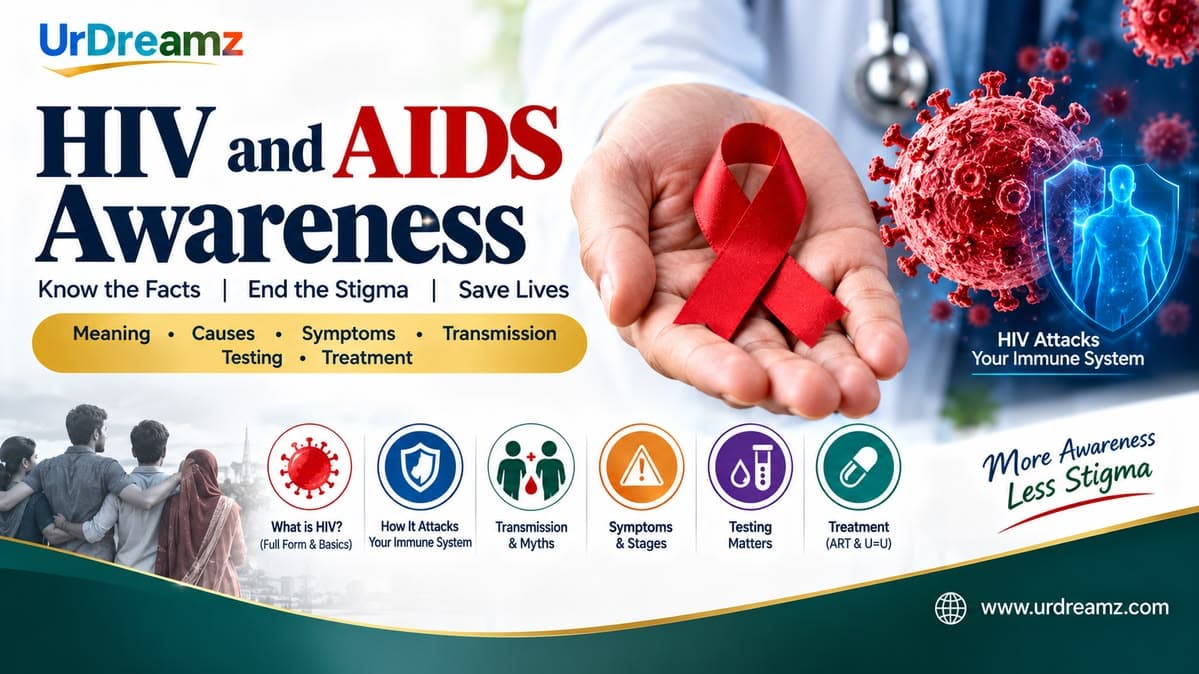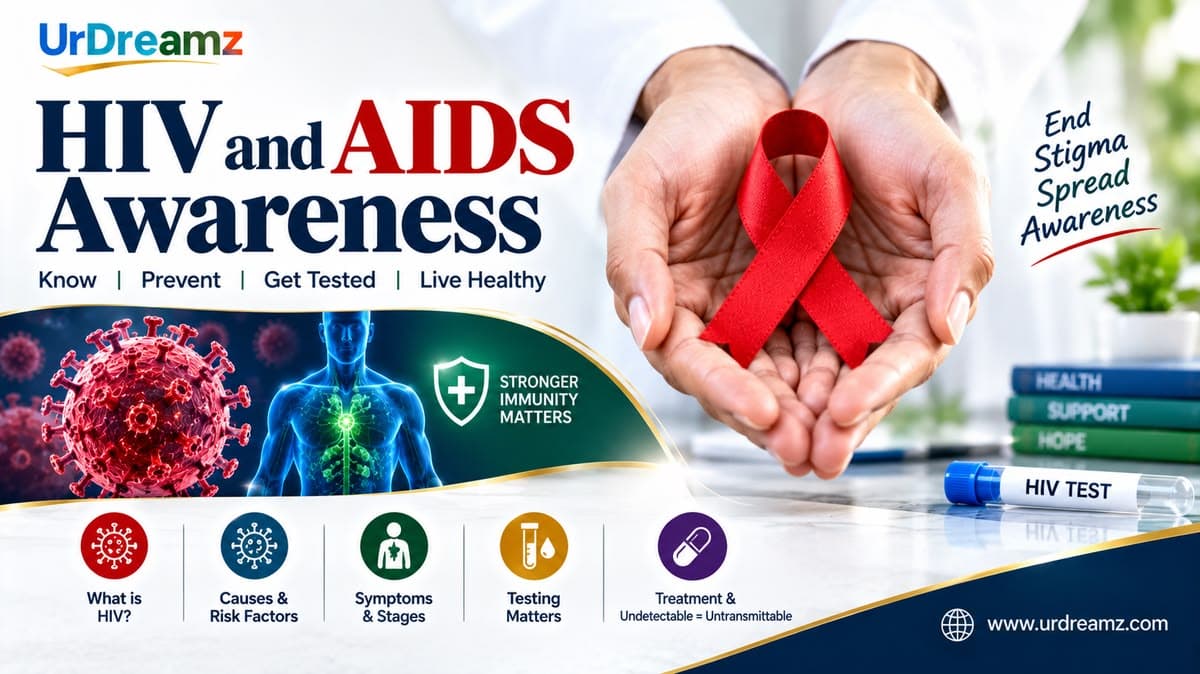
HIV and AIDS Awareness: Meaning, Causes, Symptoms, Transmission, and Treatment
HIV remains one of the most misunderstood health conditions across South Asia — surrounded by silence on one side and dangerous misinformation on the other. This guide explains, in plain language, what HIV actually is, how it genuinely spreads (and how it doesn't), the symptoms and stages to be aware of, why testing matters, and how modern treatment can now suppress the virus to the point where it can no longer be passed on at all.
Introduction
Few health topics carry as much fear, silence, and outright misinformation as HIV and AIDS, and across South Asia, that combination has proven genuinely dangerous. A common and deeply mistaken belief in many communities is that HIV is only a concern for certain "types" of people, or that avoiding marriage or certain visible risk groups is enough to stay safe. In reality, HIV doesn't check anyone's background before spreading, and the gap between what people believe about HIV and what's actually true is a major reason the disease continues to affect families across the region — including through marriage and childbirth, exactly the situations many people mistakenly assume are safe.
This guide exists to close that gap with clear, accurate, non-judgmental information. Understanding HIV properly — what it is, how it spreads, how it doesn't spread, and what treatment today actually makes possible — is genuinely one of the most effective tools available for protecting yourself, your family, and your community. As with any serious health topic, nothing here replaces a conversation with a qualified healthcare professional, but the goal is to make sure that conversation, if it ever needs to happen, starts from a place of real understanding rather than fear or myth.
It's worth being direct about why this particular topic deserves such careful, plain-language treatment. Unlike many other health conditions, HIV carries a unique social weight — a diagnosis can affect not just a person's physical health, but their marriage prospects, family relationships, and standing within their community, often based entirely on outdated or simply incorrect beliefs about how the virus spreads and what living with it actually looks like today. Correcting that gap between perception and reality isn't just a matter of medical accuracy; it's a matter of basic fairness to the many people currently living full, healthy lives with HIV, and a matter of genuine public health for everyone else, since accurate understanding is what actually slows the spread of the virus — misinformation and silence do the opposite.
What Is HIV: Full Form and Meaning
HIV stands for Human Immunodeficiency Virus. Breaking down what that name actually means makes the condition itself far easier to understand: "human" simply means it's a virus that specifically infects humans; "immunodeficiency" means it causes a deficiency, or weakening, of the immune system; and "virus" means it's a microscopic infectious agent that needs to enter human cells to reproduce and spread within the body. Keeping this full form in mind throughout the rest of this guide makes each subsequent section easier to connect back to the underlying biology.
In short, HIV is a virus that specifically targets and gradually weakens the body's immune system — the network of cells and defenses that normally protects the body from infections, illnesses, and abnormal cell growth. This direct connection to the immune system is the single most important thing to understand about HIV, because nearly everything else about the condition, from its symptoms to its long-term risks, follows directly from this one basic fact.
It's also worth understanding, briefly, where HIV actually comes from and how it behaves as a virus, since this context makes the rest of the guide easier to follow. HIV belongs to a category of viruses called retroviruses, which have a somewhat unusual way of reproducing: rather than simply multiplying on their own, they insert their own genetic material directly into the genetic material of the human cells they infect, essentially hijacking those cells' own machinery to produce more copies of the virus. This is part of why HIV is so difficult to eliminate completely from the body once someone is infected, and why treatment, discussed later in this guide, focuses on suppressing the virus's ability to multiply rather than removing it entirely.
How HIV Attacks the Immune System
To understand why HIV is so serious, it helps to understand, at a basic level, what it actually does inside the body. The immune system relies heavily on specific white blood cells called CD4 cells (also known as T-helper cells) to coordinate the body's defense against infections. HIV specifically targets and infects these CD4 cells, using them to make copies of itself, which in the process destroys the very cells the body needs to fight infection.
Over time, if left untreated, this process gradually reduces the number of healthy CD4 cells in the body. As CD4 cell counts fall, the immune system becomes progressively less able to fight off infections and certain illnesses that a healthy immune system would normally handle without difficulty. This is precisely why HIV, left untreated, doesn't just cause illness directly — it strips away the body's ability to defend itself against a wide range of other infections and conditions, some of which can become life-threatening once the immune system is significantly weakened.
Doctors monitor this process directly by measuring CD4 cell counts through a simple blood test, which gives a fairly clear picture of how strong or weakened a person's immune system currently is. A healthy adult without HIV typically has a CD4 count well within a normal range; as untreated HIV progresses, this count tends to decline over months and years, and a sufficiently low count is one of the specific medical criteria used to diagnose that HIV infection has progressed to AIDS, discussed in the next section. This same measurement is also used the other way around, as a genuinely encouraging sign of progress — for someone starting antiretroviral treatment, watching CD4 counts recover and stabilize over time is one of the clearest, most concrete indicators that treatment is working and that the immune system is regaining its strength.
It's also worth understanding, briefly, why this specific type of immune cell matters so much. CD4 cells don't just fight infections directly themselves — they act more like coordinators, signaling and directing other parts of the immune system, including the cells that produce antibodies and the cells that directly destroy infected cells, to respond appropriately to a given threat. This is part of why losing CD4 cells has such a broad, cascading effect on overall immune function, rather than simply removing one narrow piece of the body's defenses — it disrupts the coordination that the rest of the immune system depends on to work effectively together.
What Is AIDS: How HIV Progresses
AIDS stands for Acquired Immunodeficiency Syndrome, and it's important to understand clearly that AIDS is not a separate disease from HIV — it's the most advanced stage of HIV infection, reached when the immune system has been weakened to a specific, severely compromised point, generally measured by a very low CD4 cell count, or when the body develops certain serious infections or illnesses that a healthy immune system would normally be able to prevent entirely.
| Term | What It Means |
|---|---|
| HIV | The virus itself — a person can carry HIV for many years, especially with treatment, without ever progressing to AIDS |
| AIDS | The final, most advanced stage of untreated or poorly controlled HIV infection, marked by severe immune system damage |
This distinction matters enormously and is one of the most important, hopeful facts in this entire guide: a person diagnosed with HIV today, particularly if diagnosed early and started on treatment promptly, is very unlikely to ever progress to AIDS at all. Modern treatment, covered in detail later in this guide, can keep the virus suppressed indefinitely, allowing a person's immune system to remain strong and healthy for a normal lifespan. AIDS, and the serious illness historically associated with it, largely reflects what happens when HIV goes undiagnosed or untreated for a long period — not an inevitable outcome of an HIV diagnosis itself.
It's worth understanding, in general terms, what actually happens during the AIDS stage, since much of the fear historically associated with HIV really stems from this specific, advanced stage rather than from HIV infection itself. Once the immune system has been severely weakened, the body becomes vulnerable to what doctors call "opportunistic infections" — infections and illnesses caused by organisms that a healthy immune system would normally control or eliminate without difficulty, but which can become serious or even life-threatening once immune defenses are significantly compromised. Examples historically associated with advanced, untreated HIV include certain severe fungal infections, tuberculosis, and specific rare cancers. It's precisely this vulnerability to opportunistic infections — rather than HIV directly "causing" a single specific illness — that made AIDS so dangerous in the era before effective treatment existed, and it's exactly this vulnerability that modern antiretroviral therapy prevents by keeping the immune system strong in the first place.
How HIV Actually Spreads
Understanding exactly how HIV spreads — and, just as importantly, how it doesn't — is central to both genuine prevention and reducing the unnecessary fear and stigma that so often surrounds this topic. HIV is present in specific body fluids, mainly blood, semen, vaginal fluids, and breast milk, and transmission requires one of these fluids from a person with HIV to enter another person's body, typically through the bloodstream or mucous membranes, rather than through any kind of casual, everyday contact.
| Transmission Route | How It Happens |
|---|---|
| Unprotected sexual contact | Vaginal or anal sex without a condom with a partner who has HIV carries a significant transmission risk |
| Sharing needles or syringes | Reusing injection equipment, whether for medical use or drug use, that has been used by someone with HIV |
| Unsterilized medical or dental equipment | Instruments reused between patients without proper sterilization can carry blood-borne infections including HIV |
| Contaminated blood transfusions | A risk mainly in settings where blood is not properly screened before transfusion |
| Mother-to-child transmission | Can occur during pregnancy, childbirth, or breastfeeding, discussed in detail in the next section |
| Sharing unsterilized razors or blades with blood contact | A less common but real risk if blood from an infected person contaminates a shared blade used on broken skin |
It's worth being precise about the dental and grooming-related risks mentioned above, since they're genuinely relevant but often poorly understood. Any tool that comes into contact with blood — including dental instruments, razors, or piercing and tattoo equipment — carries a real, if generally low, transmission risk if it is reused on multiple people without proper sterilization between each use. This is exactly why properly licensed, hygienic clinics and salons that follow correct sterilization protocols are so important, and why single-use or properly sterilized equipment should always be expected as a basic standard of care.
It's also worth understanding a bit more precisely why sexual transmission carries the risk levels it does, since this is the route responsible for the majority of HIV transmissions worldwide. HIV is present in semen and vaginal fluids in concentrations high enough to establish infection when these fluids come into contact with mucous membranes or broken skin during unprotected vaginal or anal sex. Anal sex without a condom carries a comparatively higher transmission risk than vaginal sex due to the nature of the tissue involved, though both carry genuine, significant risk in the absence of protection. Consistent, correct condom use dramatically reduces this risk by preventing these fluids from making direct contact, which is exactly why condoms remain one of the most effective, accessible prevention tools available, discussed further in the prevention section of this guide.
Needle and syringe sharing deserves equal attention, since it remains a significant transmission route in many parts of the world, including through drug use but also, importantly, through unsafe medical practices. Reusing a needle or syringe that has already been used on someone with HIV introduces infected blood directly into the bloodstream of the next person, which is one of the most efficient transmission routes that exists, carrying a notably higher per-exposure risk than sexual contact. This is exactly why single-use, sterile needles and syringes are considered an absolute basic standard in any legitimate medical setting, and why any clinic, hospital, or informal medical provider that doesn't consistently use fresh, sterile equipment for every single patient represents a genuine, serious risk that should be avoided entirely.
Blood transfusion safety is worth a brief, separate mention as well. In settings with properly regulated blood banks and mandatory screening of all donated blood, transfusion-related HIV transmission is now extremely rare. The risk becomes meaningfully higher only in situations involving informal, unregulated, or emergency blood donation and transfusion without proper screening — which is exactly why using licensed, accredited blood banks and hospitals, even in urgent situations, matters as a genuine safety measure rather than a mere formality.
Common Myths About HIV Transmission
Misinformation about how HIV spreads causes two kinds of very real harm: it leads some people to underestimate genuine risks, and it leads many others to fear and avoid people living with HIV in situations that carry no risk at all, fueling exactly the kind of stigma that discourages testing and open conversation in the first place. Clearing up these myths directly is one of the most valuable things this guide can offer.
| Myth | Fact |
|---|---|
| HIV spreads through casual contact like handshakes | HIV does not spread through skin-to-skin contact such as shaking hands or hugging |
| HIV spreads through sharing food or utensils | HIV is not transmitted through saliva or by sharing food, plates, or cutlery |
| HIV spreads through closed-mouth kissing | Ordinary kissing does not transmit HIV; saliva does not carry the virus in meaningful, infectious amounts |
| HIV spreads through swimming pools or shared bathrooms | HIV does not survive well outside the body and is not transmitted through water, pools, or toilet seats |
| HIV spreads through mosquito bites | There is no evidence that HIV can be transmitted through insect bites |
| A person with HIV always looks visibly sick | Many people with HIV, especially on treatment, appear completely healthy and show no outward signs at all |
| HIV always progresses to AIDS and death | With early diagnosis and modern treatment, most people with HIV never progress to AIDS and can expect a normal lifespan |
It's worth being especially clear about one myth in particular, since it's a common and understandable point of confusion: deep or prolonged kissing is not considered a meaningful route of HIV transmission. HIV is not effectively carried in saliva, and the World Health Organization and major health authorities worldwide do not list kissing, of any kind, as a recognized transmission route, except in the extremely rare theoretical scenario involving open bleeding sores in both people's mouths at the same time — a situation that isn't a realistic everyday concern. Correcting this specific myth matters because inflated fears around ordinary, low-risk contact are exactly what drive unnecessary isolation and stigma against people living with HIV, while the real, evidence-based transmission routes covered in the previous section remain the ones genuinely worth understanding and protecting against.
It's worth taking a moment to explain why HIV doesn't survive or spread through the routes covered in the myths table, since understanding the biological reason tends to make the reassurance far more convincing than simply being told "don't worry." HIV is a relatively fragile virus outside the human body — it cannot survive for long once exposed to air, and it requires direct entry into the bloodstream or contact with specific mucous membranes to establish an infection. Saliva, sweat, tears, and casual skin contact simply don't provide the conditions the virus needs to transmit from one person to another. This is fundamentally different from certain other infectious diseases that spread through the air or through much more casual contact, and conflating HIV with those other conditions is one of the most common sources of unnecessary fear surrounding it.
It's also worth directly naming why these particular myths have proven so persistent and so harmful over the decades since HIV was first identified. In the early years of the global HIV epidemic, before the science of transmission was fully understood or widely communicated, fear and misinformation spread almost as quickly as the virus itself, leading to widespread, often extreme social exclusion of people living with HIV based on transmission routes that were never actually real. Decades of solid, consistent scientific evidence have since thoroughly debunked these fears, yet the myths themselves have proven remarkably persistent in many communities, passed down through word of mouth long after the medical understanding moved on. Actively replacing these outdated fears with current, accurate information is not just a matter of correcting a factual error — it's a genuine act of fairness toward people living with HIV today, who continue to face social consequences rooted in decades-old misinformation rather than any actual current risk.
Mother-to-Child Transmission
One of the most important and often misunderstood aspects of HIV is that it can affect entire families, not just the person initially exposed. HIV can be transmitted from a mother living with HIV to her child during pregnancy, during childbirth, or through breastfeeding. This is precisely why the common assumption — that avoiding a particular lifestyle or relationship status is enough to make HIV "not a concern" — is so mistaken: a person can acquire HIV and, without proper testing and treatment, unknowingly pass it on to a spouse or child.
The encouraging counterpart to this fact is that mother-to-child transmission is now highly preventable with proper medical care. Pregnant women who know their HIV status and receive appropriate antiretroviral treatment during pregnancy can reduce the risk of transmitting HIV to their baby to a very low level — in many well-managed cases, close to zero. This is one of the clearest, most powerful examples of why testing and early treatment matter so much: it doesn't just protect one person, it protects an entire family's future.
It's worth walking through, in general terms, how this prevention actually works during pregnancy, since it helps explain why early testing matters so specifically in this context. When a pregnant woman is diagnosed with HIV and begins antiretroviral treatment promptly, the medication reduces the amount of virus in her blood to very low levels well before delivery, dramatically lowering the chance that the virus will cross to the baby during pregnancy or birth. Additional precautions around the delivery process itself, along with careful guidance around infant feeding — which may include safe formula feeding or specific breastfeeding protocols combined with continued treatment, depending on individual circumstances and available resources — further reduce the risk. Babies born to mothers with HIV are also typically given a short course of preventive medication themselves immediately after birth as an additional layer of protection. Taken together, this combination of steps is why, in settings with good access to testing and care, the vast majority of babies born to mothers living with HIV are born completely HIV-negative.
This entire prevention pathway depends on one critical first step: a woman actually knowing her HIV status during pregnancy, which is precisely why routine HIV testing is now a standard, recommended part of prenatal care in well-run healthcare systems worldwide. A woman who doesn't know her status has no opportunity to access this prevention pathway at all, which is exactly why the stigma and hesitancy around testing discussed elsewhere in this guide carries such a direct, concrete cost — not just to the woman herself, but to a child who might otherwise have been born entirely free of the virus.
Symptoms and Stages of HIV
| Stage | General Characteristics |
|---|---|
| Acute HIV infection | Occurs within the first few weeks after exposure; some people experience flu-like symptoms such as fever, sore throat, fatigue, swollen lymph nodes, and rash, while others experience no noticeable symptoms at all |
| Chronic HIV infection (clinical latency) | The virus continues to multiply at low levels; a person may feel completely well for years, especially with treatment, even though the virus remains present |
| AIDS (advanced stage) | Occurs when the immune system becomes severely weakened, typically only in cases of long-term untreated HIV, leading to a heightened risk of serious infections and illnesses |
One of the most important things to understand about HIV symptoms is that they are often unreliable as a way to know one's status. Many people with HIV, particularly in the chronic stage, feel completely healthy for years, which is exactly why symptoms alone should never be relied upon to determine whether someone has HIV — testing, covered in the next section, is the only reliable way to know for certain.
It's worth expanding briefly on the acute stage described in the table above, since it's often the most confusing for people trying to make sense of possible symptoms after a specific exposure. The flu-like symptoms that can occur within the first few weeks after HIV infection — fever, sore throat, fatigue, body aches, swollen lymph nodes, and sometimes a rash — are frustratingly non-specific, meaning they closely resemble the symptoms of many far more common and far less serious illnesses, including ordinary viral infections. This overlap is exactly why these symptoms cannot reliably confirm or rule out HIV on their own; a person could have HIV and experience none of these symptoms, or could experience all of them and have nothing more than a common seasonal illness. The only way to resolve this uncertainty with confidence is through an actual HIV test, ideally timed appropriately after any potential exposure, as discussed further in the next section.
The chronic stage deserves equal attention, precisely because of how deceptively uneventful it can feel. During this stage, which can last many years, especially with treatment, a person may have no symptoms at all and feel entirely normal, even as the virus continues to affect the immune system at a slow, steady pace if left untreated. This is one of the most important reasons testing shouldn't be reserved only for moments when someone feels unwell — by the time noticeable symptoms of advanced immune weakening finally appear, without treatment, significant time may have already passed, and the immune system may have already sustained damage that could have been prevented with earlier diagnosis and treatment.
Why HIV Testing Matters
Given how unreliable symptoms alone can be, and how effective modern treatment has become, HIV testing is genuinely one of the most important and empowering steps a person can take for their own health and for the health of their family and community. A simple blood test can determine HIV status, often with results available within a short period, and many testing centers offer confidential or anonymous testing specifically to reduce the fear and stigma that can otherwise discourage people from getting tested.
Testing early is genuinely one of the most powerful actions available against HIV, not because a positive result is something to fear, but because it opens the door to effective treatment before the immune system suffers significant, lasting damage — and because knowing one's status, either way, allows for informed decisions that protect both oneself and loved ones.
It's worth addressing directly one of the most common reasons people avoid testing: fear of the result itself, and what it might mean socially, before even considering the medical facts. This fear is understandable given the stigma discussed later in this guide, but it's worth weighing against what a delayed diagnosis actually costs. A person who avoids testing out of fear doesn't make the underlying situation go away — if HIV is present, it continues to affect the immune system regardless of whether the person knows about it, and it continues to carry the ability to be unknowingly passed on to a spouse or child. Testing doesn't create the risk; it simply reveals whether the risk already exists, at exactly the point in time when something can still be done about it most effectively.
It's also worth mentioning practically what the testing process itself typically involves, since uncertainty about the process itself can be a genuine barrier for some people. Modern HIV testing is usually a simple blood draw or, in many settings, a rapid test using a small finger-prick sample, with results in many cases available the same day. Many testing centers, including many hospitals and dedicated clinics, offer confidential testing, meaning results are shared only with the individual being tested, and some offer entirely anonymous testing as well. Pre- and post-test counseling is also commonly offered, giving a person the chance to ask questions and understand next steps regardless of the result — a service specifically designed to make the process feel less isolating and more supportive than many people expect going in.
HIV Awareness Gap in South Asia
Across parts of South Asia, HIV remains a significant and, in some areas, growing public health concern — including among children, often as a result of mother-to-child transmission that could have been prevented with earlier testing and treatment. A combination of factors contributes to this ongoing challenge.
| Contributing Factor | Why It Matters |
|---|---|
| Low general awareness | Many people lack accurate, basic information about how HIV spreads and how it's treated |
| Stigma and silence | Fear of judgment discourages open conversation, testing, and disclosure, allowing the virus to spread unknowingly |
| Limited access to testing and treatment | Particularly in rural or underserved areas, testing and antiretroviral therapy may be difficult to access |
| Misconceptions about risk | The mistaken belief that HIV only affects certain groups leads many at genuine risk to skip testing entirely |
This combination of factors — low awareness, stigma, and limited access — closely mirrors the pattern seen in other serious, preventable health conditions across the region, and it points to the same solution: honest, accessible, stigma-free information and testing, reaching communities directly rather than assuming awareness will spread on its own.
The particular concern around HIV affecting children in some communities deserves direct, honest attention, since it's one of the clearest illustrations of what happens when awareness gaps go unaddressed. A child acquiring HIV almost always traces back to mother-to-child transmission that could have been prevented, as described earlier in this guide, had the mother had access to testing and treatment during pregnancy. This isn't a reflection of any inevitability about the virus itself — it's a direct, measurable consequence of gaps in awareness and access, which is exactly why public health experts consistently emphasize that reducing pediatric HIV cases starts with reaching women of childbearing age with accurate information and accessible testing, well before pregnancy occurs whenever possible, and certainly as early as possible once it does.
It's also worth recognizing what has actually worked in other regions facing similar awareness challenges, since it offers a genuinely hopeful, evidence-based path forward rather than simply describing a problem without a solution. Countries and regions that have made the most significant progress against HIV have generally done so through a consistent combination of community-level education delivered in local languages by trusted messengers, widely accessible and destigmatized testing, and reliable access to treatment once diagnosed. None of these elements works particularly well in isolation — awareness without accessible testing leaves people informed but unable to act, and testing without treatment access leaves a diagnosis without a meaningful next step. Closing all three gaps together, rather than focusing on just one, is consistently what has driven the most meaningful, measurable reductions in new HIV cases wherever it's been genuinely attempted.
Treatment: Antiretroviral Therapy (ART)
While there is currently no cure that completely eliminates HIV from the body anywhere in the world, modern medicine has transformed HIV from what was once considered an almost certainly fatal diagnosis into a manageable, long-term condition for people who receive proper treatment. This treatment is called antiretroviral therapy, commonly abbreviated as ART.
ART involves taking a combination of medications daily that work together to suppress the virus's ability to multiply within the body. With consistent use, ART can reduce the amount of virus in the blood — known as the viral load — to extremely low, often undetectable levels using standard laboratory tests. This doesn't mean the virus is gone entirely, but it does mean the immune system is no longer under active attack, allowing CD4 cell counts to recover and immune function to remain strong, often for a normal lifespan.
It's worth explaining briefly why ART typically involves a combination of medications rather than a single drug, since this reflects one of the most important lessons learned in the history of HIV treatment. HIV multiplies rapidly and can mutate easily, and a single medication used alone often allows the virus to develop resistance relatively quickly, eventually rendering that medication less effective. By combining several medications that each target the virus in different ways at once, modern ART makes it far more difficult for the virus to develop resistance to the entire combination simultaneously, which is why this multi-drug approach has become the standard of care worldwide and has dramatically improved long-term treatment outcomes compared to earlier, single-medication approaches used in the past.
Today's ART regimens have also become considerably more convenient than in the earlier years of treatment, when patients sometimes had to take many separate pills on a complicated schedule throughout the day. Many people on modern ART now take just a single combination pill once a day, which has made consistent, long-term adherence to treatment far more achievable for most people — an important practical detail, since the effectiveness of ART depends heavily on taking it consistently and correctly exactly as prescribed, without missed doses, in order to keep the virus reliably suppressed over time.
Undetectable Equals Untransmittable (U=U)
One of the most important and genuinely hopeful developments in HIV science over the past decade is a concept known as Undetectable = Untransmittable, commonly abbreviated as U=U. Research has consistently shown that a person living with HIV who takes ART consistently and maintains an undetectable viral load cannot sexually transmit the virus to a partner.
This finding has profoundly changed both the medical and social understanding of HIV. It means a person on effective, consistent treatment is not only protecting their own long-term health, but is also protecting their partner and, in the context of pregnancy, significantly reducing the risk to their child as well. U=U is one of the strongest, most evidence-based reasons why testing and treatment — rather than fear and avoidance — are the genuinely effective response to HIV, both for individuals and for families.
The significance of U=U extends well beyond the clinical facts themselves — it has meaningfully changed what's actually possible for people living with HIV in their personal relationships and family planning. Couples where one partner has HIV can, with consistent treatment and an undetectable viral load, have a genuine, evidence-based level of confidence about not transmitting the virus during sex, something that would have seemed almost unimaginable in the earlier decades of the epidemic. This single scientific finding, more than perhaps any other development in HIV research, has helped shift the conversation away from fear and exclusion and toward the much more accurate, hopeful reality of treatment as a genuinely powerful form of prevention in its own right.
Living With HIV Today
It's worth stating plainly, given how much fear historically surrounds this topic: a person diagnosed with HIV today, who has access to proper testing and consistent treatment, can expect to live a long, healthy life, build a career, have a family, and, thanks to U=U, do so without transmitting the virus to a partner through consistent treatment. This is a dramatically different reality from decades past, and it's exactly why accurate, up-to-date awareness matters so much — outdated fear rooted in the past does real harm to people living with a condition that is now genuinely manageable.
Employment, travel, insurance, and everyday social life are all areas where outdated assumptions about HIV continue to cause unnecessary harm, even though the medical reality has moved on considerably. Recognizing this gap between perception and current medical fact is part of what allows communities to treat HIV the way they would any other manageable chronic health condition, rather than as something to be hidden or feared.
Prevention Strategies
Beyond these core strategies, it's worth knowing that medical prevention options exist for people at higher ongoing risk of HIV exposure, including a daily preventive medication known as PrEP (pre-exposure prophylaxis) and an emergency medication called PEP (post-exposure prophylaxis) that can be started shortly after a potential exposure. Both should be discussed directly with a doctor, since eligibility and appropriate use depend on individual circumstances, including a person's specific risk factors and overall health.
Who to Consult
Anyone with concerns about HIV — whether about testing, potential exposure, an existing diagnosis, or simply wanting accurate information — should consult a qualified healthcare professional, typically an infectious disease specialist or an internal medicine physician with experience in HIV care. Many areas also have dedicated HIV testing and counseling centers specifically set up to offer confidential, non-judgmental support, which can be a helpful and less intimidating first step for many people.
It's also worth mentioning that primary care doctors and general physicians are often a perfectly reasonable starting point as well, particularly for an initial conversation or referral, since they can guide a person toward the right specialist or testing center based on their specific situation, rather than requiring someone to already know exactly which type of specialist to seek out on their own.
Stigma: Why It Makes Everything Worse
Stigma is not a side issue in the HIV epidemic — it is one of its central, ongoing drivers. Fear of judgment, rejection, or social consequences discourages people from getting tested, discourages open conversation between partners, and discourages people already diagnosed from seeking or continuing treatment. Every one of these effects directly works against the prevention and treatment strategies described throughout this guide.
Stigma also tends to feed on exactly the kind of misinformation this guide has tried to correct throughout — the myths around casual transmission, the outdated assumption that a diagnosis is a death sentence, and the mistaken belief that HIV only affects certain kinds of people. Each of these misconceptions, on its own, adds another layer of unnecessary fear and judgment, and together they compound into the kind of silence that keeps people from testing, disclosing, or seeking care in the first place. Breaking this cycle starts, quite literally, with conversations like this one — accurate, calm, and willing to say plainly what is and isn't actually true.
Reducing stigma starts with exactly the kind of accurate information this guide has tried to provide: understanding that HIV does not spread through everyday contact, that people living with HIV on treatment can live full, healthy lives without transmitting the virus, and that testing is an act of responsibility and care — for oneself and for loved ones — rather than something to fear or hide. Treating HIV as an ordinary, manageable health condition, spoken about openly and without shame, is one of the most powerful tools available for actually reducing its spread.
Frequently Asked Questions
What are the symptoms of HIV?
Early HIV infection can cause flu-like symptoms such as fever, sore throat, and swollen lymph nodes, though many people experience no noticeable symptoms at all, especially in the years following infection, which is why testing is essential rather than relying on symptoms alone.
What is the meaning of HIV?
HIV stands for Human Immunodeficiency Virus, a virus that attacks and gradually weakens the immune system by targeting CD4 cells.
What is the treatment for HIV?
The standard treatment is antiretroviral therapy (ART), a combination of daily medications that suppress the virus, allowing the immune system to remain strong and healthy for a normal lifespan.
HIV AIDS kya hota hai?
HIV is a virus that attacks the immune system, and AIDS is the most advanced stage of untreated HIV infection, occurring when the immune system becomes severely weakened.
What is the full form of HIV and AIDS?
HIV stands for Human Immunodeficiency Virus, and AIDS stands for Acquired Immunodeficiency Syndrome.
What causes HIV?
HIV is caused by infection with the human immunodeficiency virus, transmitted mainly through unprotected sexual contact, shared needles, unsterilized medical or dental equipment, contaminated blood transfusions, or from mother to child during pregnancy, birth, or breastfeeding.
How is HIV tested?
HIV is diagnosed through a blood test that checks for the virus or the antibodies the body produces in response to it, and results are often available within a short period at a clinic or testing center.
How does HIV transmission happen?
HIV spreads when infected blood, semen, vaginal fluid, or breast milk enters another person's body, most commonly through unprotected sex, shared needles, or mother-to-child transmission.
HIV kaise hota hai?
HIV most commonly spreads through unprotected sexual contact, sharing needles or unsterilized injection equipment, contaminated blood, and from mother to child during pregnancy, childbirth, or breastfeeding.
Does HIV spread through kissing?
No, ordinary kissing does not transmit HIV, since the virus is not present in meaningful, infectious amounts in saliva.
Does HIV spread through sharing food or utensils?
No, HIV is not transmitted through sharing food, plates, or cutlery.
Can HIV be cured?
There is currently no cure that eliminates HIV from the body, but antiretroviral therapy can suppress the virus to undetectable levels, allowing a person to live a long, healthy life.
What does undetectable equals untransmittable (U=U) mean?
It means that a person on consistent, effective HIV treatment with an undetectable viral load cannot sexually transmit the virus to a partner.
Can a baby get HIV from its mother?
Yes, HIV can be transmitted from mother to child during pregnancy, childbirth, or breastfeeding, but this risk can be reduced to a very low level with proper testing and treatment during pregnancy.
Is HIV always fatal?
No, with early diagnosis and consistent antiretroviral treatment, most people with HIV never progress to AIDS and can expect a normal lifespan.
Who should get tested for HIV?
Testing is recommended before marriage, during pregnancy, after any potential exposure, and periodically as part of routine healthcare, particularly for anyone sexually active.
Can HIV spread through a handshake or hug?
No, HIV does not spread through casual skin-to-skin contact such as handshakes or hugging.
What is the difference between HIV and AIDS?
HIV is the virus itself, while AIDS is the most advanced stage of untreated HIV infection, marked by severe immune system damage.
Can someone with HIV live a normal life?
Yes, with consistent antiretroviral treatment, a person with HIV can live a long, healthy life, work, and have a family, without progressing to AIDS.
Who should I consult if I think I've been exposed to HIV?
An infectious disease specialist or an internal medicine physician experienced in HIV care can provide testing, guidance, and, if needed, emergency preventive medication.
Conclusion
HIV is a serious virus, but it is also, today, a genuinely manageable one — and the biggest danger for many families across South Asia isn't the virus itself so much as the silence, misinformation, and stigma that continue to surround it. Understanding what HIV actually is, how it genuinely spreads, how it doesn't, and what modern treatment can achieve replaces fear with something far more useful: the ability to make informed, protective decisions for yourself and the people you love.
Testing, treatment, and honest conversation — not avoidance or assumption — are what actually protect families from HIV. Knowing your status is not something to fear; it's one of the most responsible, caring steps a person can take, both for their own health and for everyone connected to them.
None of the information in this guide is meant to replace a conversation with a qualified healthcare professional, and anyone with specific questions or concerns about their own situation should reach out to a doctor, infectious disease specialist, or a confidential testing and counseling service. What this guide can offer, though, is a starting point grounded in accuracy rather than fear — and for a topic so often clouded by silence and misinformation, that starting point matters more than it might seem.