RAAS Mechanism Explained: How the Body Naturally Regulates Low Blood Pressure
When blood pressure drops — from dehydration, blood loss, heavy sweating, or low sodium — the body has a built-in hormonal system that brings it back up automatically. This is the Renin-Angiotensin-Aldosterone System, or RAAS. This guide breaks the entire mechanism down step by step, in simple terms, covering every organ involved: the kidney, liver, lungs, adrenal glands, and brain.
Introduction
The human body is remarkably good at keeping itself stable, and one of the clearest examples of that is what happens the moment blood pressure starts to fall. Rather than leaving blood pressure to drift dangerously low, the body activates a coordinated hormonal relay involving the kidneys, liver, lungs, adrenal glands, and brain — a system known as the Renin-Angiotensin-Aldosterone System, or RAAS. Understanding RAAS is a foundational topic in physiology, pharmacology, and medicine, and it explains not just how the body naturally regulates blood pressure, but also how many of the most widely used blood pressure medications actually work, and why they are prescribed the way they are.
This guide walks through the RAAS mechanism in detail, step by step, exactly in the order the body actually carries it out — starting with what triggers the system, moving organ by organ through the kidney, liver, lungs, and adrenal glands, and finishing with how the brain and ADH complete the process. Along the way, it also covers the clinical relevance of RAAS in conditions like hypertension and heart failure, and how a well-known class of medications, ACE inhibitors, works by interrupting this exact pathway.
This topic comes up constantly across biology and medical curricula — from introductory human physiology classes to more advanced pharmacology and clinical medicine courses — precisely because it ties together so many other concepts at once: kidney anatomy, endocrine signaling, cardiovascular physiology, and pharmacology all meet in this single pathway. Once the RAAS mechanism genuinely makes sense step by step, a surprising number of other topics in medicine — why certain blood pressure drugs are chosen over others, why kidney disease and heart failure are so closely linked, and why blood tests sometimes show unexpected potassium or sodium changes — start to make a lot more sense as well, rather than needing to be memorized as separate, disconnected facts.
What Is RAAS: Full Form and Overview
RAAS stands for the Renin-Angiotensin-Aldosterone System. Its full form directly describes its three central components: renin, the enzyme that starts the process; angiotensin, the hormone that does most of the direct work of raising blood pressure; and aldosterone, the hormone that manages sodium and water retention to sustain that effect over the longer term.
At its core, RAAS is a hormone pathway that regulates long-term blood pressure, blood volume, and fluid balance in the body. It's worth emphasizing the word "long-term" here, because RAAS is not the body's instant, split-second response to a sudden pressure drop — that's largely handled by faster nervous system reflexes. RAAS instead works over minutes to hours, and its effects, once triggered, tend to persist until the underlying problem — low blood volume, low sodium, or low blood pressure — is actually corrected. This is exactly why RAAS plays such a central role in more sustained conditions like chronic hypertension and heart failure, which are covered in detail later in this guide.
It also helps to understand, at a high level, why the body evolved such a multi-organ, multi-step process instead of something simpler. A single-step system would be fast but fragile — if that one signal failed for any reason, blood pressure regulation would fail entirely. By spreading the process across several organs and several sequential hormone conversions, the body builds in natural redundancy and fine control: each step can be independently regulated, amplified, or dampened based on additional information from elsewhere in the body, which is part of why RAAS activity can be adjusted so precisely to match the actual severity of the underlying problem, rather than always producing an all-or-nothing response.
Quick Nephron Revision
Because the kidney plays the starting role in RAAS, it helps to briefly recall the basic structure of the kidney's functional unit, the nephron, before diving into the mechanism itself.
| Nephron Structure | Basic Role |
|---|---|
| Glomerulus | A tight cluster of capillaries where blood is filtered |
| Bowman's capsule | Surrounds the glomerulus and collects the filtered fluid |
| Proximal Convoluted Tubule (PCT) | Reabsorbs most filtered water, salts, and nutrients back into the blood |
| Loop of Henle | Creates a concentration gradient that allows the kidney to concentrate urine |
| Distal Convoluted Tubule (DCT) | Fine-tunes sodium, potassium, and pH balance, and is a key site of aldosterone action |
| Collecting duct | Final site of water reabsorption, strongly influenced by ADH |
In short: the nephron is the functional unit of the kidney, and its main job is to filter blood and form urine. Nearly every hormone discussed in this guide — renin, aldosterone, and ADH — ultimately acts somewhere along this same nephron pathway, which is why understanding this basic structure makes the rest of the RAAS mechanism far easier to follow.
What Triggers RAAS Activation
RAAS doesn't activate randomly — it switches on in response to specific warning signs that the body's blood pressure or blood volume is dropping. In everyday life, this can happen for a number of very ordinary reasons.
| Trigger | Why It Activates RAAS |
|---|---|
| Not drinking enough water for a long period | Reduces overall blood volume, which lowers blood pressure |
| Excessive sweating | Causes loss of both water and sodium, reducing blood volume and triggering the sodium-sensing part of the system |
| Injury and blood loss | A wound or significant bleeding directly reduces circulating blood volume |
| Low sodium levels in the body | Detected directly by specialized kidney cells, triggering the system even before blood pressure itself has dropped significantly |
At a more precise physiological level, RAAS activation is triggered by three main signals working together: low blood pressure sensed within the kidney's own blood vessels, low sodium levels detected by specialized cells called the macula densa, and activation of the sympathetic nervous system — the body's fight-or-flight response, which itself often ramps up during dehydration, blood loss, or significant stress on the circulatory system. All three of these converge on the same starting point in the kidney, which is where the RAAS mechanism actually begins.
Step 1: The Kidney Detects the Problem
The very first step of RAAS happens inside the kidney, which acts as the body's built-in sensor for exactly this kind of problem. Within a specialized region of the nephron called the juxtaglomerular apparatus sits a group of cells known as the macula densa. These cells sit directly alongside the part of the nephron where filtered fluid flows past on its way toward eventually becoming urine, and they are specifically built to monitor the sodium chloride concentration of that fluid as it passes by.
When sodium levels in this fluid drop — which typically reflects a broader drop in blood sodium and blood volume throughout the body — the macula densa cells register this change and send out a signal. This signal has two effects that happen almost together: it stimulates activation of the sympathetic nervous system, and it directly signals a neighboring group of cells to begin the next step of the RAAS mechanism.
It's worth appreciating just how sensitive and well-positioned this detection system is. The macula densa sits at almost exactly the point in the nephron where the kidney is deciding, moment to moment, how much sodium and water to conserve versus excrete, which makes it an ideal location to monitor the body's overall sodium status in something close to real time. This is also why kidney health matters so directly for blood pressure regulation more broadly — because this entire detection system lives inside the kidney itself, any significant kidney damage or disease can distort how accurately the body senses and responds to its true blood pressure and sodium status, sometimes triggering RAAS activation even when it isn't actually needed.
Step 2: Renin Release from Juxtaglomerular Cells
Right next to the macula densa, within the walls of a small blood vessel called the afferent arteriole (the vessel that carries blood into the glomerulus), sit specialized smooth muscle cells known as juxtaglomerular cells, sometimes also called granular cells. These cells act on the signal sent by the macula densa, along with their own direct sensitivity to blood pressure within that vessel, and respond by releasing an enzyme called renin directly into the bloodstream.
It's worth being precise about what renin actually is: it is not itself the hormone that raises blood pressure. Renin is an enzyme — its job is to act on another substance already circulating in the blood and convert it into the next step of the pathway, which is exactly what happens as blood carrying this newly released renin travels onward toward the liver.
It's also worth knowing that renin release isn't purely a one-time, on-off event — its rate of release is continuously adjusted based on ongoing feedback from multiple sources, including the same macula densa cells, the pressure sensed directly within the afferent arteriole's walls, and signals from the sympathetic nervous system. This means RAAS activity can be finely tuned, ramping up more strongly during a severe drop in blood volume, such as significant blood loss, and only mildly during a smaller, temporary dip, such as a few hours without water. This graded response is part of what makes RAAS such an efficient regulatory system rather than a blunt, all-or-nothing switch.
Step 3: The Liver and Angiotensinogen
The liver plays a quiet but constant role in RAAS, continuously producing and releasing a protein called angiotensinogen into the bloodstream around the clock, regardless of whether RAAS is currently active or not. Angiotensinogen on its own is biologically inactive — it simply circulates in the blood, waiting.
When blood carrying renin reaches this circulating angiotensinogen, the renin acts as a precise molecular "cutting" enzyme, cleaving a specific portion off the angiotensinogen protein. This cutting action converts angiotensinogen into a new molecule called angiotensin I. Angiotensin I is still not yet biologically very active on its own — it needs one more transformation, which happens in the next organ in the pathway: the lungs.
The liver's role here is worth appreciating for how steady and unconditional it is. Unlike the kidney's renin release, which ramps up and down based on need, the liver produces angiotensinogen essentially all the time, regardless of whether RAAS is currently active. This means the raw material for the pathway is always available in the blood, waiting; the actual rate-limiting step of the entire RAAS mechanism is really how much renin is being released by the kidney at any given moment, since that's what determines how much angiotensinogen actually gets converted into angiotensin I. This is a useful detail to remember, since it explains why measuring renin activity, rather than angiotensinogen levels, is generally the more clinically meaningful way to assess how active a person's RAAS system currently is.
Step 4: The Lungs and ACE
As blood carrying angiotensin I circulates through the body, it eventually passes through the extensive network of small blood vessels within the lungs. Lining these vessels is an enzyme called angiotensin-converting enzyme, universally known by its abbreviation, ACE.
ACE acts on angiotensin I in a very specific way: angiotensin I is a chain of ten amino acids, and ACE clips off the final two, leaving behind a shorter, eight-amino-acid chain known as angiotensin II. This seemingly small change transforms the molecule from a relatively inactive precursor into one of the most powerful blood-pressure-raising hormones in the entire body. From this point onward, angiotensin II is the molecule doing most of the direct work of the RAAS mechanism, which is exactly why it's covered in its own dedicated section next.
The choice of the lungs as the primary site for this conversion is not arbitrary. Blood from essentially the entire body passes through the lungs on every single circuit, since that's where it goes to pick up oxygen before being pumped back out to the rest of the body. This means the lungs' enormous network of small blood vessels offers an extremely efficient location for an enzyme like ACE to act on a large volume of passing blood in a short amount of time, ensuring that angiotensin I is converted to angiotensin II quickly and consistently rather than slowly and unpredictably.
Step 5: Effects of Angiotensin II
Once formed in the lungs, angiotensin II re-enters general circulation and acts on multiple targets throughout the body almost simultaneously, each contributing to raising blood pressure back toward normal.
| Effect of Angiotensin II | How It Raises Blood Pressure |
|---|---|
| Vasoconstriction | Narrows small blood vessels throughout the body, increasing resistance to blood flow and directly raising blood pressure |
| Thirst stimulation | Signals the brain to trigger the sensation of thirst, encouraging the person to drink more water |
| ADH release | Signals the pituitary gland in the brain to release antidiuretic hormone (ADH), prompting the body to retain water |
| Aldosterone release | Signals the adrenal glands to release aldosterone, which drives sodium and water retention in the kidneys |
The vasoconstriction effect is the fastest-acting of these — by narrowing blood vessels throughout the body, angiotensin II immediately increases resistance within the circulatory system, and since blood pressure is directly related to both blood volume and vascular resistance, this narrowing produces a fairly quick rise in blood pressure even before the slower aldosterone and ADH pathways have had time to act. However, this vasoconstriction effect alone is not enough to sustain normal blood pressure over the longer term, which is exactly why angiotensin II simultaneously sets the remaining two, slower-acting pathways into motion.
It's worth noting that angiotensin II is considered one of the most potent vasoconstrictors produced naturally by the human body — even relatively small amounts circulating in the blood can produce a meaningful rise in blood pressure, which is part of why medications that block its formation or action, discussed later in this guide, are so effective at lowering blood pressure in return. Angiotensin II also has a few additional, more localized effects beyond the four listed above, including stimulating the release of a hormone called norepinephrine from nearby nerve endings and directly promoting sodium reabsorption in the kidney's proximal tubule, both of which reinforce the same overall goal of restoring blood volume and blood pressure through multiple, overlapping mechanisms rather than relying on any single pathway alone.
Step 6: Aldosterone and the Adrenal Glands
As part of its multiple effects, angiotensin II travels to the adrenal glands — small, triangular glands that sit directly on top of each kidney — and signals them to release a hormone called aldosterone into the bloodstream. Aldosterone then travels specifically back to the kidneys to complete its job.
Once aldosterone reaches the kidney, it acts primarily on the distal convoluted tubule and collecting duct portions of the nephron, described earlier in the nephron revision section. Here, it essentially opens a set of specialized doorways in the cell membrane called epithelial sodium channels, commonly abbreviated as ENaC. These channels pull sodium out of the fluid that would otherwise become urine and pull it back into the bloodstream, while at the same time causing potassium to be released into the urine in exchange. Since water naturally follows sodium through osmosis, this sodium reabsorption also pulls water back into the blood along with it, which increases total blood volume — one of the two essential ingredients, alongside water retention from ADH, that the body needs to fully restore blood pressure to normal.
Aldosterone's effect isn't instantaneous in the way vasoconstriction is — it works by increasing the number and activity of these sodium channels at the cellular level, a process that takes some time to build up, generally on the order of an hour or more before its full effect is felt. This is part of why aldosterone is considered a slower, more sustained contributor to blood pressure control compared to the almost immediate vasoconstriction produced by angiotensin II, and it's exactly this sustained, longer-acting quality that makes aldosterone so important for maintaining blood pressure correction over hours rather than just the first few minutes after a trigger.
Step 7: ADH and the Brain
While aldosterone handles sodium, a second and equally important pathway is unfolding at the same time in the brain. Angiotensin II travels to the pituitary gland, a small but critically important gland located at the base of the brain, and signals it to release antidiuretic hormone, universally abbreviated as ADH.
ADH then travels through the bloodstream to the kidneys, where it acts specifically on the collecting ducts of the nephron. Its job is to increase the permeability of these ducts to water, allowing more water to be reabsorbed back into the bloodstream rather than being lost in urine. The direct, visible result of this is more concentrated, darker urine — a genuinely useful clinical sign, since darker, more concentrated urine can be a simple, everyday indicator that the body is retaining water in response to lower fluid levels.
Put together, aldosterone retains sodium and ADH retains water, and since blood needs both sodium and water to restore its normal volume, these two hormones working in parallel are what ultimately completes the RAAS mechanism and brings blood pressure back to its optimized, normal level.
It's worth pointing out one subtle but important distinction between these two final hormones: aldosterone's effect is tied specifically to sodium, while ADH's effect is tied specifically to water, and the body actually needs both working together rather than either alone to properly restore blood volume. Sodium retention without adequate water retention would raise blood sodium concentration without meaningfully restoring blood volume, and water retention without sodium retention would dilute blood sodium levels without providing the salt needed to hold that water in the bloodstream over time rather than losing it back into the tissues. This is exactly why the body evolved to trigger both pathways together from the same angiotensin II signal, rather than relying on just one.
RAAS Mechanism Flowchart
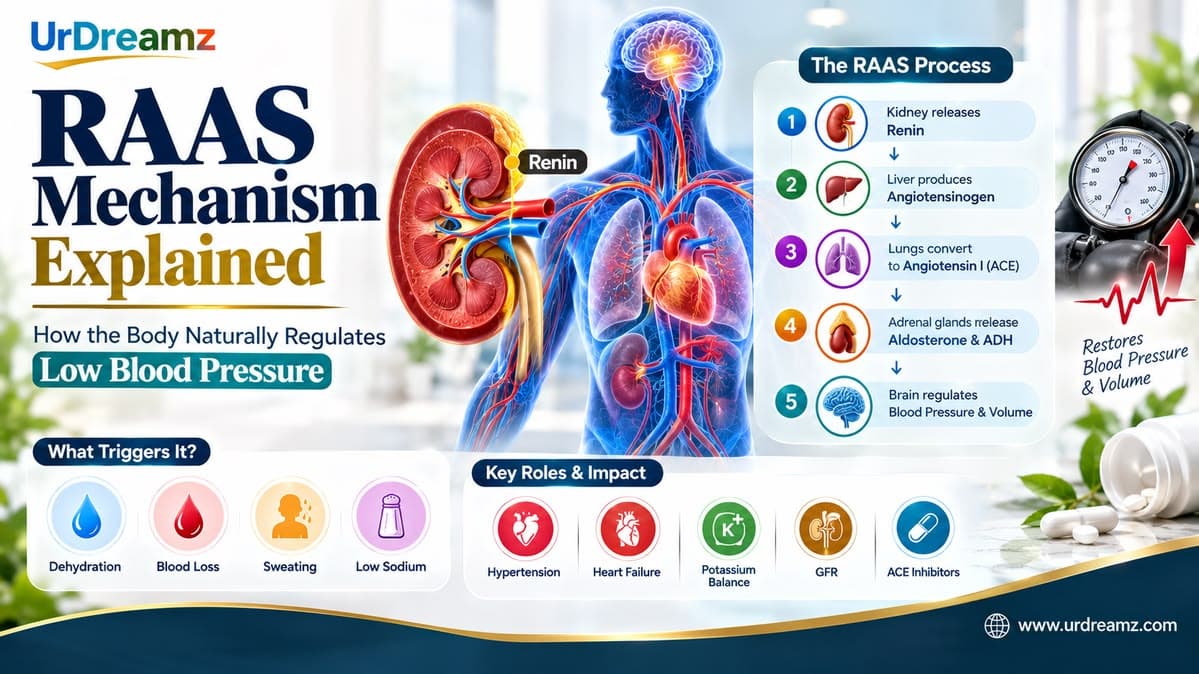
Bringing every step together, the complete RAAS mechanism can be summarized as the following sequential flowchart, exactly in the order these events occur inside the body.
- Low blood pressure, low blood volume, or low sodium is detected by the kidney (macula densa) and the sympathetic nervous system.
- Juxtaglomerular cells in the kidney release renin into the blood.
- Renin acts on angiotensinogen, continuously produced by the liver, converting it into angiotensin I.
- As blood passes through the lungs, ACE converts angiotensin I into angiotensin II.
- Angiotensin II causes vasoconstriction, triggers thirst, and signals both the adrenal glands and the pituitary gland.
- The adrenal glands release aldosterone, which causes the kidneys to reabsorb sodium (and water along with it) via ENaC channels.
- The pituitary gland releases ADH, which causes the kidneys' collecting ducts to reabsorb additional water.
- Blood volume and blood pressure rise back toward normal, and once sodium and blood pressure are restored, the trigger signals fade and the system quiets down again.
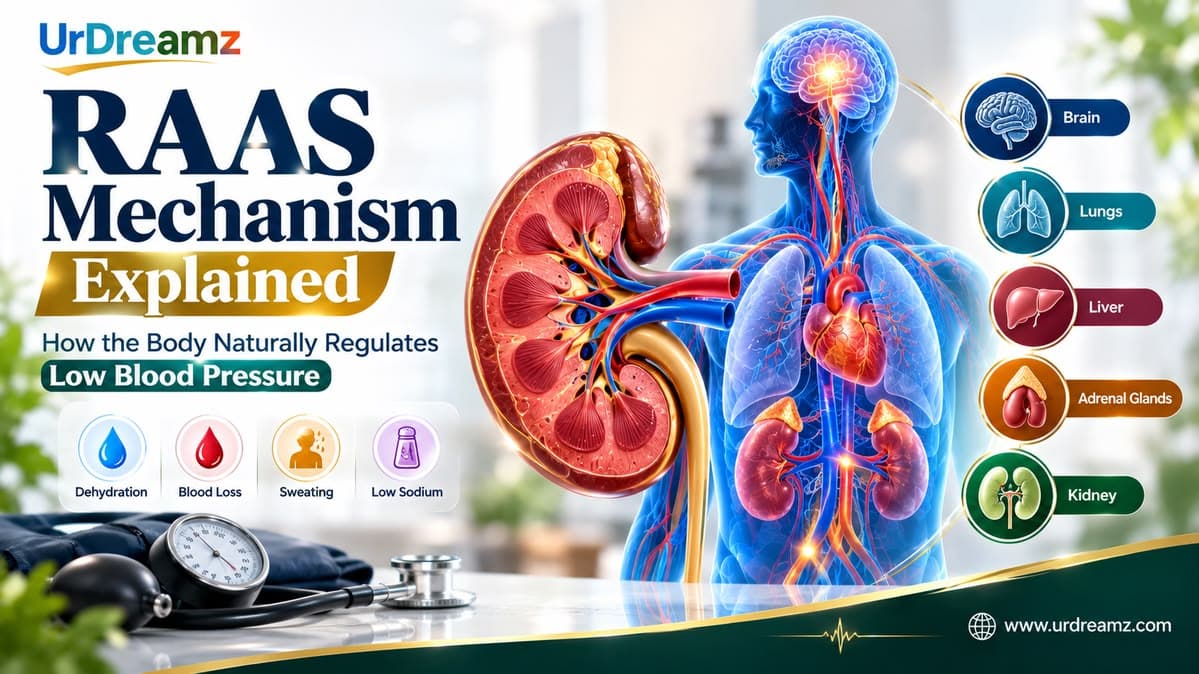
This step-by-step flow is exactly what's typically drawn out as a RAAS mechanism diagram in textbooks and lecture notes — kidney, liver, lungs, adrenal glands, and brain, connected in a single continuous loop that starts and ends with blood pressure and blood volume, and the same eight steps hold true whether the diagram is drawn as a simple flowchart for a beginner or as a detailed, fully labeled pathway for an advanced pharmacology course.
Organs Involved in RAAS
One of the most useful ways to remember the RAAS mechanism in detail is by organ, since each organ has one clearly defined job within the overall system.
It's worth noticing that the kidney appears at both the very beginning and the very end of this pathway — it's both the organ that first detects the problem and the organ where the final solution, sodium and water reabsorption, actually takes place. Every other organ in between exists purely to transform and relay the signal from one active hormone to the next, almost like a relay race where the baton, in this case a hormone signal, is passed from one runner to the next until it finally reaches the finish line back at the kidney.
RAAS in Hypertension
While RAAS is a completely normal and necessary system for maintaining healthy blood pressure, it becomes clinically important in a different way when it becomes chronically overactive. In many people with high blood pressure, or hypertension, the RAAS system is contributing to sustaining that elevated pressure over the long term, even when the original trigger — such as dehydration or blood loss — is no longer present.
This can happen for a variety of reasons, including reduced blood flow to the kidneys (which the kidney may misinterpret as low blood pressure, triggering renin release inappropriately), certain kidney conditions, or simply a general tendency toward higher baseline RAAS activity in some individuals. Because RAAS plays such a central role in many cases of hypertension, it has become one of the most important and heavily targeted pathways in blood pressure medicine, which is precisely why a major class of blood pressure medications, discussed in detail later in this guide, works by directly blocking specific steps of this exact pathway.
This is also why doctors will sometimes specifically investigate whether a patient's hypertension has an identifiable RAAS-related cause, such as narrowing of one of the arteries supplying the kidney, rather than assuming every case of high blood pressure is simply "essential" or without a clear underlying trigger — because in cases where RAAS overactivity has a specific, identifiable cause, addressing that cause directly can sometimes be more effective than relying on medication alone.
RAAS Effect on Potassium and GFR
Two commonly asked, more technical questions about RAAS concern its effect on blood potassium levels and on glomerular filtration rate (GFR), the standard measure of how well the kidneys are filtering blood.
Effect on potassium. As covered in the aldosterone section above, the sodium reabsorption driven by aldosterone in the kidney happens through an exchange mechanism — as sodium is pulled back into the blood, potassium is pushed out into the urine to be excreted. This means that when RAAS is highly active, blood potassium levels tend to fall somewhat, while urine potassium levels rise. This relationship is also why medications that block RAAS, such as ACE inhibitors, can sometimes cause blood potassium levels to rise instead, since blocking the pathway reduces this potassium-excreting effect. This is precisely why doctors routinely monitor blood potassium levels in patients starting ACE inhibitors, ARBs, or aldosterone antagonists, and why these medications are generally used cautiously, if at all, in patients who already have elevated potassium levels for other reasons.
Effect on GFR. Angiotensin II's vasoconstriction effect doesn't just act on blood vessels throughout the body generally — it also acts directly on the small blood vessels within the kidney itself, particularly the efferent arteriole (the vessel carrying blood away from the glomerulus). By constricting this specific vessel more than the vessel carrying blood in, angiotensin II actually helps maintain filtration pressure within the glomerulus even when overall blood pressure is low, which helps protect GFR during times of reduced blood volume. This is also why ACE inhibitors and similar RAAS-blocking medications must be used carefully in people with significant kidney artery narrowing, since removing this compensatory vasoconstriction can, in specific situations, cause a meaningful drop in GFR.
ACE Inhibitors and RAAS Blockers
Because RAAS plays such a central role in blood pressure regulation, several major classes of blood pressure medication work by deliberately interrupting specific steps of this exact pathway.
| Medication Class | How It Works | Example |
|---|---|---|
| ACE Inhibitors | Block the angiotensin-converting enzyme in the lungs, preventing angiotensin I from being converted into angiotensin II | Lisinopril |
| ARBs (Angiotensin Receptor Blockers) | Block angiotensin II from binding to its receptors, preventing its effects even though the hormone is still produced | Losartan |
| Aldosterone Antagonists | Block aldosterone's effect directly at the kidney, reducing sodium and water retention | Spironolactone |
| Direct Renin Inhibitors | Block renin itself at the very first step of the pathway | Aliskiren |
By interrupting the RAAS pathway at different points, these medications reduce vasoconstriction, sodium retention, and water retention, which together lower blood pressure — essentially working in the opposite direction of the natural mechanism described throughout this guide. This is exactly why understanding the RAAS mechanism in detail makes it so much easier to understand how and why these commonly prescribed medications actually work, rather than simply memorizing their names and side effects in isolation.
It's also worth understanding why doctors sometimes choose one class over another for a specific patient, since this connects directly back to the mechanism itself. ACE inhibitors, for instance, block the same enzyme responsible for breaking down another substance called bradykinin, which is part of why they can cause a distinctive dry cough in some patients — a side effect that ARBs, which work by a different mechanism further down the pathway, generally don't share. This is a good example of how understanding exactly where in the RAAS cascade a medication acts often explains its side effect profile just as much as its intended blood-pressure-lowering effect.
RAAS in Heart Failure
RAAS also plays a significant, and somewhat paradoxical, role in heart failure. When the heart's pumping ability is reduced, blood flow to the kidneys can drop, and the kidneys interpret this as a sign of low blood pressure or low blood volume — even when the actual problem is a weakened heart rather than a genuine lack of fluid in the body. This triggers RAAS activation in an attempt to raise blood pressure and blood volume, but in heart failure, this response tends to backfire: the resulting fluid retention and increased vascular resistance actually place additional strain on an already weakened heart, potentially worsening the underlying condition over time.
This is precisely why RAAS-blocking medications, particularly ACE inhibitors and ARBs, along with aldosterone antagonists, form a cornerstone of modern heart failure treatment — not because RAAS itself is inherently harmful, but because in the specific context of heart failure, its normally protective response becomes counterproductive, and interrupting it helps reduce the extra workload placed on the heart.
This dynamic is sometimes described as a vicious cycle: a weakened heart leads to reduced kidney perfusion, which activates RAAS, which causes fluid retention and vasoconstriction, which increases the volume of blood and the resistance the heart has to pump against, which in turn places further strain on a heart that was already struggling. Breaking this cycle at the RAAS level, through the medications discussed in the previous section, is one of the most effective strategies modern medicine has for improving both symptoms and long-term survival in people living with heart failure — a clear, practical example of how understanding a physiological mechanism translates directly into life-saving treatment.
Short-Term vs Long-Term Blood Pressure Control
It's useful to place RAAS within the broader picture of how the body controls blood pressure overall, since RAAS is only one part of a layered system operating on different timescales.
| Control System | Timescale | Mechanism |
|---|---|---|
| Baroreceptor reflex | Seconds | Nerve-based sensors in blood vessels trigger immediate changes in heart rate and vessel tone |
| RAAS | Minutes to hours (sustained) | Hormonal cascade involving the kidney, liver, lungs, adrenal glands, and brain, described throughout this guide |
| Long-term fluid and kidney regulation | Hours to days | Ongoing renal adjustment of sodium and water balance to maintain stable blood volume over time |
RAAS sits in an important middle ground within this system — it's slower than the instant nervous system reflexes that respond within seconds, but it's also the system primarily responsible for sustaining blood pressure correction over a longer period, which is exactly why it becomes so clinically significant in chronic conditions like long-term hypertension and heart failure, rather than in split-second emergencies alone.
It's helpful to think of these layers as working in relay, rather than in competition. The baroreceptor reflex buys the body a few crucial seconds by immediately adjusting heart rate and vessel tone, RAAS then takes over to sustain and reinforce that correction over the following minutes to hours, and finally, ongoing kidney regulation of fluid and electrolyte balance keeps blood volume stable over the following hours and days, well after the original trigger has been resolved. Recognizing which layer is responsible for what makes it much easier to understand why some blood pressure problems are corrected almost instantly, while others — particularly chronic hypertension — require sustained, long-term treatment rather than a single quick fix.
Quick Revision Summary
Quick Revision: RAAS is a hormone chain reaction that begins with the kidney sensing low sodium, low blood pressure, or low blood volume, and ends with the kidney reabsorbing sodium and water to restore blood pressure — with the liver, lungs, adrenal glands, and brain each playing one specific role along the way.
Common Misconceptions About RAAS
A few misunderstandings come up repeatedly when people first learn the RAAS mechanism, and clearing them up tends to make the whole system click into place more clearly.
| Misconception | Clarification |
|---|---|
| Renin itself raises blood pressure | Renin is only an enzyme that starts the cascade; the actual blood-pressure-raising work is done by angiotensin II, aldosterone, and ADH further down the pathway |
| Angiotensin I and angiotensin II are the same thing | Angiotensin I is a relatively inactive precursor; only after ACE removes two amino acids in the lungs does it become the far more active angiotensin II |
| Aldosterone and ADH do the same job | Aldosterone retains sodium (and water follows passively); ADH directly increases water reabsorption independent of sodium — together they restore both parts of blood volume |
| RAAS is only relevant to blood pressure | RAAS also directly affects potassium balance and glomerular filtration rate, both of which matter significantly in kidney and heart conditions |
| ACE is only found in the lungs | While the lungs are the major site due to their extensive blood vessel network, ACE is also present in smaller amounts in other tissues, including the kidneys themselves |
A Real-Life Example: Dehydration and Blood Loss
Walking through a concrete, everyday scenario often makes the abstract steps of RAAS easier to hold onto. Imagine someone who has been working outdoors in the heat for several hours without drinking enough water, sweating heavily the entire time. As sweat loss continues, both water and sodium are lost from the body, and blood volume gradually drops.
Within the kidney, the macula densa cells notice the drop in sodium concentration reaching them, and simultaneously, reduced blood volume means less blood flow and lower pressure within the afferent arteriole. Both signals point toward the same underlying problem. The juxtaglomerular cells respond by releasing renin into the blood. From here, the cascade described throughout this guide plays out exactly as outlined: renin converts the liver's angiotensinogen into angiotensin I, the lungs' ACE converts that into angiotensin II, and angiotensin II narrows blood vessels while triggering both aldosterone and ADH release. The person may notice they feel thirsty around this same time — that's the direct, felt effect of angiotensin II's action on the brain's thirst centers, working in parallel with the hormonal cascade.
Over the following hour or so, aldosterone causes the kidneys to hold onto sodium, and ADH causes them to hold onto water, gradually restoring blood volume and, with it, blood pressure. If the person also drinks water in response to their thirst, that adds directly to the effort already underway internally. This is precisely why a person who has been sweating heavily for hours often produces noticeably darker, more concentrated urine afterward — that's the visible, external sign of ADH actively working to conserve water, exactly as described in the ADH section of this guide.
A similar cascade plays out, often more urgently, after significant blood loss from an injury. A sudden drop in circulating blood volume triggers the same detection mechanisms in the kidney, and the same RAAS cascade activates, though in this case, the body's faster nervous system reflexes also kick in immediately alongside RAAS, working together — one acting within seconds, the other sustaining the correction over the following minutes and hours — to prevent blood pressure from dropping to a dangerous level.
Frequently Asked Questions
What is the full form of RAAS?
RAAS stands for the Renin-Angiotensin-Aldosterone System.
What is the RAAS mechanism of action?
Low blood pressure, blood volume, or sodium triggers renin release from the kidney, which converts angiotensinogen from the liver into angiotensin I, which is then converted to angiotensin II by ACE in the lungs; angiotensin II then causes vasoconstriction and triggers aldosterone and ADH release to restore blood pressure.
Can you explain the RAAS mechanism diagram in detail?
A RAAS diagram typically shows a loop: kidney releases renin, liver supplies angiotensinogen, renin converts it to angiotensin I, ACE in the lungs converts it to angiotensin II, which acts on blood vessels, the adrenal glands (releasing aldosterone), and the brain (releasing ADH), with both hormones acting back on the kidney to restore blood pressure.
How does RAAS work in the kidney specifically?
The kidney both starts and finishes the RAAS mechanism — it detects low sodium and low pressure via the macula densa and releases renin, and later reabsorbs sodium and water under the influence of aldosterone and ADH to restore blood volume.
What is the RAAS mechanism in simple terms for class 11 students?
In simple terms: low blood pressure is detected by the kidney, which releases renin; renin activates a hormone chain (angiotensin I, then angiotensin II) that narrows blood vessels and triggers two hormones, aldosterone and ADH, which together make the kidney hold onto sodium and water, raising blood pressure back to normal.
What is the RAAS mechanism in pharmacology?
In pharmacology, RAAS is important because several major blood pressure drug classes — ACE inhibitors, ARBs, aldosterone antagonists, and direct renin inhibitors — work specifically by blocking different steps of this pathway.
What is the RAAS mechanism in hypertension?
In many people with hypertension, RAAS remains chronically overactive, contributing to sustained high blood pressure through ongoing vasoconstriction and sodium and water retention, which is why RAAS-blocking medications are commonly used to treat hypertension.
Can you explain the RAAS system simply, like for a beginner?
Think of it as the body's automatic "raise the pressure" alarm system: low blood pressure or low salt triggers the kidney to send out a signal (renin), which travels through the liver and lungs to become a powerful hormone (angiotensin II) that tightens blood vessels and tells the body to hold onto more salt and water until blood pressure returns to normal.
What is the effect of the RAAS system on potassium?
Aldosterone, released as part of RAAS activation, causes the kidney to reabsorb sodium while excreting potassium, so active RAAS tends to lower blood potassium levels somewhat.
What is the effect of the RAAS system on GFR?
Angiotensin II constricts the efferent arteriole within the kidney more than the afferent arteriole, which helps maintain glomerular filtration pressure and protect GFR even when overall blood pressure is low.
What enzymes are involved in the RAAS system?
The two key enzymes are renin, released by the kidney, and angiotensin-converting enzyme (ACE), found mainly in the lungs, which together convert angiotensinogen into the active hormone angiotensin II.
Where is the RAAS system located in the body?
RAAS isn't located in a single organ — it spans the kidney, liver, lungs, adrenal glands, and brain, all connected through hormones circulating in the bloodstream.
How does the RAAS system respond to low blood pressure?
Low blood pressure is detected by the kidney's juxtaglomerular apparatus, which releases renin and starts the full RAAS cascade described throughout this guide, ultimately restoring blood pressure through vasoconstriction and sodium and water retention.
What is the role of the lungs in the RAAS system?
The lungs house angiotensin-converting enzyme (ACE), which converts the relatively inactive angiotensin I into the highly active hormone angiotensin II as blood passes through the lung's blood vessels.
What is the role of the liver in the RAAS system?
The liver continuously produces and releases angiotensinogen, the inactive precursor protein that renin acts on to begin the angiotensin hormone cascade.
Is the RAAS system a long-term or short-term blood pressure control mechanism?
RAAS is primarily a long-term regulatory system, acting over minutes to hours and sustaining its effect until blood volume, sodium, and blood pressure are fully restored, unlike faster nervous system reflexes that act within seconds.
What does a labeled RAAS system diagram typically show?
A labeled RAAS diagram typically shows the kidney (renin release), liver (angiotensinogen), lungs (ACE and angiotensin II formation), adrenal glands (aldosterone), and brain (ADH), connected by arrows showing the sequential hormone cascade back to the kidney.
How does lisinopril relate to the RAAS system?
Lisinopril is an ACE inhibitor, meaning it blocks the angiotensin-converting enzyme in the lungs, preventing angiotensin I from being converted into angiotensin II and thereby lowering blood pressure.
What activates the RAAS system?
RAAS is activated by low blood pressure within the kidney, low sodium detected by the macula densa, and activation of the sympathetic nervous system.
How is the RAAS system connected to hypertension?
Chronic overactivity of RAAS is a major contributing factor in many cases of hypertension, which is why RAAS-blocking medications form a core part of standard hypertension treatment.
What is the role of aldosterone in the RAAS system?
Aldosterone, released by the adrenal glands in response to angiotensin II, causes the kidney to reabsorb sodium (and water along with it) through ENaC channels, increasing blood volume and blood pressure.
What is the role of ADH in the RAAS system?
ADH, released by the pituitary gland in response to angiotensin II, increases water reabsorption in the kidney's collecting ducts, further increasing blood volume alongside aldosterone's sodium retention.
How is the RAAS system connected to heart failure?
In heart failure, reduced blood flow to the kidneys triggers RAAS activation, but the resulting fluid retention and vasoconstriction can worsen the strain on an already weakened heart, which is why RAAS-blocking medications are a cornerstone of heart failure treatment.
What are RAAS inhibitors, and what are some examples?
RAAS inhibitors are medications that block one or more steps of the pathway; examples include ACE inhibitors like lisinopril, ARBs like losartan, aldosterone antagonists like spironolactone, and direct renin inhibitors like aliskiren.
Which organs are involved in the RAAS system?
The kidney, liver, lungs, adrenal glands, and brain (specifically the pituitary gland) are all directly involved in the RAAS mechanism.
Which organ produces renin?
Renin is produced and released by juxtaglomerular cells located in the kidney.
What will trigger the RAAS system in everyday life?
Not drinking enough water, excessive sweating, blood loss from an injury, and low sodium intake are common everyday triggers of RAAS activation.
Conclusion
The RAAS mechanism is one of the clearest examples of how the human body works as a genuinely connected system rather than a collection of separate organs. A single trigger — low blood pressure, low blood volume, or low sodium — sets off a precise relay running through the kidney, liver, lungs, adrenal glands, and brain, each contributing one specific, necessary step, before the process loops back to the kidney to actually restore normal blood pressure through sodium and water retention.
Beyond being a fascinating piece of physiology, RAAS has direct, practical relevance in medicine: it helps explain why hypertension so often becomes a chronic, self-sustaining condition, why heart failure can trigger a cycle of worsening fluid retention, and why an entire class of widely prescribed medications — ACE inhibitors, ARBs, aldosterone antagonists, and direct renin inhibitors — works by deliberately interrupting this exact pathway at different points. Understanding RAAS step by step, organ by organ, makes both the body's natural blood pressure regulation and the medications used to treat its disorders far easier to genuinely understand rather than simply memorize.
Whether the goal is passing an exam, understanding a family member's blood pressure medication, or simply satisfying genuine curiosity about how the body manages something as fundamental as blood pressure, the RAAS mechanism rewards being learned as a connected story rather than a list of isolated facts — kidney to liver, liver to lungs, lungs back to the kidney and brain, and finally back to blood pressure itself, restored and steady once again.