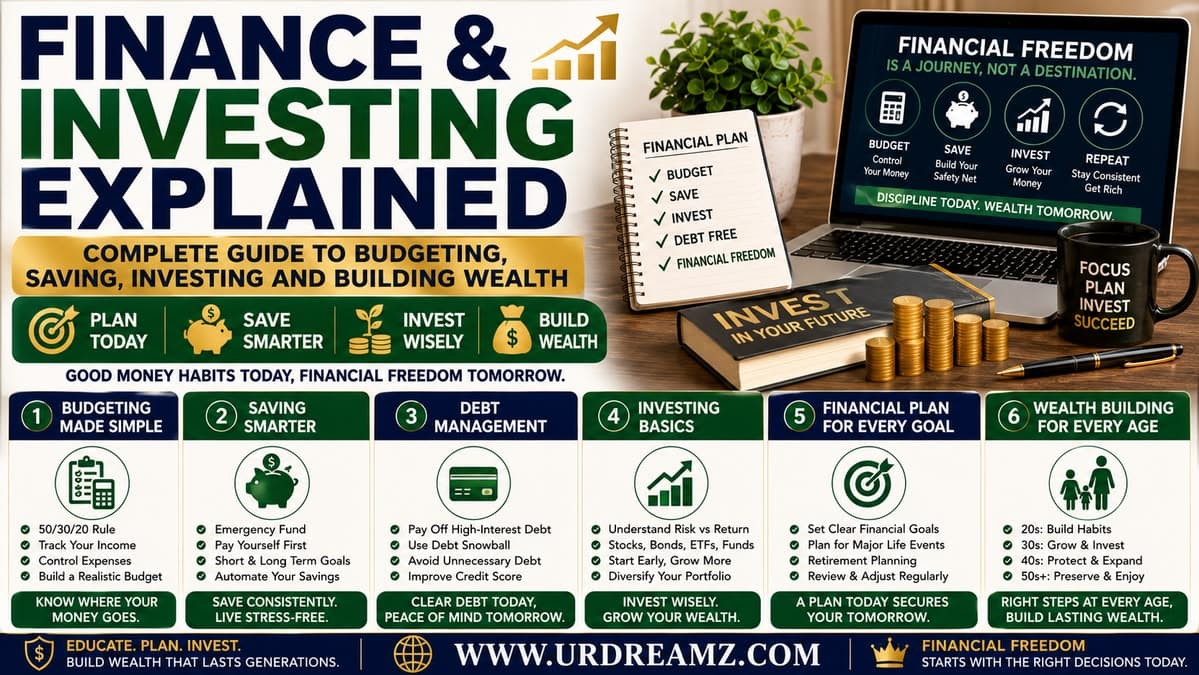
Finance & Investing Explained: Complete Guide to Budgeting, Saving, Investing and Building Wealth
Building real financial security has very little to do with luck or a huge salary, and almost everything to do with a handful of consistent, learnable habits applied patiently over years. This guide brings together the core building blocks of personal finance - budgeting, saving, debt management, insurance, and investing - into one complete, practical roadmap, along with a set of simple numeric rules that make everyday money decisions dramatically easier, and a stage-by-stage breakdown of what actually matters at each age of your financial life.
1. What Is Financial Literacy?
Financial literacy is the practical ability to understand and confidently use core money skills - budgeting, saving, investing, and managing debt - to make sound decisions rather than reactive ones. It isn't an abstract academic subject; it's the working knowledge that determines whether a paycheck quietly disappears every month or steadily builds toward something bigger. Financial literacy generally rests on six pillars: budgeting, saving, debt management, investing, income and employment, and insurance and risk management, all tied together by ongoing financial planning.
2. Budgeting: The Foundation of Every Financial Plan
Budgeting simply means tracking what comes in, planning where it goes, and deliberately avoiding spending more than you earn. A working budget requires knowing your income and expenses in detail, planning your spending and saving in advance rather than after the fact, and treating overspending as a solvable, ongoing habit to correct rather than a personal failing to feel ashamed of.
3. The 50/30/20 Rule Explained
One of the simplest, most widely used budgeting frameworks splits after-tax income into three broad categories: 50 percent toward genuine needs, 30 percent toward wants, and 20 percent toward savings and debt repayment. On a $3,000 monthly income, that works out to roughly $1,500 for needs, $900 for wants, and $600 directed toward savings - a simple enough split that most people can actually stick to it, which matters more than any theoretically "perfect" budget they'd abandon within a month.
4. Saving Money: Why It Matters More Than People Think
Saving isn't just about setting cash aside - it's what creates the breathing room to handle a surprise expense without going into debt, and the raw material that eventually gets invested to build real long-term wealth. Without a saving habit in place first, even a strong income tends to simply expand spending to match it, a pattern often called lifestyle creep.
5. Twenty Practical Money-Saving Habits
- Track daily expenses - simple awareness alone tends to reduce unnecessary spending
- Build and follow a monthly budget to keep spending under control
- Cancel subscriptions you no longer actively use
- Cook at home more often to meaningfully cut food costs
- Wait roughly 24 hours before any non-essential purchase to avoid impulse buying
- Buy household essentials in bulk where it genuinely saves money
- Use public transport where practical to reduce travel costs
- Shop sales strategically, but only for things you actually need
- Start a dedicated emergency fund for unexpected expenses
- Set specific, written saving goals to stay motivated
- Save spare coins and small change - it adds up more than it seems
- Prioritize quality over quantity for a longer-lasting purchase
- Compare prices online before any significant purchase
- Automate your savings so a portion moves away before you can spend it
- Repair items instead of replacing them where reasonably possible
- Avoid lifestyle creep - resist the urge to spend more just because you earn more
- Handle simple repairs yourself instead of paying for basic services
- Look for legitimate bonus or extra income opportunities
- Automate contributions to a retirement or investment account
- Review recurring costs regularly rather than assuming they're still the best deal available
6. Seven Financial Rules Everyone Should Know
Beyond general habits, a handful of simple numeric rules make major money decisions dramatically easier to reason through quickly.
| Rule | What It Means | Example |
|---|---|---|
| 50/30/20 Rule | Split income into needs, wants, and savings | $3,000 income → $1,500 needs, $900 wants, $600 savings |
| Rule of 72 | Divide 72 by your interest rate to estimate how many years it takes money to double | At 6% returns, money doubles in roughly 12 years |
| Emergency Fund Rule | Keep three to six months of expenses saved for emergencies | Spending $2,000/month means keeping $12,000 saved |
| Car Buying Rule (20/4/10) | 20% down payment, finance for no more than 4 years, keep total car costs under 10% of income | Earning $4,000/month means keeping car payments under roughly $400/month |
| Age-Based Portfolio Rule | Subtract your age from 100 to estimate the percentage of your portfolio to keep in stocks | At age 30, roughly 70% stocks and 30% safer assets like bonds |
| 4% Withdrawal Rule | A common guideline for how much to withdraw annually in retirement without depleting savings too fast | A $1 million portfolio at 4% provides roughly $40,000 a year |
| Risk Tolerance Rule | Only invest an amount you could genuinely afford to lose without real hardship | Before investing $5,000, honestly ask whether losing double that amount would be manageable |
None of these rules are rigid laws - they're simplified starting points meant to make an otherwise overwhelming decision easier to approach, and adjusting them to your own real circumstances is not just acceptable but expected.
7. Debt Management Basics
Not all debt is equal - "good debt," such as a mortgage or a reasonably priced student loan, can build long-term value, while "bad debt," typically high-interest consumer debt like credit cards, tends to quietly erode financial progress. Paying loans on time, understanding your credit score, and prioritizing high-interest debt for early repayment are the basic habits that keep debt a useful tool rather than a growing burden.
8. Understanding Your Credit Score
A credit score is a numerical measure of how reliably you've repaid debt in the past, and it directly affects the interest rates and loan terms you're offered in the future. Paying bills on time, keeping credit card balances low relative to your limit, and avoiding unnecessary new credit applications are the core habits that protect and improve this score over time.
9. Investing Basics for Beginners
Investing means putting money into assets - stocks, bonds, index funds, real estate - with the expectation that it grows in value over time, rather than simply sitting still in cash and slowly losing purchasing power to inflation. The two ideas every beginner genuinely needs to understand before investing anything are the relationship between risk and return, and the long-term power of compounding, where reinvested growth builds on itself year after year.
10. Understanding Risk vs Return
Generally, investments with higher potential returns carry higher potential risk, and there's no reliable way around that basic trade-off - anyone promising high returns with little to no risk should be treated with serious skepticism. A sound investing approach matches the level of risk taken to your actual time horizon and genuine emotional tolerance for watching an investment's value fluctuate.
11. The Power of Compound Growth
Compounding means your investment returns themselves start generating further returns over time, which is why starting to invest early - even with a modest amount - tends to outperform investing a much larger amount later, purely because of how many additional years that money has to keep compounding.
12. Diversification Explained
Diversification means spreading investments across different assets rather than concentrating everything in one place, reducing the damage any single poor-performing investment can do to an overall portfolio. It doesn't eliminate risk entirely, but it meaningfully smooths out the ride compared to betting everything on one stock, sector, or asset type.
13. Insurance and Risk Management
Insurance exists to protect against financial losses too large to comfortably absorb out of pocket - health issues, property damage, or the loss of income. Understanding the basics of health, life, and property insurance is a core piece of financial literacy precisely because a single uninsured emergency can undo years of otherwise careful saving and budgeting.
14. Building a Financial Plan: Step One, Clarity
A real financial plan starts with an honest, complete picture of where you currently stand - tracking your income, listing every expense, calculating your net worth, and genuinely understanding your monthly cash flow. Skipping this step and jumping straight to goals or investments almost always produces a plan built on guesswork rather than reality.
15. Building a Financial Plan: Step Two, Setting Goals
Effective financial goals give your money real direction, typically split across short-term goals within a year, mid-term goals across one to five years, longer-term goals beyond five years, and bigger "dream" goals that provide long-term motivation even if they're years away.
16. Building a Financial Plan: Step Three, Budgeting With Purpose
Every dollar in a well-built plan has an assigned purpose - covering needs, allowing for wants, or being directed toward saving and investing - ideally with saving and investing treated as a fixed priority rather than whatever happens to be left over at the end of the month.
17. Building a Financial Plan: Step Four, Protecting What You've Built
Protection means maintaining an emergency fund covering three to six months of expenses, holding appropriate insurance, and actively avoiding high-interest debt - collectively forming a financial safety net that keeps a single bad month or unexpected bill from undoing months or years of progress.
18. Building a Financial Plan: Step Five, Growing Your Money
Growth comes from investing consistently, letting compounding do the heavy lifting over time, and diversifying across different assets rather than chasing a single speculative bet - the same fundamentals covered earlier in this guide, now applied specifically inside a structured, ongoing plan.
19. Building a Financial Plan: Step Six, Reviewing and Adjusting
A financial plan isn't a one-time document - checking progress monthly, adjusting the plan as circumstances change, staying consistent through inevitable setbacks, and deliberately acknowledging small wins along the way are what keep a plan alive and genuinely followed rather than abandoned after the first difficult month.
20. Financial Tips for Teens (Ages 13-19)
The teenage years are the ideal time to build foundational habits: saving at least 20 percent of allowance or part-time earnings, opening a first bank account and learning basic budgeting, staying cautious around "buy now, pay later" schemes, understanding the basics of credit and interest early, and saving specifically toward short-term goals like technology, travel, or future education costs.
21. Financial Tips for People in Their Twenties
Your twenties are the highest-leverage decade for starting an emergency fund covering three to six months of expenses, beginning to invest early to take full advantage of long-term compounding, using credit responsibly to build a strong score, tracking spending closely enough to avoid lifestyle creep as income grows, and continuing to actively build financial knowledge rather than assuming it will come automatically with age.
22. Financial Tips for People in Their Thirties
Your thirties typically call for increasing retirement contributions rather than delaying them further, aggressively paying down high-interest debt like loans and credit cards, planning deliberately around major life milestones such as buying a home, having children, or getting married, building more than one income stream where possible, and securing the right insurance coverage across health, life, and income protection.
23. Financial Tips for People in Their Forties
The forties are often the peak-earning decade, making it the right time to maximize retirement and pension contributions, start or grow dedicated education funds for children, become genuinely tax-efficient with savings and investment choices, pay down a mortgage faster where possible, and periodically reassess whether your lifestyle and financial goals still actually match each other.
24. Financial Tips for People in Their Fifties
As retirement moves closer, the priority shifts toward protecting accumulated wealth by gradually lowering exposure to risky investments, eliminating major remaining debts like a mortgage, creating or updating a will and basic estate plan, fine-tuning a realistic retirement lifestyle plan, and prioritizing health and long-term care planning.
25. Financial Tips for People Fifty and Beyond
In the years surrounding and following retirement, the focus turns to deciding a realistic retirement timeline, whether full or phased, withdrawing savings and pensions strategically rather than haphazardly, considering downsizing if it genuinely reduces cost and stress, keeping health insurance and care plans current, and shifting attention toward legacy and wealth transfer for the next generation.
26. Multiple Income Streams and Financial Resilience
Relying on a single source of income leaves a household financially fragile if that one source is disrupted. Building even a modest secondary income stream - a side hustle, freelance work, or investment income - adds real resilience and can meaningfully accelerate progress toward every other financial goal on this list.
27. Common Personal Finance Mistakes to Avoid
- Spending without ever tracking where the money actually goes
- Carrying high-interest debt for far longer than necessary
- Waiting too long to start investing, losing years of potential compounding
- Having no emergency fund at all when an unexpected cost arrives
- Letting spending quietly rise every time income increases
- Avoiding insurance entirely to save on premiums, then facing a much larger uninsured loss later
28. Financial Myths vs Facts
| Myth | Fact |
|---|---|
| You need to be wealthy to start investing | Many investment platforms allow starting with very small, consistent amounts |
| All debt is bad | Some debt, used responsibly, can support long-term financial goals |
| Budgeting means restricting all enjoyment | A good budget simply directs spending intentionally, including planned enjoyment |
| You should wait until you earn more to start saving | Small, consistent saving habits started early tend to outperform larger amounts started later |
Frequently Asked Questions
What is the 50/30/20 rule?
A simple budgeting framework that allocates 50 percent of income to needs, 30 percent to wants, and 20 percent to savings and debt repayment.
How much should I keep in an emergency fund?
A common guideline is three to six months of essential living expenses, kept in an easily accessible account.
What is the Rule of 72?
A quick way to estimate how many years it takes an investment to double, by dividing 72 by the expected annual interest rate.
When should I start investing?
As early as realistically possible - starting small and early generally outperforms investing larger amounts later, due to the long-term power of compounding.
What is the difference between good debt and bad debt?
Good debt, like a reasonably priced mortgage, can support long-term financial goals, while bad debt, like high-interest credit card balances, tends to erode financial progress over time.
How do I build a complete financial plan?
Start with a clear picture of your finances, set specific goals, build a purposeful budget, protect your progress with an emergency fund and insurance, invest consistently to grow your money, and review the plan regularly.
Conclusion
Real financial security is built through consistent, unglamorous habits - tracking spending, saving before you're tempted to spend, avoiding unnecessary high-interest debt, and investing patiently over time - far more than through any single clever trick or lucky break. Whichever stage of life you're currently in, the same underlying principles covered throughout this guide apply: get a clear, honest picture of where you stand, set specific goals, protect what you've built, and let time and consistency do the rest.