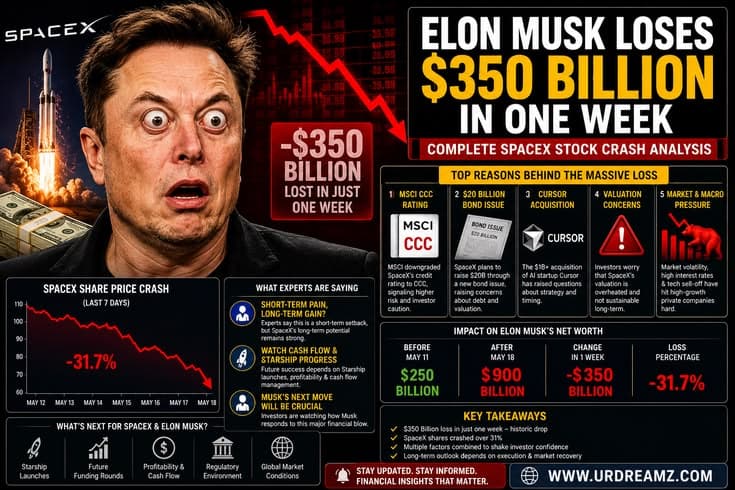
Elon Musk's Historic $350 Billion Wealth Loss: Why SpaceX Shares Crashed and What Happens Next?
In mid-June 2026, when Elon Musk achieved the honor of becoming the world's first trillionaire, it seemed as though his wealth journey was writing a new chapter in history. But just days after this celebration, within a single week, he also became the first person to experience the largest personal financial decline in the world. How and why did this $350 billion loss — which is greater than the total wealth of the world's second richest person — happen? In this comprehensive analytical report, we will examine every aspect of this historic financial event.
1. Who is Elon Musk and Where Does His Wealth Come From
Elon Reeve Musk was born on June 28, 1971, in Pretoria, South Africa. Today, he is not only the richest person in the world but has become a figure in the world of technological innovation whose every step impacts global markets. His wealth is mostly dependent on his shares in the companies he founded or in which he has made dominant investments.
Musk's primary sources of wealth are: approximately 38 to 42 percent stake in SpaceX, which is the largest portion of his total wealth; about 11 to 12 percent stake in Tesla, the world's most famous electric vehicle manufacturer; shares in xAI, the artificial intelligence company that has merged with the former Twitter; and investments in early-stage projects like Neuralink. It is important to understand that Musk does not have trillions of dollars in cash; rather, his wealth fluctuates according to the stock market valuation of these companies, like an uneven mountain range that sometimes goes up and sometimes comes down.
This is why when SpaceX shares rose rapidly, Musk became the world's first trillionaire, and when those same shares fell, his wealth experienced a record decline. But neither in the first case did he ever see that money in his bank account, nor in the second case did he actually have to pay that amount.
2. SpaceX IPO and Historic Rise
SpaceX, which is the world's most important private company in space exploration and rocket manufacturing, held its initial public offering (IPO) in June 2026. This IPO was so successful that a rush developed among investors to buy its shares. The company offered its shares at $135 per share, and within the first three days, the share price increased by more than 67 percent.
On June 16, 2026, SpaceX shares touched their highest level of $225.64 per share. At this point, the company's total market capitalization reached $2.99 trillion, momentarily making it the world's fourth largest company, surpassing even Amazon and Microsoft.
At this peak, Elon Musk's total wealth reached a historic high of $1.45 trillion, and he set the record for the first time in human history that an individual's personal wealth exceeded one trillion dollars. Forbes magazine officially declared him the world's first trillionaire. But this happiness was very short-lived.
3. The $350 Billion Loss: Complete Details
After reaching its peak on June 16, SpaceX shares began to decline rapidly. This decline was not merely a coincidence but was the combined result of various factors that came together to form a perfect storm.
Monday, June 22, 2026, saw the biggest loss when SpaceX shares suffered a record decline of 16.4 percent in a single day. The share price dropped to around $155. According to Forbes estimates, Elon Musk's personal wealth declined by more than $152 billion in just this one day, which is itself a record.
Looking at the total decline over a week, from the peak of June 16 to this decline, SpaceX shares fell by more than 31 percent. Elon Musk's total wealth fell from its high of $1.45 trillion to below $1.1 trillion — a loss of more than $350 billion in one week.
To understand how big this loss is, consider this: the world's second richest person, Larry Page, has a total wealth of $299 billion. That means Musk lost more in one week than Larry Page's entire lifetime earnings. The company's market value fell from its peak of $2.99 trillion to less than $2 trillion — nearly one trillion dollars wiped out in a week.
It is particularly noteworthy that despite this decline, SpaceX shares were still above their IPO price of $135, at approximately $154 to $155. This means that those who bought shares at the IPO time were still in profit, but those who bought near the peak were at a very large loss.
4. Why Did SpaceX Shares Crash? All Reasons
Behind this sudden and sharp decline, there was not just one reason but several factors working simultaneously. According to economic experts, this was a perfect storm in which various negative news came together at once.
The first and fundamental reason was the issue of overvaluation after the IPO. SpaceX shares had risen by more than 67 percent in the first three days after the IPO, which was a very rapid increase. Analytical institutions like Morningstar, which had already taken a cautious stance on SpaceX, kept saying that this rapidly increased price was far higher than the company's actual economic value. Some analysts even said that SpaceX had become the latest meme stock — a stock that people buy hoping others will also buy and drive the price up further, rather than based on the company's actual performance.
The second major reason was the acquisition of the software company Cursor at a hefty price of $60 billion. SpaceX announced that it would acquire the AI coding company Cursor in an all-stock deal worth $60 billion. This deal diluted the company's IPO price by 3.4 percent. Morningstar called it a major dilution and reduced its fair value estimate from $63 to $62, which was much lower than the then-market price.
The third reason was that the company announced on Monday that it would issue $20 billion in bonds to repay a short-term loan and to provide funding without further diluting existing shareholders. But investors did not take this positively because issuing bonds indicates that the company is taking on debt for its large expenses, and questions arose about its ability to afford such large expenditures in the AI sector.
The fourth reason was governance concerns. Several analysts and investors expressed concern over the company's governance structure because Elon Musk holds overwhelming voting rights over shareholders. This means that ordinary investors' opinions have very little impact on company decisions, which is considered a weakness in terms of transparency and corporate governance.
The fifth reason was the general weakness in the tech sector. SpaceX's decline was not just an isolated issue but during this period, a widespread sell-off was happening across the entire tech sector, which also affected the NASDAQ index and Asian markets.
5. What is MSCI's CCC Rating and Its Impact
An important factor in the decline of SpaceX shares was the CCC rating given by MSCI. Many readers may be wondering what this rating is and why it matters, so let's understand it.
MSCI is one of the world's largest stock market index providers. This organization evaluates companies on a sustainability scale called ESG — Environmental, Social, and Governance rating. This rating has seven levels, with AAA being the highest and CCC being the lowest.
MSCI gave SpaceX a CCC rating, which is the lowest level on its seven-tier scale. The report stated that the company is behind its industry and faces significant environmental, social, and governance risks.
The major impact of this rating was that many large institutional investors, such as pension funds and socially responsible investment funds that have their own policies of only investing in companies with a certain level of ESG rating, either stayed away from investing in SpaceX or sold their shares. This increased the selling pressure even further.
This is an important lesson that can be learned from SpaceX's decline: in today's world, a company cannot be satisfied by just making profits. Environmental responsibility, social impact, and transparent governance have become equally important for investors.
6. SpaceX Bonds and AI Spending Issue
Artificial Intelligence is the hottest investment sector in today's world. Every major tech company is in a race to invest in this field. But for SpaceX, this very race became a source of difficulty.
The company announced that it would issue $20 billion in bonds. Bonds are essentially corporate loans in which the company takes money from investors and promises to return it with interest after a fixed period. The company's intention was to use the money from these bonds to repay a previously taken short-term loan and thus prevent further dilution of existing shareholders' shares.
On the surface, this seemed like good news for shareholders, but investors saw it in the opposite way. For them, the issuance of $20 billion in bonds indicated that the company was relying on debt for its large projects, especially heavy investment in the AI sector. If the AI projects don't deliver the returns expected, this debt could become a burden for the company.
At the same time, some positive news also came. SpaceX entered into a computing agreement with the AI startup Reflection AI that could be worth up to $6.3 billion. Reflection AI will pay SpaceX $150 million every month from July 1, 2026, until 2029, and in return, it will get access to NVIDIA's GB300 chips to develop and run advanced AI models. But this positive news could not have much impact in the overall negative environment.
7. Was This Loss Real or Paper Loss
The common person naturally wonders whether Elon Musk actually lost $350 billion. Did he have to pay this amount to someone, or was it stolen from somewhere? It is important to understand the answer to this question.
No, Elon Musk did not lose $350 billion in cash. This is a decline in paper wealth, which is called a paper loss in financial terms. When the price of SpaceX shares fell, the total market value of the 4.8 billion shares that Elon Musk holds decreased. But this value only becomes real when he sells his shares. Since he did not sell shares, this loss was not actually realized.
This is similar to if the value of your house is 5 million rupees one day and 4 million rupees the next day, but you are still living in the house. You haven't lost anything because you didn't sell the house. But if you wanted to sell it at that time, you would get less money.
Similarly, if Elon Musk wanted to sell all his shares at that time, he would get $350 billion less than at the peak. But no billionaire works this way. They make long-term investments in their companies and are not bothered by short-term fluctuations.
However, this paper loss is not entirely meaningless either. If Musk uses his shares as collateral when taking loans, the decreased value of these shares can affect his borrowing capacity. Additionally, the confidence of those investing in his companies can also be shaken.
8. Elon Musk's Wealth Journey: From Beginning to Trillionaire
Elon Musk's wealth journey is truly astonishing. At the beginning of 2020, his total wealth was only around $28 billion, and he was ranked 35th on the list of the world's richest people.
In 2021 and 2022, the sharp rise in Tesla shares brought him to the top of the list. But this journey was not smooth. In 2022, after the Twitter acquisition, Tesla shares fell, and his wealth also saw a big decline. Then in 2025, once again fluctuations in Tesla shares and the correction in the tech sector kept his wealth between $300 billion and $400 billion.
In June 2026, SpaceX's IPO took place, and after that, the record increase in the company's share price raised Musk's wealth to $1.45 trillion. Forbes officially announced that Elon Musk had become the world's first trillionaire.
But this position fell very quickly. The decline in both SpaceX and Tesla shares on Wednesday, June 24, 2026, brought Musk back to the billionaire level — below one trillion dollars. According to Forbes estimates, at the market close that day, his total wealth was $970.2 billion.
But as of June 25, 2026, Forbes put his wealth at $951.8 billion, and he is still the world's number one richest person. After him, according to Bloomberg's list, Larry Page is second with wealth of around $299 billion.
9. SpaceX's Future and Reflection AI Deal
Despite the decline, SpaceX is an extremely unique and powerful company whose future many economists see as bright. The steps the company has taken in the field of artificial intelligence could open new sources of revenue.
The computing agreement with Reflection AI is one example. Under this agreement, Reflection AI will pay SpaceX $150 million every month from July 1, 2026, until 2029 — that is $5.4 billion over 3 years. The total potential value of the agreement is up to $6.3 billion. In return, Reflection AI will get access to NVIDIA's state-of-the-art GB300 chips needed to develop and run AI models.
SpaceX also acquired the software company Cursor, which makes AI-powered code-writing tools. This $60 billion acquisition was made in stock, not cash. Experts believe SpaceX will use Cursor to increase the productivity of its thousands of engineers, which could benefit the company in the long term.
SpaceX's core business — rocket technology and space missions — is also strong. The successful test of Starship, the growing customer base of the Starlink satellite internet service, and contracts for government and private space missions provide the company with stable revenue.
10. Is Musk Still the World's Richest Person
Yes, despite all the decline, Elon Musk is still the richest person in the world as of June 25, 2026. According to Forbes' real-time data, his wealth is $951.8 billion. According to the Bloomberg Billionaires Index, he is also still in first place.
But this situation is continuously changing. There was further decline in both Tesla and SpaceX shares on Wednesday, June 24, and at the market close that day, his wealth had fallen below one trillion dollars to $970 billion. That is, he lost the trillionaire status again.
It is clear that in the coming days, his wealth will depend on the prices of SpaceX and Tesla shares. If these shares stabilize or rise, Musk could become a trillionaire again, and if they fall further, his wealth could decline further.
On the current list of the world's richest people, Larry Page is second with $299 billion, Jeff Bezos is third, and Mark Zuckerberg is also in the top five. The gap between Musk and the second richest person is still very large, which keeps him safe in the number one position.
11. Lessons for Investors from This Event
This dramatic rise and volatility of SpaceX shares offers several important lessons about investing that are useful for anyone interested in the stock market.
The first lesson is: do not invest based on emotions and hype. SpaceX shares rose 67 percent in just three days after the IPO. Investors who bought near the peak in this excitement suffered losses of more than 31 percent in a short time. Just because something rises rapidly does not mean it will continue to rise.
The second lesson is: do not put all your capital in one company. If all your savings were in one stock, such a decline could destroy your financial future. Diversification is the fundamental principle of investing.
The third lesson is: it is important to understand a company's intrinsic value. Analysts like Morningstar were saying from the beginning that SpaceX was overvalued. Those who paid attention to fundamental analysis were saved from this pain.
The fourth lesson is: pay attention to corporate governance. When one person has complete control over a company and other shareholders' voices are weak, it can be a warning sign. Companies with good corporate governance perform better in the long term.
The fifth lesson is: stay away from meme stocks. When people start saying buy this stock because others will also buy, it is a red flag. Real investment should be based on the company's earnings, growth prospects, and actual business value.
The sixth lesson is: do not ignore ESG factors. MSCI's CCC rating drove large institutional investors away. In today's world, companies with environmental and social responsibility seem more attractive to investors.
12. What Happens Next: Experts' Opinions
Experts are divided on the future of SpaceX and Elon Musk's wealth. Some experts believe this decline is a temporary correction and the company will rise again, while others are expressing concerns.
On the positive side: SpaceX's core technology and business are strong. Revenue from Starlink is stable. The field of space research will become very important in the future. The company's investment in artificial intelligence could benefit it in the coming years. Shares are still above the IPO price.
On the negative side: issuing $20 billion in bonds will increase the company's debt burden. The ESG rating issue could keep large institutional investors away. Questions will continue to be raised about Elon Musk's voting control. The $60 billion acquisition of Cursor has already diluted the share price.
According to Swiss bank Swissquote analyst Ipek Ozkardeskaya, SpaceX is at risk of becoming the latest meme stock. She believes investors are buying in the expectation that others will also buy and the price will rise further, which is a dangerous trend.
On the other hand, those who think long-term say that SpaceX's business model is unique and the space economy will become very large in the next ten years. According to them, this decline can be seen as an opportunity for long-term investors.
The question of what will happen next will only be answered by time. But one thing is certain: the story of Elon Musk and SpaceX is not over yet. The world's first trillionaire, who now has wealth of approximately one trillion dollars, is still the world's richest person, and his companies are playing an important role in shaping the world's future.
The first time in history that any individual has traveled the journey of one trillion dollars in wealth and then suffered a loss of $350 billion is a reminder that nothing is permanent in financial markets. Whether you are the world's richest person or an ordinary investor, patience, diversification, and investment based on fundamental analysis is always the best path.
Summary
Elon Musk's $350 billion loss is the largest personal financial loss in the world's financial history. It was the combined result of SpaceX shares falling more than 31 percent, MSCI's lowest rating, the announcement of $20 billion in bonds, concerns arising from the $60 billion Cursor acquisition, and the general weakness in the tech sector. However, this loss is largely paper, and Musk is still the world's richest person. SpaceX shares are still above the IPO price, and the company's core business is strong, but the direction of the future will be determined by the performance of the next few months.