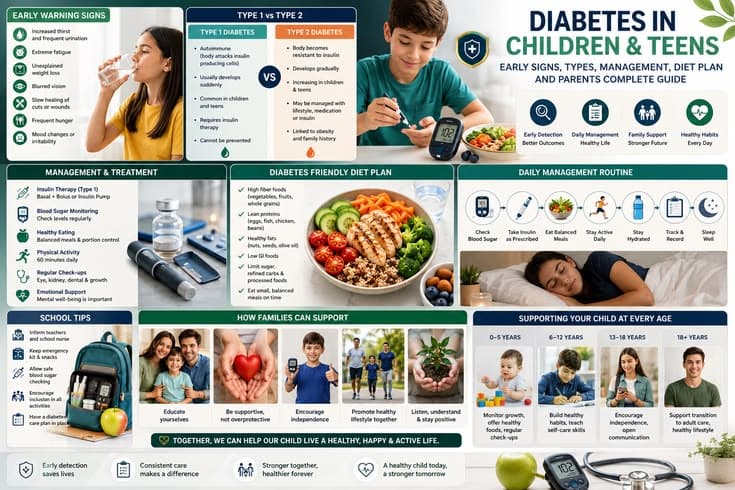
Diabetes in Children and Teens: Early Signs, Types, Management, Diet Plan and Parents Complete Guide
Discovering that your child has diabetes — or worrying that they might — is one of the most frightening experiences a parent can face. But here is what parents need to hear first: diabetes in children is highly manageable. Millions of children and teenagers around the world live full, active, healthy lives with diabetes. The key is early detection, proper understanding, and consistent care. This guide covers everything parents need to know — from the very first signs to look for, through diagnosis, treatment, daily routines, school management, diet planning, and family support.
Why Diabetes in Children Is Rising — What Every Parent Should Know
Diabetes in children is more common than many parents realize, and its rates are increasing worldwide. Type 1 diabetes — the autoimmune form that destroys insulin-producing cells in the pancreas — has historically been the most common type in children and remains so. But Type 2 diabetes, once considered exclusively an adult disease, is now being diagnosed in children and teenagers at rates that have roughly doubled over the past decade, driven primarily by rising childhood obesity and increasingly sedentary lifestyles.
Understanding which type your child has is critically important because the causes, symptoms, and treatments are fundamentally different. This guide covers both. The information here is educational — always work closely with a qualified pediatric endocrinologist (a children's hormone and diabetes specialist) for your child's actual diagnosis and treatment plan.
| Factor | Type 1 Diabetes | Type 2 Diabetes |
|---|---|---|
| What happens in the body | Immune system destroys insulin-producing cells — no insulin produced | Body produces insulin but cells resist it (insulin resistance) |
| How common in children | Most common type in children | Rising rapidly — now accounts for significant percentage of new cases |
| Age of onset | Any age, peak 4-7 and 10-14 years | Usually puberty and older, but can occur younger |
| How symptoms appear | Suddenly, over days to weeks | Gradually, often unnoticed for months |
| Can diet and exercise cause it? | No — autoimmune, not related to lifestyle | Strongly linked to weight, inactivity, and family history |
| Can it be prevented? | No — cannot be prevented | Often preventable with healthy lifestyle |
| Primary treatment | Lifelong daily insulin — non-negotiable | Diet, exercise, oral medication — insulin if needed later |
| Can child outgrow it? | No — Type 1 is permanent | Rarely goes into remission in children |
Early Signs of Diabetes in Children — The 4 Ts Every Parent Must Know
Medical professionals use a memorable system called the "4 Ts" to help parents identify the most common early warning signs of diabetes in children. Learning these can save a child's life — because Type 1 diabetes in particular can escalate to a life-threatening emergency within days if not caught and treated.
T1 — Toilet: Frequent Urination
When blood sugar is too high, the kidneys work overtime trying to filter and flush the excess glucose out of the body through urine. The result is a child who needs to use the bathroom much more frequently than usual, including waking up at night to urinate. In younger children who have already been toilet trained, parents may notice new bed-wetting — a child who had been dry at night suddenly begins wetting the bed. In babies and toddlers, diapers may become unusually heavy and need changing far more often. This is often one of the first signs parents notice.
T2 — Thirsty: Excessive and Unquenchable Thirst
Because the body is losing so much fluid through frequent urination, the child becomes severely and constantly dehydrated. They drink large amounts of water but the thirst cannot be quenched — no matter how much they drink, they still feel thirsty. Parents describe children carrying water bottles everywhere, waking up in the middle of the night for drinks, or drinking an unusual quantity of fluids throughout the day without apparent reason.
T3 — Tired: Extreme Fatigue and Weakness
Glucose is the body's primary fuel source. When insulin is absent or ineffective, cells cannot access this fuel — they are literally starving for energy even though the blood is flooded with glucose. The result is profound, unexplained exhaustion. The child may seem unusually lethargic, lack their normal energy for play, fall asleep at unusual times, or seem consistently weak and lacking their usual vitality. This fatigue is different from ordinary tiredness — it does not improve with rest.
T4 — Thinner: Unexplained Weight Loss
When cells cannot use glucose for energy, the body begins breaking down fat and muscle tissue as an alternative fuel source. This causes rapid, unexplained weight loss even while the child's appetite may be normal or even increased. A child losing weight while eating normally — or eating more than usual — is a significant warning sign that should be investigated immediately. In Type 1 diabetes, this weight loss can be dramatic and rapid.
Additional Warning Signs
Beyond the 4 Ts, parents should also watch for blurred vision (high blood sugar affects the lens of the eye), unusual mood changes and irritability, slow-healing cuts or wounds, and recurring infections. In girls, recurring vaginal yeast infections or severe diaper rash in babies can be an early indicator of uncontrolled blood sugar. In Type 2 diabetes specifically, parents may notice dark, velvety patches of skin — often on the back of the neck, armpits, or groin — a condition called acanthosis nigricans, which signals insulin resistance.
| Warning Sign | What It Looks Like | More Common In | Urgency Level |
|---|---|---|---|
| Frequent urination / bed-wetting | Many bathroom trips daily; new night-time accidents in toilet-trained child | Both Type 1 and Type 2 | See doctor soon |
| Unquenchable thirst | Drinking large amounts constantly; still thirsty | Both Type 1 and Type 2 | See doctor soon |
| Unexplained weight loss | Losing weight despite eating normally or more than usual | Mainly Type 1 | See doctor urgently |
| Extreme fatigue | Unusual lethargy, no energy for play, weak | Both | See doctor soon |
| Fruity-smelling breath | Breath smells sweet, fruity, or like nail polish remover | Type 1 — sign of ketones | Seek emergency care immediately |
| Blurred vision | Child complains of not seeing clearly, things are fuzzy | Both | See doctor soon |
| Mood changes and irritability | Unusual grumpiness, behavioral changes | Both | See doctor soon if combined with other signs |
| Dark velvety skin patches | Thick, dark patches on neck, armpits, groin | Mainly Type 2 (insulin resistance sign) | See doctor soon |
| Nausea, vomiting, stomach pain | Signs of possible DKA — serious emergency | Type 1 | Emergency — go to hospital immediately |
DKA — The Emergency Every Parent Must Recognize
Diabetic Ketoacidosis, known as DKA, is a life-threatening emergency that occurs when the body has no insulin and begins breaking down fat so rapidly that toxic acids called ketones build up in the blood. DKA can occur when Type 1 diabetes goes undiagnosed and the child has never received insulin, or when an already-diagnosed child misses insulin doses or becomes seriously ill.
Signs of DKA include fruity or acetone-like breath (similar to nail polish remover), rapid and labored breathing, severe vomiting, stomach pain, confusion, and extreme drowsiness. If your child shows these symptoms, do not wait for a doctor's appointment — go directly to an emergency room. DKA can cause coma and death within hours if untreated. It is the most common cause of death related to diabetes in children.
Diagnosing Diabetes in Children — What Tests Are Done
If a doctor suspects diabetes based on symptoms or a parent's concern, several blood tests can confirm the diagnosis quickly. The most common are the random blood sugar test (taken at any time — a result of 200 mg/dL or higher with symptoms strongly suggests diabetes), the fasting blood sugar test (taken after at least 8 hours without food — 126 mg/dL or higher indicates diabetes), and the A1C test (which shows average blood sugar over the past 3 months — 6.5 percent or higher on two tests confirms diabetes).
Once diabetes is confirmed, additional tests are done to determine whether it is Type 1 or Type 2. This matters enormously because the treatment differs fundamentally. Tests for specific autoantibodies in the blood can identify whether the immune system has been attacking insulin-producing cells, which confirms Type 1. Knowing the type guides every treatment decision that follows.
Type 1 Diabetes Treatment in Children — Insulin, Monitoring and Technology
Children with Type 1 diabetes require insulin every single day for the rest of their lives. This is not optional — without insulin, a Type 1 diabetic child will develop DKA and die. Insulin cannot be taken as a pill because stomach acid destroys it; it must be injected or delivered through a pump.
Types of Insulin Children Use
Rapid-acting insulin is taken at mealtimes to handle the glucose from food. It begins working within 15 minutes and lasts about 4 hours. Long-acting or basal insulin is taken once or twice daily and provides a steady background level of insulin throughout the day and night, preventing blood sugar from rising between meals. Most children use a combination of both types. The doses are adjusted based on how much carbohydrate is eaten, current blood sugar levels, activity level, and illness.
Insulin Delivery Options
Insulin pens are the most common delivery method for children — they look like writing pens, are easy to use, and contain pre-filled insulin cartridges. Syringes are the traditional method and are still used by many families. Insulin pumps are small devices worn on the body that deliver insulin continuously through a thin tube inserted under the skin. The pump eliminates the need for multiple daily injections and can be programmed to deliver precise doses around the clock. Many active children and teenagers prefer pumps for the flexibility they offer.
The latest advancement is the closed-loop system, sometimes called an artificial pancreas. This combines a continuous glucose monitor with an insulin pump — the two devices communicate automatically and the pump adjusts insulin delivery based on real-time blood sugar readings without requiring constant input from the child or parent. This technology has transformed diabetes management for many families and is becoming increasingly available.
Blood Sugar Monitoring
Children with Type 1 diabetes need their blood sugar checked at least four to six times daily — before every meal, at bedtime, before exercise, and when they feel unwell. Traditional glucometers require a small finger-prick blood sample. Continuous Glucose Monitors (CGMs) are wearable devices that use a tiny sensor inserted just under the skin to check blood sugar automatically every few minutes and display readings on a smartphone or watch. CGMs have become the standard of care for most pediatric diabetes teams and dramatically reduce the burden on both children and parents.
| Timing | Target Range | Action If Too Low (below target) | Action If Too High (above target) |
|---|---|---|---|
| Fasting / Before breakfast | 70 to 130 mg/dL (4.0 to 7.2 mmol/L) | Give fast-acting carbohydrate — juice, glucose tablets | Check for ketones; give correction insulin per care plan |
| Before meals (lunch, dinner) | 70 to 130 mg/dL | Treat low blood sugar before eating | Adjust mealtime insulin dose |
| 2 hours after meals | Below 180 mg/dL (10 mmol/L) | Assess if too much insulin was given | May need insulin adjustment — consult care team |
| Bedtime | 100 to 140 mg/dL | Give bedtime snack to prevent overnight low | Small correction dose if very high — per care plan |
| A1C (every 3 months) | Below 7% for most children | Below 6.5% may indicate too many lows | Above 8% requires care plan review |
Best Diet Plan for a Diabetic Child — What to Feed Your Child
One of the most important things parents need to know about feeding a child with diabetes is that it does not require a completely separate diet from the rest of the family. A diabetes-friendly diet for children is simply a healthy, balanced diet — exactly what all children should be eating. No foods are permanently forbidden; the goal is balance, consistency, and understanding how different foods affect blood sugar.
The Plate Method for Kids
The simplest way to build a balanced plate for a diabetic child is to divide it into three sections. Half the plate should be non-starchy vegetables — broccoli, cucumbers, carrots, spinach, tomatoes, bell peppers. A quarter of the plate should be lean protein — chicken, fish, eggs, lentils, low-fat cheese, or beans. The remaining quarter holds the complex carbohydrates — brown rice, whole wheat bread or chapati, sweet potato, oats, or whole grain pasta. This distribution provides steady energy without causing sharp blood sugar spikes.
Why Carbohydrate Quality Matters
All carbohydrates raise blood sugar — but they do so at different speeds. White bread, white rice, sugary cereals, and sweet snacks cause a rapid blood sugar spike that is difficult to manage with insulin. Whole grain bread, brown rice, oats, legumes, and starchy vegetables with their fiber intact release glucose more slowly and gradually, making blood sugar much easier to control. This is not about eliminating carbohydrates — which children need for energy and growth — but about choosing the right kinds and pairing them with protein and fat to slow digestion further.
Snack Ideas for Diabetic Children
Snacks should combine some carbohydrate with protein or healthy fat to provide sustained energy without causing blood sugar spikes. Apple slices with almond or peanut butter. Whole grain crackers with low-fat cheese. Hard-boiled eggs. Plain yogurt with a small handful of berries. Hummus with cucumber or carrot sticks. A small portion of unsalted nuts. These snacks keep blood sugar stable between meals and prevent the sudden drops that cause discomfort and dangerous hypoglycemia.
| Food Category | Best Choices | Limit or Avoid | Why |
|---|---|---|---|
| Grains and Carbs | Brown rice, whole wheat roti/bread, oats, sweet potato | White rice, white bread, sugary cereal, maida products | Whole grains release glucose slowly; refined carbs cause spikes |
| Protein | Chicken, fish, eggs, lentils (daal), low-fat dairy, beans | Processed meats, fried meats, high-fat processed cheese | Protein does not raise blood sugar; slows carb absorption |
| Vegetables | Spinach, broccoli, carrots, cucumber, bhindi, cauliflower | Large portions of potato and corn as main carb source | Non-starchy veggies are low carb and high in fiber |
| Fruits | Apple, pear, berries, citrus, jamun, amla | Fruit juice, large portions of very sweet fruits | Whole fruit fiber slows sugar absorption; juice spikes blood sugar fast |
| Drinks | Water, plain milk, unsweetened lassi, green tea | Cold drinks, packaged juice, energy drinks, sweetened tea | Liquid sugar absorbs instantly and causes rapid blood sugar rises |
| Snacks | Nuts, plain yogurt, whole grain crackers with cheese, eggs | Candy, biscuits, chips, commercial baked goods | Protein+fat snacks stabilize; sugary snacks spike then crash blood sugar |
| Treats | Small portions counted into carb plan, occasionally | Regular large servings of sweets or desserts | No foods are permanently banned but must be counted and insulin adjusted |
7-Day Sample Meal Plan for a Diabetic Child
This is a general framework — actual portion sizes and carbohydrate amounts depend on the child's age, weight, insulin regimen, and individual needs as determined by their diabetes care team and dietitian.
| Day | Breakfast | Lunch | Afternoon Snack | Dinner |
|---|---|---|---|---|
| Monday | Oats with milk and berries, one boiled egg | Whole wheat roti, daal, cucumber salad | Apple slices with peanut butter | Grilled chicken, brown rice, boiled vegetables |
| Tuesday | Scrambled eggs on whole wheat toast | Brown rice, moong daal, bhindi sabzi | Plain yogurt with a small handful of nuts | Grilled fish, sweet potato, green salad |
| Wednesday | Whole grain cereal with low-fat milk, half a banana | Whole wheat roti, chicken curry (low oil), tomato salad | Whole grain crackers with low-fat cheese | Lentil soup, boiled broccoli, small portion of brown rice |
| Thursday | Plain yogurt with oats and berries | Egg fried rice (brown rice, egg, vegetables, minimal oil) | Hummus with carrot and cucumber sticks | Grilled chicken, palak (spinach) sabzi, whole wheat roti |
| Friday | Oatmeal with cinnamon and a small pear | Whole wheat roti, mixed vegetable curry, plain lassi | One hard-boiled egg with a small apple | Baked fish or chicken, roasted vegetables, brown rice |
| Saturday | Whole wheat paratha (dry, no extra oil), plain yogurt | Chana (chickpeas) curry, small portion of rice, salad | Small handful of unsalted almonds or walnuts | Grilled chicken, daal mash, green salad |
| Sunday | Egg omelette with vegetables, whole wheat toast | Whole wheat roti, aloo gosht (small potato, more meat), salad | Plain yogurt with berries or a small orange | Grilled fish, boiled vegetables, small portion of brown rice |
Managing Diabetes at School — What Parents Need to Arrange
School is where children spend a significant portion of their day, and it presents specific challenges for diabetes management. A child who takes insulin must be able to check blood sugar, receive insulin doses, and access fast-acting carbohydrates at school. This requires coordination between parents, the diabetes care team, and school staff.
The Diabetes Medical Management Plan
Before a child with diabetes starts school or a new school year, parents should work with their pediatric diabetes team to create a formal Diabetes Medical Management Plan for the school. This document tells teachers and school nurses exactly how to recognize and respond to low blood sugar, what foods the child can eat at lunch and from tuck shops, when and how to administer insulin if needed, and what to do in an emergency. Every adult who cares for the child at school — teachers, sports coaches, after-school staff — should be familiar with the basics.
What to Keep at School
Every diabetic child should have a clearly labeled diabetes kit at school containing a glucometer and test strips, insulin and a pen or pump supplies if relevant, glucose tablets or juice boxes for treating low blood sugar, and emergency glucagon if prescribed by the doctor. The school nurse or a designated staff member should know where this kit is kept and how to use it.
School Lunch and Snacks
For children who count carbohydrates to match insulin doses, knowing the carbohydrate content of school meals is essential. Parents may prefer to pack home lunches where the carbohydrate content is known precisely. When preparing school lunches for a diabetic child, prioritize whole grain bread or roti, a protein source, plenty of vegetables, and a piece of whole fruit rather than juice. Avoid packing heavily processed snacks, sugary drinks, or sweets.
Low and High Blood Sugar in Children — How to Recognize and Respond
Even with careful management, blood sugar levels in children will sometimes go outside the target range. Parents and caregivers need to know how to recognize and respond to both low and high blood sugar quickly.
Hypoglycemia — Low Blood Sugar (Below 70 mg/dL)
Low blood sugar happens when there is too much insulin relative to glucose — from skipping a meal, taking too much insulin, or more exercise than usual. Symptoms include shakiness, sweating, pallor, irritability, confusion, headache, and in severe cases loss of consciousness or seizures. Treatment follows the 15-15 rule: give 15 to 20 grams of fast-acting carbohydrate (juice, glucose tablets, regular cola — not diet), wait 15 minutes, then check blood sugar again. If still low, repeat. Once blood sugar is back in range, give a small protein-containing snack to prevent another drop.
Hyperglycemia — High Blood Sugar (Above target range)
High blood sugar happens when there is not enough insulin — from eating more than anticipated, missed insulin, illness, or stress. Symptoms include frequent urination, excessive thirst, fatigue, and headache. The doctor's correction insulin plan will guide how much additional insulin to give. If blood sugar is very high (above 240 mg/dL), test for ketones. If ketones are present and the child feels unwell, contact the diabetes care team or seek emergency care — this is the beginning of DKA.
| Condition | Blood Sugar Level | Main Symptoms | Immediate Action | When to Call Doctor |
|---|---|---|---|---|
| Mild Hypoglycemia | Below 70 mg/dL | Shaky, sweaty, pale, hungry, irritable | 15-20g fast carbs; recheck in 15 min | If it keeps recurring |
| Severe Hypoglycemia | Very low; unconscious | Seizure, loss of consciousness, cannot swallow | Glucagon injection; call emergency services | Always — same day |
| Mild Hyperglycemia | High but no ketones | Thirsty, tired, frequent urination | Correction insulin per care plan; extra water | If not improving |
| DKA Emergency | Very high + ketones present | Fruity breath, vomiting, rapid breathing, confusion | Emergency room immediately | Go directly to ER — do not wait |
How Parents Can Support a Diabetic Child — Practical and Emotional Guide
A diabetes diagnosis changes family life significantly. The condition requires constant attention — blood sugar checking, carbohydrate counting, insulin dosing, monitoring for highs and lows. It can feel overwhelming, especially in the early weeks after diagnosis. But families adjust, routines become second nature, and most parents report that within a few months the new normal feels manageable.
Build a Team
No parent should try to manage childhood diabetes alone. The diabetes care team — typically consisting of a pediatric endocrinologist, a diabetes nurse educator, a registered dietitian, and a psychologist — provides the medical knowledge and ongoing guidance that parents need. Regular appointments (usually every 3 months) allow the team to review the child's A1C, adjust insulin doses as the child grows, and address any challenges the family is facing.
Create Structure and Routine
Children with diabetes do best with consistent meal times, consistent activity schedules, and consistent insulin timing. Predictability makes blood sugar easier to manage. This does not mean life becomes rigid — families still travel, celebrate holidays, and eat out — but having a general daily framework reduces the variability that makes diabetes harder to control. Eating at regular times, taking insulin at the same times daily, and checking blood sugar at consistent intervals are the foundations of good control.
Involve the Child Appropriately for Their Age
Very young children (toddlers and pre-schoolers) depend entirely on their parents for diabetes management. By middle childhood, children can begin participating in their own care — choosing which finger to prick, helping count carbohydrates at meals, learning to recognize symptoms of low blood sugar. Teenagers should be able to manage much of their diabetes independently, though parental oversight remains important because teenagers are developmentally prone to risk-taking and may skip checks or boluses during social situations. The goal is gradual, supported independence — not sudden handover of full responsibility.
Address the Emotional Side
Diabetes is an emotionally heavy diagnosis for both children and parents. Children may feel different from their peers, frustrated by the constant demands of management, or anxious about blood sugar checks and injections. Parents often experience grief, guilt, and anxiety. Acknowledging these feelings — in honest, age-appropriate conversations — is essential. Many families find enormous benefit from connecting with other diabetes families through support groups and online communities. Professional psychological support is available and should be sought if a child shows signs of diabetes distress, depression, or eating around diabetes management.
| Age Group | What Child Can Do | Parent's Role | Focus Area |
|---|---|---|---|
| Toddlers and Pre-school (under 6) | Cooperate with blood checks; identify feeling "low" or "high" | Full management responsibility; all doses, all checks | Consistency, safety, no fear of medical devices |
| School age (6 to 10) | Help count carbs, choose injection sites, recognize low symptoms | Direct supervision of all management; support growing independence | Building understanding; learning why we do what we do |
| Pre-teen (10 to 12) | Check own blood sugar, log readings, understand insulin ratios | Verify checks are happening; oversee dosing decisions | Growing confidence and competence with supervision |
| Teenager (13 to 17) | Manage most daily care; carb count, adjust insulin, respond to highs/lows | Stay engaged; check in daily; maintain doctor relationship | Supporting independence without abandoning oversight |
Common Myths About Diabetes in Children — Facts Parents Need to Know
Misinformation about childhood diabetes is widespread and can cause harm — either by parents dismissing symptoms as something else, or by stigmatizing children with the condition unnecessarily.
Myth 1: Eating too much sugar causes Type 1 diabetes
Fact: Type 1 diabetes is an autoimmune disease with no relationship to diet. It is not caused by eating sweets, sugary drinks, or any other food. The immune system attacks insulin-producing cells for reasons that are still not fully understood, involving a combination of genetic predisposition and environmental triggers. Parents of children with Type 1 should not feel guilty — nothing they fed their child caused this.
Myth 2: Children can outgrow Type 1 diabetes
Fact: Type 1 diabetes is permanent. The insulin-producing cells destroyed by the immune system do not regenerate. Children with Type 1 will require insulin for the rest of their lives. There is a temporary period shortly after diagnosis called the "honeymoon phase" where some residual beta cell function remains and insulin needs are low — but this is temporary and does not mean the diabetes is going away.
Myth 3: Diabetic children cannot play sports or exercise
Fact: Physical activity is strongly encouraged for children with diabetes. Exercise improves insulin sensitivity, supports healthy weight, and contributes to overall wellbeing. The key is planning — monitoring blood sugar before and after activity, adjusting insulin doses or providing additional carbohydrates as needed, and keeping fast-acting glucose available. Children with diabetes participate successfully in every sport and physical activity.
Myth 4: Diabetic children can never eat sweets or treats
Fact: No food is permanently forbidden for a child with diabetes. Occasional treats can be enjoyed as part of a carefully planned diet when the carbohydrate content is accounted for in the insulin dose. The goal is not elimination but balance and counting. A birthday cake slice with a properly calculated insulin bolus is completely manageable.
Family Lifestyle Changes That Support a Diabetic Child
The most effective way to support a diabetic child is for the entire family to adopt healthier habits together, rather than isolating the child on a special diet while others eat differently. When the whole family eats more vegetables, chooses whole grains, reduces sugary drinks, and becomes more active together — diabetes management becomes a shared family effort rather than a burden the child carries alone.
Eating meals together as a family at consistent times, preparing food at home where ingredients and portions can be controlled, reducing the availability of sugary snacks and drinks in the house for everyone, going for post-dinner family walks — these simple collective habits create an environment in which the diabetic child's needs are met as part of normal family life rather than as a special, isolating requirement.
For Type 2 diabetes specifically, where the family may share genetic and lifestyle risk factors, whole-family dietary and activity improvements serve a genuine preventive purpose for siblings and parents as well as directly supporting the diagnosed child.
Medical Disclaimer: This guide provides general educational information for parents about diabetes in children. It is not a substitute for medical advice, diagnosis, or treatment. Diabetes management in children is highly individualized — always work with a qualified pediatric endocrinologist and diabetes care team for your child's specific needs. If you suspect your child has symptoms of diabetes, seek medical attention promptly. For signs of DKA (fruity breath, vomiting, rapid breathing, confusion), go directly to an emergency room without delay.