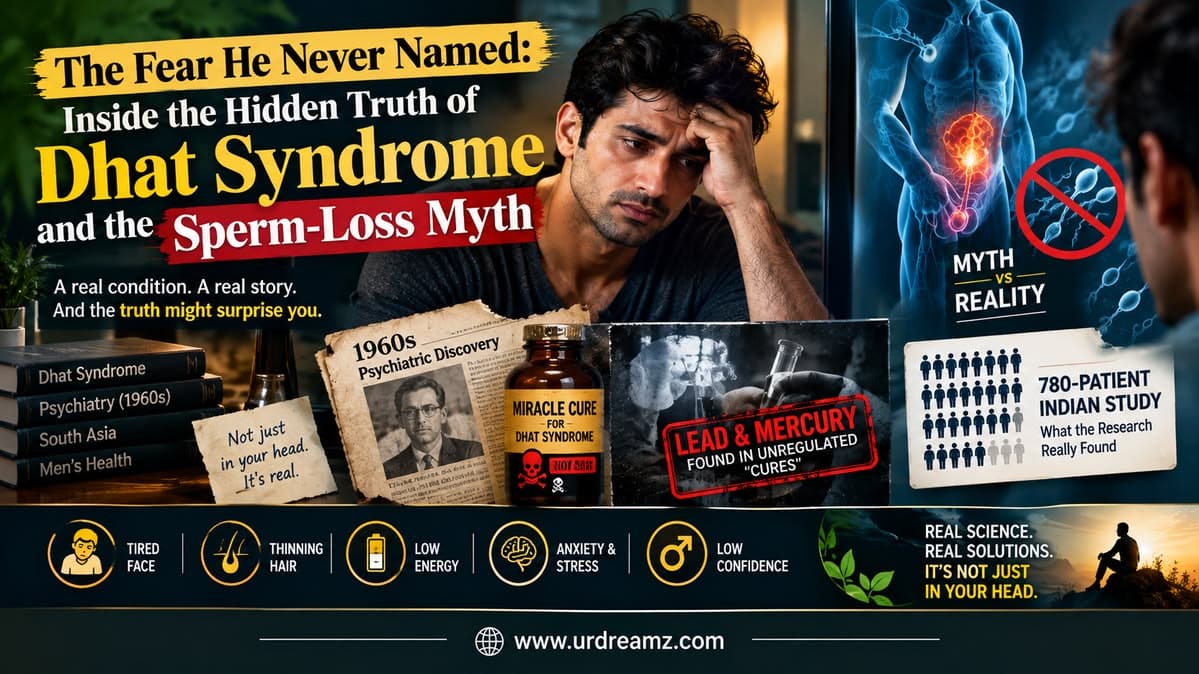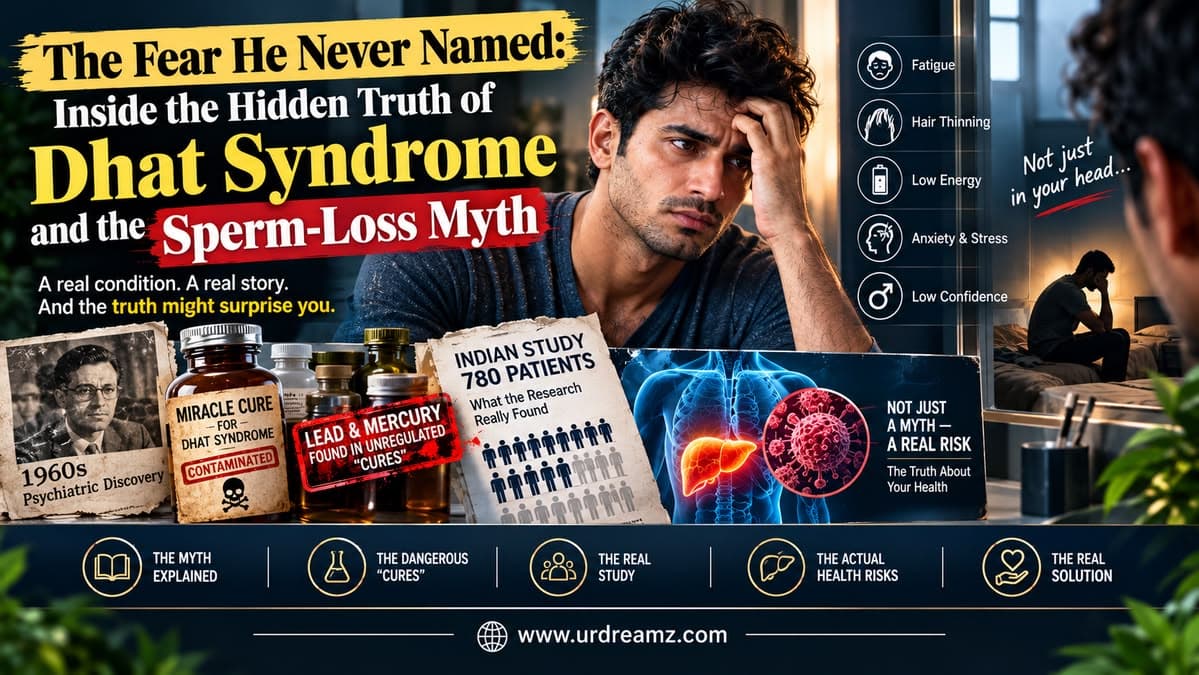
The Fear He Never Named: Inside the Hidden Truth of Dhat Syndrome and the Sperm-Loss Myth
A man stands in front of the mirror early one morning. He notices his face looks tired, drawn. There are dark circles under his eyes that weren't there before. He runs a comb through his hair and a few more strands than usual come away in his hand. A quiet, cold thought settles in: could this be from that? Could this be the price of semen loss? He is somewhere between 22 and 45, and he cannot say this thought out loud — not to his father, not to his mother, not to his closest friend, and, most tragically, not even to a doctor. Instead, this fear settles into a private, corrosive kind of shame, one that grows louder in the silence surrounding it, occasionally spilling into a genuinely painful question: if nothing happens on the wedding night, what will I tell my wife?
This isn't a rare, isolated worry — it's a documented, named, and studied psychiatric phenomenon affecting an enormous number of men, primarily across South Asia. In one landmark study, researchers across 15 cities in India sat down with 780 men and asked them, directly, the question they had been too afraid to ask for six or seven years. This article is a deep, respectful, and thoroughly researched exploration of that exact fear — where it actually comes from, what the real science says about semen and the body, why a very real and very dangerous underground industry has grown around this specific shame, and, most importantly, what genuine help actually looks like.
Quick Answer
Last updated: September 2026
Dhat Syndrome (also called Jiryan or "semen-loss anxiety") is a well-documented, culture-bound psychiatric condition, first formally described by Indian psychiatrist Dr. N.N. Wig in 1960, in which men attribute genuine symptoms of fatigue, low mood, and physical weakness to the loss of semen through masturbation, nocturnal emissions, or urine. It is officially classified in international diagnostic systems (ICD-10) as a neurotic and culture-specific disorder. The underlying physical symptoms are real, but semen loss is not their cause — semen is composed mostly of water and a very small amount of protein, far less than what a single egg provides, and the body continuously and effortlessly replenishes it. The real, evidence-based causes behind these symptoms are almost always sleep deprivation, poor nutrition, thyroid dysfunction, or underlying depression and anxiety — all genuinely treatable by a qualified doctor. A landmark Indian multicentric study of 780 patients across 15 cities found that the overwhelming majority had already sought help from unregulated quacks and "hakeems" before ever reaching a real doctor — a pattern that has fueled a dangerous underground industry of unregulated "tonics," some of which independent laboratory testing has found to be contaminated with toxic heavy metals like lead, mercury, and arsenic.
1. What Is "Dhat Syndrome"? Understanding the Condition Properly
Dhat Syndrome — also referred to in different regional languages as Jiryan, Dhatu Rog, or simply "sperm loss weakness" — is a recognized, formally studied psychiatric condition in which a man experiences genuine physical and psychological symptoms (fatigue, weakness, anxiety, poor concentration, low mood) and attributes them, incorrectly, to the loss of semen through masturbation, nocturnal emissions (commonly called "wet dreams" or "nightfall"), or the appearance of a whitish discharge in urine. The word "Dhat" itself comes from the Sanskrit word "Dhatu," referring to a vital bodily essence in classical Ayurvedic thought. It's important to state clearly, right at the outset: the distress these men feel is completely real, and the underlying physical symptoms are frequently real too. What modern medicine has established, through decades of careful study, is that the cause they've identified — semen loss — is not actually responsible for what they're experiencing.
2. Where Did This Fear Actually Come From? The Ancient "Body Ladder" Belief
To understand why this belief runs so deep, it helps to trace it back to an old, pre-scientific model of how the body was believed to work — a kind of internal "ladder" or refining process passed down through generations of traditional teaching. In this model, food is first digested, then refined into blood, then into muscle, then into fat, then into bone and marrow, and finally, at the very last and most "precious" step of this entire chain, into semen — treated as the single most concentrated, valuable essence the body could produce, the final distilled product of an entire month's worth of nourishment. Anyone raised on this specific mental picture, even informally, absorbed a very natural anxiety alongside it: if semen is genuinely the rarest, most refined substance the body makes, of course losing it would feel catastrophic. This belief is centuries old, deeply embedded in cultural teaching long before modern reproductive biology existed to correct it, which is precisely why it has proven so difficult to dislodge, even in the present day.
2b. Not Unique to South Asia: A Global History of This Same Fear
It's worth knowing that this specific anxiety, while carrying a distinct name and cultural shape in South Asia, is not actually unique to the region — versions of it have appeared across many cultures and historical periods. In 18th-century Europe, a Swiss physician named Samuel-Auguste Tissot published an enormously influential paper claiming that even a well-balanced diet could be "wasted away" through seminal loss, a claim that gained wide popularity and helped launch what historians now refer to as an era of genuine "masturbatory insanity" panic across much of Western Europe, complete with its own medical devices and treatments aimed at preventing the behavior. Similar semen-loss anxiety concepts have also been documented in Chinese medical tradition, referred to as "Shen-K'uei," and are sometimes linked historically to another culture-bound condition called Koro, in which a person becomes convinced their genitals are physically shrinking or retracting into the body. The consistent pattern across all of these historically and geographically distant examples is telling: whenever a culture treats sexuality as deeply taboo and heavily shrouded in silence, some version of this exact anxiety tends to emerge independently, suggesting the underlying driver isn't anything specific to South Asian biology or culture, but a broader, very human pattern of anxiety filling the space left by silence and misinformation.
3. The Real Composition of Semen: What the Science Actually Shows
Modern reproductive physiology paints a very different, far less dramatic picture. A single ejaculation typically involves a volume of only a few milliliters — often described as roughly a quarter of a teaspoon — and its composition is overwhelmingly water, along with fructose (a simple sugar used as fuel for sperm cells) and a genuinely small quantity of protein. To put this in concrete, everyday terms: the total protein content of a typical ejaculation is meaningfully less than the protein found in a single breakfast egg. This is not a matter of opinion or cultural interpretation — it's a straightforward biochemical fact, and it directly undercuts the "precious concentrated essence" framework discussed in the previous section. The body isn't parting with some rare, hard-to-replace resource each time; it's releasing a small volume of fluid that is continuously and effortlessly produced and replenished as part of completely normal, ongoing physiological function.
4. So Where Do the Real Symptoms Come From?
If semen loss genuinely isn't the cause, the next fair question is: where do dark circles, hair falling out in the comb, fatigue, and a tired-looking face actually come from? The honest answer is that these are all real, common, everyday symptoms with well-established, entirely unrelated medical explanations — but because a person has already decided, often years in advance, what the "cause" must be, they interpret every one of these ordinary signs through that single lens, rather than considering the far more likely, far more treatable explanations sitting right in front of them.
| Commonly Blamed Symptom | What It's Actually Usually Linked To |
|---|---|
| Dark circles / tired-looking face | Poor sleep quality, dehydration, screen time, genetics |
| Hair falling out in the comb | Genetics (family pattern hair loss), nutritional deficiency, stress |
| General fatigue and low energy | Poor sleep, thyroid dysfunction, low iron, depression |
| Difficulty concentrating | Sleep deprivation, anxiety, depression |
| Height/growth concerns | Genetics and normal bone growth-plate timing, unrelated to sexual activity |
| Cold hands and feet, memory complaints | Anxiety, thyroid issues, circulation, unrelated to semen loss |
5. Hair Loss: A Genetic Story, Not a Sperm Story
Hair thinning specifically deserves its own honest explanation, since it's one of the most commonly cited "proofs" in this particular fear. Hereditary hair thinning is, overwhelmingly, a genetic story — if hair loss runs in a man's father's or grandfather's side of the family, that pattern is the far more likely, far more scientifically supported explanation for thinning hair than anything related to sexual activity. Genetics doesn't check anyone's personal habits before deciding whether a hair follicle gradually shrinks over time — it follows an inherited biological timeline that has nothing to do with masturbation frequency or nocturnal emissions at all.
6. Height and Growth Plates: What Actually Stops Growth
The belief that height can be "stunted" by semen loss is similarly disconnected from actual human biology. Height stops increasing when the growth plates at the ends of long bones — specialized areas of cartilage responsible for bone lengthening during childhood and adolescence — naturally close, a process governed by genetics, growth hormone, and puberty-related hormonal changes, occurring on a broadly predictable biological timeline for every person regardless of sexual activity. There is no established physiological pathway through which semen loss could interrupt or influence this specific bone-growth process at all.
6b. Nocturnal Emissions: A Completely Normal, Involuntary Process
Nocturnal emissions, commonly referred to as "wet dreams" or "nightfall," deserve their own specific clarification, since they're frequently the single most distressing symptom for men experiencing this particular anxiety, precisely because they happen involuntarily, during sleep, entirely outside conscious control. This is, medically speaking, a completely normal, healthy physiological process, most common during adolescence and young adulthood, representing nothing more than the body's ordinary way of periodically releasing accumulated seminal fluid during sleep. It is not a sign of excess arousal, moral weakness, or any underlying illness, and its frequency varies enormously and normally from person to person, and even within the same person across different periods of life, without any of that variation carrying medical significance on its own. Genuine distress arises not from the event itself, but from the anxiety a person has been culturally taught to attach to it — precisely the pattern this entire article has been tracing from its very first section.
7. The Four Real Culprits: Sleep, Nutrition, Thyroid, and Mood
Rather than a single mysterious cause, the genuine, well-documented physical and mental symptoms so often mistakenly attributed to semen loss almost always trace back to one or more of four entirely unrelated, well-understood, and treatable factors.
| Real Underlying Factor | How It Produces These Symptoms |
|---|---|
| Poor Sleep | Directly causes fatigue, poor concentration, tired appearance, irritability |
| Poor Nutrition | Can cause low energy, hair changes, poor concentration through nutrient deficiencies |
| Thyroid Dysfunction | An underactive thyroid specifically causes fatigue, hair thinning, weight changes, low mood |
| Depression / Anxiety | Produces fatigue, poor concentration, low motivation, physical aches, and disturbed sleep |
Each of these four factors is identifiable through straightforward medical evaluation and blood testing, and each is genuinely, effectively treatable — a dramatically more hopeful and accurate picture than a lifetime of guilt over a biologically insignificant, entirely normal bodily process.
8. 1960: The Year a Doctor Finally Named This Fear
The term "Dhat Syndrome" wasn't coined by any traditional healer or spiritual figure — it was formally introduced into psychiatric literature in 1960 by the respected Indian psychiatrist Dr. N.N. Wig, who observed something striking in his own outpatient clinic: a consistent, recurring pattern of young men presenting with the exact same cluster of symptoms and the exact same self-diagnosed cause. Wig's landmark observation placed this condition firmly within the category of psychiatric, stress-related disorders — meaning the distress genuinely originates in the mind and nervous system's response to deep-seated cultural anxiety, not in any physical depletion caused by semen loss itself. This reframing was, and remains, a genuinely important medical contribution: it gave a real name, and a real path toward treatment, to a suffering that had previously existed only as private, unspoken shame.
9. Dhat Syndrome in International Medical Classification
Dhat Syndrome isn't a fringe or unofficial idea confined to a handful of clinics — it holds a recognized place in major international diagnostic systems. The World Health Organization's International Classification of Diseases (ICD-10) formally classifies it both as a neurotic disorder and as a culture-specific condition, defined specifically as undue concern about the debilitating effects of semen loss. It has also been referenced in the American Psychiatric Association's diagnostic manuals under cultural formulation guidance. This formal medical recognition matters enormously: it confirms that what a man experiences under this label is a genuine, documented clinical presentation, deserving of proper medical attention — not something to be dismissed, mocked, or hidden away out of embarrassment.
10. The 1954 Law Nobody Talks About
Here's a detail that surprises most people: India passed a specific law directly addressing this exact problem seventy years ago. The Drugs and Magic Remedies (Objectionable Advertisements) Act, 1954, was introduced in the Indian Parliament by the country's health minister at the time, Rajkumari Amrit Kaur, specifically to prohibit the advertisement of "magical" cures for conditions like impotence, sterility, and general "manly vigor" — recognizing, even then, how easily desperate, ashamed men could be exploited by unverified claims. The law explicitly banned any advertisement or public claim promising to enhance sexual capacity, cure semen-loss-related weakness, or offer "magical" remedies for these conditions, and it made preparing or advertising such remedies without proper regulatory and professional oversight illegal. And yet, despite this law existing for seven full decades, the handwritten banners promising exactly these cures — often found under bridges, near public toilets, and along train station walls — have remained a stubbornly persistent, largely unaddressed reality in daily life.
11. Seventy Years Later: A Recent Supreme Court Ruling
This isn't only a historical footnote — it remains an active, current legal concern. In a recent ruling, India's Supreme Court issued a series of directions to state governments specifically calling for more effective implementation of the 1954 Drugs and Magic Remedies Act, openly acknowledging how poorly the seventy-year-old law had actually been enforced on the ground. This is a genuinely significant, current development: it confirms that the exploitation this article describes isn't a relic of the past, safely behind us — it's an acknowledged, ongoing regulatory failure that the country's highest court has recently, formally stepped in to address.
12. The Boston Discovery: What Was Really Inside Those "Miracle" Bottles
In 2004, researchers from Harvard Medical School and Boston University set out to test exactly what was inside a range of Ayurvedic herbal medicine products being sold in South Asian grocery stores across the greater Boston area. They purchased 70 different products from 30 different stores and sent every single one for independent laboratory analysis, checking specifically for heavy metal contamination. The results, published in the Journal of the American Medical Association (JAMA), one of the most respected medical journals in the world, were genuinely alarming: 14 of the 70 products — exactly one in five — contained detectable, potentially harmful levels of lead, mercury, and/or arsenic, three heavy metals well documented to damage the nervous system, brain function, and kidneys with repeated exposure. Disturbingly, half of the contaminated products carried dosing instructions intended for children.
| Finding | Detail |
|---|---|
| Products tested | 70 Ayurvedic herbal medicine products from 30 Boston-area stores |
| Products containing heavy metals | 14 out of 70 (20%) |
| Metals detected | Lead (13 products), mercury (6 products), arsenic (6 products) |
| Products marketed for children's use | Half of the contaminated products |
| Publishing journal | JAMA (Journal of the American Medical Association), 2004 |
*Based on Saper et al., "Heavy Metal Content of Ayurvedic Herbal Medicine Products," JAMA, 2004.
The core takeaway isn't that Ayurveda itself is unsafe — properly manufactured, regulated Ayurvedic medicine, prepared according to established professional standards, is a genuinely respected traditional medical system. The danger identified here specifically concerned unregulated products, often sold without proper oversight, precisely the kind promoted by the informal "miracle cure" sellers this article is centrally concerned with.
13. Why Do People Still Buy These Products?
Given everything covered so far — a real law banning these claims, real laboratory evidence of genuine danger — the obvious question is why anyone still purchases these products at all. The honest answer connects directly back to shame and silence. A man convinced he's suffering from irreversible semen-loss weakness, and too embarrassed to say this to a real doctor, is often left with exactly one visible option: a quiet, anonymous banner promising a private, judgment-free solution. The entire business model of this underground industry depends on precisely the isolation and secrecy this article has been describing from its very first paragraph — it thrives specifically because legitimate, comfortable medical conversation about this topic remains so difficult to access.
14. India's 780-Patient Study: What Doctors Actually Found
One of the most important pieces of research on this exact topic is a genuine, nationwide multicentric study conducted across 15 different Indian cities, in which researchers directly interviewed 780 men, most between the ages of roughly 21 and 31, many from smaller towns and villages, all presenting with Dhat Syndrome concerns. The findings were revealing on several fronts. More than half of the patients reported comorbid sexual difficulties like premature ejaculation or erectile dysfunction, and research from related studies found that a substantial majority also had some form of diagnosable psychiatric condition — most commonly depression or anxiety — running alongside their semen-loss beliefs. Crucially, the majority of participants openly acknowledged that masturbation was part of their personal history, confirming that the anxiety wasn't rooted in some rare or unusual behavior, but in an entirely common, universal human experience that had simply been reframed, culturally, as a source of catastrophic harm.
*Based on Grover et al., "Comorbidity in patients with Dhat syndrome: A nationwide multicentric study," Journal of Sexual Medicine, 2015, and related follow-up research.
15. The Silence Before the Question: Why Men Wait Six or Seven Years
Perhaps the single most heartbreaking detail from this body of research is the timeline: many of these men had privately carried this specific fear for six or seven years — sometimes longer — before anyone ever sat them down and asked about it directly, and even then, it took a structured, anonymous research interview to finally surface a question they had never once felt safe enough to raise on their own, with anyone, ever. Related research on "pathways to care" for Dhat Syndrome patients found something equally telling: the overwhelming majority — commonly cited at around 98% — had already visited an unqualified source (a local quack, an informal "hakeem," or a roadside banner-advertised healer) before ever reaching a properly trained doctor, and in the process, many reported feeling their anxiety worsen rather than improve, since these encounters typically reinforced the original fear rather than correcting it, often while extracting significant money from patients in the process.
16. Semen Production: The Body Is Not a Bank Account
One final, important clarification on the biology itself: the body does not treat semen production like a finite bank account that can be drained down to zero. Sperm and seminal fluid are continuously produced as part of ongoing, standard physiological processes — for every unit released, the body is already in the process of producing more, on a continuous, self-renewing cycle, not a one-time, irreplaceable withdrawal. Genuine harm doesn't come from the volume or frequency of release itself; it comes from an entirely different category of signal — the point at which sleep is being disrupted, concentration and work performance are genuinely deteriorating, or mood has meaningfully declined. Those specific signals — not any perceived "count" of releases — are the ones worth taking seriously enough to see a doctor about, and they point toward treatable conditions like anxiety, depression, or sleep disruption, not toward semen loss itself.
17. When Should You Actually See a Doctor? Real Warning Signs
| Genuine Reason to See a Doctor | Not a Genuine Reason on Its Own |
|---|---|
| Persistent fatigue affecting daily work or study | Frequency of masturbation or nocturnal emissions |
| Ongoing sleep disruption | The appearance of semen texture or color alone |
| Low mood, loss of interest, or persistent anxiety | Occasional whitish discharge unrelated to burning or pain |
| Genuine sexual difficulty affecting a relationship | Family or peer comments about "weakness" |
| Burning, pain, or unusual discharge during urination | Height or hair pattern matching a parent's or relative's |
18. The Diabetes and Infection Connection: Real Medical Causes Worth Ruling Out
It's worth being clear that a whitish discharge in urine is not always purely psychological — it genuinely can, in some cases, be an early sign of a real, treatable medical condition, which is exactly why proper medical evaluation matters so much more than self-diagnosis or an anonymous "cure." Conditions like urinary tract infections and diabetes (where excess sugar can appear in urine) can produce a similar visible symptom, and both are straightforward to diagnose through basic testing and genuinely treatable once identified. This is precisely the article's central, repeated point: the underlying complaint is often real and deserves real medical attention — it's the informal, unverified, and frequently fraudulent source of that attention that causes so much additional, unnecessary harm.
19. Stress at the Wrong Address: The Complaint Is Real, the Cause Is Misdiagnosed
A useful way to summarize much of this article's core message: the complaint these men bring forward is genuine — the fatigue, the anxiety, the low mood are all real and worth addressing. What's mistaken is the address the blame gets sent to. The distress is happening in the mind, rooted in cultural anxiety, guilt, and misinformation passed down for generations — not in any physical depletion of a bodily resource. This is exactly why medication for a physical ailment that was never actually present accomplishes nothing, while genuine psychiatric or psychological support — treating the actual, correctly identified source of distress — has been shown in research to produce real, measurable improvement.
19b. What Effective Treatment Actually Looks Like
For men whose evaluation points toward an anxiety or depression-driven root cause — which, based on the research covered throughout this article, applies to a substantial share of cases — effective treatment typically combines two complementary approaches. Psychoeducation, meaning a clear, direct medical explanation of exactly what this article has covered (the real composition of semen, the body's continuous replenishment process, and the true source of the physical symptoms), has itself been shown in clinical research to meaningfully reduce distress on its own, simply by replacing years of misinformation with accurate, reassuring fact. Alongside this, structured psychological approaches such as cognitive behavioral therapy — which helps identify and gently challenge the specific catastrophic thoughts driving the anxiety — combined with treatment for any underlying depression or anxiety disorder where present, have shown genuine, documented effectiveness in clinical studies of Dhat Syndrome patients specifically. This is a fundamentally different, and considerably more hopeful, treatment path than the anonymous "tonic" or "miracle cure" model discussed earlier in this article — one aimed at resolving the actual underlying condition, rather than perpetuating the original, mistaken belief indefinitely.
20. An Important Distinction: This Isn't an Attack on Ayurveda
21. Depression Wearing a Different Mask
In many documented cases, what initially presents as Dhat Syndrome is, on proper clinical evaluation, revealed to be depression expressing itself through a culturally familiar narrative. Depression frequently manifests through physical symptoms — fatigue, poor concentration, disturbed sleep, loss of interest and motivation — rather than a straightforward statement of "I feel sad." In a cultural context where openly naming depression carries its own significant stigma, but where "weakness from semen loss" is, paradoxically, a more culturally available, more sayable explanation, it's genuinely understandable how the same underlying suffering gets channeled into this particular narrative instead. Recognizing this pattern matters enormously for treatment, because addressing the depression directly — through proper psychiatric or psychological care — resolves the actual underlying condition, while addressing "semen loss" resolves nothing at all.
21b. A Modern Twist: How the Internet Era Has Reshaped This Old Fear
While Dhat Syndrome traces back to a centuries-old belief system, its modern expression has been noticeably reshaped by internet access and online pornography exposure, particularly among younger men. A newer, related pattern of anxiety has emerged around perceived "excessive" masturbation frequency specifically tied to online content consumption, often accompanied by guilt, secrecy, and a fear of being caught by family — anxieties that layer directly on top of the older, traditional semen-loss belief rather than replacing it. Some younger men now describe a kind of compounded shame: guilt about the content itself, guilt about the act, and the older cultural fear about physical depletion, all reinforcing one another simultaneously. This modern layer doesn't change the underlying medical reality already established throughout this article, but it does mean today's version of this anxiety often arrives with an added layer of digital-age secrecy and self-blame that earlier generations experiencing this same core fear didn't have to navigate in quite the same way.
22. The Cycle of Exploitation: How Fraudulent Healers Profit From Silence
Takes Root
Honest Questions
Sought Instead
Money Extracted
Real Cause Untreated
This cycle is precisely what allows an illegal industry to persist for seven decades, entirely unbothered by a law specifically written to stop it. Every part of the cycle depends on the previous step: cultural fear creates shame, shame prevents honest conversation, silence creates demand for an anonymous alternative, and that anonymous alternative, having no genuine incentive to actually resolve the underlying fear, quietly ensures the cycle continues rather than closing it.
23. Breaking the Silence: What to Actually Do
For anyone recognizing themselves in any part of this article, the path forward is genuinely simpler and more hopeful than years of silence might suggest. It starts with separating the symptom from the assumed cause — accepting that fatigue, low mood, or hair changes are real and worth addressing, while setting aside the specific "semen loss" explanation as one this article has thoroughly shown doesn't hold up. From there, a proper medical evaluation — starting with a general physician, who can refer onward to a urologist, endocrinologist, or psychiatrist as needed — can identify the actual, treatable cause, whether that's a sleep issue, a thyroid condition, a nutritional gap, or an underlying mood disorder. None of this requires public disclosure, embarrassment, or confession to family; medical consultations of this kind are entirely confidential, exactly as they should be.
24. Talking to a Doctor: What That Conversation Actually Looks Like
For many men, the biggest barrier isn't the treatment itself — it's the imagined embarrassment of the very first conversation. In practice, doctors who specialize in this area, including urologists and psychiatrists across South Asia, encounter this exact concern with genuine regularity; it is, quite simply, one of the most common presenting complaints in the region, not some rare or shameful outlier a patient needs to brace themselves to confess. A typical consultation focuses on ruling out real physical causes through basic bloodwork (thyroid function, blood sugar, general nutrition markers) and asking straightforward questions about sleep, mood, and stress — not on judgment, lecture, or moral commentary. Framing the visit around the actual symptom ("I've been feeling constantly tired and low" rather than a specific confession about masturbation) is entirely acceptable and, for many men, considerably easier as a starting point, with the deeper conversation unfolding naturally and privately from there if relevant.
25. A Message for Families and Partners
Because this article has also touched on the fear of a wedding night going differently than expected, it's worth addressing partners and families directly. If someone close to you is dealing with this specific anxiety, the most helpful response is calm, factual reassurance rather than dismissal or ridicule — both of which tend to deepen the shame that keeps this cycle going in the first place. Gently encouraging a proper medical consultation, framed around general wellbeing rather than a specific accusation, tends to be far more effective than confrontation. And for partners specifically: sexual performance difficulties rooted in this kind of anxiety are a recognized, treatable medical and psychological issue, not a reflection of genuine incapacity or a lack of care for the relationship — understanding this distinction can meaningfully ease tension during what is already, for the person experiencing it, a deeply vulnerable and difficult period.
26. Frequently Asked Questions
What is Dhat Syndrome?
Dhat Syndrome is a recognized culture-bound psychiatric condition, first described in 1960, in which men attribute real symptoms like fatigue and anxiety to semen loss through masturbation, nocturnal emissions, or urine, though modern medicine has established that semen loss is not the actual cause.
Does masturbation actually cause weakness, hair loss, or reduced height?
No. These symptoms have well-established, unrelated causes such as genetics, sleep quality, nutrition, thyroid function, and mood, none of which are affected by masturbation frequency.
Is Dhat Syndrome a recognized medical condition?
Yes. It is formally classified in the ICD-10 (International Classification of Diseases) as both a neurotic disorder and a culture-specific condition.
What does semen actually contain?
Semen is composed mostly of water, fructose, and a small amount of protein, less than what is found in a single egg. It does not represent a rare or irreplaceable bodily resource.
Is it dangerous to use unregulated "sexual weakness" tonics or hakeem remedies?
Potentially, yes. A 2004 study published in JAMA found that 1 in 5 unregulated Ayurvedic products tested contained harmful levels of lead, mercury, or arsenic, some marketed for children's use.
Is there a law against advertising "magical" cures for sexual weakness in India?
Yes. The Drugs and Magic Remedies (Objectionable Advertisements) Act, 1954, explicitly prohibits such advertisements, though enforcement has historically been weak, prompting a recent Supreme Court ruling calling for better implementation.
How common is Dhat Syndrome?
It is considered one of the most common presenting complaints among men in South Asian sexual health and psychiatric clinics, affecting a very large number of men, many of whom delay seeking proper help for years.
What is the real cause behind these symptoms?
The four most common real causes are poor sleep, poor nutrition, thyroid dysfunction, and underlying depression or anxiety, all of which are identifiable and treatable through proper medical evaluation.
Should I see a doctor or an Ayurvedic practitioner for this concern?
A qualified doctor is the appropriate first step to rule out genuine physical or psychiatric causes. Properly regulated, professionally practiced Ayurveda is legitimate, but unregulated informal remedies carry real, documented health risks.
Is it embarrassing to talk to a doctor about this?
It's understandable to feel that way, but doctors across South Asia encounter this exact concern extremely regularly. It can also be raised simply by describing symptoms like fatigue or low mood, without needing to lead with a specific confession.