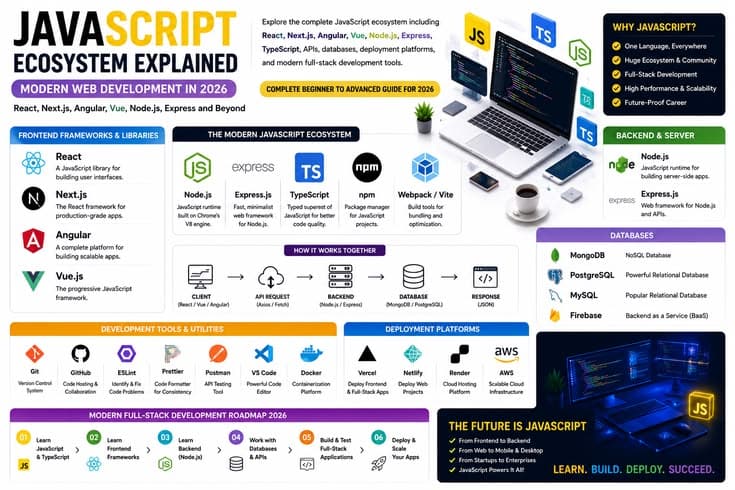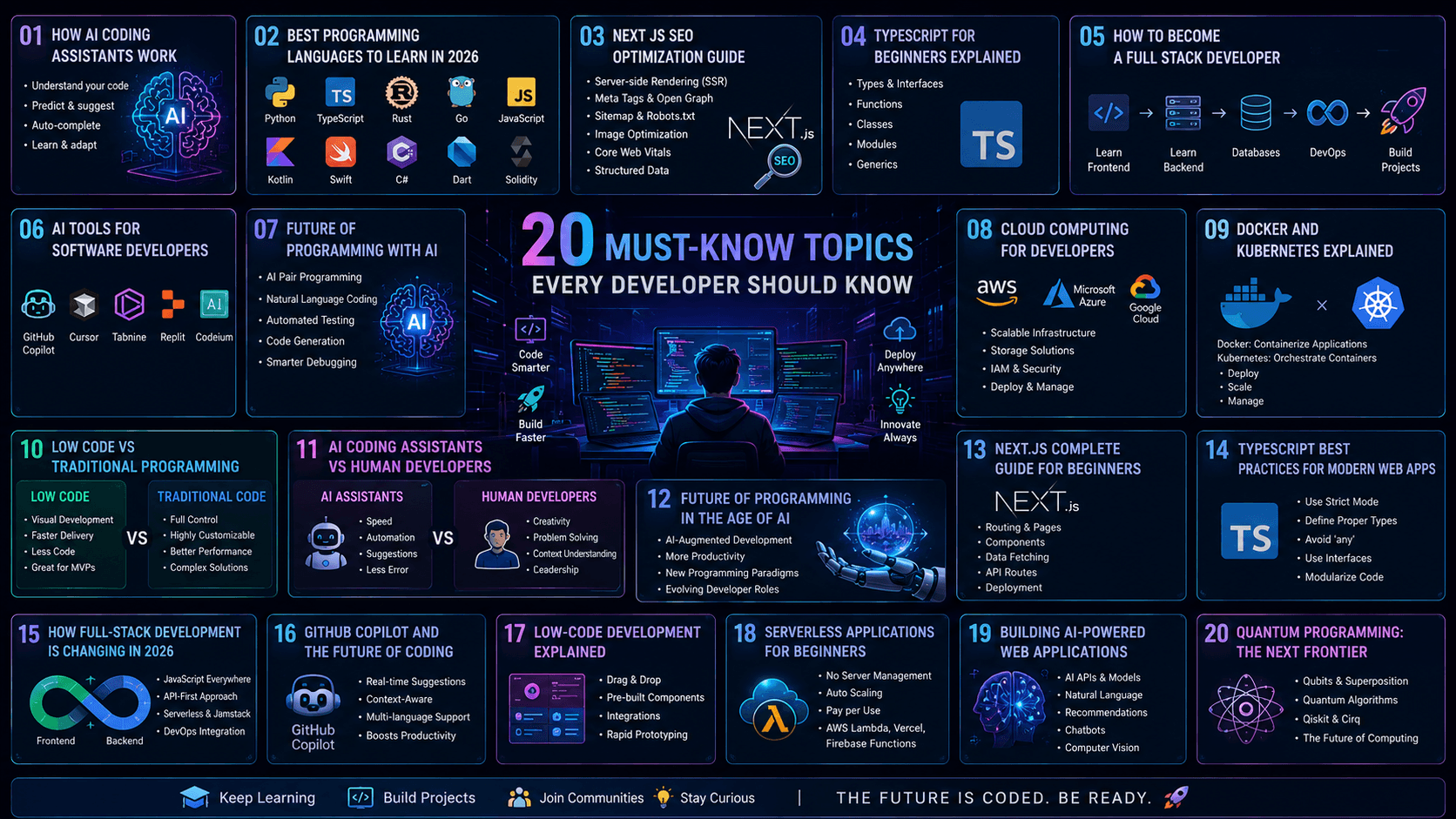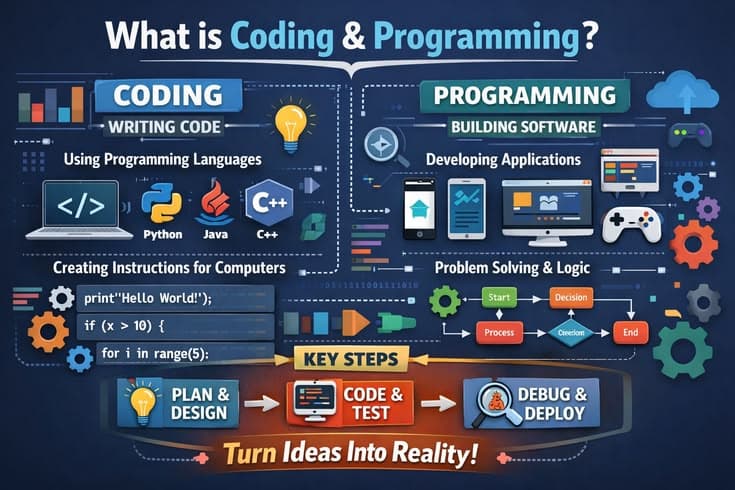
In today's digital world, coding and programming have become some of the most valuable skills a person can learn. Whether you are a complete beginner wondering what is coding in simple words, a student asking is coding hard to learn, or a professional deciding between coding vs programming salary — this guide covers everything you need to know. From the definition of programming to the top 5 programming skills, from coding for kids to coding and artificial intelligence — read on for the most comprehensive guide to coding and programming available today.

What is Coding? – Definition in Simple Words
What is coding in simple words? Coding is the process of writing instructions for a computer using a specific language the computer can understand. Think of it like writing a recipe — you give the computer step-by-step instructions, and it follows them exactly. These instructions are written in a coding language such as Python, JavaScript, C++, or Java.
What is coding in computer? In a computer context, coding means translating human ideas and logic into a format (called code) that a machine can execute. Every app on your phone, every website you visit, every game you play — all of it was built using code.
What is coding for kids? For kids, coding is often introduced through fun visual tools like Scratch, where they drag and drop colorful blocks to make characters move. It teaches logical thinking, problem-solving, and creativity — all without needing to memorize complex syntax right away.
What is coding for beginners? For beginners, coding starts with understanding basic concepts: variables (storing information), loops (repeating actions), conditions (making decisions), and functions (grouping reusable instructions). Once these fundamentals click, everything else follows naturally.
What is coding for students? For students, coding is both an academic subject and a life skill. Many schools and universities now include coding in their curriculum because it develops analytical thinking and opens up enormous career opportunities in technology, science, finance, healthcare, and beyond.
What is Programming? – The Best Definition
What is the definition of programming? Programming is the broader process of designing, writing, testing, debugging, and maintaining the source code of computer programs. While coding refers specifically to writing code, programming encompasses the entire lifecycle — from planning what the program should do, to writing the code, to testing it and fixing errors, to updating it over time.
What is programming in simple words? Programming is problem-solving using code. A programmer identifies a problem, designs a solution, writes code to implement that solution, and then refines it until it works correctly and efficiently.
What is the best definition for programming? The best definition: programming is the art and science of instructing computers to perform tasks through logically structured code, with the goal of solving real-world problems efficiently.
What is programming in Python? Python programming means writing code in the Python language — one of the most beginner-friendly and powerful languages in the world. Python is used for web development, data analysis, artificial intelligence, automation, and much more. Its clean, readable syntax makes it the top recommended language for beginners worldwide.
What is programming for kids? Programming for kids is introducing logical thinking through tools like Scratch, Code.org, or simple Python exercises. The goal is not to make children experts overnight but to build the habit of computational thinking — breaking big problems into smaller, manageable steps.
What is Coding and Programming? – Are They the Same?
Is programming the same as coding? This is one of the most commonly asked questions. The short answer: all programming involves coding, but not all coding is programming. Coding is simply writing code — the act of translating instructions into a computer language. Programming is the full process: planning, architecting, writing, testing, debugging, and deploying software. Think of coding as one tool inside the larger toolbox of programming.
What is coding and programming? Together, coding and programming describe the complete skill set needed to build software. A coder writes the lines of code. A programmer thinks about the entire system — how it works, how it scales, how it handles errors, and how it serves its users.
What is coding and decoding? In the context of computer science, coding means writing instructions in a computer language. Decoding means interpreting or converting that code back into something understandable — like how a computer processes binary (0s and 1s) to display text and images on your screen.

Coding vs Programming – Key Differences Explained
Coding vs programming is a debate that comes up constantly in the tech world. Here is a clear breakdown of the differences:
| Aspect | Coding | Programming |
|---|---|---|
| Definition | Writing code in a specific language | Full process of building software |
| Scope | Narrow – focused on syntax | Broad – includes design, logic, testing |
| Skills Needed | Knowledge of a coding language | Algorithms, data structures, system design |
| Output | Lines of code | Complete, functional software |
| Tools | Text editors (VS Code, Notepad++) | IDEs, version control, testing frameworks |
| Learning Curve | Easier to start | Steeper – requires deeper thinking |
Coding vs programming vs scripting: Scripting is a type of coding where you write scripts — short programs that automate tasks. For example, a Python script that renames 1,000 files automatically. Scripting is often simpler than full programming but just as powerful for automation tasks.
Coding vs programming vs development: Development (or software development) is the broadest term. It includes programming, coding, system design, database management, UI/UX, testing, deployment, and maintenance. A software developer is someone who handles the complete product, not just the code.
Coding vs programming salary: In most job markets, programmers and software developers earn more than basic coders because they bring deeper skills to the table. In 2026, the average software developer salary globally ranges from $70,000 to $150,000+ per year depending on experience, location, and specialization. In Pakistan, skilled programmers are earning between PKR 150,000 to PKR 800,000+ per month working remotely for international companies.
What Should I Learn First – Coding or Programming?
What should I learn first, coding or programming? The answer: start with coding. Pick one language — most experts recommend Python for beginners — and learn its basics. Write small programs. Get comfortable reading and writing code. Once you understand the syntax and logic of one language, transition into programming concepts: algorithms, data structures, object-oriented programming, and system design.
Is 14 too late to start coding? Absolutely not. In fact, 14 is a fantastic age to start coding. Many of the world's top developers started in their teens. With platforms like freeCodeCamp, Khan Academy, Codecademy, and YouTube tutorials available for free, there has never been a better time to begin. The only requirement is curiosity and consistency.
Is coding hard to learn? Coding can feel challenging at first — especially understanding why your code is not working. But like learning any new language or skill, it becomes progressively easier with practice. Most beginners can write functional simple programs within weeks of starting. The key is not to give up when you hit errors — errors are how programmers learn.
What are the 4 Types of Coding?
What are the 4 types of coding? In the broadest sense, coding can be categorized into four major types:
1. Front-End Coding: This involves coding the visual parts of a website or app — everything the user sees and interacts with. Languages include HTML, CSS, and JavaScript. Front-end coders build buttons, layouts, animations, and user interfaces.
2. Back-End Coding: This is the server-side code that powers applications behind the scenes. It handles databases, authentication, APIs, and business logic. Languages include Python, Node.js, PHP, Ruby, Java, and C#.
3. Full-Stack Coding: A full-stack developer handles both front-end and back-end coding — they can build complete web applications from scratch. Full-stack skills are among the most in-demand and highest paid in the tech industry.
4. Data/AI Coding: This type of coding involves working with data, machine learning, and artificial intelligence. Python is the dominant language here, used alongside libraries like TensorFlow, PyTorch, Pandas, and NumPy.
What are the 7 Steps of Coding?
What are the 7 steps of coding? Professional programmers typically follow these seven steps when building any software:
Step 1 – Understand the Problem: Before writing a single line of code, clearly define what problem you are solving and what the expected output is.
Step 2 – Plan the Solution: Design your approach using flowcharts, pseudocode, or diagrams. Think through the logic before typing.
Step 3 – Choose the Right Language and Tools: Select the programming language, framework, and tools best suited for the task.
Step 4 – Write the Code: Translate your plan into actual code, following best practices for readability and efficiency.
Step 5 – Test the Code: Run your program and test it with different inputs — including edge cases — to make sure it behaves correctly.
Step 6 – Debug and Fix Errors: Identify and fix any bugs (errors) in your code. Debugging is a core skill every programmer must master.
Step 7 – Deploy and Maintain: Release the program for real users and continue updating it as requirements change or new bugs are discovered.
Programming Languages – The Complete Guide
What is a programming language? A programming language is a formal set of rules and syntax that allows humans to communicate instructions to computers. There are hundreds of programming languages — each designed for specific use cases.
What is programming in computer? In computing, programming languages are the tools developers use to build operating systems, apps, websites, games, AI models, and virtually every piece of software that exists.
Programming fundamentals: Regardless of which language you learn, the fundamentals stay the same — variables, data types, loops, conditionals, functions, and data structures. Master these and you can learn any language quickly.
Programming fundamentals C++: C++ is one of the most powerful and widely used programming languages, especially in game development, system programming, and performance-critical applications. Its fundamentals include classes, objects, pointers, memory management, and templates.
Does NASA use C++ or Python? NASA uses both. C++ is used for mission-critical systems where performance and reliability are paramount — like spacecraft control systems. Python is increasingly used for data analysis, simulations, and scientific computing tasks. Python's popularity at NASA has grown significantly over the past decade.
| Language | Best For | Difficulty Level | Job Demand (2026) |
|---|---|---|---|
| Python | AI, Data Science, Web, Automation | Beginner-Friendly | Very High |
| JavaScript | Web Development (Front + Back) | Beginner-Friendly | Very High |
| C++ | Games, Systems, Performance Apps | Advanced | High |
| Java | Enterprise, Android, Backend | Intermediate | High |
| SQL | Databases, Data Analysis | Beginner-Friendly | Very High |
| C# | Game Dev (Unity), Windows Apps | Intermediate | Medium-High |
| Rust | Systems Programming, Safety | Advanced | Growing Fast |
Is Python Coding or Programming?
Is Python coding or programming? Python is both. When you write Python code, you are coding. When you use Python to design, build, test, and deploy a complete application or system, you are programming. Python is the world's most popular programming language in 2026 — topping the TIOBE Index and the Stack Overflow Developer Survey for several years running. Its simplicity, versatility, and massive library ecosystem make it the first choice for beginners and experts alike.
Coding and Artificial Intelligence – The Most Important Connection of 2026
How is coding used in artificial intelligence? Coding is the foundation of AI. Every AI model — from ChatGPT to Google Gemini to Elon Musk's Grok — was built by programmers writing millions of lines of code. Specifically, AI development involves:
Python for AI: Python is the dominant language for AI and machine learning. Libraries like TensorFlow, PyTorch, Scikit-learn, and Keras are all Python-based and power the majority of AI systems in production today.
Is C or C++ better for AI? For most AI development, Python is preferred because of its simplicity and rich library ecosystem. However, C++ is used in AI for performance-critical components — for example, the underlying computation engines of TensorFlow and PyTorch are written in C++. So both have their place: Python for rapid development, C++ for speed optimization.
Programming vs artificial intelligence: Programming and AI are deeply intertwined. AI is a product of programming — but AI is also now changing programming itself. Tools like GitHub Copilot, ChatGPT, and Claude can now write code, debug programs, and suggest improvements. This does not eliminate the need for programmers — it makes skilled programmers significantly more productive.
Coding and art: One fascinating intersection is generative AI art — where programmers write code that creates visual art, music, and literature. Tools like Midjourney and DALL-E are fundamentally software products built by coders. The line between coding and art has never been more blurred or more exciting.

Famous Coders – Is Elon Musk a Coder? Is Bill Gates a Coder?
Is Elon Musk a coder? Yes — Elon Musk taught himself to code as a child and wrote his first commercial software (the video game Blastar) at age 12 and sold it for $500. He also wrote significant portions of the early code for Zip2 and X.com (which became PayPal). While he no longer codes professionally day-to-day, he has a deep technical understanding that informs his work at Tesla, SpaceX, and xAI.
Is Bill Gates a coder? Absolutely. Bill Gates is one of the most famous programmers in history. He co-founded Microsoft and was known for his exceptional coding skills. Gates wrote the original BASIC interpreter for the Altair 8800 microcomputer — the product that launched Microsoft. He was renowned for his ability to review and optimize other programmers' code with extraordinary precision.
What is Elon Musk's IQ level? Elon Musk's IQ has never been officially tested publicly, but various estimates place it between 150 and 155 — putting him in the "genius" category. For context, the average IQ is 100, and anything above 140 is generally considered genius level.
"Learning to write programs stretches your mind, and helps you think better, creates a way of thinking about things that I think is helpful in all domains." — Bill Gates
Binary Code – What Does 01001000 Mean?
What is binary? Binary is the most fundamental language of computers — a number system that uses only two digits: 0 and 1. Every piece of data in a computer, every image, every piece of text, every program, is ultimately stored and processed as combinations of 0s and 1s.
Are 0 and 1 called digits? Yes — in binary, 0 and 1 are called binary digits, or bits (short for binary digits). Eight bits together make a byte, which is the basic unit of digital storage.
What does 01001000 01100101 01101100 01101100 01101111 00100001 mean? This binary sequence translates to the word "Hello!" in ASCII (American Standard Code for Information Interchange). Every letter, number, and symbol has a binary equivalent that computers use to store and display text.
What does 1001 mean in code? In binary, 1001 equals the number 9 in decimal. Binary counting: 1 = 1, 10 = 2, 11 = 3, 100 = 4, 101 = 5, 110 = 6, 111 = 7, 1000 = 8, 1001 = 9.
What does 1234 mean in code? 1234 is often used as a PIN or password — but in programming contexts, it is simply a decimal integer value. In binary, 1234 is represented as 10011010010.
What is 0 first called? The concept of zero was first formalized by Indian mathematicians, particularly Brahmagupta around 628 CE. Zero is foundational to binary — without 0 and 1, modern computing as we know it would not exist.
Is zero an Arabic word? The word "zero" comes from the Arabic word sifr (meaning empty), which was adapted into Latin as zephirum and eventually became "zero" in English.
Coding for Jobs – Career Opportunities in 2026
What is coding jobs for beginners? Even beginners can access several entry-level coding jobs: Junior Web Developer, Front-End Developer, WordPress Developer, QA Tester, Data Entry with Excel/SQL, and Junior Python Developer. These roles typically require 3–6 months of consistent self-learning plus a portfolio of projects.
Which IT jobs don't require coding? Not all tech jobs require coding. IT Support Specialist, Project Manager, UX/UI Designer (basic), Business Analyst, Technical Writer, Digital Marketer, and Cybersecurity Analyst (some roles) are examples of tech-adjacent careers that require minimal or no coding.
Which 3 jobs will survive AI? According to multiple labor market studies, the jobs most resistant to AI replacement are: (1) Creative professionals who combine technical skill with human empathy and originality, (2) Skilled programmers and AI engineers who build and maintain AI systems themselves, and (3) Healthcare professionals — particularly those requiring human touch, judgment, and emotional intelligence.
Which jobs will be gone by 2030? Jobs highly at risk include: data entry clerks, basic customer service representatives, routine accounting tasks, simple content moderation, and assembly line work. However, new jobs are also being created — AI trainers, prompt engineers, and automation specialists are among the fastest-growing new roles.
Why is Gen Z struggling to get jobs? Gen Z faces several challenges: over-reliance on AI tools without developing foundational skills, an extremely competitive job market, mismatched expectations between salary desires and entry-level pay, and in some markets a surplus of graduates in fields with limited local openings. The solution? Develop rare, hard-to-automate skills — deep coding expertise, system design, and strong communication abilities.
Can I learn AI in 3 months? You can learn the basics of AI in 3 months with dedicated daily effort. This would include Python fundamentals, basic machine learning concepts, and using pre-built libraries. However, becoming a professional AI engineer typically takes 1–2 years of focused study and practice.
What are the Top 5 Programming Skills in 2026?
What are the top 5 programming skills? Based on 2026 job market data and industry trends, here are the five most valuable programming skills:
1. Python (AI/ML/Data): Python remains the #1 most in-demand programming skill globally, particularly for artificial intelligence, machine learning, and data science roles.
2. JavaScript/TypeScript (Web): JavaScript powers the entire web — front-end, back-end (Node.js), and mobile (React Native). TypeScript, a typed superset of JavaScript, has become essential for large-scale applications.
3. Cloud Computing (AWS/Azure/GCP): Programming combined with cloud skills is a powerful combination. Developers who can deploy and manage applications on cloud platforms command significantly higher salaries.
4. SQL and Database Management: Every application needs to store data. SQL skills remain universally required across industries — from startups to Fortune 500 companies.
5. AI/ML Engineering: The ability to build, fine-tune, and deploy machine learning models is the highest-paying programming skill in 2026. Companies are paying premium salaries to engineers who can work with large language models, neural networks, and AI pipelines.
How to Say "I Love You" in Code – Fun Coding Facts
How to code "I love you" in C? Here is one way to print "I Love You" in C programming:
#include <stdio.h>
int main() {
  printf("I Love You");
  return 0;
}
What is "I love you" in number code? In the most common version: 143 — where 1 represents the number of letters in "I," 4 represents the letters in "love," and 3 represents the letters in "you." This was originally a pager code used before smartphones.
How do I say "I like you" in secret code? "I like you" in letter-count code would be 1-4-3 as well (I=1, like=4, you=3). In binary: 01001001 00100000 01101100 01101001 01101011 01100101 00100000 01111001 01101111 01110101.
Who to say "I love you" in maths? A classic mathematical expression of "I love you" uses the integral symbol: ∫(1/cabin)d(cabin) = log(cabin) + C = "log cabin" — a playful math pun. Another version: draw a heart using a mathematical polar equation: r = 1 – sin(θ).
What number has 100000000000000000000000000000 zeros? A number with 100 zeros is called a Googol — which is where the tech company Google got its name (a misspelling of "googol"). A number with a googol of zeros would be called a Googolplex.
Coding Websites and Free Resources – Where to Learn
Coding websites: The best free and paid platforms to learn coding in 2026 include:
freeCodeCamp — completely free, covers web development from beginner to advanced with certifications. Codecademy — interactive beginner-friendly courses in Python, JavaScript, SQL, and more. Coursera — university-level programming courses from Stanford, MIT, and Google. Kaggle — the best platform for data science and machine learning practice with real datasets. LeetCode — essential for interview preparation with hundreds of coding challenges used by top tech companies.
Coding app: Mobile apps that teach coding include Grasshopper (by Google), SoloLearn, Encode, and Mimo. These are ideal for learning 15–30 minutes a day on your phone — making coding education accessible anywhere.
Coding game: Learning through games is one of the most effective methods for beginners. Platforms like CodinGame, CheckiO, and CodeCombat teach real programming logic through engaging game mechanics. You write real Python or JavaScript code to make your characters move, fight, and solve puzzles.
Artificial intelligence course: For those specifically interested in AI, top courses include: Andrew Ng's Machine Learning Specialization (Coursera), DeepLearning.AI courses, fast.ai (free and practical), and Google's Machine Learning Crash Course (free).
Is Coding Good or Bad? – A Balanced View
Is coding a good or bad skill to learn? Coding is overwhelmingly a positive skill to learn — but like any tool, it comes with considerations. On the positive side: it opens enormous career opportunities, develops logical thinking, enables you to build products from scratch, and in 2026 remains one of the highest-paying skill sets globally. On the challenging side: it requires ongoing learning as technology evolves rapidly, it can be mentally exhausting, and without discipline, self-taught learners can develop bad habits that are hard to unlearn.
Is coding harder than math? This is subjective. Some people find coding easier than math because it gives immediate visual feedback — you run your code and see results instantly. Others find math easier because it follows strict logical rules without requiring memorization of syntax. Most professional programmers agree that a reasonable comfort with mathematical thinking (not necessarily advanced calculus) is helpful but not essential for most coding paths.
Is 2 a single digit? Yes — 2 is a single-digit number (any number from 0 to 9 is considered single-digit). In programming, the distinction between single-digit and multi-digit numbers matters in contexts like number formatting, string manipulation, and algorithm design.
What country is no. 1 in math? According to international assessments like PISA (Programme for International Student Assessment), Singapore, China, and Japan consistently rank at the top globally for mathematics education. These countries also consistently produce a high number of skilled programmers and engineers per capita.
What rank is the USA in math? The United States typically ranks around 25th to 38th globally in mathematics education — significantly behind top Asian nations. This has prompted major investment in STEM (Science, Technology, Engineering, Mathematics) education across American schools.
Why is America so behind in math? Experts cite several factors: over-reliance on standardized testing, a shortage of qualified math teachers in underserved areas, a cultural attitude that frames math as inherently difficult, and inequitable access to quality education across different socioeconomic groups.
What is a Coding Course? – Your Path to Getting Started
What is a coding course? A coding course is a structured learning program that teaches you programming concepts, syntax, and practical skills in a specific language or technology. Coding courses range from free online tutorials to paid bootcamps to university degree programs.
Artificial intelligence a modern approach: This refers to the landmark textbook by Stuart Russell and Peter Norvig — widely considered the bible of AI education. It covers search algorithms, machine learning, natural language processing, robotics, and ethical AI. Most serious AI courses and university programs reference this book extensively.
Artificial intelligence using Python: Python-based AI courses are the most popular and practical entry point into the field. They typically cover: NumPy and Pandas for data manipulation, Matplotlib for visualization, Scikit-learn for machine learning, and TensorFlow or PyTorch for deep learning.
Artificial intelligence in medicine: AI coding is transforming healthcare. Programmers are building AI systems that diagnose cancer from medical images, predict patient deterioration, personalize drug dosages, and accelerate drug discovery. Python-based tools like TensorFlow are the backbone of most medical AI applications.
Programming Paradigms – How Programmers Think
Programming paradigms are fundamental styles or approaches to programming. Understanding paradigms makes you a significantly better programmer because you can choose the right approach for each problem.
Procedural Programming: Code is organized as a sequence of instructions. C is the classic procedural language. Great for simple, linear programs.
Object-Oriented Programming (OOP): Code is organized around objects — bundles of data and behavior. Python, Java, C++, and C# are OOP languages. OOP makes large, complex systems manageable.
Functional Programming: Code is organized around functions and avoids changing state. Haskell and Erlang are pure functional languages; Python and JavaScript support functional programming styles.
Declarative Programming: You describe what you want, not how to get it. SQL is a prime example — you say "give me all users over 30" without specifying how the database finds them.
Conclusion – Why Coding is the Most Important Skill of the 21st Century
From what is coding for beginners to coding and artificial intelligence, from coding vs programming salary to which 3 jobs will survive AI — one message runs through all of it: coding literacy is no longer optional. It is the language of the modern world.
Whether you want to build the next great app, work at NASA, create AI systems, earn a six-figure remote salary from Pakistan, or simply understand the technology that shapes every aspect of modern life — coding is your gateway. The best time to start was yesterday. The second best time is right now.
Programming with Mosh, freeCodeCamp, Codecademy, and hundreds of other free resources are available to you today. There is no barrier except starting. Pick Python. Write your first "Hello, World!" program. And take the first step toward one of the most powerful and rewarding skill sets available to any human being in 2026.