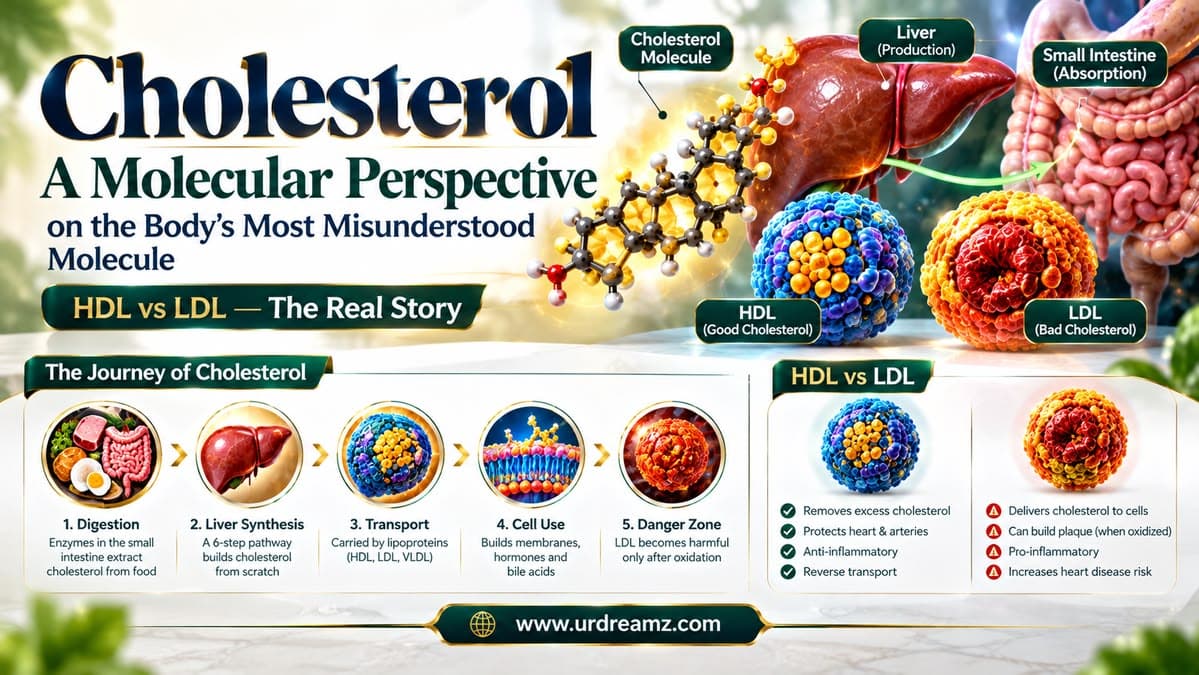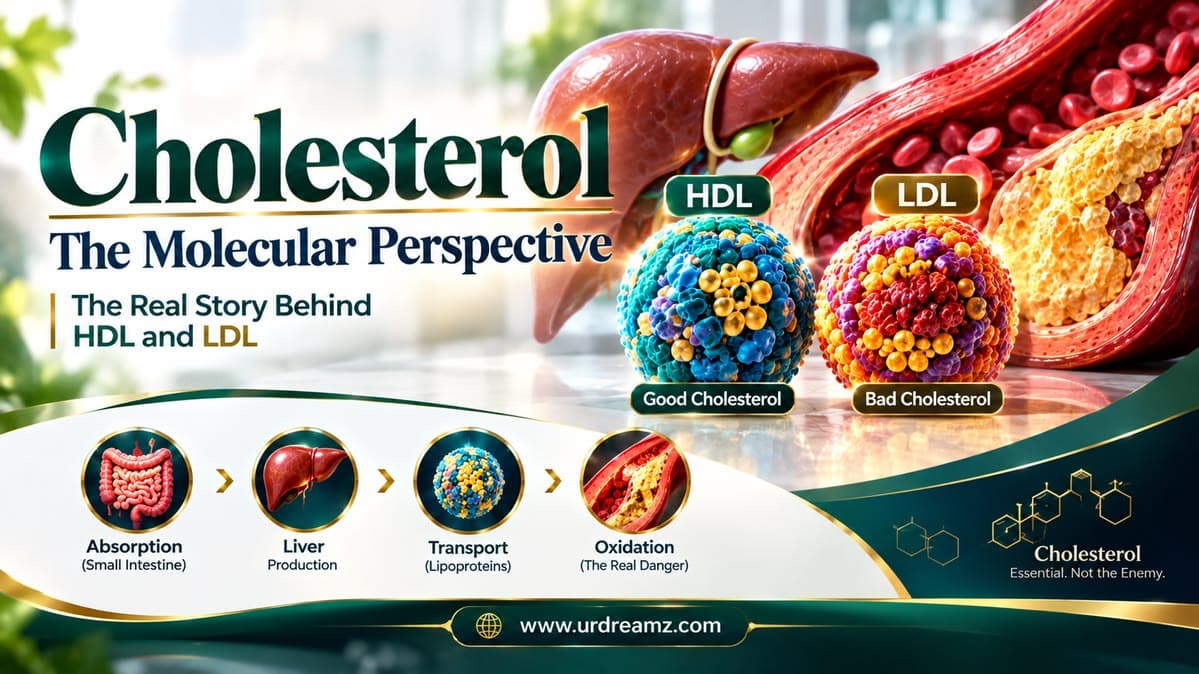
Cholesterol: A Molecular Perspective on the Body's Most Misunderstood Molecule
Say the word "cholesterol" out loud and most people flinch a little, as though naming a disease. Decades of health warnings have trained us to treat it as an enemy hiding in eggs, butter, and red meat, something to be minimized at every meal. What almost none of that messaging bothers to mention is that cholesterol is one of the most biologically essential molecules keeping you alive right now. It holds every one of your cell membranes together. It's the literal raw material your body uses to build cortisol, testosterone, estrogen, progesterone, and aldosterone. It's what your liver converts into bile acids so you can digest fat in the first place. Cholesterol isn't the villain of this story — it's one of the supporting characters your entire body depends on, and the real story is considerably more interesting, and more precise, than "good" versus "bad."
In this molecular-level lecture, we'll trace cholesterol's complete journey through the body: how it's absorbed from food in the small intestine, the exact six-step pathway your liver uses to manufacture it from scratch, how it's packaged and shipped throughout the bloodstream in different lipoprotein "delivery trucks," and the precise molecular moment at which LDL cholesterol actually becomes dangerous — a moment that has almost nothing to do with LDL simply existing, and everything to do with a specific chemical reaction called oxidation.
Quick Answer
Last updated: September 2026
Cholesterol is a waxy lipid molecule essential for building cell membranes, producing steroid hormones (cortisol, testosterone, estrogen, progesterone, aldosterone), and manufacturing bile acids for fat digestion. Roughly 80% of the body's cholesterol is made internally by the liver, while only about 20% comes from diet. Dietary cholesterol is absorbed in the small intestine through a transporter called NPC1L1, re-packaged inside intestinal cells (enterocytes) with the help of the enzyme ACAT2, and shipped through the lymphatic system as chylomicrons before reaching the liver. The liver manufactures its own cholesterol through the mevalonate pathway, with the enzyme HMG-CoA reductase controlling the rate-limiting step — precisely the enzyme statin medications block. The liver then exports cholesterol as VLDL, which progressively loses triglycerides in the bloodstream to become IDL and finally LDL ("bad" cholesterol), delivering cholesterol to cells throughout the body. LDL itself isn't inherently harmful; it becomes dangerous specifically when oxidized by free radicals, triggering immune cells (macrophages) to engulf it and form "foam cells" that build up as arterial plaque, causing atherosclerosis. HDL ("good" cholesterol) works in the opposite direction, pulling excess cholesterol out of cells via a transporter called ABCA1 and returning it to the liver via the SR-B1 receptor, a process called reverse cholesterol transport.
1. Redeeming Cholesterol: Why "Bad" Was Never the Right Word
Cholesterol has an image problem. Public health messaging over the decades has trained most people to associate the word almost exclusively with heart disease, clogged arteries, and dietary restriction. What tends to get lost entirely in that framing is that cholesterol is a genuinely essential molecule, without which human cells simply couldn't function. The real, scientifically accurate story isn't that cholesterol is dangerous — it's that specific forms of it, in specific quantities, under specific conditions, can contribute to disease, while the molecule itself, at every level, remains something your body actively needs and manufactures on purpose.
2. What Cholesterol Actually Is: A Waxy, Essential Building Block
Cholesterol is a waxy, fat-like lipid molecule, structurally built around a distinctive four-ring carbon skeleton called a steroid nucleus. It's found in the membranes of essentially every cell in the body, and while some of it comes from food, the majority, as this lecture will demonstrate, is manufactured internally, on demand, by the liver. Far from being an alien substance the body merely tolerates, cholesterol is a purpose-built structural and biochemical component, integrated into the design of the human body at a fundamental level.
3. Job 1: Holding Every Cell Membrane Together
Every cell in the human body is enclosed by a membrane built from a phospholipid bilayer, and cholesterol is woven directly into this structure, embedded between the phospholipid molecules throughout the membrane. Its specific role here is to regulate membrane fluidity — keeping the membrane flexible enough to function properly at body temperature, while also providing enough structural rigidity to maintain the cell's shape and integrity. Without cholesterol embedded in this way, cell membranes would become either too rigid or too fluid, depending on temperature, threatening the basic structural stability every single cell depends on to survive.
4. Job 2: The Backbone of Every Steroid Hormone
Cholesterol also serves as the direct chemical precursor for every steroid hormone the human body produces. Cortisol (the body's primary stress hormone), aldosterone (which regulates blood pressure and salt balance), and the sex hormones testosterone, estrogen, and progesterone are all synthesized starting from a cholesterol backbone, through a series of enzymatic modifications carried out primarily in the adrenal glands and gonads. Without adequate cholesterol availability, the body would be structurally unable to manufacture any of these hormones, each of which plays an essential, wide-ranging role in normal physiological function.
5. Job 3: Making Bile Acids for Fat Digestion
The liver also converts a significant portion of cholesterol into bile acids, which are stored in the gallbladder and released into the small intestine during digestion. Bile acids work by emulsifying dietary fats — breaking large fat globules into smaller droplets, dramatically increasing the surface area available for digestive enzymes to act on, allowing fats and fat-soluble vitamins to be properly digested and absorbed. This function creates a genuinely interesting biological loop, since the cholesterol absorbed from food, covered in detail in the sections ahead, must itself first be digested and absorbed with the help of bile acids that were, in turn, originally made from cholesterol.
6. The 80/20 Split: Why Diet Isn't the Main Source
Here's a detail that surprises most people: approximately 80% of the cholesterol circulating in your body at any given time is manufactured internally by your own liver, entirely independent of diet. Only the remaining 20% comes directly from the food you eat. This single fact carries genuine practical significance — it explains why some people with a genuinely healthy diet can still have high cholesterol (their liver may simply produce more than average), and why dietary changes alone don't always bring cholesterol levels down as dramatically as many people expect, since the body's own internal production, covered in detail later in this lecture, continues regardless of what's on the plate.
*Commonly cited approximate split in metabolic and lipidology literature.
7. Dietary Cholesterol's Journey: From Plate to Small Intestine
Nearly everything we eat that contains fat — meat, dairy, eggs, and cooking oils alike — also contains some cholesterol, since cholesterol is a component of cell membranes across both animal and plant tissue. Once consumed, this dietary fat and cholesterol travel to the small intestine, where the real molecular story covered throughout the rest of this section of the lecture actually begins.
8. Cholesteryl Esters and the Esterase Enzyme
As dietary cholesterol arrives in the small intestine, much of it exists in a form called cholesteryl ester — cholesterol chemically bonded to a fatty acid molecule. Before this cholesterol can actually be absorbed, an enzyme called cholesterol esterase acts on it, cleaving off the attached fatty acid and leaving behind free, unbound cholesterol, ready for the next stage of absorption.
9. NPC1L1: The Doorway Into the Enterocyte
Once freed from its fatty acid, cholesterol is absorbed into the cells lining the small intestine, called enterocytes, through a specific transport protein embedded in the enterocyte's surface membrane called NPC1L1 (Niemann-Pick C1-Like 1). This transporter functions essentially as a dedicated doorway, specifically responsible for pulling free cholesterol out of the intestinal contents and into the enterocyte itself. This transporter is genuinely significant clinically: it's the specific molecular target of a class of cholesterol-lowering medication (ezetimibe), which works by blocking NPC1L1 directly, preventing dietary cholesterol from being absorbed at all and allowing it to pass through the digestive system unabsorbed instead.
10. Inside the Enterocyte: ACAT2 Re-Esterifies Cholesterol
Once inside the enterocyte, free cholesterol doesn't stay in that form for long. An enzyme called ACAT2 (Acyl-CoA Cholesterol Acyltransferase 2) re-attaches a fatty acid to the cholesterol molecule, converting it back into a cholesteryl ester — essentially reversing the exact reaction performed by cholesterol esterase back in the intestinal lumen. This re-esterification step is a necessary preparation stage for the next part of the journey: packaging cholesterol into a transport particle suitable for entering circulation, covered in the next section.
11. Building the Chylomicron: ApoB-48 and the Assembly Line
Within the enterocyte, newly re-esterified cholesterol is combined with dietary triglycerides and a specific structural protein called ApoB-48, assembling together into a large transport particle called a chylomicron. This particle functions as a dedicated delivery vehicle, specifically built to carry dietary fats and cholesterol out of the enterocyte and into general circulation, structured in a way that keeps these fat-soluble cargo molecules stable and transportable within the watery environment of blood and lymph.
12. From Enterocyte to Bloodstream: The Lymphatic Detour
Interestingly, newly formed chylomicrons don't enter the bloodstream directly from the enterocyte — they're first released into the lymphatic system, a separate circulatory network running throughout the body, before eventually draining into the bloodstream through a large vein near the neck. This lymphatic detour is a distinctive feature specific to dietary fat and cholesterol absorption, differing from how most other absorbed nutrients, like sugars and amino acids, enter the bloodstream far more directly.
in Food
Cholesterol
Into Enterocyte
Re-Esterifies
Assembled (ApoB-48)
Lymphatic System
13. Chylomicrons in Circulation: Feeding Muscle and Fat Cells
Once chylomicrons reach the bloodstream, they circulate throughout the body, and along the way, an enzyme positioned on the surface of blood vessel walls near muscle and fat tissue extracts triglycerides directly from the chylomicron, delivering that fat to nearby cells for immediate energy use or long-term storage. As this process continues, the chylomicron progressively loses much of its original triglyceride content, becoming smaller and relatively more concentrated in cholesterol as it continues circulating.
14. Chylomicron Remnants: The Trip Back to the Liver
Once a chylomicron has given up the majority of its triglyceride cargo to peripheral tissues, what remains is called a chylomicron remnant — a smaller, cholesterol-enriched particle that has essentially completed its primary fat-delivery mission and now begins circulating back toward the liver, the final destination for this entire absorption pathway.
15. ApoE Receptors and Endocytosis: How the Liver Reclaims Cholesterol
When a chylomicron remnant reaches the liver, hepatocytes (liver cells) recognize it specifically through a receptor on their surface that binds to a protein called ApoE, present on the remnant particle's surface. This receptor-ligand recognition triggers receptor-mediated endocytosis — the hepatocyte essentially pulls the entire chylomicron remnant into itself, engulfing the particle whole, rather than absorbing its contents piece by piece from outside the cell.
16. Inside the Hepatocyte: Four Possible Fates for Absorbed Cholesterol
Once inside the hepatocyte, the chylomicron remnant is broken down, releasing its cholesterol cargo directly into the liver cell's internal processing systems. From this point, the hepatocyte makes an active decision about what to do with this cholesterol, based on the body's current needs.
| Possible Fate | Description |
|---|---|
| Cell Membrane Repair | Used to reinforce or repair the hepatocyte's own membrane structure |
| Bile Acid Production | Converted into bile acids and sent to the gallbladder for fat digestion |
| Hormone Precursor Storage | Made available as raw material for steroid hormone production elsewhere in the body |
| Re-Export as VLDL | Repackaged and sent back into circulation to deliver cholesterol to other tissues, covered in detail later in this lecture |
17. How the Liver Makes Its Own Cholesterol: The Mevalonate Pathway
Separate from anything absorbed through diet, liver cells are also fully capable of manufacturing cholesterol entirely from scratch, through a well-characterized sequence called the mevalonate pathway. This internal manufacturing process is precisely what accounts for the roughly 80% of total body cholesterol discussed earlier in this lecture, and it begins with a molecule most people have never heard of but that plays a genuinely central role throughout cellular metabolism: acetyl-CoA.
18. Acetyl-CoA to HMG-CoA: Building the Precursor
Acetyl-CoA, a two-carbon molecule generated as a byproduct of cellular respiration, is the true starting material for this entire pathway. Two molecules of acetyl-CoA combine to form acetoacetyl-CoA, a four-carbon compound. A third acetyl-CoA molecule then joins this structure, forming a six-carbon compound called HMG-CoA (3-hydroxy-3-methylglutaryl-CoA) — the direct precursor molecule from which cholesterol will ultimately be built, through the remaining steps of this pathway.
(x2)
(4 carbons)
HMG-CoA (6 carbons)
19. HMG-CoA Reductase: The Rate-Limiting Step (and Where Statins Work)
The next step in this pathway is catalyzed by an enzyme called HMG-CoA reductase, which converts HMG-CoA into a compound called mevalonate. This specific step is the slowest, most tightly regulated point in the entire cholesterol synthesis pathway, which is why it's referred to as the rate-limiting step — the pathway's overall speed is effectively controlled by how active this one particular enzyme is at any given time. This is precisely the enzyme targeted by statin medications, among the most widely prescribed cholesterol-lowering drugs in the world: statins directly bind to and block HMG-CoA reductase, preventing the conversion to mevalonate and, in doing so, reducing the liver's own internal cholesterol production at its earliest, most controllable stage. From mevalonate, a further series of enzymatic steps ultimately produces cholesterol itself, completing the pathway.
20. Packaging for Export: VLDL, ApoB-100, and the Journey Begins
Whether sourced from dietary absorption or internal synthesis, cholesterol that the liver decides to export back into circulation is packaged into a particle called VLDL (Very-Low-Density Lipoprotein). This assembly combines cholesteryl esters, triglycerides, and a large structural protein called ApoB-100 (distinct from the ApoB-48 used in chylomicrons, despite the similar name). Because VLDL carries a comparatively large amount of triglyceride relative to its protein content, it has a notably low density — hence its name — and it enters the bloodstream ready to begin the transformation covered in the next section.
21. VLDL to IDL to LDL: A Shrinking, Changing Particle
As VLDL circulates through the bloodstream, the same enzyme responsible for extracting triglycerides from chylomicrons, discussed earlier, also acts on VLDL, progressively removing triglycerides and delivering that fat to peripheral tissues. As VLDL loses triglyceride content, it transforms first into an intermediate particle called IDL (Intermediate-Density Lipoprotein), and as further triglyceride is removed, IDL continues transforming into the far more familiar LDL (Low-Density Lipoprotein) — the particle popularly known as "bad" cholesterol.
| Particle | Relative Triglyceride Content | Relative Cholesterol Content | Density |
|---|---|---|---|
| VLDL | High | Lower | Very low |
| IDL | Moderate (transitional) | Moderate | Intermediate |
| LDL | Low | High | Low |
(High Triglyceride)
Extracted by Tissues
(Transitional)
Removed
(Cholesterol-Rich)
22. Why LDL Isn't Inherently "Bad": The Oxidation Story
Here's the central, most important clarification this entire lecture has been building toward. LDL's actual job is genuinely essential: it circulates throughout the bloodstream delivering cholesterol to cells throughout the entire body, since every cell needs a continuous supply for the membrane maintenance function discussed at the very beginning of this lecture. LDL only becomes genuinely dangerous under a specific circumstance: when it undergoes oxidation. If an LDL particle happens to pass through blood vessel walls at a location experiencing existing inflammation or minor injury, immune-related free radicals present at that site can chemically react with the LDL particle, oxidizing it.
23. Foam Cells and Atherosclerosis: When LDL Gets Trapped
Once LDL has been oxidized, the body's immune system treats it very differently than normal, unmodified LDL. Macrophages, immune cells patrolling blood vessel walls, recognize oxidized LDL as abnormal material requiring cleanup, and engulf it in large quantities. As these macrophages accumulate more and more oxidized LDL, they become swollen and visually distinctive under a microscope, earning the name foam cells. These foam cells then accumulate at the site, building up as fatty streaks and, over time, more substantial plaque deposits along the artery wall — the underlying process behind atherosclerosis, the gradual narrowing and stiffening of arteries that raises the risk of heart attack and stroke, depending on which specific blood vessels are affected.
Normally
Free Radicals
Engulf Oxidized LDL
Form
(Atherosclerosis)
This is precisely why LDL is described as "bad" specifically at elevated levels: more circulating LDL statistically increases the likelihood that some portion of it will eventually undergo this oxidation process somewhere in the vascular system, not because LDL itself is a harmful substance simply by existing in the blood.
24. HDL's Origin: ApoA-1 and Phospholipids
HDL (High-Density Lipoprotein) begins its life inside liver cells as well, formed from a structural protein called ApoA-1 combined with phospholipids, together released from the hepatocyte into the bloodstream as a small, relatively protein-rich, lipid-poor starting particle — quite different in composition from the triglyceride-rich VLDL particle discussed earlier in this lecture.
25. ABCA1: The Doorway Cholesterol Leaves Through
Once in circulation, this newly formed HDL particle interacts with a specific transport protein embedded in the surface of peripheral cells, called ABCA1 (ATP-Binding Cassette Transporter A1). The ApoA-1 protein on the HDL particle's surface interacts directly with ABCA1, prompting it to open and actively transfer excess cholesterol out of the cell and onto the HDL particle. This is the specific molecular mechanism through which HDL earns its "good" reputation: it actively pulls excess cholesterol out of cells and blood vessel walls, rather than depositing cholesterol into tissue the way LDL does.
26. SR-B1 and the Return to the Liver: Reverse Cholesterol Transport
As HDL circulates, it continues collecting cholesterol from cells and blood vessel walls throughout the body, gradually growing larger and more cholesterol-rich along the way, before eventually returning to the liver. There, hepatocytes recognize HDL through a specific receptor called SR-B1 (Scavenger Receptor class B type 1). Through this receptor, the liver selectively removes cholesteryl esters from the HDL particle, while the remaining HDL particle itself, now smaller again, returns to circulation to repeat the entire collection process once more. This entire cycle — collecting excess cholesterol from tissues and delivering it back to the liver for disposal or recycling — is called reverse cholesterol transport, and it's the core functional reason HDL is protective against the plaque buildup process described earlier in this lecture.
27. Putting It All Together: Why "Good" and "Bad" Are Simplifications
28. Frequently Asked Questions
What percentage of the body's cholesterol comes from food versus the liver?
Approximately 80% is produced internally by the liver, while only about 20% comes from diet.
What are the three main functions of cholesterol in the body?
Building and maintaining cell membranes, serving as the precursor for all steroid hormones, and being converted into bile acids for fat digestion.
What does NPC1L1 do, and why does it matter for medication?
NPC1L1 is the transporter that absorbs dietary cholesterol into intestinal cells. It's the specific target of cholesterol-lowering medications like ezetimibe, which block cholesterol absorption.
What is the rate-limiting step in cholesterol synthesis?
The conversion of HMG-CoA to mevalonate, catalyzed by the enzyme HMG-CoA reductase, which is the direct target of statin medications.
Is LDL cholesterol always harmful?
No. LDL's normal job is delivering cholesterol to cells throughout the body. It becomes harmful specifically when oxidized by free radicals, triggering the process that leads to plaque buildup.
What is a foam cell?
A foam cell is a macrophage that has engulfed large amounts of oxidized LDL, becoming swollen and contributing to arterial plaque buildup in atherosclerosis.
How does HDL actually remove cholesterol from the body?
HDL uses the ABCA1 transporter to collect excess cholesterol from cells and returns it to the liver via the SR-B1 receptor, a process called reverse cholesterol transport.
What is the difference between VLDL, IDL, and LDL?
They represent the same particle at different stages: VLDL is triglyceride-rich when first released by the liver, and progressively loses triglycerides to become IDL and then the more cholesterol-concentrated LDL.
Why is cholesterol needed for hormone production?
Cholesterol serves as the direct chemical building block for all steroid hormones, including cortisol, aldosterone, testosterone, estrogen, and progesterone.
What happens to chylomicrons after they deliver fat to tissues?
Once they lose most of their triglycerides, they become chylomicron remnants, which are recognized by ApoE receptors on liver cells and absorbed via endocytosis.