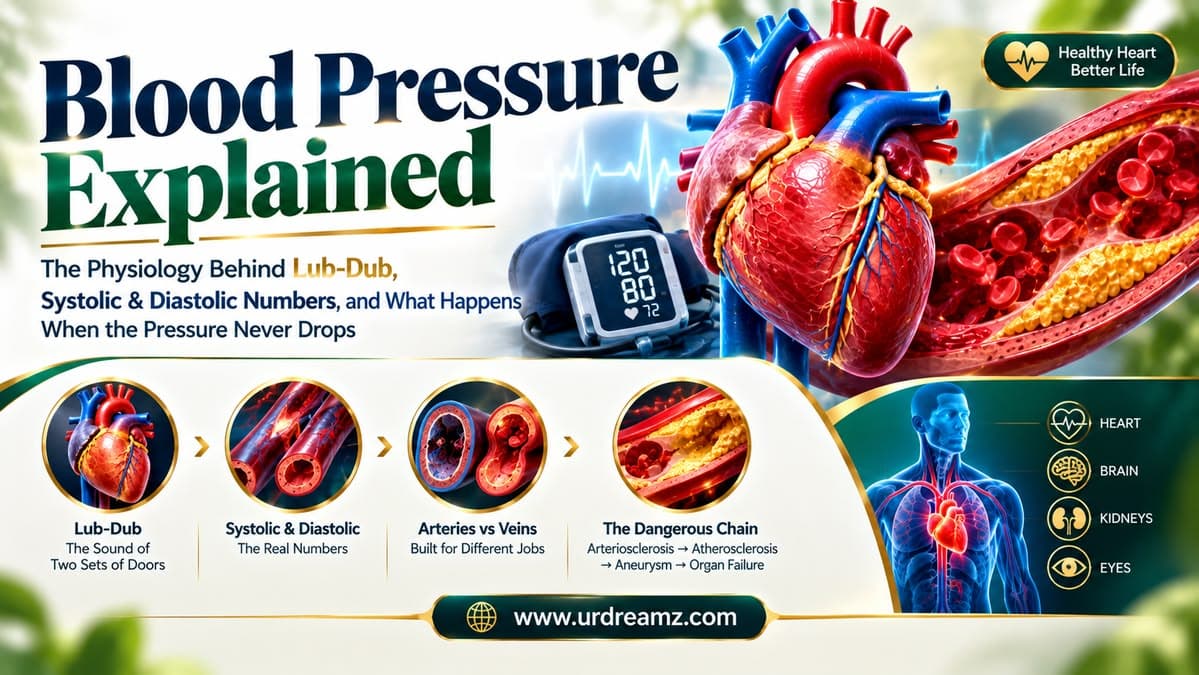
Blood Pressure Explained: The Physiology Behind Lub-Dub, Systolic & Diastolic Numbers, and What Happens When the Pressure Never Drops
Every time a doctor wraps a cuff around your arm and reads out two numbers — "120 over 80" — they're actually describing something happening inside a sealed, four-chambered pump the size of your fist, roughly once every second, for your entire life. Blood pressure isn't the speed of your blood, and it isn't some vague, abstract "stress level" number. It's a precise physical measurement: the amount of force blood exerts against the walls of the vessels carrying it. Understanding where that force actually comes from — and exactly what your heart's own "lub-dub" sound has to do with it — turns two numbers on a screen into something genuinely understandable, rather than a mysterious figure a doctor simply approves or frowns at.
In this lecture, we're going to build blood pressure up from its most basic physical definition, trace exactly where the two heart sounds "lub" and "dub" come from and why they correspond directly to your systolic and diastolic numbers, walk through the real anatomical differences between arteries and veins, and then follow the complete, step-by-step chain of physiological events — arteriosclerosis, atherosclerosis, aneurysm, stroke, kidney damage, and more — that unfolds specifically when blood pressure is allowed to stay elevated for too long.
Quick Answer
Last updated: September 2026
Blood pressure is the force blood exerts against the walls of blood vessels as it circulates. It's expressed as two numbers: systolic pressure (the higher number, generated when the heart contracts and pushes blood out) and diastolic pressure (the lower number, measured when the heart relaxes between beats). The heart's characteristic "lub-dub" sound comes from two sets of valves snapping shut: "lub" is the tricuspid and bicuspid (mitral) valves closing together, and "dub" is the pulmonary and aortic valves closing together. Normal blood pressure is below 120/80 mmHg; hypertension (high blood pressure) is diagnosed at 130/80 mmHg or higher, while hypotension (low blood pressure) is below 90/60 mmHg. Arteries carry blood away from the heart under high pressure and have thick, elastic walls that stretch and recoil, while veins carry blood back to the heart under low pressure and rely on one-way valves to prevent backflow. When blood pressure stays chronically elevated, it damages the smooth muscle in artery walls (arteriosclerosis), creating a rough surface where cholesterol, calcium, and fat accumulate into plaque (atherosclerosis), which can lead to weakened, ballooning vessel walls (aneurysm), stroke (hemorrhagic or ischemic), kidney failure, and hypertensive retinopathy affecting the eyes.
1. What Blood Pressure Actually Measures
Let's start by clearing up the single most common misunderstanding about this term: blood pressure is not the speed at which blood is moving. Picture a blood vessel as a flexible tube, with blood — a mixture of plasma, proteins, water, minerals, and blood cells — flowing continuously through it. Blood pressure is specifically the amount of force that moving blood exerts against the inner walls of that vessel. If the total volume of blood pushing through increases, or if the vessel itself narrows, the force against those walls rises correspondingly — and that rise in force is precisely what a blood pressure reading captures.
2. The River and the Riverbank: A Simple Analogy
A useful way to picture this: think of a river pushing against its banks. If more water flows through, or if the riverbanks narrow, the water pushes harder against those banks. Your blood vessels work the same way — the "banks" are the vessel walls, the "water" is your blood, and blood pressure is simply how hard that moving blood is pressing outward against the walls containing it, at any given moment.
3. Two Numbers, One Heartbeat: Systolic and Diastolic
A blood pressure reading always comes as two numbers because the heart doesn't generate a single, constant level of pressure — it alternates between two distinct phases with every single beat. Systolic pressure, the higher of the two numbers, is generated the moment the heart's main pumping chambers contract and forcefully push blood out into circulation. Diastolic pressure, the lower number, is measured during the brief moment the heart relaxes between beats, refilling with blood before the next contraction. Both numbers matter, because they describe two genuinely different physical states your blood vessels experience, dozens of times every minute, for your entire life.
4. Lub-Dub: Where Heart Sounds Actually Come From
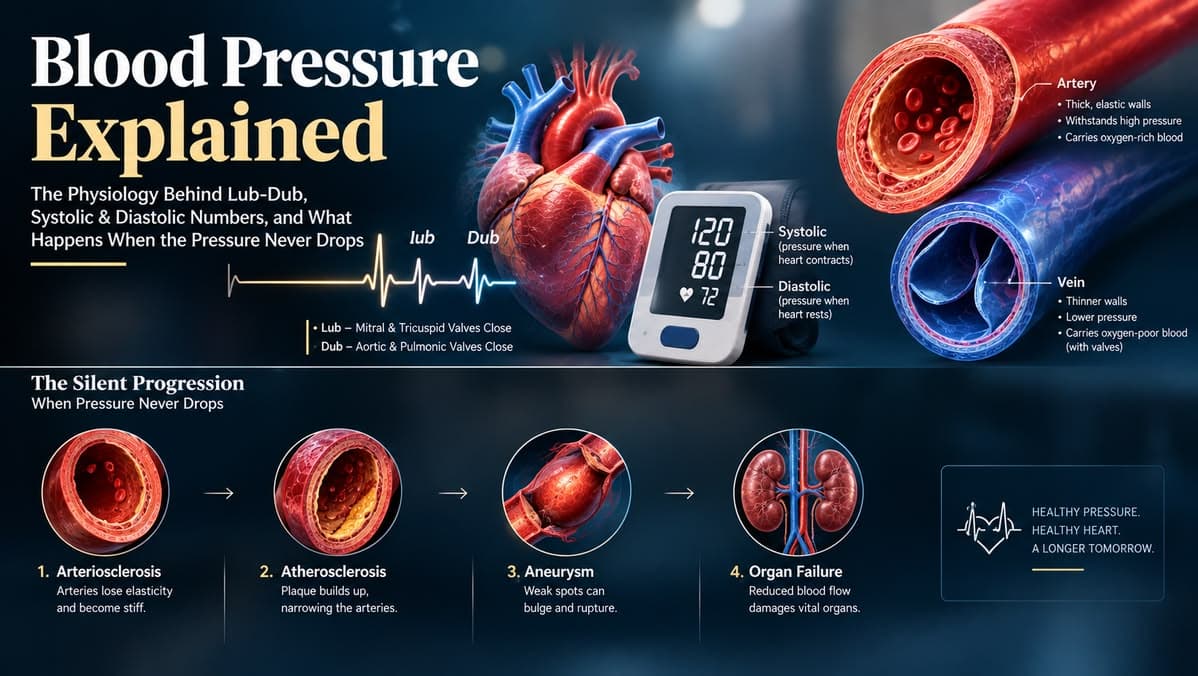
Here's a detail most people have never had properly explained: the classic "lub-dub" sound a doctor hears through a stethoscope has nothing to do with heart muscle contracting or blood rushing through chambers. It comes entirely from valves — specifically, four one-way doors inside the heart snapping shut at two distinct moments in every heartbeat. "Lub" is a slightly longer, lower-pitched sound; "dub" is shorter and sharper. Together, these two sounds mark the precise transition points between systole and diastole discussed in the previous section.
5. The Four Valves: Tricuspid, Bicuspid, Pulmonary, and Aortic
The heart contains four chambers and four corresponding valves, each positioned to ensure blood flows in one direction only, never backward.
| Valve | Location | Also Called |
|---|---|---|
| Tricuspid Valve | Between right atrium and right ventricle | — |
| Bicuspid Valve | Between left atrium and left ventricle | Mitral Valve |
| Pulmonary Valve | Between right ventricle and pulmonary artery | — |
| Aortic Valve | Between left ventricle and the aorta | — |
6. Why "Lub" Happens: The AV Valves Closing
The tricuspid and bicuspid valves (together called the atrioventricular, or AV, valves) close simultaneously at the exact moment the heart's ventricles begin contracting, sealing off the atria above so that blood is forced forward into circulation rather than leaking backward. This synchronized closure of two valves at once is what produces the first heart sound, "lub" — and this moment marks the very beginning of systole, the contraction phase responsible for generating the higher, systolic blood pressure number.
7. Why "Dub" Happens: The Semilunar Valves Closing
The pulmonary and aortic valves (together called the semilunar valves) close together a moment later, right as the ventricles finish contracting and begin to relax. Their closure prevents blood that has just been pumped out into the pulmonary artery and aorta from flowing backward into the relaxing heart. This synchronized closure produces the second heart sound, "dub" — marking the beginning of diastole, the relaxation phase responsible for the lower, diastolic blood pressure number.
Valves Close ("Lub")
(Systolic Pressure)
Valves Close ("Dub")
(Diastolic Pressure)
8. Reading the Numbers: What 120/80 Actually Means
With this physiology in place, a reading of "120 over 80" now has a genuinely precise meaning: 120 mmHg is the systolic pressure, generated the moment the AV valves close and the ventricles contract, and 80 mmHg is the diastolic pressure, measured during the relaxed phase that begins as the semilunar valves close. Neither number exists in isolation — both describe the same continuous, repeating cardiac cycle, captured at its two most physiologically distinct moments.
9. The Official Blood Pressure Categories
| Category | Systolic (mmHg) | Diastolic (mmHg) | |
|---|---|---|---|
| Normal | Less than 120 | and | Less than 80 |
| Elevated | 120–129 | and | Less than 80 |
| Hypertension Stage 1 | 130–139 | or | 80–89 |
| Hypertension Stage 2 | 140 or higher | or | 90 or higher |
| Hypertensive Crisis (seek emergency care) | Higher than 180 | and/or | Higher than 120 |
| Hypotension (Low BP) | Lower than 90 | and/or | Lower than 60 |
*Based on standard American Heart Association blood pressure classification.
10. Arteries: The Heart's High-Pressure Highways
The circulatory system relies on two fundamentally different types of vessels, built for two completely different jobs. Arteries carry freshly pumped blood away from the heart, out to every tissue in the body, and because that blood has just been forcefully pushed out by ventricular contraction, arteries operate under considerably higher pressure than the vessels covered in the next section. To handle this demand, artery walls are built thick and, critically, elastic — capable of stretching outward slightly with each powerful pulse of blood and then recoiling back to their original shape, smoothing out the pressure wave as it travels onward through the body.
11. Veins: The Low-Pressure Return Journey
Veins handle the opposite job: collecting blood, along with accumulated waste products, from throughout the body and returning it back toward the heart. By the time blood reaches the venous system, the powerful pressure generated by the heart's contraction has largely dissipated, meaning veins operate under considerably lower pressure than arteries, and blood moves through them at a noticeably slower pace.
12. Why Veins Need Valves and Arteries Don't
Because venous pressure is so low, particularly in the legs, where blood must travel a long distance upward against gravity to reach the heart, veins face a genuine mechanical challenge that arteries don't. To solve this, veins are equipped with one-way valves positioned along their length, which open to let blood pass upward and then snap shut to prevent it from sliding back down under gravity's pull. These valves work in combination with the natural squeezing action of surrounding skeletal muscles during normal movement, together generating the extra propulsive force needed to keep blood reliably moving back toward the heart — a job arteries simply don't require, since they already have the heart's own contraction force actively pushing blood forward.
| Feature | Arteries | Veins |
|---|---|---|
| Direction of Blood Flow | Away from the heart | Toward the heart |
| Pressure | High | Low |
| Wall Structure | Thick, elastic, muscular | Thinner, less elastic |
| Valves | Generally absent (except heart valves) | Present throughout, to prevent backflow |
| Speed of Flow | Faster, pulsatile | Slower, steadier |
13. What Happens When Pressure Stays High: Arteriosclerosis
Now we arrive at what actually happens when blood pressure doesn't just spike briefly, but remains elevated persistently, day after day. Arteries are built to handle occasional surges — that's precisely what their elasticity is designed for, stretching under pressure and recoiling back afterward. But when pressure stays high continuously, this repeated stretching begins to genuinely damage the smooth muscle cells embedded within the artery wall, the very cells responsible for that elasticity in the first place. As this smooth muscle sustains ongoing damage, the artery wall gradually loses its flexibility and becomes stiff and hardened — a condition called arteriosclerosis, quite literally meaning "hardening of the arteries."
14. From Stiff to Sticky: How Atherosclerosis Builds On Arteriosclerosis
Once an artery wall has stiffened through arteriosclerosis, its formerly smooth inner surface becomes noticeably rougher and less uniform. This rough surface creates a genuine physical problem: material circulating in the bloodstream — red blood cells, cholesterol, calcium, and fats — can now catch and stick to these irregular surfaces far more easily than they could against a smooth, healthy vessel wall. As this material continues accumulating and gradually building up over time, it develops into a distinct, well-recognized condition called atherosclerosis — a term describing this specific buildup process, closely related to but distinct from the general arterial stiffening of arteriosclerosis that set the stage for it.
Blood Pressure
Damage
(Stiff, Rough Walls)
to Rough Surface
(Plaque Buildup)
15. Plaque: The Traffic Jam Inside Your Arteries
This accumulated buildup of cholesterol, calcium, and fat is called plaque, and it functions essentially like a traffic jam forming along the inside of an artery — progressively narrowing the space available for blood to pass through. Depending on exactly where this plaque forms, the consequences can be genuinely severe: plaque narrowing arteries feeding the heart can trigger a heart attack, plaque affecting arteries feeding the brain can trigger a stroke, and plaque affecting arteries feeding the eyes, discussed further later in this lecture, can contribute to vision loss.
16. Ballooning: How Aneurysms Form
A related but distinct complication can occur when one specific section of a blood vessel wall is already weakened, whether from the damage processes described above or from an inherent structural vulnerability. Under sustained high blood pressure, this weakened section can bulge outward, forming a balloon-like swelling called an aneurysm. This is a genuinely dangerous structural situation, since the thinned, stretched wall at the site of the bulge is considerably more fragile than the surrounding healthy vessel, and remains at ongoing risk of rupture as long as the underlying pressure and structural weakness persist.
17. When the Balloon Bursts: Hemorrhagic Stroke
If an aneurysm, or any sufficiently weakened blood vessel, actually ruptures, blood escapes directly into surrounding tissue rather than staying contained within the circulatory system — an event called a hemorrhage. When this rupture happens within a blood vessel supplying the brain specifically, the resulting bleeding into brain tissue is called a hemorrhagic stroke, a genuinely severe medical emergency, since the escaped blood both deprives downstream brain tissue of oxygen and physically damages surrounding brain tissue through the pressure of the accumulating blood itself.
18. When the Road Is Blocked: Ischemic Stroke
A second, distinct type of stroke occurs through an entirely different mechanism: rather than a vessel rupturing, a vessel supplying the brain becomes blocked, typically by the plaque buildup described earlier in this lecture, or by a blood clot forming at a narrowed, plaque-affected site. This blockage cuts off blood flow, and therefore oxygen, to the brain tissue downstream of the obstruction — an event called an ischemic stroke. This is, notably, the more common of the two stroke types, and it shares its underlying mechanism directly with the plaque-formation process traced throughout this lecture.
| Stroke Type | Underlying Cause | What Happens |
|---|---|---|
| Hemorrhagic Stroke | Blood vessel ruptures (often at an aneurysm) | Blood leaks into brain tissue, causing damage and pressure |
| Ischemic Stroke | Blood vessel becomes blocked (typically by plaque or a clot) | Brain tissue downstream is deprived of oxygen |
19. The Kidney's Tiny, Fragile Filters
The kidneys deserve their own specific discussion in this lecture, because their internal structure makes them particularly vulnerable to the effects of chronic high blood pressure. Each kidney contains roughly a million tiny functional filtering units, and within each of these units sits an extremely small, delicate network of blood vessels responsible for the actual filtering process. These capillaries are considerably more fragile and narrower than the larger arteries discussed earlier in this lecture, meaning they're especially sensitive to sustained elevated pressure.
20. How High Blood Pressure Quietly Destroys Kidney Function
When blood pressure remains elevated over an extended period, these tiny, fragile filtering capillaries undergo the same basic process described earlier for larger arteries — they stiffen, lose elasticity, and become increasingly damaged. Because each filtering unit depends entirely on its own small blood supply functioning correctly, damage at this microscopic level effectively disables that individual unit. As this same damage accumulates across thousands, and eventually millions, of these tiny units, kidney function progressively deteriorates, unit by unit, until, in severe long-term cases, the kidney as a whole can fail entirely — a genuinely serious, well-documented consequence of chronic, poorly controlled high blood pressure.
21. Varicose Veins: When the One-Way Valves Fail
Returning to the vein-specific valve system discussed earlier in this lecture, a related condition worth understanding is varicose veins. Recall that veins rely on one-way valves to push blood upward against gravity, back toward the heart. If these valves become weakened or damaged, for a variety of possible reasons, blood can no longer be reliably pushed forward and instead begins pooling and accumulating within the affected vein. This pooling causes the vein to visibly swell and bulge, producing the twisted, enlarged appearance characteristic of varicose veins, most commonly seen in the legs, where veins must work hardest against gravity in the first place.
22. The Eyes Under Pressure: Hypertensive Retinopathy
If high blood pressure remains uncontrolled over time, it can affect essentially every organ system in the body, and the eyes are no exception. The retina, the light-sensitive tissue lining the back of the eye, depends on a dense network of small blood vessels for its function, and these vessels are vulnerable to the same pressure-related damage described throughout this lecture. This condition, called hypertensive retinopathy, can progressively weaken vision and, in more severe or prolonged cases, contribute to significant vision loss. This condition is also frequently connected to obesity, discussed briefly in the next section, since obesity is itself one of the most common underlying contributors to chronic high blood pressure in the first place.
23. Obesity's Role in the Bigger Picture
It's worth closing this physiological walkthrough by noting that a large share of chronic high blood pressure cases trace back, at least in part, to excess body weight. Obesity places additional demand on the cardiovascular system in several ways covered in more detail in our earlier dedicated blood pressure lifestyle article, and it remains one of the single most significant, modifiable contributors to the entire chain of events this lecture has traced — from arteriosclerosis through to kidney damage and hypertensive retinopathy.
24. Putting It All Together: One Number, Many Organs
Stepping back from the individual mechanisms covered throughout this lecture, the bigger picture is genuinely striking: a single physiological measurement — the force of blood against vessel walls — when left chronically elevated, has the capacity to affect the heart's own valve-driven rhythm, the structural integrity of arteries throughout the entire body, the brain, the kidneys, the veins in the legs, and the delicate vessels of the eyes, all through fundamentally the same underlying mechanism of sustained mechanical stress on blood vessel walls. Understanding blood pressure at this level of physiological detail transforms it from an abstract number on a cuff readout into a genuinely meaningful, whole-body health indicator, worth taking seriously well before any of the complications traced throughout this lecture have a chance to develop.
25. Frequently Asked Questions
What is blood pressure, in simple terms?
Blood pressure is the force blood exerts against the walls of blood vessels as the heart pumps it through the circulatory system.
What causes the "lub-dub" heart sound?
"Lub" is caused by the tricuspid and bicuspid valves closing together, and "dub" is caused by the pulmonary and aortic valves closing together.
What is the difference between systolic and diastolic pressure?
Systolic pressure is generated when the heart's ventricles contract and push blood out; diastolic pressure is measured during the relaxation phase between heartbeats.
What is considered normal blood pressure?
A reading below 120/80 mmHg is generally considered normal.
What is the difference between arteries and veins?
Arteries carry blood away from the heart under high pressure with thick, elastic walls, while veins carry blood back to the heart under low pressure and rely on one-way valves to prevent backflow.
What is the difference between arteriosclerosis and atherosclerosis?
Arteriosclerosis is the general stiffening and hardening of artery walls due to smooth muscle damage, while atherosclerosis is the specific buildup of plaque (cholesterol, calcium, and fat) on the resulting rough arterial surface.
What is an aneurysm?
An aneurysm is a balloon-like bulge that forms in a weakened section of a blood vessel wall under sustained pressure, carrying a risk of rupture.
What is the difference between hemorrhagic and ischemic stroke?
A hemorrhagic stroke occurs when a blood vessel ruptures and bleeds into brain tissue, while an ischemic stroke occurs when a vessel becomes blocked, cutting off blood flow to brain tissue.
How does high blood pressure affect the kidneys?
It damages the kidneys' tiny, fragile filtering capillaries, progressively disabling filtering units and potentially leading to kidney failure over time.
What causes varicose veins?
Varicose veins occur when the one-way valves in veins weaken or fail, allowing blood to pool and the vein to swell and bulge, most commonly in the legs.