Chinese Salt (MSG) Explained: How It's Made, the Real Science of Blood Pressure, and Why Pakistan Reversed Its Ban
Few ingredients have had a stranger journey through public opinion than Chinese salt — officially known as monosodium glutamate, or MSG. It went from a beloved flavor enhancer stocked in kitchens across the world, to a feared "toxin" blamed for headaches and heart palpitations, to a nationally banned substance in Pakistan, and finally, six years later, back to being declared safe by the very same government that banned it. That's not a simple story, and most people never get the full version of it.
This guide walks through the complete picture: how MSG is actually manufactured today, the real chemistry connecting sodium to blood pressure through a genuinely fascinating brain mechanism, where the fear around MSG originally came from, and exactly why Pakistan's government reversed a six-year ban based on expert scientific review.
1. What Is Chinese Salt, Really?
Chinese salt is the common name for monosodium glutamate, or MSG, a flavor-enhancing food additive widely used in cooking, particularly in Asian cuisine, and also known in Pakistan and several other countries by its commercial brand name, Ajinomoto.
2. How Much Salt Does the Body Actually Need?
Health guidelines, including those from the World Health Organization, recommend keeping total daily salt intake under 5 grams — an amount that includes all sources of sodium in the diet, not just table salt added directly to food.
3. Why Salt Intake Is Directly Tied to Blood Pressure
Salt's connection to blood pressure isn't incidental — it's one of the most well-established relationships in nutrition science, which is exactly why every type of salt, including MSG, deserves genuine attention rather than blanket fear or blanket dismissal.
4. Where the Name "Chinese Salt" Comes From
The name "Chinese salt" stuck because MSG became closely associated with Chinese cuisine in Western countries, where it was widely used to enhance flavor in restaurant cooking, eventually leading to the ingredient becoming something of a cultural shorthand, fairly or not, for Chinese food specifically.
5. The 1968 Letter That Started It All
In 1968, a doctor wrote a letter describing a set of symptoms — headache, flushing, and heart palpitations — he experienced after eating at Chinese restaurants, speculating that MSG might be the cause. This single letter, published in a medical journal, is the actual origin point of decades of public concern about MSG.
6. How "Chinese Restaurant Syndrome" Got Its Name
Following that letter, the described set of symptoms was informally labeled "Chinese Restaurant Syndrome," a name that stuck in public consciousness and media coverage for decades afterward, despite originating from a single anecdotal account rather than rigorous scientific study.
7. Why That Original Claim Was Never Solid Science
In the decades since, numerous controlled scientific studies have attempted to reproduce these symptoms under blinded conditions, and the results have been inconsistent at best, with major food safety authorities, including the FDA, classifying MSG as generally recognized as safe. The original 1968 letter, while historically significant in shaping public perception, was never itself a rigorous, controlled scientific study.
8. Pakistan's 2018 Ban Explained
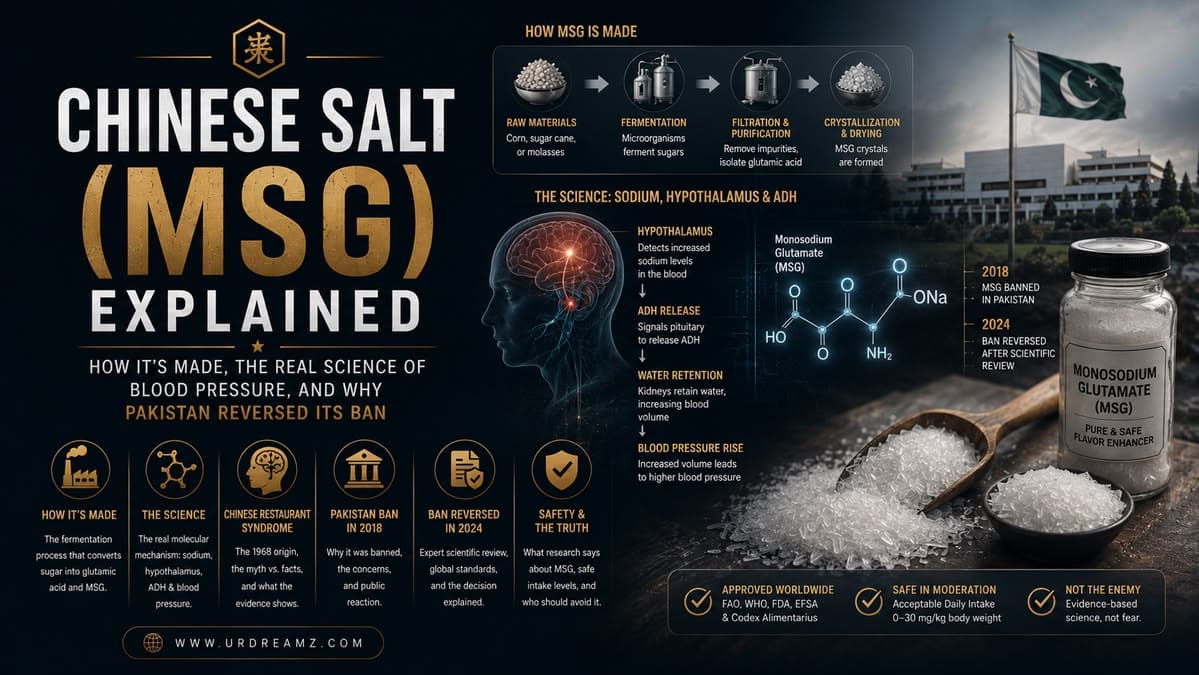
In 2018, Pakistan's Supreme Court ordered a ban on the sale, import, and export of MSG, acting on findings from the Punjab Food Authority that linked MSG to symptoms including headaches, fatigue, palpitations, and facial numbness, and describing it as hazardous to health.
9. Why the Ban Lasted Six Years
Despite objections from Japan and MSG manufacturer Ajinomoto — who argued the ban lacked scientific backing and was unique to Pakistan among world markets — the restriction remained in place for years, with a review petition filed in 2020 going largely unaddressed until the issue was raised again through diplomatic channels in 2022.
10. The Expert Committee That Changed Everything
In March 2023, following renewed diplomatic pressure, Pakistan's Ministry of Commerce formed a technical expert committee — including representatives from the Pakistan Council of Scientific and Industrial Research, the National Agricultural Research Centre, and the Pakistan Standards and Quality Control Authority — specifically tasked with reviewing global research and international guidelines, including those from the WHO and FDA, on MSG's health and safety.
11. Why the Ban Was Reversed in 2024
The committee's findings confirmed MSG as a safe food additive, widely used in food industries around the world, and concluded that the original ban lacked adequate scientific basis while also risking Pakistan's trade relationship with Japan. Based on these findings, Pakistan's federal cabinet formally lifted the ban in December 2024.
12. MSG: The Full Name and What It Actually Means
MSG stands for Monosodium Glutamate — a compound combining a single sodium ion ("mono-sodium") with glutamate, an amino acid. This chemical structure is the key to understanding both why it enhances flavor and how it interacts with the body.
13. Regular Table Salt: Sodium Chloride Explained
Ordinary table salt is chemically sodium chloride, a much simpler compound made of just sodium and chloride ions, without any amino acid component. This structural difference is exactly why MSG delivers a distinctly different taste sensation than plain table salt.
14. Himalayan Pink Salt: What Makes It Different
Himalayan pink salt is also fundamentally sodium chloride, chemically similar to table salt, but it additionally contains trace minerals like iron and magnesium, which give it its characteristic pink color, though these trace minerals don't meaningfully change its overall sodium content or health impact in typical usage amounts.
15. The Common Thread: Sodium
Whether it's table salt, pink Himalayan salt, or MSG, the ingredient they all genuinely share — and the one that actually matters most for blood pressure — is sodium. Understanding sodium's role in the body is really the key to understanding the entire MSG conversation.
16. How MSG Is Actually Made: Step One
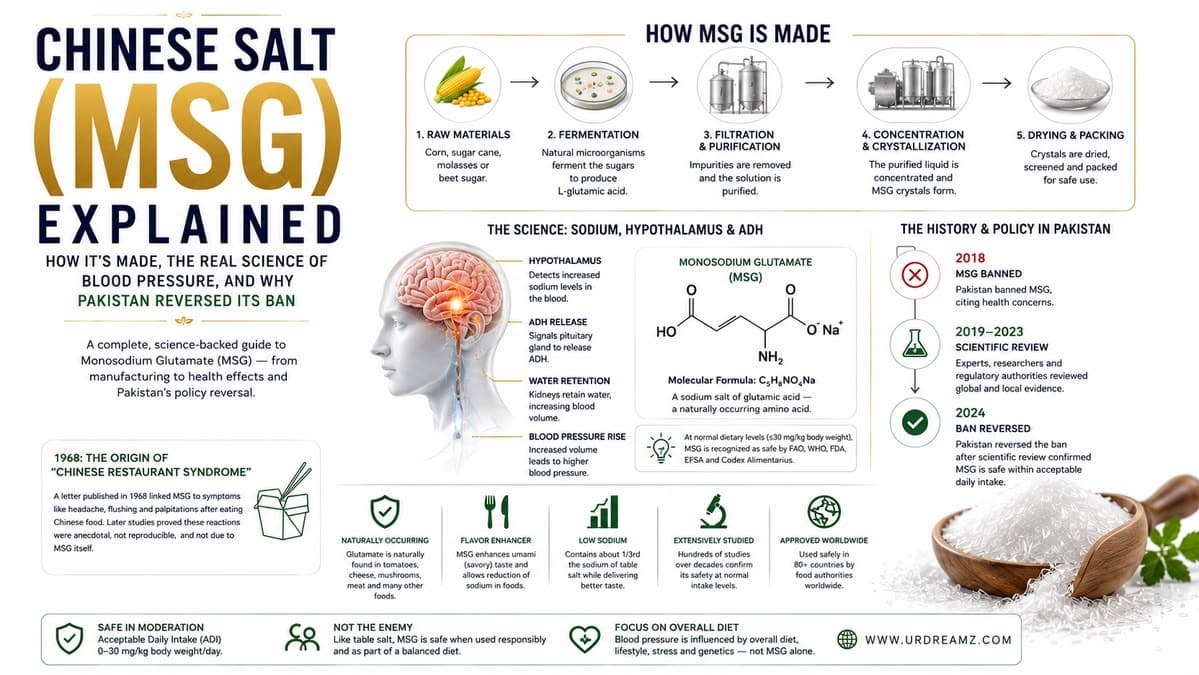
Modern MSG production begins with a natural raw material: sugarcane or sugar beet, the same crops used in sugar production, providing the starting sugars needed for the manufacturing process.
17. Fermentation Explained
Fermentation is a natural biological process in which microorganisms — in this case, specific bacteria — break down sugars and convert them into other compounds. This is essentially the same broad category of process used to make products like yogurt, soy sauce, and vinegar, applied here to produce glutamic acid.
18. How Bacteria Produce Glutamate
Sugarcane or sugar beet extract is combined with specific bacteria and left to ferment for a period, generally around two months, during which the bacteria metabolize the sugars and naturally produce glutamic acid as a byproduct — the same basic amino acid also found naturally in many everyday foods.
19. From Glutamate to MSG: The Final Step
Once fermentation is complete, the glutamic acid is purified and extracted, then combined with sodium to form the final, crystallized product: monosodium glutamate, ready for use as a flavor enhancer.
20. Why This Manufacturing Process Matters
Understanding that MSG is produced through a natural fermentation process, rather than being some synthetic laboratory chemical unrelated to anything in nature, helps explain why major food safety bodies have consistently found no basis for treating it as inherently more dangerous than other common food ingredients produced through similar processes.
21. The Five Basic Tastes
Human taste perception is generally organized around five basic tastes: sweet, sour, salty, bitter, and umami — with the first four being familiar to most people, and umami being the more recently formally recognized addition to this list.
22. Umami: The Fifth Taste Explained
Umami, often translated as "savory," is the taste most strongly associated with glutamate specifically. It's the deep, rich, meat-like flavor MSG contributes when added to dishes, distinct from any of the four more traditionally recognized basic tastes.
23. Why Umami Feels Like "Savory" or "Meaty"
Glutamate receptors on the tongue respond specifically to this amino acid, producing a taste sensation the brain interprets as rich and savory — closely resembling the natural taste of well-cooked meat or aged, fermented foods, which is exactly why MSG is so effective at deepening flavor in dishes like biryani or broths.
24. Where Glutamate Naturally Occurs in Food
| Food | Contains Natural Glutamate |
|---|---|
| Tomatoes | Yes, in meaningful amounts |
| Mushrooms | Yes |
| Potatoes | Yes |
| Aged cheese | Yes, in high concentrations |
| Meat | Yes, naturally present |
25. Why MSG Isn't as Foreign as People Think
Because glutamate occurs naturally in so many everyday foods, the body is already well-adapted to processing it regularly, regardless of whether it comes from a tomato, a piece of aged cheese, or an added spoonful of MSG in a curry — the glutamate itself isn't a fundamentally new or unfamiliar compound to human digestion.
26. Now, the Real Science: How Sodium Enters the Blood
Whenever food containing salt — whether table salt, pink salt, or MSG — is consumed, the sodium it contains is absorbed and enters the bloodstream, where it begins directly influencing the body's fluid balance.
27. Sodium as a "Water Magnet"
Sodium has a strong natural tendency to attract and hold onto water through a process called osmosis, effectively acting like a magnet for water molecules within the bloodstream. The more sodium present, the more water gets pulled in and retained alongside it.
28. What Blood Pressure Actually Measures
Blood pressure refers to the force blood exerts against the walls of blood vessels as it circulates through the body. This force naturally rises and falls based on how much fluid volume is moving through the vessels at any given time.
29. Why Extra Water in Blood Raises Pressure on Artery Walls
When excess sodium pulls additional water into the bloodstream, total blood volume increases, and that additional volume has to move through the same fixed space inside blood vessels — directly increasing the pressure exerted against the vessel walls, which is precisely the mechanism connecting salt intake to blood pressure.
30. The Hypothalamus: Your Brain's Salt Detector
The hypothalamus, a small but critically important region of the brain, plays a central role in monitoring and regulating the body's fluid and sodium balance, constantly receiving information about what's currently circulating in the blood.
31. Osmoreceptors Explained
Within the hypothalamus, specialized cells called osmoreceptors continuously monitor the concentration of sodium and other solutes in the surrounding blood. When sodium concentration rises above normal, these osmoreceptors detect the change and trigger a hormonal response.
32. How the Pituitary Gland Gets Involved
Once osmoreceptors detect elevated sodium levels, they signal the pituitary gland, a small gland located just beneath the hypothalamus, to release a specific hormone in response — setting the next stage of this process into motion.
33. ADH Explained
ADH, or antidiuretic hormone, is the hormone released by the pituitary gland in response to elevated blood sodium. Its job is to help the body conserve water, directly counteracting the fluid imbalance detected by the hypothalamus.
34. What ADH Actually Does at the Kidneys
ADH travels through the bloodstream to the kidneys, where it signals them to reabsorb more water from urine back into the bloodstream rather than excreting it, effectively diluting the elevated sodium concentration by retaining more water in circulation.
35. The Thirst Signal Explained
Alongside triggering ADH release, the hypothalamus also signals the broader nervous system to generate the sensation of thirst, prompting a person to drink more water — a second, complementary way the body works to dilute excess sodium and restore balance.
36. Why Drinking Water Turns the Signal Off
Once a person drinks enough water to bring blood sodium concentration back toward normal, the osmoreceptors detect this change and the hypothalamus reduces its ADH signaling accordingly, allowing the kidneys to resume excreting water normally rather than continuing to conserve it.
37. What Happens When This System Is Overwhelmed
This entire system works well for occasional, moderate salt intake, but when sodium consumption is consistently and significantly excessive over time, the body's fluid retention response can contribute to sustained elevated blood pressure, increasing long-term risk for conditions like stroke and heart attack.
38. Why the Kidneys Bear the Real Long-Term Load
Because the kidneys are directly responsible for regulating sodium and water excretion, chronically high sodium intake places sustained extra demand on kidney function over years, which is part of why excessive salt intake is also a recognized concern for long-term kidney health, not just blood pressure alone.
39. MSG's Sodium Content vs Table Salt
| Ingredient | Approximate Sodium Content by Weight |
|---|---|
| Table Salt (Sodium Chloride) | Approximately 39% |
| MSG (Monosodium Glutamate) | Approximately 12% |
This means, gram for gram, MSG contains roughly one-third the sodium of ordinary table salt.
40. Why This Comparison Actually Matters
Because MSG delivers strong umami flavor with meaningfully less sodium than an equivalent amount of table salt needed to achieve similar flavor intensity, thoughtfully substituting some table salt with a smaller amount of MSG can, in some cases, actually help reduce total sodium intake in a dish rather than increasing it — a genuinely useful, if counterintuitive, point.
41. Who Should Still Be Cautious With MSG
People managing high blood pressure, kidney disease, or heart conditions should still be mindful of their total sodium intake from all sources, including MSG, and individuals who report genuine sensitivity or discomfort after consuming MSG should reasonably continue avoiding it, regardless of what broader population-level research shows.
42. Is Chinese Salt Halal or Haram?
Modern MSG, produced through bacterial fermentation of sugarcane or sugar beet, does not involve any animal-derived or otherwise impermissible ingredients, and is generally considered halal by most scholars and food certification authorities. Checking for specific halal certification on individual product packaging remains a reasonable practice for anyone seeking full certainty.
43. Debunking the "MSG Contains Fat" Myth
A commonly repeated claim suggests MSG contains fat, sometimes framed as an explanation for supposed health risks — this claim is not accurate and isn't supported by any verified scientific source. MSG is a sodium salt of an amino acid, not a fat or oil in any form.
44. How to Use Chinese Salt Responsibly
| Tip | Why It Helps |
|---|---|
| Use in small, measured amounts | A little goes a long way for flavor enhancement |
| Account for it within your total daily sodium intake | Helps stay within the WHO's recommended 5 grams of salt per day |
| Consider it as a partial substitute for table salt | May help reduce total sodium given its lower sodium content by weight |
| Discontinue if you notice a personal reaction | Individual sensitivity, while not universally proven in research, is still worth respecting |
45. Myths vs Facts
| Myth | Fact |
|---|---|
| MSG is a dangerous synthetic chemical | Modern MSG is produced through natural bacterial fermentation of sugarcane or sugar beet |
| MSG contains fat | MSG is a sodium salt of an amino acid, not a fat or oil |
| MSG has more sodium than table salt | MSG contains roughly one-third the sodium of table salt by weight |
| Chinese Restaurant Syndrome is scientifically proven to be caused by MSG | The original claim came from a single 1968 letter, and controlled studies since then have not consistently confirmed a direct causal link |
| MSG is unique and unlike anything naturally found in food | Glutamate occurs naturally in tomatoes, mushrooms, cheese, and meat |
46. Quick Glossary
| Term | Meaning |
|---|---|
| MSG | Monosodium Glutamate; a flavor-enhancing compound combining sodium and the amino acid glutamate |
| Umami | The fifth basic taste, associated with savory, meaty flavor |
| Osmoreceptors | Cells in the hypothalamus that detect changes in blood sodium concentration |
| ADH | Antidiuretic hormone; signals the kidneys to retain water in response to rising sodium |
| Fermentation | A natural biological process where microorganisms convert sugars into other compounds |
47. Frequently Asked Questions
Is Chinese salt (MSG) halal or haram?
Modern MSG is produced through bacterial fermentation of sugarcane or sugar beet, a process generally considered halal by most scholars and food certification bodies, since it does not involve any animal-derived or otherwise impermissible ingredients. As with any food product, checking for specific halal certification on packaging is recommended for full certainty.
Is Chinese salt banned in Pakistan?
Chinese salt (MSG) was banned in Pakistan by the Supreme Court in 2018, but the ban was lifted in December 2024 after a government-formed expert committee reviewed international scientific evidence and declared MSG safe for consumption.
Is Chinese salt good or bad for health?
MSG is generally recognized as safe by major food safety bodies including the FDA and WHO when consumed in normal culinary amounts. Like regular table salt, it contains sodium and should be used in moderation, particularly by people managing blood pressure, but it is not considered inherently dangerous.
What are the side effects of Chinese salt?
A small subset of people report symptoms like headache, flushing, and heart palpitations after consuming large amounts of MSG, sometimes called Chinese Restaurant Syndrome, though controlled scientific studies have not consistently proven a direct causal link, and most people experience no reaction at all.
What is Chinese salt made from?
Modern Chinese salt (MSG) is produced by fermenting sugarcane or sugar beet molasses with specific bacteria that naturally produce glutamic acid, which is then combined with sodium to form monosodium glutamate.
Does Chinese salt raise blood pressure?
MSG contains sodium, and like any sodium-containing ingredient, excessive intake can contribute to fluid retention and elevated blood pressure. However, MSG contains roughly one-third the sodium of regular table salt by weight, meaning moderate use can actually reduce total sodium intake compared to using more table salt for the same flavor intensity.
What is Chinese Restaurant Syndrome?
Chinese Restaurant Syndrome is a term coined after a 1968 letter describing symptoms like headache, flushing, and heart palpitations reported after eating at Chinese restaurants, which was initially attributed to MSG, though later research has not consistently confirmed a direct causal relationship in controlled studies.
What is umami taste?
Umami is the fifth basic taste, alongside sweet, sour, salty, and bitter, described as a savory, meaty flavor. It's the taste most strongly associated with glutamate, the active compound in MSG, and occurs naturally in foods like tomatoes, mushrooms, cheese, and meat.
How does sodium affect blood pressure in the body?
Sodium draws water into the bloodstream, increasing blood volume, which raises the pressure blood exerts on artery walls. The hypothalamus detects rising sodium levels through osmoreceptors and signals the release of ADH, which causes the kidneys to retain more water, further influencing blood volume and pressure.
Does MSG contain fat?
No, this is a common but inaccurate claim. MSG is a sodium salt of an amino acid (glutamate), not a fat or oil, and this rumor is not supported by any verified scientific source.
48. Conclusion
The story of Chinese salt is really a story about how quickly fear can outrun evidence, and how long it can take for evidence to actually catch up. A single anecdotal letter in 1968 gave rise to decades of public suspicion, an entire ingredient category earned a reputation as a "toxin," and a national government banned it outright — only to spend six years, form an expert committee, review the WHO and FDA's own safety findings, and quietly reverse course once the actual science was properly examined.
None of this means MSG deserves blind trust either. Like any source of sodium, it belongs in the diet in reasonable amounts, within the same 5-gram daily salt limit that applies to any other salt in the kitchen — not because it's uniquely dangerous, but because sodium itself, from any source, genuinely affects blood pressure through a real, well-understood mechanism running from your bloodstream to your hypothalamus and back to your kidneys. Used thoughtfully, MSG isn't the villain it was made out to be. It's simply salt with a molecular twist, a savory taste most of the world already loves, and a much more honest scientific story than the one that got it banned in the first place.