What Is Fanatical Ideology? How Rigid Thinking Shows Up in Leaders, Teachers, and Everyday Authority
You've probably met someone like this before, even if you never had a word for it. You raise a fair concern, point out something that isn't working, ask a genuinely reasonable question — and instead of a real answer, you get shut down so hard, so fast, that you quietly decide never to bring it up again. That reaction, and the mindset behind it, has a name: fanatical ideology. It's not really about any specific belief. It's about how tightly someone holds a belief, and what they do to anyone who dares to question it.
This guide breaks the concept down completely — what actually defines fanatical thinking, how it shows up in everyday authority figures like leaders, teachers, officials, and elected representatives, what separates it from ordinary conviction or passion, what "ideology" itself actually means, and how two real, widely discussed ideologies illustrate the broader idea of belief systems forming, spreading, and being defended.
1. What Is Fanatical Ideology?
Fanatical ideology is a rigid, extreme set of beliefs held with total, uncritical certainty, where the person holding it treats their own view as the only valid one and treats anyone who disagrees, questions, or criticizes it as an enemy or a threat, rather than as someone offering a different, potentially useful perspective.

2. Breaking Down the Core Definition
The key word here isn't really "belief" — everyone holds beliefs. It's "fanatical," which describes the manner in which that belief is held: with such rigidity and certainty that facts, evidence, and other people's experiences simply don't get to matter anymore. A fanatical mindset isn't defined by what someone believes, but by their complete unwillingness to ever seriously reconsider it.
3. Why This Matters in Everyday Life, Not Just History
Fanatical ideology usually gets discussed in the context of extremist movements or historical dictators, and those are certainly real examples. But the exact same pattern of thinking shows up in far more ordinary, everyday settings — a boss, a teacher, a local official, a family elder — anywhere someone holds enough authority that their decisions genuinely affect other people's lives, and where that authority goes unchecked by any real tolerance for pushback.
4. The Four Everyday Authority Figures We All Encounter
To make this concept concrete rather than abstract, it helps to look at four common roles almost everyone interacts with at some point: a ruler or leader, a teacher, a local officer or authority figure, and an elected representative. Each of these roles carries real power over other people's lives, which is exactly why how they respond to criticism reveals so much about their underlying mindset.
5. Case Study: The Ruler Who Can't Take Feedback
Imagine telling a ruler or leader that a specific policy isn't working the way it was intended to. A fanatical response doesn't engage with the substance of that concern at all — instead of a real answer, it comes back as a harsh, defensive counterattack, designed specifically to make you regret ever raising the issue in the first place, rather than to actually address it.
6. Case Study: The Teacher Who Punishes Questions
The same pattern shows up in education, when a teacher responds to a genuine question not with an explanation, but with a dismissive "don't ask that" or an implication that questioning itself is somehow disrespectful. Repeated criticism, even when constructive, can escalate this further — a student seen as persistently challenging can start to be treated as a future threat to that teacher's authority, rather than as someone simply trying to understand something better.
7. Case Study: The Local Officer or Authority Figure
Local officials and authority figures who oversee community decision-making — settling disputes, managing local affairs — can fall into this same trap, treating any criticism of their decisions as a personal challenge to their authority rather than as useful feedback that could actually improve outcomes for the community they're meant to serve.
8. Case Study: The Elected Representative
Elected representatives are, in principle, directly accountable to the people who voted for them, which makes fanatical unresponsiveness to criticism especially problematic in this role. A representative who treats every question from constituents as an attack, rather than as the basic accountability their position requires, is exhibiting the exact same rigid pattern found in any other kind of fanatical authority.
9. What Separates a Fanatical Mind From a Flexible One
The dividing line isn't whether someone holds strong opinions — plenty of genuinely effective leaders and thinkers hold very strong opinions. It's what happens next, when that opinion is challenged. A flexible mind treats challenge as information worth considering; a fanatical mind treats it as an attack that must be neutralized.
10. What Open-Minded Leadership Looks Like Instead
Picture the same ruler from earlier, but responding differently: instead of firing back a harsh answer, they actually sit with the suggestion, consider whether adjusting the policy could genuinely benefit more people, and adjust their approach accordingly. This isn't weakness — it's a mindset that treats good ideas as valuable regardless of where they come from, which tends to produce far better long-term outcomes than rigid defensiveness ever does.
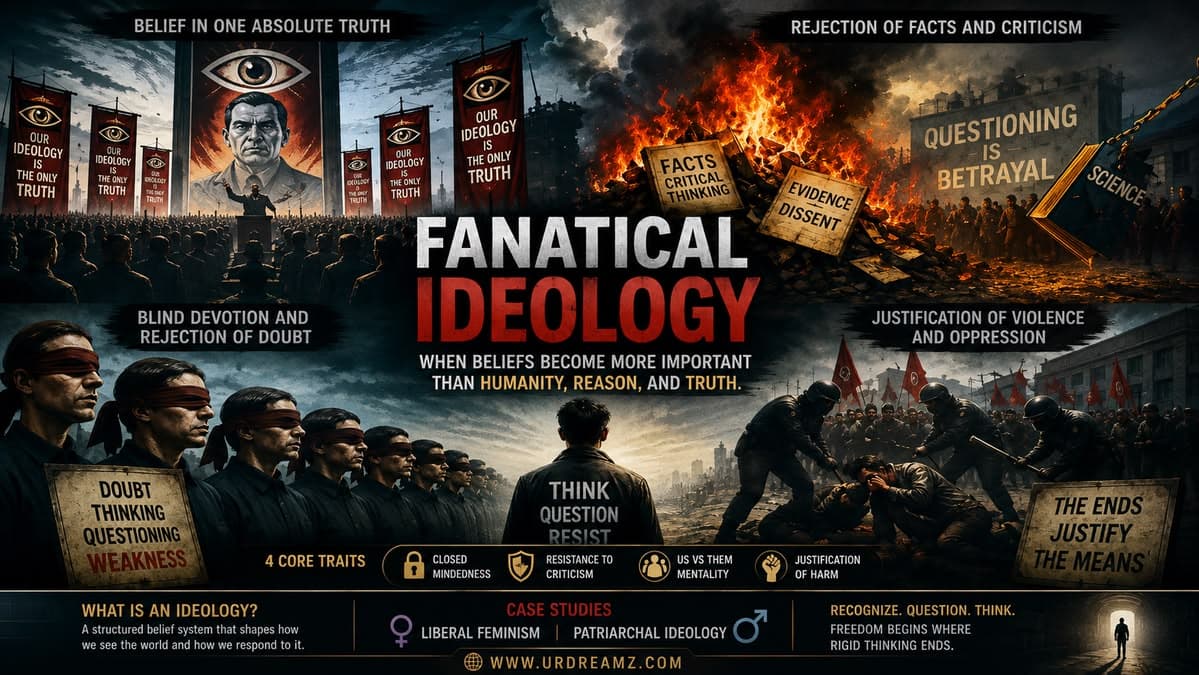
11. Rejection of Facts and Criticism Explained
This is one of the clearest markers of fanatical ideology: facts, evidence, and critical thinking get treated not as useful tools for improving a position, but as threats to be dismissed, discredited, or outright burned away, so to speak, rather than genuinely engaged with.
12. Justification of Violence and Oppression Explained
In its most extreme forms, fanatical ideology doesn't stop at simply rejecting disagreement — it actively justifies using force, coercion, or oppression against people who don't comply, framing this harm as necessary or even righteous in service of the larger cause, no matter the human cost involved.
13. Blind Devotion and Rejection of Doubt Explained
Fanatical ideology treats doubt itself as a weakness or a betrayal, rather than as a normal, healthy part of thinking things through. Followers are often expected to display unwavering devotion, with even private uncertainty treated as something shameful to hide rather than something worth exploring honestly.
14. Belief in One Absolute Truth Explained
Fanatical ideology generally insists there is exactly one correct way to see the world, one true leader, one valid interpretation — with no legitimate room for alternative perspectives, nuance, or the possibility that the picture might be more complicated than a single, absolute narrative allows.
15. Why These Four Traits Tend to Cluster Together
These traits — rejecting facts, justifying harm, demanding blind devotion, and insisting on one absolute truth — reinforce each other in a self-sustaining loop. Once doubt is treated as betrayal and facts are treated as threats, justifying harsh action against dissenters becomes far easier to rationalize, which in turn makes the whole belief system even more resistant to outside challenge.
16. What "Fanatical" Actually Means
At its root, "fanatical" describes excessive, unreasonable enthusiasm or devotion to something — a cause, a leader, an idea — carried to a degree that overrides rational thought and tolerance for other perspectives.
17. Fanatic vs Passionate: Where's the Real Line?
Passion and fanaticism can look similar on the surface — both involve strong feeling and commitment — but the real difference lies in flexibility. A passionate person can still hear a counterargument, update their view when shown compelling evidence, and disagree respectfully. A fanatic generally cannot, or will not, do any of these things.
18. Is Being a Fanatic Always Bad?
Context matters a lot here. Being an enthusiastic "fanatic" about a sports team, a hobby, or a favorite artist is generally harmless and even fun. Fanaticism becomes genuinely concerning specifically when it involves rejecting facts, silencing dissent, or justifying harm toward people who see things differently — which is a very different situation from simply loving something intensely.
19. What Actually Makes Someone Become Fanatical
Fanaticism tends to develop through a combination of factors: a strong psychological need for certainty in an uncertain world, a powerful sense of group identity and belonging, a perceived history of grievance or victimhood, and environments — whether political, religious, educational, or organizational — that consistently reward loyalty and obedience over independent, critical thinking.
20. Now, What Is an "Ideology," Really?
An ideology is essentially a shared, organized set of beliefs held by a group of people about how society should be structured and run — covering questions like the roles of men and women, the proper function of government, the role of religion, the meaning of justice, and how power should be distributed. When enough people agree on this shared framework, it tends to organize itself into a recognizable movement, party, or community.
21. How a Shared Ideology Turns Into a Movement or Party
Picture a group of people who broadly agree on how society should work — what rights people should have, what roles different groups should play, how institutions like courts, banks, or religious bodies should function. Once that agreement is organized and consistently followed, the group effectively becomes followers of a shared ideology, which can then evolve into a formal political party, social movement, or community identity.
22. Case Study Ideology #1: Liberal Feminism Explained
Liberal feminism is one widely recognized ideological framework, focused on achieving gender equality by working within existing democratic and legal systems, rather than by overturning them entirely. It's one of several major branches within the broader feminist movement, distinguished specifically by its emphasis on legal reform and equal access rather than more radical structural change.
23. Core Ideas and Goals of Liberal Feminism
| Core Idea | What It Means in Practice |
|---|---|
| Equal legal rights | Men and women should have identical rights under the law |
| Equal access | Equal opportunity in education, employment, banking, and immigration |
| Reform through existing systems | Change pursued through voting, legislation, and policy reform rather than revolution |
| Equal pay and protections | Closing pay gaps and legally addressing workplace discrimination and harassment |
24. Common Criticisms of Liberal Feminism
Liberal feminism faces criticism from more than one direction. Some critics, often from more radical feminist perspectives, argue it moves too slowly and relies too heavily on incremental legal reform rather than addressing deeper structural or cultural roots of inequality, and that its focus can center the experiences of more privileged women while overlooking issues tied to race, class, or region. From more traditionalist or conservative perspectives, critics argue liberal feminism's emphasis on individual rights and workforce participation can, in their view, come at the expense of traditional family structures or roles they consider valuable. Both sets of criticism exist in ongoing public and academic debate.
25. Case Study Ideology #2: Patriarchal Ideology Explained
Patriarchal ideology is a different framework, built around the belief that men naturally hold primary authority, decision-making power, and leadership roles in society, while women are expected to occupy more supportive, domestic, or subordinate roles. Its defenders typically justify this structure by appealing to tradition, religious interpretation, or claims about inherent biological differences between men and women.
26. Core Beliefs Within Patriarchal Ideology
| Core Belief | How It's Typically Framed |
|---|---|
| Male leadership | Men are viewed as natural decision-makers, protectors, and heads of household |
| Female role expectations | Women are generally expected to focus on caregiving and domestic responsibilities |
| Lineage and authority | Family names, inheritance, and household decisions typically follow the father or eldest male |
| Justification | These roles are defended as rooted in tradition, religious interpretation, or biology |
27. How Patriarchal Ideology Has Been Historically Justified
Historically, patriarchal social structures have been defended through a combination of cultural custom, religious interpretation, and claims about biological or natural differences between men and women, with these justifications differing considerably across different regions, religions, and time periods rather than following one single, universal explanation.
28. Common Critiques of Patriarchal Ideology
Mainstream sociological and feminist scholarship generally critiques patriarchal ideology as a system that limits opportunity and autonomy for women specifically, arguing that roles defended as "natural" or "traditional" are, in this view, actually socially constructed and enforced rather than biologically inevitable. Defenders of more traditional gender-role frameworks, on the other hand, often argue these structures reflect complementary, rather than unequal, roles between men and women, and point to family stability or cultural continuity as values worth preserving. This remains a genuinely contested area of ongoing social and academic debate.
29. Comparing the Two: Where They Fundamentally Disagree
| Point of Comparison | Liberal Feminism | Patriarchal Ideology |
|---|---|---|
| View of Gender Roles | Should be equal and flexible, not fixed by sex | Should be distinct, with men in leadership roles |
| Source of Authority | Individual rights and legal equality | Tradition, religious interpretation, or perceived natural order |
| View of Change | Achieved through legal and institutional reform | Generally favors preserving established roles and structures |
Presenting both frameworks here is meant to illustrate how two entirely different ideologies can each organize a coherent worldview around the same basic question — the roles of men and women in society — while reaching very different conclusions, not to declare a definitive verdict on which is correct.
30. Can Any Ideology Become Fanatical?
Yes — this is a genuinely important point. Fanaticism isn't limited to any one specific ideology; it's a manner of holding beliefs that can attach itself to virtually any belief system, political or otherwise. A liberal feminist and a strict traditionalist can both become fanatical in the exact same way, by refusing to tolerate disagreement, rejecting evidence that complicates their position, or treating anyone who questions them as an enemy.
31. The Real Difference: Ideology vs Fanatical Ideology
An ideology, on its own, is simply a coherent set of beliefs about how society should work — something virtually everyone holds in some form. It becomes a fanatical ideology specifically when it's held with total, unquestioning certainty, defended through hostility toward dissent, and treated as more important than the people it's meant to serve.
32. How to Recognize Fanatical Thinking in Yourself
A useful, honest self-check: when someone disagrees with you, do you find yourself genuinely considering their point, even briefly — or do you feel an immediate need to shut them down, discredit them, or treat their disagreement as a personal attack? Noticing that instinct in yourself, rather than only in others, is often the first real step away from rigid, fanatical thinking.
33. Why Healthy Societies Need Room for Criticism
Institutions, leaders, and belief systems that can absorb honest criticism and adjust accordingly tend to correct their own mistakes over time, while those that punish or silence criticism tend to keep repeating the same failures, since nobody remaining close to them is willing to point those failures out anymore. Tolerance for dissent isn't a weakness in a system — it's one of the clearest signs of a genuinely functional one.
34. Myths vs Facts
| Myth | Fact |
|---|---|
| Fanaticism is only about religion or politics | It can attach to any belief system, including workplace culture, family dynamics, or purely secular ideas |
| Strong conviction always means fanaticism | Conviction becomes fanatical specifically when it can no longer tolerate questioning or evidence |
| Only "extremists" can be fanatical | Everyday authority figures — teachers, bosses, local officials — can display the exact same rigid pattern |
| Being passionate about something is the same as being fanatical | Passion remains open to reconsideration; fanaticism generally does not |
| All ideologies about gender roles are equally "extreme" or "moderate" | Ideologies vary widely in content, but any of them can become fanatical depending on how rigidly they're held and defended |
35. Quick Glossary
| Term | Meaning |
|---|---|
| Ideology | A shared, organized set of beliefs about how society should be structured |
| Fanaticism | Excessive, uncritical devotion to a belief or cause, intolerant of disagreement |
| Dogmatism | A tendency to assert beliefs as unquestionably true without allowing debate |
| Dissent | Disagreement with a prevailing view or authority |
| Liberal Feminism | An ideology pursuing gender equality through legal and institutional reform |
| Patriarchal Ideology | A belief system holding that men naturally occupy primary leadership roles in society |
36. Frequently Asked Questions
What is fanatical belief?
Fanatical belief is an extreme, uncritical commitment to an idea, leader, or cause, held with total certainty and defended without regard to evidence, facts, or opposing viewpoints.
What does fanatical mean?
Fanatical describes excessive, unreasonable enthusiasm or devotion to something, typically to the point of rejecting criticism, doubt, or any information that challenges that devotion.
What is a fanatical personality?
A fanatical personality generally shows intense, rigid conviction, an intolerance for questioning or dissent, a tendency to divide the world into absolute categories of right and wrong, and difficulty accepting facts that contradict deeply held beliefs.
What does it mean by fanatical?
It means holding a belief or devotion so intensely and uncritically that it overrides reason, evidence, and tolerance for other perspectives.
What is another word for fanatic?
Common alternative words include zealot, extremist, radical, and diehard, though each carries slightly different connotations depending on context.
Is being fanatic bad?
It depends on context. Intense enthusiasm for a hobby or interest is generally harmless, but fanaticism becomes genuinely harmful when it involves rejecting facts, silencing dissent, or justifying harm toward people who disagree.
What makes a fanatic?
Fanaticism often develops through a combination of factors, including a strong need for certainty, group identity and belonging, perceived victimhood or grievance, and environments that reward loyalty over independent thinking.
What is another word for religious fanatic?
Terms like zealot or extremist are sometimes used, though these words can be used unfairly if applied broadly to entire religious communities rather than specifically to individuals who reject reasonable questioning and coexistence.
What is an example of being fanatical?
A leader who responds to constructive criticism with hostility, punishes questioning as betrayal, and insists their approach is the only acceptable one, regardless of evidence, is displaying fanatical thinking.
Who are the fanatics?
Fanatics can be found in any context where rigid belief is defended without tolerance for criticism, whether in political movements, religious extremism, cult-like social groups, or even everyday positions of authority like leadership or teaching.
37. Conclusion
Fanatical ideology isn't really about which belief someone holds — it's about the posture they take toward anyone who challenges it. A ruler, a teacher, an officer, a representative, or honestly any of us in a moment of feeling threatened, can slide into that same rigid, criticism-proof stance if we're not paying attention to it. The alternative isn't having no convictions at all; it's holding convictions the way a genuinely confident, secure mind does — willing to actually hear a challenge, weigh it honestly, and change course when the evidence genuinely calls for it.
Looking at liberal feminism and patriarchal ideology side by side isn't about declaring a winner between them — it's a reminder that ideologies themselves are just organized answers to hard questions about how people should live together, and reasonable people continue to disagree about those answers. What actually determines whether any of it turns dangerous isn't the content of the belief. It's whether the people holding it can still say, honestly, "I might be wrong about this" — and mean it.