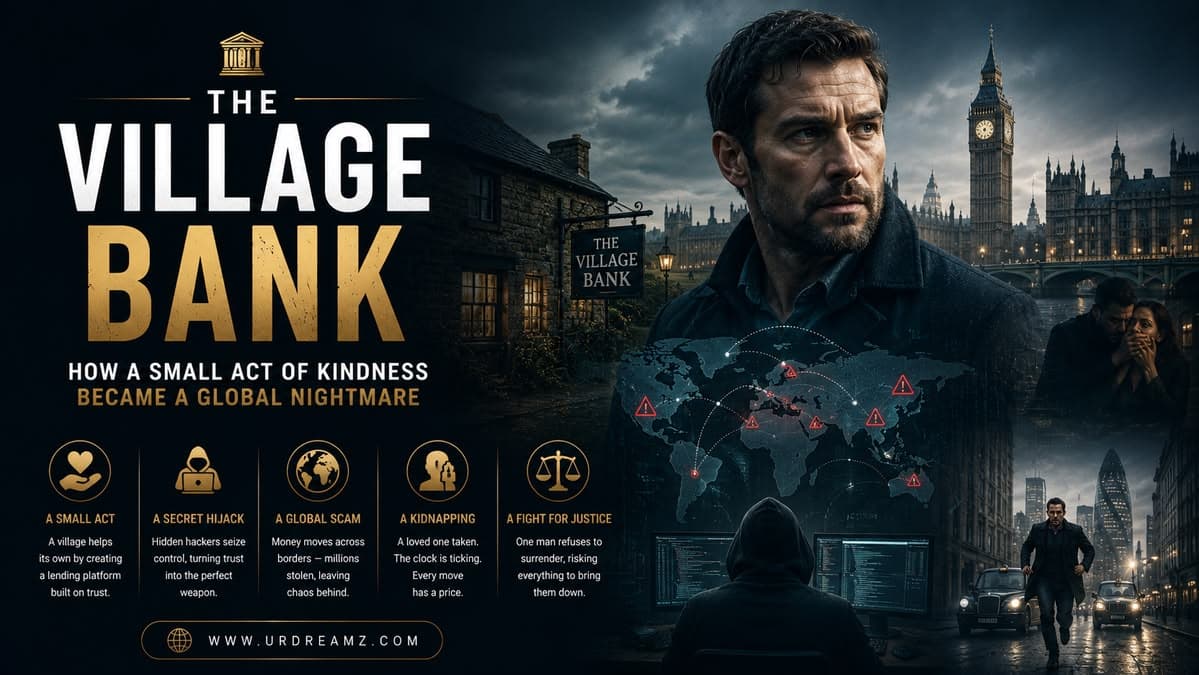
The Village Bank: How a Small Act of Kindness Became a Global Nightmare
There is a particular kind of danger that does not announce itself with sirens or headlines. It creeps in quietly, disguised as convenience, wrapped in the comforting language of technology, coding, and the promise of an easier life. We are told, again and again, that AI, software, and the online world exist to make things simpler for us. And mostly, they do. But every so often, a story surfaces that reminds us just how easily the very systems built to help people can be twisted into something capable of touching millions of lives at once — for the worse.
This is one such story. It takes place in and around Manchester, England, during the years when digital banking was reaching what many called its peak — a time when apps, online loan approvals, and instant transfers had become so normal that almost nobody stopped to ask how secure the invisible wiring behind them really was. What began as a small, well-meaning idea in a struggling household eventually spiraled into one of the most staggering financial and technological disasters imaginable — a scheme that, by the time it was finally stopped, had reached into the bank accounts of roughly eight hundred million people across Europe and the United States.
Before we go any further, a necessary note: this is a fictional story, inspired loosely by the kind of thriller plots you might find in a novel or a film. The characters, the exact events, and the scale of the scheme described here are dramatized for storytelling purposes. Only the general setting — Manchester and London, England — is real. Nothing here should be understood as a factual account of any real bank, company, or individual. We will return to this point again at the end, but it bears repeating clearly up front as well.
A Girl, A House, and A Debt She Never Chose
Our story begins with a young woman named Leona, who lived in a small village on the outskirts of Manchester. Leona's father had died when she was still quite young, and his passing left more than just grief behind. It left cracks — in the family's finances, in the walls of the house they lived in, and, in some ways, in the sense of stability every child assumes will always be there until it suddenly isn't.
By the time Leona was old enough to pursue her master's degree, the family home had two portions — essentially two separate floors that functioned almost like two households sharing one roof. The family had fallen into real hardship. Bills piled up. Repairs to the house went undone. And like so many young people who watch their families struggle, Leona began looking for a way to help, even while still balancing her studies.
What she came up with was simple, almost quaint compared to the chaos it would eventually unleash. She opened a small, informal lending operation out of her home — a kind of village-level banking service. Local residents, many of them working-class families with little access to traditional bank loans, could come to her for small amounts of money: some needed forty pounds, others needed fifty, each according to whatever gap they were trying to close that month. Leona processed these requests through a digital platform, approving loans quickly and without the bureaucratic friction of formal banks.
For a while, it worked beautifully. Word spread through the village. People who had once been turned away by banks, or who simply couldn't bear the paperwork and waiting periods, found in Leona's little operation something rare: speed, trust, and a human face behind the transaction. The system, in its early form, genuinely helped people. It gave the village a kind of informal safety net that no official institution had bothered to provide.
The Man Upstairs
Living in the upper portion of Leona's house was a man named Hileum. He worked for the country's anti-corruption department — a serious, disciplined man whose professional life revolved around uncovering exactly the kind of financial wrongdoing that would later come to define this story. Despite the seriousness of his day job, Hileum was warm toward Leona and the wider village. He supported her small lending initiative, seeing in it something genuinely good: ordinary people helping each other survive.
In his spare time, Hileum ran a modest dairy farm, employing around ten to twelve local workers. It was steady, honest work, and it gave him a second identity separate from the world of corruption investigations — a life among cows, fences, and early mornings, far removed from the digital shadows that would soon consume everyone around him.
Nobody, least of all Hileum, could have predicted that the quiet lending system operating one floor below his own bedroom would soon become the epicenter of a financial catastrophe large enough to make international headlines.
The Loan That Wouldn't End
Among the workers on Hileum's dairy farm was a man named David — hardworking, unremarkable in the best sense of the word, the kind of employee who showed up early and left late without complaint. Like many others in the village, David eventually turned to Leona's lending platform when he found himself short on cash. He requested a loan of fifty-three thousand — a significant sum for someone in his position — and, as had become routine, the loan was approved through the platform without much delay.
David repaid the loan. That, by any normal understanding of lending, should have been the end of the matter. But shortly afterward, he began receiving messages claiming that the loan carried additional interest he hadn't been told about, and that this interest also needed to be paid. Confused but not yet alarmed, David paid what was demanded, assuming it was simply a misunderstanding about terms he hadn't read carefully enough.
Then came a third message. And a third demand. This time, the tone had shifted — no longer a polite reminder, but a threat: pay, or face a police report. David paid again, increasingly uneasy but still unwilling to make trouble over what he assumed was a bureaucratic error somewhere in the system. When a fourth demand arrived, insisting yet again that more money was owed, something in David finally broke. This wasn't a misunderstanding. This was extortion, dressed up in the language of banking terms and legal threats.
He went to Leona directly, laid out everything that had happened, and asked her, plainly: what exactly was going on with her system?
Cracks in the System
Leona was stunned. As far as she knew, her lending platform charged simple, transparent terms — nothing like the escalating, threatening demands David described. She reached out to a trusted contact of hers, a cyber security specialist who lived some distance away and had occasionally helped her with technical matters related to the platform. When she explained what David had experienced, her contact's reaction was immediate concern — because, as it turned out, David wasn't the only one. Several other users had quietly reported similar experiences: loans repaid, followed by mysterious additional charges, followed by threats.
The cyber expert began digging. What they found was troubling in a way that went far beyond a village lending scheme gone wrong. The network behind the "additional interest" messages was extraordinarily well protected — far more sophisticated than anything a small, informal village platform should have required. Despite considerable effort, the expert could not fully breach its defenses. But they uncovered enough to understand the shape of what they were dealing with.
Whenever a loan was approved through the platform, something else happened quietly in the background: the borrower's phone contacts were being harvested. Every single number stored on that person's device was extracted, uploaded, and filtered. And this is where the story stops being about a village and starts becoming something far larger. The filtering process wasn't random. It was specifically designed to identify which of those extracted contacts belonged to individuals with active, traceable bank accounts — with particular attention paid to people employed in government or public-sector roles, whose financial information tended to be easier to cross-reference and exploit.
The Mathematics of a Catastrophe
To understand how something that started with a handful of village loans could spiral into a continent-spanning crisis, it helps to walk through the arithmetic the way the cyber expert eventually did. Imagine each borrower's phone contained, on average, a hundred contacts. Of those hundred, perhaps forty belonged to people with identifiable, hackable bank accounts. Now imagine that each of those forty people's phones was, in turn, harvested the same way — each yielding another forty exploitable contacts of their own.
This is not linear growth. It is exponential — the same kind of multiplying pattern that makes viral outbreaks, whether biological or digital, so difficult to contain once they cross a certain threshold. What began as a handful of village loan approvals fanned outward, contact list by contact list, account by account, until the network had quietly reached an almost unthinkable scale: something in the neighborhood of eight hundred million bank accounts across Europe and the United States, all silently compromised, all sitting dormant, waiting for a single coordinated trigger.
That trigger arrived on the first of the month — payday for hundreds of millions of ordinary people. As salaries landed in accounts across two continents, the hidden network activated all at once. Fifteen thousand here, twenty thousand there, forty thousand from another account — small enough, in many individual cases, to avoid immediate suspicion, but multiplied across hundreds of millions of victims, the total drained from the system reached a number so large it defied easy comprehension: something in the range of eight trillion dollars, extracted in a single coordinated wave.
Panic Spreads
It did not take long for the scale of what had happened to become impossible to hide. News outlets across Europe and the United States began reporting a wave of unexplained account drains hitting ordinary citizens on the very day their salaries arrived. Confusion turned quickly to panic. People who had budgeted carefully for the month found their accounts emptied overnight. Government employees — the very population the scheme had specifically targeted — were disproportionately affected, adding an unsettling layer of concern about how deeply compromised official systems might be.
Leona, watching the story unfold on national news and realizing with growing horror that the origin point somehow traced back to her small village lending platform, made the decision to travel to London, where her platform's main office — the administrative hub through which all of her loan approvals technically routed — was located. She needed answers. She needed to understand how something she had built to help her neighbors had become the ignition point for a crisis of historic proportions.
She never arrived. Somewhere along the road to London, Leona was kidnapped.
David's Darkest Hour
Back in the village, David — the man whose repeated, escalating loan demands had first exposed cracks in the system — spiraled into despair. He had, without ever intending to, been the thread that unraveled a scheme large enough to destabilize financial systems across two continents. Now the woman who had tried to help him, who had built her small lending platform out of genuine concern for people like him, had vanished, likely at the hands of whoever was truly behind the scheme.
The weight of it all — the extortion, the exposure, the disappearance of Leona, and the sheer, almost incomprehensible scale of the disaster his own case had helped uncover — pushed David to the edge of his own despair. He was not a man built for headlines or investigations. He was a farmhand who had simply wanted a loan to get through a difficult month, and instead had become tangled in something far larger than he could process.
It was at this darkest point that the story's true central figure stepped forward — not David, not Leona, but the quiet man who had lived one floor above the whole affair from the very beginning.
Hileum Takes Charge
Hileum, the anti-corruption officer and part-time dairy farmer who had supported Leona's village lending system from its earliest days, could not simply stand by. This was, in many ways, exactly the kind of case his professional life had trained him for — except now it was personal. The woman whose platform had been hijacked lived under his own roof. The scale of the crime dwarfed anything his department typically handled, but the starting thread was right there, in his own village.
He began his own investigation, working parallel to, and eventually far beyond, whatever official channels existed. His research led him to a local criminal network — a regional operation with connections to the kind of organized groups that often provide the muscle and logistics for schemes too large for any single hacker to run alone. This local network, it turned out, had been deeply involved in facilitating the scheme's operations in and around Manchester, providing cover, intimidation, and enforcement for whoever controlled the technology behind it.
Hileum approached them directly, delivering a clear warning: stop, cooperate, or face consequences. They refused. What followed was a violent confrontation in which Hileum, drawing on skills and resources most people around him had never suspected he possessed, dismantled the local network entirely, neutralizing roughly fifteen to twenty men connected to the operation. It was a turning point — the moment Hileum stopped being merely an investigator and became something closer to the story's reluctant, dangerous protagonist.
With the local branch of the operation eliminated, he set his sights on London — and on the main office where Leona's platform had, according to every thread of the investigation, been quietly hijacked from the very beginning.
Confronting the Head Office
In London, Hileum tracked down the administrative office that served as the nerve center of the scheme's operations — the same office Leona had been traveling toward when she disappeared. He confronted those in charge directly, making it unmistakably clear that he knew what they had built, how it worked, and that he intended to bring it down.
What he had not anticipated was how quickly the people behind the scheme could turn the tables, using tools that had nothing to do with physical confrontation and everything to do with control of information itself.
The Frame-Up
Within days, a video began circulating — first quietly, then explosively, across social media platforms throughout the United Kingdom and, soon after, across the rest of Europe. The footage appeared to show Hileum orchestrating the very scam he had spent weeks trying to dismantle. His face had been digitally altered onto footage of the scheme's actual operators, a manipulation sophisticated enough that, to the untrained eye, it looked entirely convincing.
The effect was immediate and devastating. Overnight, Hileum went from an anti-corruption officer hunting down a historic financial crime to the public face of that very crime. News outlets across Europe ran his image under headlines branding him the mastermind behind the eight-trillion-dollar scheme. The police, who might otherwise have supported his investigation, instead redirected their entire effort toward hunting him down — not as an ally, but as the primary suspect.
It was, in every sense, the scheme's most elegant defense mechanism: rather than fighting Hileum directly, its architects had simply rewritten the story of who he was, using the same digital tools that had enabled the original theft to now steal his reputation as well.
An Unexpected Ally
For several days, Hileum found himself a fugitive — hunted by the very institutions he had once worked alongside, unable to clear his name through any official channel, since those channels themselves had been turned against him. It was during this period that another figure entered the story: a young woman, previously unconnected to the main events, who had grown suspicious of how quickly and seamlessly the incriminating video had spread.
Working independently, she began tracing the footage back to its source, examining inconsistencies in lighting, movement, and digital artifacts that suggested manipulation. Within three or four days of dedicated work, she succeeded in recovering the original, unaltered footage — proof that Hileum's face had been artificially imposed onto someone else entirely. When she released this original footage publicly, the effect was almost as immediate as the frame-up itself had been. Public opinion, and eventually official scrutiny, began to shift.
But shifting public opinion is a slow process, and slower still is convincing an entire police force to reverse course after having already committed publicly to hunting a supposed criminal mastermind. Despite the emergence of the real footage, police continued pursuing Hileum, unwilling — or perhaps institutionally unable — to simply abandon a manhunt already so far underway.
A Desperate Night
Cornered, discredited in the eyes of the very institution meant to support his work, and running out of conventional options, Hileum made a decision that would define the darkest chapter of his pursuit of the truth. Late one night, he made his way to the private residence of the police commissioner overseeing the investigation against him. There, in a confrontation the story leaves largely to the imagination rather than dwelling on in detail, he extracted critical information about the scheme's remaining operations and about Leona's location — information that, up to that point, had been deliberately withheld or buried within the investigation.
The commissioner did not survive the encounter.
It was a line Hileum could never uncross, a moment where the story's protagonist became something far more morally complicated than a simple hero pursuing justice. And yet, from his perspective, it was a moment born of desperation — a man who had exhausted every legitimate avenue available to him, watching institutions meant to protect the public instead protect a criminal enterprise, and choosing, in that darkest of moments, to take matters entirely into his own hands.
The Video That Should Never Have Existed
Just as Hileum believed he was closing in on the scheme's final operators, the people behind the scam delivered their cruelest blow yet. They released a video showing Leona — still alive, still captive — connected to some form of electrical device. As the video began circulating and view counts climbed, so too, according to the mechanism the scammers had built into the footage, did the intensity of the current running through her.
It was a horrifying, almost unthinkable weaponization of viral attention itself — transforming the very metric that platforms use to measure engagement into an instrument of harm. As millions of people, many unaware of the video's true mechanism, clicked, watched, and shared it, each view pushed the situation further toward tragedy. By the time the video had reached roughly twenty million views, Leona was dead.
The horror of what had happened, however, left behind something the scheme's operators had not anticipated: a digital trail. A video with that many views, hosted and distributed through specific channels, could be traced — and traced it was. Investigators, working alongside whatever remained of Hileum's own network of contacts, managed to identify the IP address from which the original footage had been uploaded and controlled.
Reckoning
Armed with the location the IP trace revealed, Hileum moved directly against the individual in London who had been operating at the center of the scheme — the same person responsible for the device that had killed Leona. In a confrontation shaped by grim, poetic symmetry, this operator met an end mirroring the very method he had used against his victim, struck down in a manner tied to the same mechanism he had weaponized against Leona.
With the scheme's central figure eliminated, Hileum finally turned to the institutions he had spent the previous weeks fighting against, this time seeking their cooperation rather than avoiding their pursuit. With the true perpetrators exposed and the original manipulated video thoroughly discredited, official departments — including cyber crime units with far greater technical resources than any individual investigator could muster — began working alongside him rather than against him.
Together, they worked to reverse as much of the financial damage as possible, using recovered access to the scheme's own infrastructure to trace and return stolen funds to the millions of victims across Europe and the United States whose accounts had been drained. It was slow, painstaking work, nothing like the dramatic confrontations that had defined the weeks before, but it mattered enormously to the ordinary people whose salaries had vanished overnight months earlier.
Finally, with police support now fully behind him rather than arrayed against him, Hileum led a coordinated operation against what remained of the scheme's main head office — the administrative core from which the entire disaster had originally been set into motion. It was dismantled entirely, its infrastructure seized, its remaining operators taken into custody or otherwise removed from the picture.
The Village Before the Storm
To understand how devastating the eventual collapse felt, it helps to spend a little more time in the village before anything went wrong — back when Leona's small lending operation was still just a source of quiet local pride. In the months after she first opened her makeshift banking service, the atmosphere in the village genuinely began to shift. Families who had spent years avoiding the humiliation of formal bank rejections suddenly had somewhere to turn. A widow who needed money for a boiler repair. A young couple trying to cover a deposit on their first rented flat. A shopkeeper needing a short-term bridge loan to restock shelves before the holiday season. Leona approved these requests herself, often sitting at her kitchen table with a laptop, cross-referencing need against ability to repay, treating every applicant less like a transaction and more like a neighbor she happened to be able to help.
Word of her fairness spread. People began describing her, half-jokingly, as "the village bank" — a nickname that started as an affectionate joke and slowly became something closer to a genuine title. Hileum, watching from the floor above, often remarked to friends at the dairy farm that Leona had built something the big banks in London could never replicate: trust rooted in proximity, in actually knowing the people whose lives you were affecting with every approved or denied loan.
It is worth sitting with this image for a moment, because it makes everything that followed so much harder to reconcile. The system that would eventually be blamed for draining the accounts of hundreds of millions of strangers across two continents had, at its very origin, been built out of something almost tender — a young woman trying to hold her fractured family and struggling village together after the sudden loss of her father. Nothing about her intentions, at any point in this story, was ever malicious. That distinction matters enormously to how the rest of the story should be understood.
How the Platform Was Hijacked
The cyber expert's later investigation eventually reconstructed, at least partially, how the platform had been compromised in the first place. Leona's lending system, like countless small digital tools built by well-meaning but non-specialist developers, had been assembled quickly, using third-party components and templates rather than custom-built, heavily audited infrastructure. Somewhere within those borrowed components, a vulnerability had existed for months — invisible, dormant, and waiting.
Whoever discovered that vulnerability did not announce themselves. They did not deface the platform or draw attention to their access. Instead, they did something far quieter and, in hindsight, far more dangerous: they inserted themselves silently into the loan approval process itself, riding along on every legitimate transaction Leona's system processed. To Leona, everything continued to look completely normal. Loan requests came in. She reviewed them. She approved them. The interface she used every day gave no indication that, in the background, every approval was now triggering a second, hidden process entirely outside her knowledge or control.
This is, in many ways, the most unsettling detail of the entire story. The scheme did not require Leona to make a single mistake beyond the very human, very understandable choice to build her platform quickly and without the kind of expensive, specialized security auditing that only larger institutions could typically afford. It exploited not her carelessness, but her limitations — the gap between what a well-intentioned individual can build alone and what a large, resourced institution can properly secure.
The First Signs Nobody Noticed
Looking back later, several villagers would recall small, strange details from the weeks before David first raised the alarm — details that, at the time, seemed too minor to mention. One woman recalled her phone battery draining unusually fast for several days after her loan was approved. Another recalled receiving a handful of spam calls shortly after borrowing a small sum, calls she dismissed as unrelated nuisance marketing. A shopkeeper mentioned, almost as an aside, that his phone had briefly frozen and restarted on its own the same evening his loan went through.
None of these things, on their own, seemed worth reporting. This is often how large-scale digital compromises unfold in the real world as well — not through a single dramatic breach that sets off alarms, but through a scattering of small, easily dismissed anomalies that only make sense in hindsight, once pieced together after the fact. By the time David's escalating, threatening messages finally forced the issue into the open, the hidden network had already been quietly expanding for weeks, perhaps months, entirely undetected.
Inside the Kidnapping
Leona's disappearance on the road to London remained, for the first several days, almost entirely without explanation. Her family reported her missing. Local police opened an investigation that produced little beyond a description of her car found abandoned at a service station along her route. It was only later, once Hileum's own investigation began drawing connections between the local criminal network and the wider scheme, that a clearer picture emerged: Leona had not simply vanished into misfortune. She had been deliberately taken, almost certainly because the scheme's operators recognized that her platform's original owner represented a loose thread capable of unraveling their entire operation if she reached the London office and started asking the wrong questions to the wrong people.
In captivity, according to what was later pieced together from surviving communications and testimony, Leona was kept isolated, moved between locations more than once, and used, in the most calculated and cynical sense, as leverage — first quietly, as a means of discouraging investigation, and later, horrifically, as the centerpiece of the scheme's most extreme act of intimidation once its exposure became unavoidable.
The Weight Hileum Carried
It would be a mistake to portray Hileum's transformation from anti-corruption officer to something closer to a one-man vigilante force as effortless or without cost. Colleagues who had known him for years later described a man who seemed to age visibly over the course of just a few weeks — sleeping little, eating less, driven by a combination of guilt, obligation, and a growing recognition that no official process was moving quickly enough to save Leona or stop the scheme before it caused even more damage.
There is a particular kind of loneliness that comes from being right about something enormous while everyone around you insists you are wrong — and that loneliness defined much of Hileum's experience once the manipulated video began circulating. Former colleagues in the anti-corruption department, people who had worked alongside him for years, found themselves torn between personal loyalty and the overwhelming, seemingly conclusive video evidence being broadcast across every major news outlet. Some quietly continued feeding him information. Most, under pressure from their own superiors, distanced themselves entirely.
This isolation shaped many of the decisions Hileum made in the story's later chapters. Acting almost entirely without institutional support, cut off from the normal checks and oversight that might have moderated his approach, he increasingly relied on his own judgment alone — a dangerous position for anyone to occupy, and one that arguably explains, even if it cannot fully excuse, the increasingly extreme measures he resorted to as the story reached its climax.
The Aftermath in the Village
Long after the main office in London had been dismantled and the immediate crisis had passed, the village where this story began was left to reckon with what had happened. Leona's small lending platform, once a source of local pride, became a subject of quiet, uncomfortable silence. Villagers who had genuinely benefited from her loans — who had fixed boilers, covered deposits, restocked shelves — found themselves in an odd position, grateful for what her system had once given them, yet aware that the very same system had, through no fault of her own, become the origin point of a catastrophe felt by hundreds of millions of strangers.
David, whose escalating loan demands had first exposed the hidden network, struggled for a long time afterward with a complicated mixture of guilt and relief. Guilt, because his case had been the thread that unraveled everything, indirectly connected to Leona's disappearance and death. Relief, because if he hadn't pushed back against the mysterious interest demands, the scheme might have continued undetected far longer, reaching even further before anyone noticed.
Hileum, for his part, never fully returned to the life he had lived before. The dairy farm continued operating, managed increasingly by others as he became absorbed into the far larger, far more complicated work of helping investigators fully untangle a scheme that had touched hundreds of millions of accounts across two continents. The quiet, orderly life of an anti-corruption officer with a small farm on the side was, in every meaningful sense, gone — replaced by something heavier, something that came with the story's central, uncomfortable question still unresolved: whether the ends he ultimately achieved could ever fully justify the means he had used to reach them.
What Technology Experts Learned From a Story Like This
Even framed as fiction, stories built around plausible technological mechanisms tend to resonate because they mirror real concerns that cybersecurity professionals raise constantly, if rarely in language dramatic enough to make headlines. The idea of a lending platform silently harvesting contact lists and using them to identify further targets is not entirely divorced from real patterns seen in actual malware campaigns, which frequently spread by exploiting exactly this kind of trust network — the fact that people are far more likely to click a link, open a file, or trust a request that appears to come from someone in their own contact list rather than a stranger.
The exponential growth described in this story, where a relatively small starting point cascades into hundreds of millions of compromised accounts, echoes real-world discussions among security researchers about how quickly poorly secured, rapidly scaled digital systems can become vectors for enormous, cascading failures. Small platforms built quickly, without the resources of major institutions, are frequently cited as particularly vulnerable precisely because they combine real-world trust — the kind Leona had built with her village — with digital infrastructure that has not been tested against the kind of sophisticated, patient attackers capable of exploiting it silently over an extended period.
The Question of Justice
Perhaps the most difficult thread running through this entire story is the question of what justice actually looked like by the time it ended. The scheme's operators were stopped. The stolen funds were, at least largely, returned to their rightful owners. The main office responsible for orchestrating the disaster was dismantled. By almost any conventional measure, the story ends with the villains defeated and the immediate crisis resolved.
And yet, Leona was gone. The police commissioner Hileum confronted in the story's darkest chapter was gone as well, a death that occurred entirely outside any legal process, justified only by the desperate logic of a man who believed, rightly or wrongly, that official channels had already failed everyone who mattered. David carried guilt that no recovered funds could fully resolve. And Hileum himself emerged from the story not as a clean, uncomplicated hero, but as someone whose methods raised as many uncomfortable questions as they answered.
This is, in many ways, exactly the kind of moral ambiguity that separates a genuinely engaging thriller from a simple, tidy story of good triumphing over evil. Real justice, even in fiction, rarely arrives without cost, and this story — dramatized and exaggerated as it is — leaves that cost fully visible rather than conveniently forgotten in the final act.
Why This Kind of Story Keeps Getting Told
Stories combining financial fraud, hacking, kidnapping, and vigilante justice have become a familiar genre for a reason: they compress a very modern anxiety — the sense that our financial lives now depend on invisible, poorly understood digital systems — into a narrative structure old enough to feel emotionally familiar. Beneath the futuristic mechanics of hacked contact lists and viral-view-triggered devices lies an ancient storytelling shape: an ordinary person wronged, a quiet protector pushed past every reasonable limit, and a reckoning that arrives only after institutions meant to provide it have already failed.
What makes this particular version distinctive is the way it grounds its most extreme, almost science-fiction elements — a video whose view count directly determines the severity of harm inflicted on a hostage — within an otherwise mundane, believable setting: a village outside Manchester, a small lending platform, a dairy farm, an anti-corruption officer who never asked to become anyone's protector. That contrast, between the ordinary and the horrifying, between quiet village life and continent-spanning catastrophe, is precisely what gives the story its unsettling staying power.
Frequently Asked Questions
Q1: Is this story based on real events?
No. This is a completely fictional story, written in the style of a thriller novel or film. The characters — Leona, David, Hileum, and all others — are entirely invented. Only the general setting of Manchester and London in England is real.
Q2: Why does the story include so much detail about Manchester and London if it's fictional?
Grounding a fictional story in a real, recognizable setting helps make the narrative feel more believable and immersive, even when the events themselves are purely invented.
Q3: Is the scale of the scheme — eight hundred million accounts, eight trillion dollars — realistic?
The scale is deliberately exaggerated for dramatic effect. It is not meant to reflect any real-world event or capability, but rather to emphasize the story's central theme about how quickly trust-based digital systems could theoretically cascade if compromised.
Q4: What is the main message of this story?
The story explores the tension between convenience and vulnerability in modern digital systems, the unpredictable nature of how small, well-intentioned ideas can be twisted, and the morally complicated choices people sometimes make when institutional support fails.
Q5: Should I be worried about my own banking security after reading this?
While the story is fictional, it does touch on real concerns that cybersecurity professionals discuss regularly. If you have questions about your own digital security, it is always a good idea to consult verified, factual sources or speak with a qualified professional rather than relying on a dramatized story.
Q6: Were any real banks, companies, or individuals involved in this story?
No. No real bank, financial institution, government department, or individual is depicted, referenced, or accused of any wrongdoing. Any resemblance to actual events, organizations, or people is entirely coincidental.
Q7: Why does the story end with the question of whether Hileum's methods were justified?
The story is deliberately designed to leave that question open, because real justice and moral choices are rarely simple or clean. It invites the reader to consider whether extreme circumstances can ever justify extreme actions, without providing a neat, easy answer.
Conclusion
Stories like this one — dramatized, fictionalized, larger than life in almost every respect — nonetheless tend to linger in the imagination because they touch on something genuinely unsettling about the world we now live in. We have built systems that move money, verify identities, and connect people's most private information across borders in fractions of a second. Most of the time, this works exactly as intended, quietly making ordinary life easier in a thousand small ways.
But the same architecture that allows a small village lending platform to process loans instantly is, in principle, the same architecture that could, if compromised by the wrong hands, cascade outward with terrifying speed — contact list by contact list, account by account — until a local problem becomes a continental one. The fictional scale of this story, eight hundred million compromised accounts and eight trillion dollars in losses, is deliberately extreme, almost cinematic in its exaggeration. But the underlying anxiety it draws on is real: the fear that convenience and vulnerability are, in modern digital systems, often two sides of the very same coin.
It is also, in its own dramatic way, a story about the unpredictable places where courage and consequence collide. Hileum began the story as a quiet anti-corruption officer with a part-time dairy farm, a man whose greatest act of support toward Leona was simply believing in what she was trying to build for her village. He ended it as something far more complicated — a man who had crossed moral lines he never expected to cross, driven there by institutions that failed to protect the people they were meant to serve, and by a criminal network that had learned to weaponize not just money and data, but public perception itself.
As promised at the very beginning, it is important to close with complete clarity: this is a work of fiction, written in the style of a thriller novel or film, and inspired by exactly that kind of dramatic storytelling rather than by real events. The characters — Leona, David, Hileum, and every other figure in this account — are entirely fictional and bear no connection to any real person, living or deceased. Only the general setting, Manchester and London in England, reflects real places; everything else, including the banking scheme, the scale of the losses, the kidnapping, the frame-up, and every confrontation described, is a dramatized, invented narrative created purely for storytelling and entertainment purposes.
No real bank, financial institution, government department, or individual is being depicted, referenced, or accused of any wrongdoing in this story. Any resemblance to actual events, organizations, or people is entirely coincidental. If this story raised questions in your mind about real-world cybersecurity and financial fraud, those are absolutely worth exploring further — but they should be explored through verified, factual sources, not through a dramatized tale such as this one.
Thank you for reading this fictional story to the end. If it kept you turning the page — or scrolling — that was, at its core, always its only real purpose: to entertain, not to inform anyone about actual events. Please treat it accordingly, and if you ever come across similar dramatic claims presented as real news online, take a moment to verify them through trustworthy sources before believing or sharing them further.