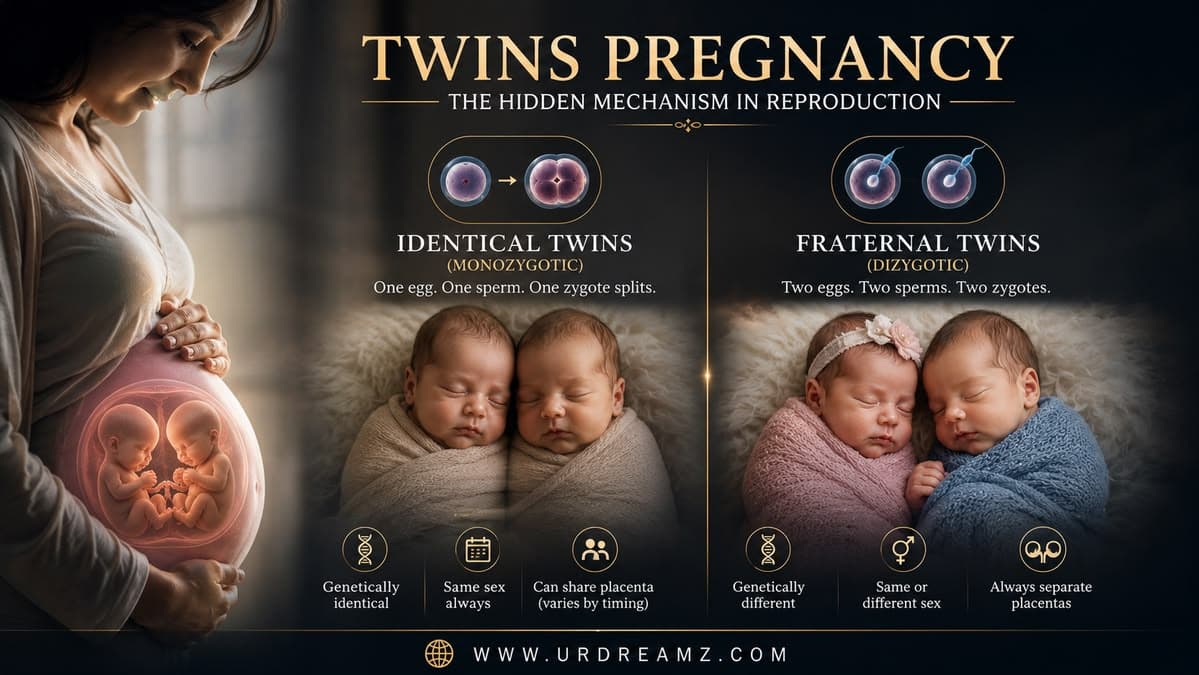
Twins Pregnancy, Triplets & Beyond: The Hidden Mechanism In Reproduction
Somewhere between one and two days after fertilization, a single cell can make a decision that will define two entire human lives — whether to stay whole, or to split into two. The exact day that split happens determines almost everything that follows: whether the resulting twins will have their own separate placenta or share one, whether they'll face serious risks like tangled umbilical cords, or in the rarest cases, whether they'll remain physically joined for life. This guide walks through the complete biological mechanism behind twin and multiple pregnancies — identical and fraternal twins, the four distinct placental configurations, real conjoined twin cases, Vanishing Twin Syndrome, and the leading scientific theories for why this splitting happens at all.
1. What Is a Twin Pregnancy?
A twin pregnancy means carrying two babies at the same time inside the uterus. It is typically confirmed through an ultrasound, which can identify not just that two babies are present, but also critical structural details — specifically, whether the two babies share a single placenta or each have their own. This distinction is not a minor technicality; as this guide will show, it is arguably the single most important factor determining how safe or risky a particular twin pregnancy will be.
2. The Two Fundamental Types of Twins
All twin pregnancies fall into one of two fundamentally different biological categories: Identical Twins (also called monozygotic twins) and Fraternal Twins (also called dizygotic twins). Although both result in two babies being born together, the underlying biological events that produce them are entirely different, and understanding this difference is the foundation for understanding everything else about twin pregnancy.
3. Identical Twins: One Egg Becomes Two
Identical twins begin with a single, ordinary fertilization event — one egg, fertilized by one sperm, forming what is called a zygote. Under normal circumstances, this single zygote would go on to develop into one baby. In an identical twin pregnancy, however, at some point after fertilization, this single zygote splits into two separate, genetically identical groups of cells, each capable of independently developing into a complete, healthy baby.
What makes this process especially remarkable is that a healthy split does not create a "weaker" or "stronger" baby out of the original one — both resulting embryos carry the exact same full genetic instructions and, in most cases, go on to develop as two completely healthy, independent individuals. This is an important point worth emphasizing, since a common misconception assumes that twin pregnancies inherently mean one baby "shares" or "steals" resources meant for a single baby. In truth, especially in the earliest and safest form of splitting, each resulting embryo proceeds largely as if it were its own independent pregnancy from that point forward.
4. Why Timing Is Everything
Here is the single most important concept in this entire guide: exactly when, after fertilization, this zygote splits determines nearly everything about the resulting pregnancy — how many placentas will form, how many amniotic sacs will exist, and how much risk the pregnancy will carry. The same basic event — one zygote becoming two — can result in outcomes ranging from a very low-risk pregnancy to an extremely high-risk one, purely based on the timing of the split, measured in days.
5. Type 1: Splitting Within 1-3 Days (DCDA Twins)
If the zygote splits very early — within roughly the first one to three days after fertilization — the two resulting embryos separate before the placenta has even begun forming. As a result, each twin develops its own completely separate placenta and its own separate amniotic sac. This configuration is called Dichorionic-Diamniotic, commonly abbreviated as DCDA.
6. Why DCDA Twins Are Considered the Safest
DCDA twins are widely regarded as the safest form of twin pregnancy. Since each baby has an entirely independent placenta and nutrient supply, there is no direct blood-flow connection between the two babies — meaning one twin cannot draw resources away from the other, and complications affecting one baby's placenta generally do not directly endanger the other. Neither baby is inherently "weaker" simply for being a twin in this configuration; both typically develop with essentially the same health prospects as a single, non-twin pregnancy would offer.
Interestingly, all fraternal twins are DCDA by default, since they originate from two entirely separate fertilized eggs that never shared a common placental origin in the first place. This is one of several reasons doctors place particular importance on determining chorionicity (whether one or two placentas are present) as early as possible during a twin pregnancy — it does not just tell them whether the twins are identical or fraternal, it directly tells them how closely the pregnancy needs to be monitored going forward.
7. Type 2: Splitting at Days 4-8 (MCDA Twins)
If the split instead happens somewhat later — roughly between day 4 and day 8 after fertilization — the outer layer of cells that will eventually become the placenta has already begun forming before the split occurs. Since this placenta-forming layer is shared before the split happens, the two resulting twins end up sharing a single placenta, even though each baby still develops within its own separate amniotic sac. This configuration is called Monochorionic-Diamniotic, or MCDA — and notably, this is the single most common configuration among all identical twin pregnancies.
8. Understanding the Trophoblast and Shared Placenta
The specific outer layer of cells responsible for eventually forming the placenta is called the trophoblast. In MCDA twins, because the split happens after this trophoblast layer has already begun developing, both babies end up drawing nutrients and oxygen from the same shared placental structure, even though they remain physically separated by their own individual amniotic membranes. Because the two babies share a single placenta and its associated blood vessel network, MCDA pregnancies require noticeably closer medical monitoring than DCDA pregnancies, due to the possibility of imbalanced blood flow between the twins.
This blood vessel network within a shared placenta can, in some cases, develop uneven connections between the two babies' circulatory systems — a situation that can lead to a serious condition called twin-to-twin transfusion syndrome, where one twin ends up receiving a disproportionate share of blood flow at the expense of the other. Because of this risk, doctors managing MCDA pregnancies typically schedule more frequent ultrasounds, specifically checking amniotic fluid levels and growth patterns for both babies, so that any emerging imbalance can be identified and, where possible, managed before it becomes seriously dangerous for either baby.
9. Type 3: Splitting at Days 8-13 (MCMA Twins)
If the split is delayed even further — occurring between roughly day 8 and day 13 after fertilization — the zygote has, by this point, already implanted into the uterine wall. When the split finally occurs at this stage, not only do the twins share a single placenta, but they also end up sharing a single amniotic sac. This configuration is called Monochorionic-Monoamniotic, or MCMA, and it carries meaningfully higher risk than the earlier two types.
10. The Danger of a Shared Amniotic Sac: Cord Entanglement
Because MCMA twins share a single amniotic sac, both babies float freely within the exact same fluid space, without any dividing membrane separating them. Since each baby has its own umbilical cord extending from the shared placenta, this shared space creates a real and serious risk: as the babies move around within the sac, their umbilical cords can become wrapped around each other, or wrapped around one of the babies themselves — a complication known as cord entanglement, or, when a cord wraps around a baby's own neck, a nuchal cord.
MCMA pregnancies are considerably rarer than the DCDA and MCDA types described above, accounting for only a small fraction of overall twin pregnancies, precisely because the required timing window for this specific outcome — the zygote splitting between roughly day 8 and day 13 — is relatively narrow. Because of the elevated risk involved, MCMA pregnancies are typically managed as high-risk from the outset, often involving hospital admission for continuous fetal monitoring during the later stages of pregnancy, specifically to watch for any signs of cord compression affecting either baby's heart rate.
11. What Doctors Do When Cord Entanglement Occurs
When a nuchal cord or broader cord entanglement is detected, doctors closely monitor both babies' heart rates, since restricted blood flow through a tangled cord can directly compromise a baby's oxygen supply. If the entanglement is relatively minor and does not appear to be affecting fetal wellbeing, doctors may continue close monitoring throughout pregnancy. However, if the tangling is more severe, or if there are signs that a baby's heart rate or oxygen supply is being significantly affected, doctors will typically plan a C-section delivery rather than risking a vaginal delivery, since the cord entanglement can create serious danger during the physical process of labor itself.
12. Type 4: Splitting After 13 Days (Conjoined Twins)
In the rarest and most complex scenario, if the zygote's split is delayed beyond day 13 after fertilization, the developing embryo has, by this point, already implanted and progressed significantly further in its development. When the split finally attempts to occur this late, it is often incomplete — the two developing embryos begin to separate, but do not fully divide, leaving them physically joined together at one or more points on the body. This results in conjoined twins.
13. How Doctors Evaluate Conjoined Twins for Separation
Conjoined twins can be joined at many different points on the body — the chest, abdomen, back, or, in some rare and especially complex cases, the head. Doctors evaluating whether surgical separation is possible focus heavily on whether critical organs are shared. If, for example, the twins share a single heart, or in a condition called craniopagus — where the twins are joined at the head and share brain tissue — separation surgery becomes either extraordinarily difficult or, in some cases, simply not possible without severe risk to one or both individuals.
When separation is medically feasible, it typically requires an extensive, carefully planned surgical team spanning multiple specialties — pediatric surgeons, cardiologists, neurosurgeons, and anesthesiologists, depending on exactly which structures are shared — and can take many hours, sometimes even spanning multiple separate surgical sessions over weeks or months. Even in cases where separation is technically possible, doctors and families must weigh the surgical risks against the quality of life each twin might have both with and without separation, since some conjoined twins, as the following real cases illustrate, go on to live full, meaningful, connected lives without ever undergoing separation at all.
14. Real Case: Abby and Brittany Hensel
One of the most well-known real-life cases of conjoined twins in the United States involves Abby and Brittany Hensel. They are what is known as dicephalic conjoined twins, meaning each has her own separate head and neck, but they share a single body below that point. Rather than undergoing separation surgery — which would not have been survivable given how extensively their internal organs and body are shared — they have lived their entire lives as conjoined individuals.
One of the most well-known real-life cases of conjoined twins in the United States involves Abby and Brittany Hensel. They are what is known as dicephalic conjoined twins, meaning each has her own separate head and neck, but they share a single body below that point. Rather than undergoing separation surgery — which would not have been survivable given how extensively their internal organs and body are shared — they have lived their entire lives as conjoined individuals.
Physiologically, each twin has full sensation and control over her own side of their shared body — Abby controls the right arm and leg, while Brittany controls the left, and they have each developed independent, distinct personalities, preferences, and voices despite sharing so much of their physical form. Their case is frequently cited in medical literature as one of the most successful examples of dicephalic twins living long-term without separation surgery, precisely because their shared organs, including a single circulatory and digestive system beneath the waist, made any separation attempt fundamentally incompatible with both twins surviving.
"), ] for old, new in repls: assert old in content, old[:60] content = content.replace(old, new) with open('twins-pregnancy-blog.js', 'w', encoding='utf-8') as f: f.write(content) print("done")15. Their Remarkable, Independent Lives
What makes their story particularly remarkable is how fully independent and accomplished their lives have become despite sharing a single body. Both became certified teachers after completing their education, and both learned to drive — each controlling the limbs on her own side of their shared body, coordinating together to operate the vehicle. Abby went on to marry a U.S. Army nurse named Josh Bowling, and interestingly, on their marriage paperwork, the documentation specifically reflects that he married Abby individually, reflecting the way the law and the sisters themselves navigate their unique, dual-identity existence within one physical body.
16. Real Case: Lori and George Schappell
Another well-documented case involves Lori and George Schappell (formerly known as Lori and Reba Schappell), who were joined at the head and shared brain tissue — a true craniopagus conjoined twin pair. Unlike Abby and Brittany, Lori and George each had their own separate body below the point of connection. They lived a genuinely full and independent life, both pursuing individual careers as musicians, and remained together until their passing in 2024, at the age of 62 — a lifespan that itself speaks to how much medical understanding and care for conjoined twins has advanced over the decades.
Craniopagus twins like Lori and George represent one of the rarest and most complex forms of conjoined twinning, occurring in only a small fraction of already-rare conjoined twin cases. Because their conjoinment involved actual shared brain tissue and vascular structures within the skull, separation was never considered a viable option for them, given the near-certainty of catastrophic harm to at least one twin. Instead, their story became a widely cited example of how conjoined individuals can lead genuinely rich, self-determined lives — each maintaining her or his own distinct identity, career, and independence, while sharing a physical connection most people find difficult to imagine.
17. Why Timing Is the Single Biggest Factor
Looking back across all four configurations — DCDA, MCDA, MCMA, and conjoined twins — the single unifying factor determining which outcome occurs is simply when, in terms of days after fertilization, the zygote splits. One day, three days, eight days, thirteen days — this single variable of timing is what separates a low-risk, fully independent twin pregnancy from one involving lifelong physical connection between two individuals.
18. Why Identical Twins Are Always the Same Sex
An important and consistent feature across all forms of identical (monozygotic) twins is that they are always the same biological sex — if one baby is male, the other will also be male, and the same applies for female twins. This is because identical twins originate from the exact same fertilized egg, meaning they share identical DNA, including the same sex chromosomes, from the very beginning. There is no possibility of an identical male-female twin pair, precisely because the genetic material determining sex was set at the single moment of fertilization, before the split even occurred.
19. Fraternal Twins: Two Separate Eggs
The second major category, fraternal twins (also called dizygotic twins), involves an entirely different starting mechanism. Rather than a single fertilized egg splitting into two, fraternal twins begin when two separate eggs are released — one from the left ovary and one from the right, or occasionally both from the same ovary — and each egg is fertilized by a separate sperm cell. This produces two entirely distinct zygotes from the very beginning, each with its own unique combination of genetic material.
20. Can Different Types of Twins Happen Together?
Interestingly, it is biologically possible for both mechanisms to occur within the same pregnancy simultaneously. For example, if two separate eggs are released and fertilized — one from the left ovary and one from the right — but then one of those two resulting zygotes itself splits into two, the pregnancy could result in triplets: one set of identical twins from the split zygote, plus one additional fraternal sibling from the other, separately fertilized egg.
21. Superfetation and Hyperovulation
This kind of multiple-egg release phenomenon is sometimes referred to as hyperovulation, and in certain rare cases, an even more unusual phenomenon called superfetation can occur, where a second egg is fertilized at a slightly later point after the first pregnancy has already begun. These phenomena illustrate that fraternal twinning is fundamentally tied to how many eggs are released and fertilized during a single reproductive cycle, distinct from the single-zygote-splitting mechanism behind identical twins.
22. Why Fraternal Twin Genetics Cannot Be Predicted
Because fraternal twins originate from two entirely separate fertilization events, there is no way to predict their sex combination in advance — they could be two boys, two girls, or one of each, with roughly equal likelihood for each combination, much like any two individual pregnancies happening to occur at the same time. Genetically, fraternal twins share, on average, about the same proportion of DNA as any typical siblings — roughly 50% — despite having developed in the womb together and being born on the same day.
23. Cause One: Genetics
Several distinct factors can contribute to the release of multiple eggs during ovulation, leading to fraternal twins. The first is genetics — a tendency toward releasing more than one egg during ovulation, sometimes called a hyperovulation trait, can run in families and be passed down, which is part of why fraternal twins are often observed to "run in the family" on the mother's side specifically.
24. Cause Two: Fertility Drugs and FSH
A second major cause involves fertility treatments. Many fertility medications work specifically by increasing levels of Follicle-Stimulating Hormone (FSH) in the body, a hormone that plays a central role in stimulating the ovaries to mature and release eggs. Since FSH directly governs how many follicles mature toward ovulation in a given cycle, medications that boost FSH levels can meaningfully increase the likelihood that more than one egg is released and fertilized during that same cycle, raising the chances of a fraternal twin (or higher multiple) pregnancy.
25. Cause Three: IVF (In Vitro Fertilization)
The third major cause is IVF (In Vitro Fertilization), a process commonly used by couples facing fertility challenges. In IVF, eggs and sperm are combined in a laboratory setting to create embryos outside the body, and one or more of these embryos are then transferred directly into the uterus. Because it is technically possible to transfer multiple embryos during a single IVF procedure, a multiple pregnancy can result directly and deliberately from this technical choice — if several embryos are transferred and successfully implant, each will develop as its own separate, fraternal-type pregnancy, occurring simultaneously within the same uterus.
Historically, transferring multiple embryos was a fairly common practice specifically to improve the overall odds of at least one successful pregnancy, since not every transferred embryo successfully implants. However, as IVF success rates for individual embryo transfers have improved over the years, many fertility clinics have shifted toward transferring a single embryo per cycle wherever medically appropriate, specifically to reduce the higher health risks associated with multiple pregnancies for both the mother and the babies. That said, multiple embryo transfer remains a deliberate, available option in certain cases, meaning some IVF-related twin or higher-multiple pregnancies are the result of an intentional clinical decision rather than pure biological chance.
26. So Why Does a Zygote Actually Split? The Scientific Theories
While the mechanisms behind fraternal twinning (multiple eggs, multiple fertilizations) are well understood, the deeper question of why a single zygote sometimes splits into two — the origin of identical twins — remains genuinely unresolved in modern science. Researchers have proposed several plausible theories, but none has been definitively confirmed as the actual cause.
27. Theory One: Cell Adhesion Problems
One proposed explanation involves what's called cell adhesion problems. In the earliest stages of embryonic development, the initial cells of the developing zygote are held together by adhesive bonds. According to this theory, if this binding between the very first cells is weaker than normal, the cells may separate from one another prematurely. Since each of these earliest cells retains what is called totipotency — the ability to independently develop into a complete, separate individual — this early separation could result in two distinct embryos rather than one.
28. Theory Two: Mechanical Force
A second proposed explanation involves simple mechanical force. As the developing embryo travels through the fallopian tube toward the uterus for implantation, the natural muscular contractions of the reproductive tract — a process called peristalsis — could potentially exert enough physical pressure or movement on the delicate, early-stage embryo to cause it to split into two separate groups of cells.
29. Theory Three: Delayed Implantation
A third theory centers on delayed implantation. Normally, a fertilized egg implants into the uterine lining within roughly three to four days of reaching the uterus. According to this theory, if implantation is delayed — taking six to eight days or longer instead — this extended, unattached period may create conditions under which the zygote becomes more likely to split into two separate developing embryos.
30. Science Admits the Limits of Its Own Answer
It is worth being direct about something important here: despite these theories, modern medical science openly acknowledges that the fundamental cause of identical twin splitting remains classified as occurring "for an unknown reason." Researchers have specifically ruled out several commonly assumed explanations — it is not caused by the father's sperm, it is not linked to any particular hormone imbalance, it is not tied to overall health status, and it is not the result of any identifiable genetic defect. Given this genuine scientific uncertainty, it is worth noting that the Quran, in Surah Ash-Shura, describes Allah as the sole possessor and controller of the heavens and the earth, granting whomever He wills a female child, a male child, or none at all, according to His own will and power — a framework many find meaningful precisely in a space where empirical science itself acknowledges the limits of its current explanatory power.
This gap between what science can describe and what it can fully explain is not unique to twin pregnancy — it appears throughout many areas of biology where a phenomenon is well-documented in terms of its mechanics, timing, and downstream effects, while its ultimate root trigger remains elusive. Identical twinning is a particularly striking example precisely because the outcome is so binary and so consequential — either a zygote splits, or it does not — and yet, after decades of dedicated research, no single confirmed trigger has been isolated as the definitive cause behind that decision.
31. Vanishing Twin Syndrome (VTS)
Not every twin pregnancy that begins as two ends as two. In a phenomenon known as Vanishing Twin Syndrome (VTS), one of the twins — despite having successfully split and begun developing, sometimes even having its own detectable heartbeat on an early ultrasound — stops developing and effectively disappears during the pregnancy, typically within the first trimester. In many cases, the remaining tissue is either reabsorbed by the mother's body or, in shared-placenta pregnancies, absorbed into the placenta shared with the surviving twin. This phenomenon is estimated to occur in as many as 25% of confirmed twin pregnancies, though it often goes completely undetected unless an early ultrasound happened to capture the presence of both twins beforehand.
For expecting parents, learning about Vanishing Twin Syndrome can understandably be emotionally difficult, particularly if they had already seen and bonded with the idea of two babies on an early scan. Doctors generally reassure patients that VTS, when it occurs early in the first trimester, typically poses no direct danger to the surviving twin or to the mother, and the ongoing pregnancy usually proceeds normally from that point forward. In some cases, mild spotting or cramping may accompany the loss, though many women experience no noticeable physical symptoms at all, only learning about it retrospectively when a later ultrasound shows only one baby where two were previously seen.
32. Why One Twin Sometimes Doesn't Survive
Several potential causes are associated with Vanishing Twin Syndrome. One significant factor is chromosomal abnormality — rather than the typical 46 chromosomes, an affected embryo might carry an abnormal count, such as 45 or 47, making healthy continued development impossible. A second potential cause involves errors occurring during the normal process of cell division as the embryo grows. A third relates to problems with placental blood supply, particularly relevant in shared-placenta twin pregnancies, where one twin may not receive adequate nutrients and oxygen. A fourth potential factor is simply insufficient space within the uterus to support the continued healthy development of both embryos simultaneously.
33. Common Twin Pregnancy Symptoms
Twin pregnancies often present with certain symptoms more intensely than typical single pregnancies, frequently prompting closer investigation with an ultrasound. These commonly include stronger and more prolonged early pregnancy nausea, a uterus that grows visibly larger or faster than expected for the stage of pregnancy, unusually elevated pregnancy hormone (hCG) levels detected on blood testing, and, once fetal monitoring equipment can detect it, more than one distinct heartbeat.
34. Twin Pregnancy Risks to Watch For
Because carrying two babies places significantly greater demands on the mother's body, twin pregnancies carry a meaningfully elevated risk profile compared to single pregnancies. Key risks include high blood pressure and preeclampsia, gestational diabetes, preterm labor and early delivery, and — specifically in identical twin pregnancies sharing a placenta — complications related to imbalanced shared blood flow and nutrient distribution between the two babies, such as twin-to-twin transfusion syndrome in monochorionic pregnancies.
35. Prenatal Care and Delivery for Twins
Given these elevated risks, twin pregnancies require noticeably more intensive prenatal care than single pregnancies — including more frequent doctor visits and ultrasound scans to closely monitor both babies' growth and wellbeing, along with a greater focus on adequate iron, calcium, and overall healthy weight gain to support two developing babies simultaneously. Delivery is often planned around 36 to 37 weeks, somewhat earlier than a typical single pregnancy, and may be managed through induced labor or a planned C-section, depending on the specific placental configuration, the position of the babies, and any complications identified during pregnancy monitoring.
36. Summary Table: All Four Twin Types Compared
| Split Timing | Configuration | Placenta | Amniotic Sac | Relative Risk |
|---|---|---|---|---|
| Day 1-3 | DCDA (Dichorionic-Diamniotic) | Separate | Separate | Lowest |
| Day 4-8 | MCDA (Monochorionic-Diamniotic) | Shared | Separate | Moderate |
| Day 8-13 | MCMA (Monochorionic-Monoamniotic) | Shared | Shared | High |
| After Day 13 | Conjoined Twins | Shared | Shared | Highest / Complex |
| Feature | Identical (Monozygotic) | Fraternal (Dizygotic) |
|---|---|---|
| Origin | One egg, one sperm, zygote splits | Two separate eggs, two separate sperm |
| DNA Shared | ~100% | ~50% (like regular siblings) |
| Sex | Always the same | Can be same or different |
| Placenta Type | Depends on split timing | Almost always separate |
37. AI Image Generation Prompts for This Topic
For anyone looking to generate accompanying visuals for this topic using an AI image tool such as Google's labs.google (ImageFX/Whisk), the following descriptive prompts are designed to produce clear, educational, medically-styled illustrations for each major concept covered in this guide.
| Visual Needed | Suggested Prompt |
|---|---|
| Zygote Splitting Timeline | "A clean, modern medical infographic showing a single fertilized human egg splitting into two cells at four different time points labeled Day 1-3, Day 4-8, Day 8-13, and After Day 13, with soft blue and white color palette, minimalist scientific illustration style, white background, labeled arrows" |
| DCDA vs MCDA vs MCMA Comparison | "A medical diagram comparing three types of twin pregnancy placental configurations: two separate placentas with two separate sacs, one shared placenta with two separate sacs, and one shared placenta with one shared sac, cross-section illustration of a uterus, labeled clearly, clean flat vector medical illustration style, pastel colors" |
| Identical vs Fraternal Twins Diagram | "A side-by-side educational diagram comparing identical twins (one egg splitting into two identical embryos) and fraternal twins (two separate eggs each fertilized by separate sperm), simple flat vector illustration, labeled with arrows, soft color palette, white background, medical textbook style" |
| Conjoined Twins Formation Concept | "An educational, respectful, non-graphic conceptual illustration showing a delayed embryo split resulting in two connected forms, abstract and simplified silhouette style, soft pastel tones, educational medical diagram, white background, no realistic human depiction" |
| Vanishing Twin Syndrome Illustration | "A gentle medical illustration showing an early ultrasound view of a uterus with two gestational sacs at one stage and a single remaining sac at a later stage, timeline arrow between the two images, soft blue tones, minimalist flat vector medical illustration" |
| Twin Pregnancy Ultrasound Concept | "A stylized, simplified ultrasound scan illustration showing two small fetal outlines within a uterus, soft grayscale ultrasound aesthetic with labeled callouts, clean medical educational style" |
Note: When generating medical illustrations with AI tools, favor simplified, diagrammatic, non-photorealistic styles rather than realistic human imagery, both for clarity as an educational aid and to avoid any content policy restrictions many AI image generators apply to realistic depictions of pregnancy, embryos, or medical procedures.
38. Frequently Asked Questions
- Q1: What is the difference between identical and fraternal twins?
- Identical twins come from a single fertilized egg that splits into two, sharing nearly 100% of their DNA and always the same sex. Fraternal twins come from two separate eggs fertilized by two separate sperm, sharing about 50% DNA like regular siblings, and can be the same or different sexes.
- Q2: What determines whether twins share a placenta?
- For identical twins, this depends entirely on how many days after fertilization the zygote splits — an earlier split (days 1-3) results in separate placentas, while a later split (days 4-8 or beyond) results in a shared placenta.
- Q3: What are DCDA, MCDA, and MCMA twins?
- These describe the placental and amniotic sac configuration: DCDA twins have separate placentas and sacs (lowest risk), MCDA twins share one placenta but have separate sacs, and MCMA twins share both one placenta and one sac (highest risk among non-conjoined twins).
- Q4: What causes conjoined twins?
- Conjoined twins result when a zygote's split is delayed beyond roughly 13 days after fertilization, causing the separation to be incomplete, leaving the twins physically joined at one or more points.
- Q5: Why is a nuchal cord dangerous in twin pregnancies?
- In MCMA twins sharing a single amniotic sac, umbilical cords can become tangled or wrapped around a baby's neck, restricting blood flow and oxygen, sometimes requiring a planned C-section delivery.
- Q6: Are identical twins always the same sex?
- Yes. Since identical twins originate from the same fertilized egg and share identical DNA, including sex chromosomes, they are always the same biological sex.
- Q7: What causes fraternal twins?
- Fraternal twins result from the release and fertilization of two separate eggs during the same cycle, influenced by genetics, fertility medications that increase FSH, or IVF procedures involving multiple embryo transfers.
- Q8: Why do fertility drugs increase the chance of twins?
- Many fertility drugs work by raising Follicle-Stimulating Hormone (FSH) levels, which can cause more than one egg to mature and release during a single ovulation cycle.
- Q9: Does science know exactly why a zygote splits into identical twins?
- No. Despite several proposed theories, including cell adhesion problems, mechanical force, and delayed implantation, the precise cause of identical twin splitting remains scientifically unconfirmed.
- Q10: What is Vanishing Twin Syndrome?
- Vanishing Twin Syndrome occurs when one twin in a confirmed twin pregnancy stops developing and is reabsorbed by the body or placenta, occurring in an estimated 25% of twin pregnancies, usually in the first trimester.
- Q11: Can conjoined twins always be surgically separated?
- Not always. Separation depends heavily on which organs are shared; cases involving a shared heart or shared brain tissue (craniopagus) are often extremely difficult or impossible to separate safely.
- Q12: What are common symptoms of a twin pregnancy?
- Common symptoms include stronger early pregnancy nausea, faster uterine growth, higher hCG hormone levels, and detecting more than one heartbeat on fetal monitoring.
- Q13: What are the main risks of a twin pregnancy?
- Key risks include preeclampsia, gestational diabetes, preterm labor, and, in shared-placenta pregnancies, complications like twin-to-twin transfusion syndrome.
- Q14: When are twins typically delivered?
- Twin deliveries are often planned around 36 to 37 weeks, somewhat earlier than typical single pregnancies, via induction or C-section depending on the specific pregnancy's circumstances.
- Q15: Can both identical and fraternal twins occur in the same pregnancy?
- Yes, in rare cases. If two separate eggs are fertilized and one of the resulting zygotes then splits, the pregnancy can result in triplets combining both an identical pair and a separate fraternal sibling.
39. Conclusion
Twin pregnancy is, at its core, a story about timing. A single fertilized egg's decision to split — whether on day one or day thirteen — cascades into entirely different outcomes: two babies with completely independent placentas and minimal added risk, two babies sharing a single placenta requiring close monitoring, two babies sharing one amniotic sac with real risk of cord entanglement, or, in the rarest cases, two lives that remain physically connected from the very beginning. Alongside this, fraternal twins tell an entirely separate story, rooted in genetics, fertility treatment, and the simple release of more than one egg in a single cycle. And running beneath both stories is a genuine scientific humility — despite decades of research, no one fully knows why a zygote sometimes chooses to become two rather than one. Understanding this full picture, from DCDA to conjoined twins, from Vanishing Twin Syndrome to the real, remarkable lives of people like Abby and Brittany Hensel, offers a far richer appreciation for just how much complexity, and how much sheer biological chance, underlies something as seemingly simple as "having twins."