The Science of Saffron: How Zafraan Affects the Brain, Body, and Strength
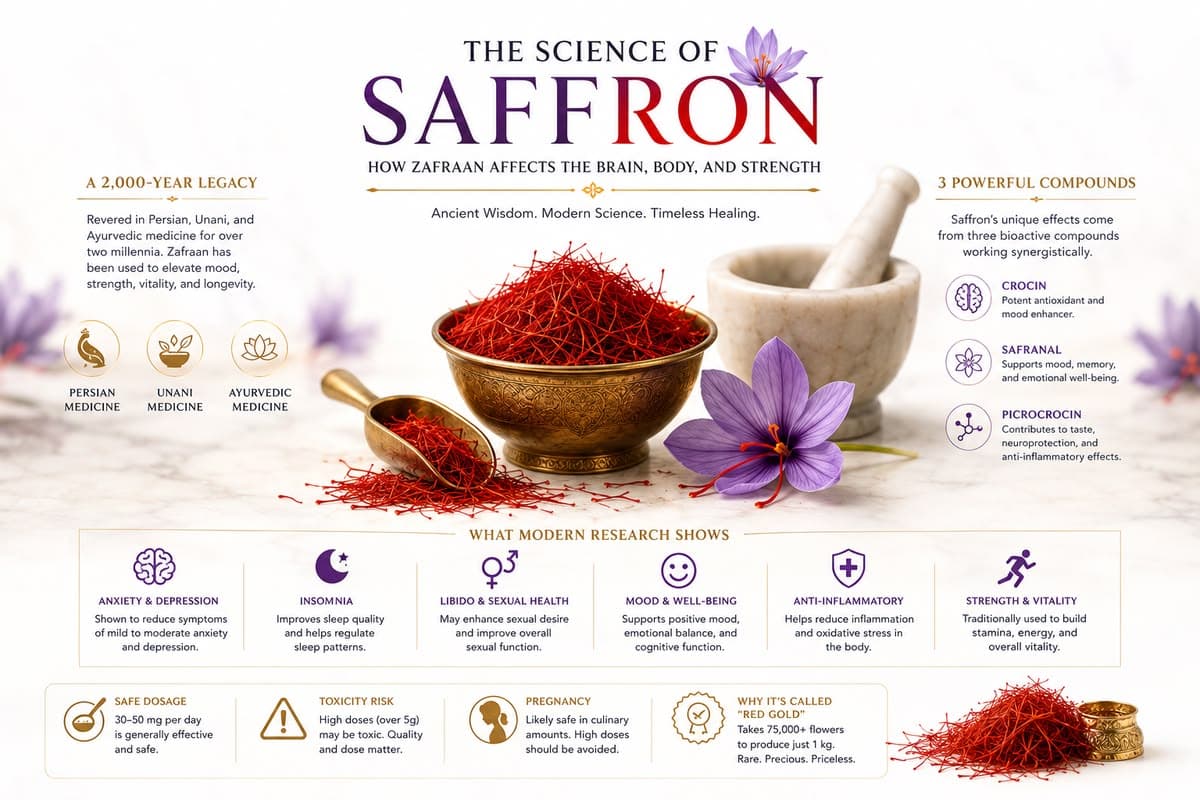
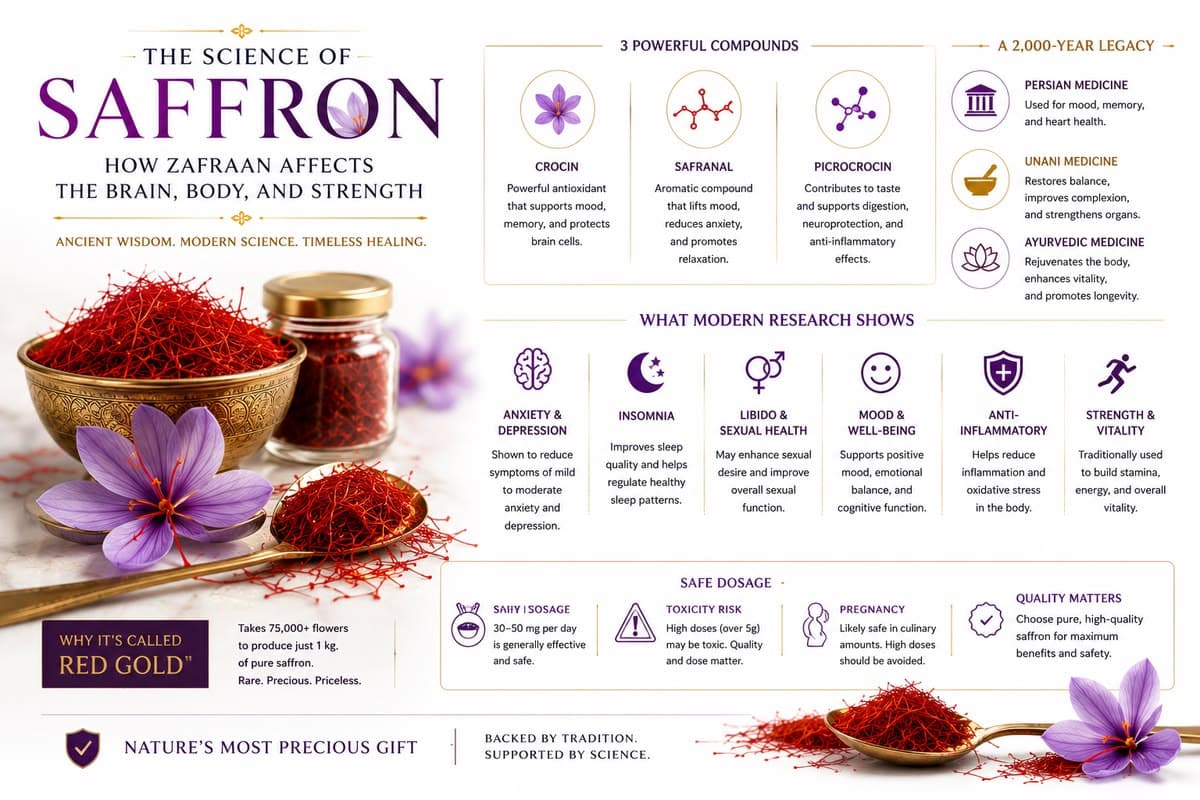
If you've ever wondered why a spice can cost more per gram than silver, saffron — known across South Asia and the Middle East as zafraan — is the answer. It's been prized for roughly two to three thousand years across Persian medicine, Unani medicine, and Ayurveda, long before modern pharmaceutical research ever got involved. And in the last two decades, that ancient reputation has actually started holding up under real scientific scrutiny, with a genuinely interesting body of research on saffron's effects on mood, anxiety, sleep, and more.
This guide covers the complete picture: what saffron actually is and why it's so labor-intensive to produce, the three specific chemical compounds responsible for its effects, what current research genuinely supports for anxiety, depression, insomnia, libido, mood, and inflammation, and — just as importantly — how to use it safely, including dosage limits, toxicity risks, and pregnancy considerations. If you're currently managing anxiety or depression with medication or therapy, this guide is meant to inform that conversation with your doctor, not to replace it.
1. What Is Saffron?
Saffron, known as zafraan in Urdu and several other South Asian languages, is a spice derived from the dried stigmas of a specific crocus flower, valued for thousands of years both as a culinary ingredient and as a component of traditional medicine across multiple civilizations.
2. The Flower Behind the Spice: Crocus Sativus
Saffron comes from a flower called Crocus sativus, commonly known as the saffron crocus, a purple-petaled flower that blooms for only a brief window each year, generally in autumn.
3. Why Saffron Is So Difficult to Cultivate
Growing saffron successfully requires specific soil, climate, and altitude conditions, and the crop is notoriously labor-intensive from planting through harvest, which is a major reason saffron cultivation remains concentrated in a relatively small number of regions worldwide, primarily Iran, along with parts of India, Afghanistan, and Spain.
4. The Red Stigmas: What's Actually Harvested
Each Crocus sativus flower contains just three thread-like red stigmas, the part of the flower actually harvested to produce saffron. These delicate red threads must be carefully removed from each flower entirely by hand.
5. Why Harvesting Saffron Is So Labor-Intensive
Because each flower yields only three tiny threads, producing even a single kilogram of dried saffron requires harvesting tens of thousands of flowers, all picked and processed by hand within a narrow harvesting window before the flowers wilt — a scale of labor that directly explains saffron's extraordinary price.
6. A History Spanning Thousands of Years
Saffron's use in medicine and culture stretches back roughly two to three thousand years, with historical records of its use spanning ancient Persia, the broader Middle East, and South Asia, long before any of its effects were studied in a modern laboratory setting.
7. Saffron in Persian Medicine
In traditional Persian medicine, saffron has long held a prominent place, used to support mood, digestion, and general vitality, and remains deeply embedded in Persian culinary and medicinal tradition to this day.
8. Saffron in Unani (Arabic) Medicine
Unani medicine, rooted in ancient Greek and Arabic medical traditions and widely practiced across South Asia and the Middle East, has historically used saffron for a range of purposes, including supporting mood, circulation, and overall wellbeing.
9. Saffron in Ayurvedic Medicine
In Ayurveda, saffron is traditionally regarded as a valuable herb for supporting mental clarity, mood, skin health, and overall vitality, and remains a commonly used ingredient in Ayurvedic formulations today.
10. Saffron in Modern Nutrition and Pharmaceutical Research
Over the past two to three decades, modern scientific research has increasingly turned its attention to saffron, running controlled clinical trials examining its effects on mood, anxiety, sleep, and other areas — moving saffron from purely traditional use into an actively studied area of nutritional and pharmaceutical science.
11. The Three Key Compounds Inside Saffron
Laboratory analysis of saffron threads consistently identifies three primary active compounds, each responsible for a different aspect of saffron's color, aroma, taste, and biological effect.
12. Crocin Explained
Crocin is the compound primarily responsible for saffron's rich golden-red color, and is also its most significant antioxidant component, playing a central role in many of saffron's studied health effects.
13. What Are Reactive Oxygen Species (ROS)?
Reactive oxygen species, or ROS, are unstable molecules naturally produced during the body's metabolic processes. Left unchecked, they can damage cells and contribute to inflammation, playing a role in the development of conditions ranging from cancer to diabetes to accelerated aging.
14. How Crocin Works as an Antioxidant
Crocin works by neutralizing these reactive oxygen species before they can cause cellular damage, helping to reduce the oxidative stress and resulting inflammation that would otherwise accumulate over time.
15. Why Reducing Oxidative Stress Matters So Much
Because oxidative stress and chronic inflammation are linked to such a broad range of health conditions, compounds like crocin that genuinely help reduce this burden are of significant interest across many areas of health research, not just any single condition.
16. Safranal Explained
Safranal is the compound primarily responsible for saffron's distinctive aroma, and it's the compound most closely studied in connection with saffron's potential effects on mood, anxiety, and depression.
17. Why Aroma Compounds Can Affect Mood
Aromatic compounds like safranal can interact with the body's sensory and nervous systems in ways that influence mood and emotional state, a connection long recognized in aromatherapy traditions and increasingly explored in formal pharmacological research as well.
18. Picrocrocin Explained
Picrocrocin is the compound responsible for saffron's characteristic slightly bitter, distinctive taste, rounding out the three primary compounds that together define saffron's color, smell, and flavor.
19. Why Saffron Tastes Slightly Bitter
The bitterness picrocrocin contributes is a defining, recognizable part of genuine saffron's flavor profile, which is one reason quality assessments of saffron often take taste into account alongside color and aroma when evaluating authenticity.
20. Saffron for Anxiety: What Research Shows
Several clinical studies have examined saffron extract's effect on anxiety symptoms, with a number finding meaningful improvement compared to placebo, generally over several weeks of consistent use, contributing to saffron's growing reputation as a genuinely promising natural option for anxiety support.
21. Saffron for Depression: What Research Shows
Saffron extract has been studied specifically for mild to moderate depression, with a number of clinical trials finding effects comparable to certain conventional antidepressant medications in these studies, an area of genuinely active ongoing research interest.
22. A Necessary Caution About Depression and Anxiety Treatment
It's important to be clear here: while this research is genuinely promising, saffron should not be treated as a guaranteed cure or a substitute for professional care. Depression and anxiety are real medical conditions, and anyone currently taking prescribed medication or working with a mental health professional should discuss saffron with their doctor before adding or changing anything in their treatment plan, rather than stopping prescribed treatment on their own.
23. Saffron for Insomnia
Some research suggests saffron may support improved sleep quality, potentially related to its effects on mood and relaxation, making it a commonly used traditional remedy for people struggling with occasional sleep difficulty.
24. Saffron for Mood More Broadly
Beyond formal diagnoses of anxiety or depression, saffron is traditionally used simply to support a more stable, positive mood day to day, a use consistent with both its historical reputation and its studied effects on emotional wellbeing.
25. Saffron as an Aphrodisiac: The Historical Use
Saffron has a long-standing traditional reputation as an aphrodisiac, used historically across multiple cultures to support sexual vitality and desire, particularly in men.
26. Saffron for Libido and Erection: What Research Shows
A number of studies have explored saffron's potential role in supporting libido and erectile function, with some research showing modestly positive results, contributing to renewed modern interest in its traditional aphrodisiac reputation, though it is not a direct medical equivalent to prescribed erectile dysfunction treatments.
27. Saffron and Medication-Related Sexual Side Effects
Some research has specifically explored saffron's potential to help offset sexual side effects associated with certain antidepressant medications, an area of genuine scientific interest given how common this particular side effect is among people taking these medications.
28. Saffron for Inflammation
Thanks largely to crocin's antioxidant activity, saffron has been studied for its potential anti-inflammatory effects, contributing to interest in its broader role in supporting long-term health beyond mood alone.
29. Saffron for Skin and Aging
Saffron's antioxidant properties have also led to interest in its potential skin benefits, including supporting a healthier complexion and helping counter some visible effects of oxidative stress on skin over time, and it appears in various topical skincare formulations.
30. Saffron for Weight and Metabolism
Some research has explored saffron's potential role in appetite regulation and modest metabolic support, though its effect in this area is generally considered supportive rather than a primary weight-loss tool on its own.
31. Saffron for Children and ADHD: What's Actually Known
Some limited research has explored saffron's potential effects in children, including in the context of ADHD, but this area is far less established than saffron's research in adults, and any use of saffron for children should be discussed with a pediatrician rather than pursued independently.
32. How to Use Saffron Traditionally
Traditionally, saffron is used by steeping a small number of dried threads in a warm liquid, allowing the threads to release their color, aroma, and active compounds before consuming the liquid, often along with the softened threads themselves.
33. Saffron in Warm Water, Milk, or Tea
A common approach involves steeping around 2 to 5 saffron threads in a cup of warm water, milk, or tea, allowing them a few minutes to release their color and aroma before drinking.
34. Why Evening Use Is Often Recommended
Many people prefer using saffron in the evening, shortly before bed, given its traditional association with relaxation and its potential supportive role for sleep, though individual response can vary.
35. Standardized Extract vs Raw Threads
Most of the clinical research on saffron's effects for anxiety and depression specifically has used standardized saffron extract supplements, generally dosed around 30mg per day, rather than home-measured raw threads — meaning that while traditional thread-based use is a reasonable everyday approach, more precise research-backed dosing is better achieved through a standardized extract product, ideally discussed with a healthcare provider.
36. How Much Saffron Is Actually Safe?
| Amount | General Guidance |
|---|---|
| Under 1.5 grams per day | Generally considered a safe upper limit for regular use |
| 2 to 5 grams | Can begin causing toxic effects, including nausea and abdominal distress |
| Around 20 grams | Considered a potentially lethal dose |
37. What Happens at Toxic Doses
At high doses, saffron can cause nausea, severe abdominal discomfort, extreme drowsiness, and other symptoms of toxicity, which is exactly why staying well within recommended, moderate amounts matters, even though saffron's high cost naturally limits how much most people would ever realistically consume at once.
38. Why Pregnant Women Should Be Cautious
In larger, medicinal amounts, saffron may stimulate contractions of uterine muscle, which is why it's generally not recommended for pregnant women outside of small, occasional culinary use, and any medicinal use of saffron during pregnancy should be discussed directly with a doctor beforehand.
39. Who Else Should Be Careful With Saffron
People taking blood pressure medication, antidepressants, or blood-thinning medication should discuss saffron use with their doctor, given its potential to interact with how these medications work, and anyone with a known allergy to plants in the crocus family should avoid it entirely.
40. Why Saffron Is Called "Red Gold"
Saffron has earned the nickname "red gold" both for its rich crimson-red color and for its extraordinarily high price relative to its weight, a nickname that reflects centuries of its status as one of the most valuable, labor-intensive agricultural products in the world.
41. What Saffron Actually Costs Today
As of 2026, high-quality saffron generally sells for somewhere in the range of $2,500 to $4,500 per kilogram at wholesale, with retail prices for smaller quantities often running higher, roughly $5 to $30 per gram depending on grade, origin, and certification — prices that have continued climbing in recent years due to climate-related supply pressures in major growing regions.
42. How to Identify Real Saffron
| Sign of Genuine Saffron | What to Look For |
|---|---|
| Thread Appearance | Long, uniform, deep red threads with slightly orange tips |
| Aroma | A distinctive floral, honey-like scent, not artificially perfumed |
| Taste | A subtle, genuine bitterness from picrocrocin |
| Price | Suspiciously cheap saffron is very likely fake or heavily adulterated |
| Form | Whole threads are generally more trustworthy than pre-ground powder |
43. Saffron in Cooking
Beyond its medicinal reputation, saffron remains one of the world's most prized culinary spices, valued for the golden color, subtle aroma, and distinctive flavor it brings to dishes like biryani, paella, and a wide range of rice and dessert recipes across South Asian, Persian, and Mediterranean cuisines.
44. Myths vs Facts
| Myth | Fact |
|---|---|
| More saffron always means better results | Doses above roughly 1.5 grams daily can move into a toxic range; more is not automatically better or safer |
| Saffron is a guaranteed cure for depression and anxiety | Research is genuinely promising, but saffron should complement, not replace, professional mental health care |
| All saffron sold at low prices is genuine | Real saffron is expensive to produce; unusually cheap products are very likely fake or adulterated |
| Saffron is completely safe in any amount during pregnancy | Larger, medicinal doses may stimulate uterine contractions and should be discussed with a doctor |
| Saffron's effects come from just one active ingredient | Its effects are attributed to a combination of at least three key compounds: crocin, safranal, and picrocrocin |
45. Quick Glossary
| Term | Meaning |
|---|---|
| Crocus Sativus | The flower species from which saffron is harvested |
| Crocin | Saffron's primary antioxidant compound, responsible for its color |
| Safranal | The compound responsible for saffron's aroma, linked to mood effects |
| Picrocrocin | The compound responsible for saffron's distinctive bitter taste |
| Aphrodisiac | A substance traditionally believed to enhance sexual desire or function |
| Reactive Oxygen Species (ROS) | Unstable molecules that can damage cells and contribute to inflammation |
46. Frequently Asked Questions
What is saffron used for?
Saffron is used both as a culinary spice for flavor and color, and in traditional and modern medicine for potential support with mood, anxiety, sleep, inflammation, and libido, thanks to active compounds like crocin, safranal, and picrocrocin.
What is saffron good for health-wise?
Research suggests saffron may support antioxidant activity, help ease mild to moderate depression and anxiety symptoms, support better sleep, help with libido and sexual function, and contribute to reduced inflammation, though it should be used alongside, not as a replacement for, professional medical care.
Why is saffron so expensive?
Saffron is extremely labor-intensive to harvest, requiring tens of thousands of hand-picked Crocus sativus flowers to produce just a small amount of dried threads, with each flower yielding only three tiny stigma threads, all collected by hand during a short annual blooming period.
How much saffron is safe to use daily?
Most safety guidance suggests staying under about 1.5 grams of saffron per day for regular use. Doses in the range of 2 to 5 grams or more can cause toxic effects, and doses around 20 grams are considered potentially lethal.
Is saffron safe during pregnancy?
Saffron in larger, medicinal amounts is generally not recommended during pregnancy, since it may stimulate uterine muscle contractions. Small culinary amounts used occasionally in cooking are generally considered lower risk, but pregnant women should consult their doctor before using saffron medicinally.
What are the three main active compounds in saffron?
Saffron's three primary active compounds are crocin, which acts as a powerful antioxidant and gives saffron its color; safranal, which is responsible for its aroma and is linked to mood-related effects; and picrocrocin, which contributes to its distinctive bitter taste.
Can saffron help with anxiety and depression?
A number of clinical studies have found saffron extract may help reduce symptoms of mild to moderate anxiety and depression, with some trials showing effects comparable to certain conventional antidepressants, though it should be discussed with a doctor rather than used as a substitute for prescribed treatment.
Does saffron help with libido and erectile function?
Saffron has a long traditional use as an aphrodisiac, and some modern research supports a potential role in supporting libido and erectile function, including in cases of medication-related sexual side effects, though it is not a direct medical substitute for prescribed treatments like those for erectile dysfunction.
How should saffron be used for health benefits?
A common traditional method is steeping a small number of saffron threads, generally around 2 to 5, in warm water, milk, or tea, often used in the evening to support relaxation and sleep, though standardized extract supplements are more precisely dosed for research-supported uses.
What is saffron good for in cooking?
In cooking, saffron is prized for its distinctive golden color, subtle floral-honey aroma, and gentle bitter-sweet flavor, commonly used in dishes like biryani, paella, and various rice-based and dessert recipes across Persian, South Asian, and Mediterranean cuisines.
47. Conclusion
Saffron's story is a rare example of ancient tradition and modern science genuinely converging rather than contradicting each other. Persian physicians, Unani practitioners, and Ayurvedic scholars were reaching for the same three tiny red threads, for many of the same reasons — mood, vitality, calm — thousands of years before anyone could name crocin, safranal, or picrocrocin, let alone run a controlled clinical trial to test them. That modern research has since found genuine, measurable support for several of these traditional uses is a genuinely satisfying thread connecting centuries of practical wisdom to today's laboratory findings.
None of this makes saffron a miracle cure, and it shouldn't be treated as one. Used thoughtfully — a few threads, in moderation, ideally alongside a doctor's guidance if you're managing anxiety, depression, or any other health condition — saffron is a genuinely well-supported natural option with a remarkable pedigree. Used carelessly or in excess, even something this ancient and prized carries real risk. Like most good things worth having, saffron rewards respect far more than excess.