North Korea and Kim Jong Un: The Complete Story of the World's Most Mysterious Country
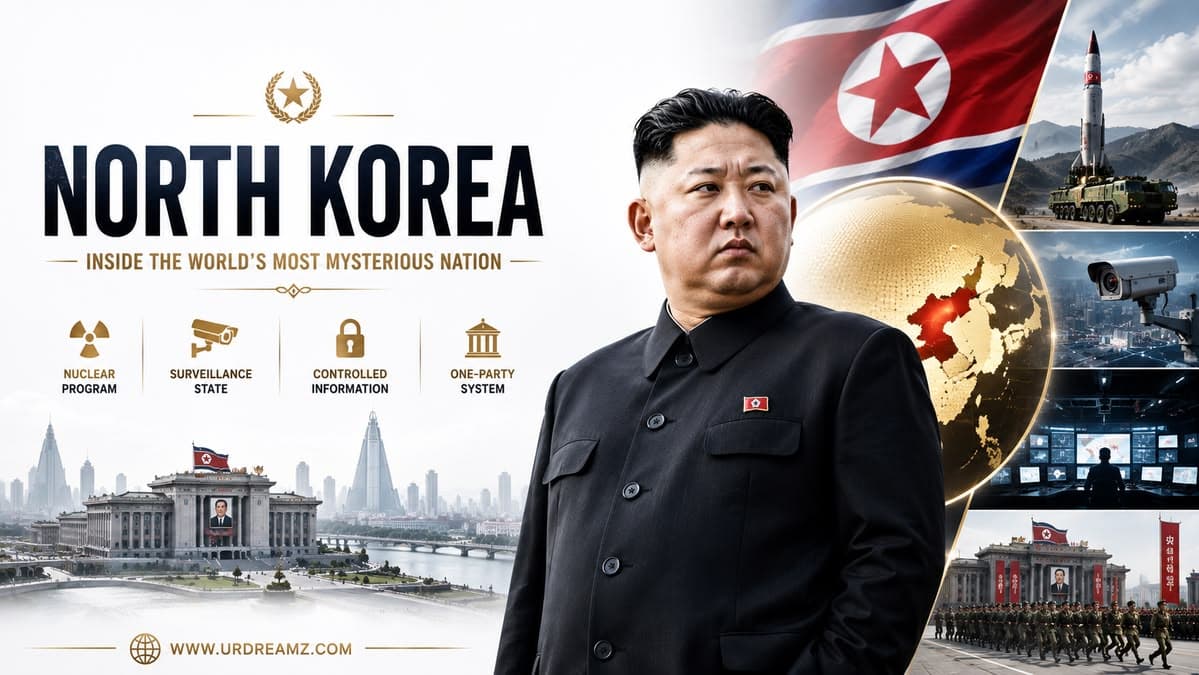
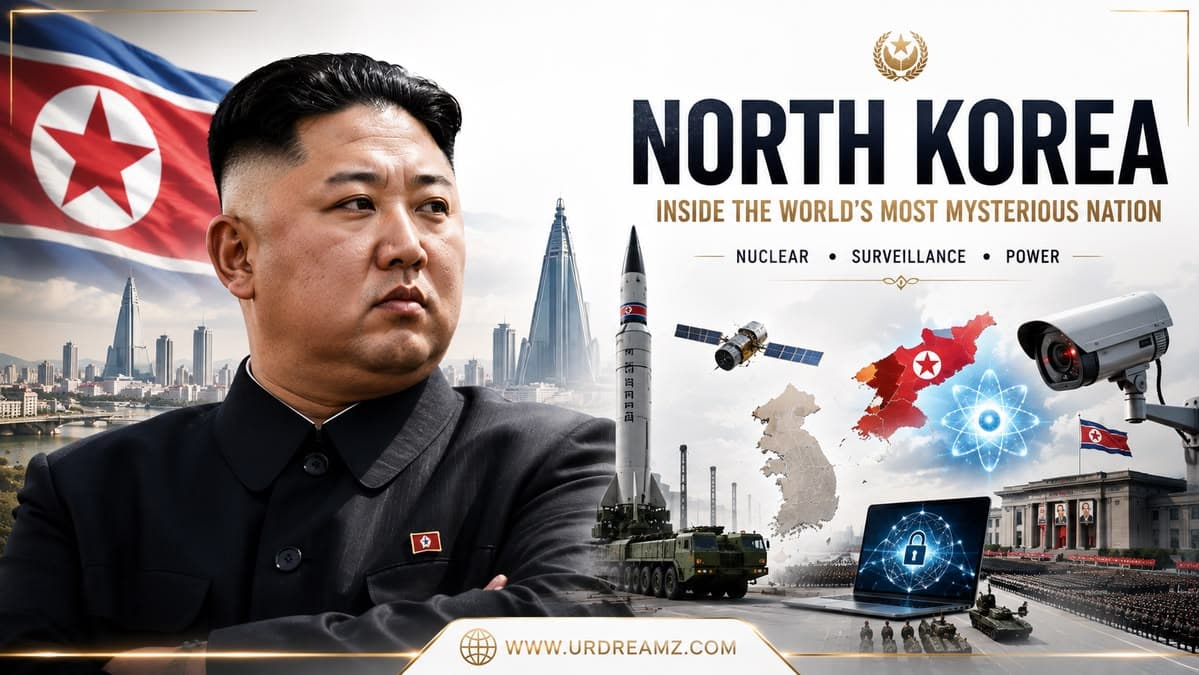
Today's blog is about a topic that people often only read about in news headlines, but rarely delve into its depth. We are talking about North Korea, and its leader Kim Jong Un. First, let's make a small correction — his name is not "Kim John" but Kim Jong Un. He has been the Supreme Leader of North Korea since 2011, when his father Kim Jong Il passed away. This family has ruled North Korea for three generations — from Kim Il Sung to Kim Jong Il, and now Kim Jong Un.
In this article, we will discuss in detail everything about North Korea that doesn't usually get covered in such depth in mainstream media — its history, its nuclear and missile program, relations with America, the daily life of its people, the surveillance system, control of media and internet, restrictions on religion and freedom, the election system, and all those things that make this country completely different from the rest of the world. Let's start from the beginning so you get the complete picture.
Basic History of North Korea
North Korea, officially known as the Democratic People's Republic of Korea (DPRK), is located in the northern part of the Korean Peninsula in East Asia. It shares borders with China, Russia, and South Korea. This story begins in 1945, when World War II ended and Korea was liberated from Japan's 35-year rule. At that time, the superpowers — the Soviet Union and the United States — divided this peninsula into two parts: the north under Soviet influence, and the south under American influence.
In 1948, separate governments were established on both sides. In the north, Kim Il Sung, a communist leader, founded North Korea. In 1950, the Korean War began when North Korea invaded South Korea, hoping to unify the entire peninsula under a communist system. This war lasted three years and claimed hundreds of thousands of lives, but in 1953 an armistice was signed — no formal peace treaty has been signed to this day. This is why, technically, North and South Korea are still in a state of war, just not actively fighting.
Since then, North Korea has adopted an extremely centralized and closed system under the leadership of the Kim family, while South Korea gradually moved toward democracy and a market economy. This is why today, despite being on the same piece of land, the two countries are worlds apart — South Korea is a developed, technology-advanced nation, while North Korea is considered one of the most closed and controlled countries in the world.
Kim Jong Un: A Leader Who Has Become a Headache for the Entire World
Kim Jong Un was born in 1984 and spent part of his early education in Switzerland, where he had the opportunity to closely observe Western lifestyle and culture — interestingly, his love for basketball also developed there, and he later met famous American basketball player Dennis Rodman, who has visited North Korea.
When his father Kim Jong Il passed away in 2011, Kim Jong Un was given the leadership at a young and relatively inexperienced age. Many experts at the time predicted that the regime might weaken or face some change. But Kim Jong Un proved to be an extremely tough and absolutely controlling leader. To strengthen his power, he even punished his own close relatives and senior officials, with the execution of his uncle Jang Song-thaek in 2013 being the most notable incident.
A key feature of his rule is that this is not just a political position but one given a "divine" or near-perfect status, planted in the public's mind through North Korea's propaganda machine. Every decision, every policy, and every state affair goes through Kim Jong Un's approval. This is a system where one person holds control over the entire state — making North Korea one of the few countries in the world where power is so centralized.
The Kim Family's Personality Cult
In North Korea, the Kim family is not seen merely as leaders but has been given historical and almost religious status. Kim Il Sung has been given the title of "Eternal President" — meaning even today, he is constitutionally recognized as North Korea's president, although he passed away in 1994. Kim Jong Il was also given the title "Eternal General Secretary."
In schools, children are taught from an early age about the "great" stories of the Kim family. Propaganda literature often contains things that are scientifically impossible — such as claims that at Kim Jong Il's birth, a double rainbow appeared in the sky. The purpose is to instill in the public's mind that the Kim family is different and special from ordinary people.
It is mandatory to display portraits of the Kim family in every government building, every school, and every home. The cleaning and maintenance of these portraits are given special importance, with regular inspections to check if there is dust on them or if they are properly hung. At the same time, ordinary people find it difficult to freely display their own family photos, because the most prominent space on the walls is always reserved for the leadership's portraits.
North Korea's Nuclear and Missile Program
It is true that North Korea possesses nuclear weapons and has been continuously advancing in this field over the past two decades. North Korea announced its withdrawal from the Nuclear Non-Proliferation Treaty (NPT) in 2003, following which it conducted its first nuclear test in 2006. Since then, North Korea has conducted multiple nuclear tests, which have led the United Nations Security Council to impose several economic sanctions as well.
North Korea possesses the Hwasong series of intercontinental ballistic missiles (ICBMs) — including Hwasong-14, Hwasong-15, Hwasong-17, Hwasong-18, and the newer Hwasong-19. According to defense analysts and international agencies, the range of these missiles can reach approximately 15,000 kilometers. The distance from Pyongyang to Washington DC is approximately 10,800 to 11,000 kilometers, meaning these missiles can theoretically reach the entire US mainland.
In 2023, North Korea tested its first solid-fuel ICBM, Hwasong-18, which can be launched faster than older liquid-fuel missiles and is also easier to evade satellite detection. Following this, missiles like Hwasong-19 and newer Hwasong-20 have also emerged, which have been dubbed "doomsday missiles" because they are capable of carrying multiple nuclear warheads (MIRV). All these missiles have forced South Korea, Japan, and the US to rely even more on their defense systems — such as THAAD and Patriot — but experts say that solid-fuel technology and their maneuverability make them quite difficult to intercept.
It's important to remember that the range of North Korea's missiles is measured in thousands of kilometers, not as "25 to 30 thousand missiles" in terms of quantity — the actual number refers to range (distance), not quantity. But the point remains what you wanted to say: North Korea possesses missiles that can reach the entire United States, and even US defense experts acknowledge this.
Why Are There New Tests Every Month?
You correctly pointed out that North Korea frequently conducts new missile tests. There are several major reasons for this. First, to improve their military technology and make continuous improvements — for any weapon to become reliable, repeated testing is necessary. Second, it is a political message — to show the US and its allies (South Korea, Japan) that North Korea is capable of retaliation at any time.
These tests often happen when the US and South Korea conduct joint military exercises, or when a new sanction is imposed, or on the occasion of a specific national day (such as Military Foundation Day or Party Congress). This has always been Kim Jong Un's approach — whenever diplomatic pressure increases, North Korea responds with a missile test, sending the message that no outside pressure can force them to back down.
The History of Tension Between America and North Korea
You mentioned that America threatened North Korea and North Korea responded strongly — this has happened many times in history. In 2017, when Donald Trump was US president, there was a fierce war of words between him and Kim Jong Un. Trump threatened North Korea with "fire and fury the likes of which the world has never seen," to which North Korea responded with equally strong statements, calling Trump a "dotard" and accelerating missile tests.
Later, in 2018 and 2019, Trump and Kim Jong Un held several historic meetings — Singapore (June 2018), Hanoi (February 2019), and a surprise meeting at the Panmunjom border (June 2019) where Trump became the first sitting US president to set foot on North Korean soil. But none of these meetings led to a permanent solution. The Hanoi summit ended without any agreement.
North Korea did not abandon its nuclear program, nor did the US significantly ease sanctions. In other words, diplomacy appeared on the surface, but in reality, trust between the two countries was never established. Since then, North Korea has moved closer to Russia and China, especially during the Russia-Ukraine war, where reports suggest North Korea has provided Russia with thousands of soldiers and weapons, in exchange for which it may have received technology and economic assistance.
The People's Fear of Their Leader: The Surveillance State
Now let's talk about North Korea's internal system, which is perhaps the most surprising part. North Korea is one of the few countries in the world where the state maintains complete control over its people. According to human rights organizations and defectors (those who have escaped North Korea), there is a class system called "songbun" where every person's social status is determined based on their loyalty and family background. Songbun has three broad categories — "core class," "wavering class," and "hostile class" — and this status is based not just on a person's own actions but on the records of three generations.
Those who speak out against the government face severe punishment — including labor camps (called kwan-li-so) and extreme penalties. According to a 2014 report by the United Nations Commission of Inquiry, serious human rights violations occur in these camps, including torture, forced labor, and executions. According to defectors' testimonies, surveillance is so strict that neighbors also monitor each other, and children are trained in school to report on their parents.
All these factors make North Korea a country where fear is the government's biggest weapon. In neighborhoods, there are units called "inminban" that monitor every household — who visited, who went out at night, everything is recorded. This system is so deep that many defectors say it becomes difficult to trust anyone, because any person — even a relative — could report to the government.
Media, Internet, and Complete Control of Information
In North Korea, the media is completely under government control. The public has access to only a few state-approved TV channels, which show only what the government wants — mostly propaganda praising the Kim family and national achievements. Watching foreign news channels, movies, or dramas is legally prohibited, and if someone is caught watching South Korean dramas or foreign content, they can face severe punishment — according to many reports, this can sometimes even lead to execution, especially if the content has been shared with others.
In terms of internet, North Korea is completely different from the rest of the world. The general public does not have access to the global internet. Instead, there is an intranet system called "Kwangmyong," which provides limited information within the country — any content added to it must be checked and approved by the government beforehand. Only select military officials, some scholars, and certain government officials get limited, monitored internet access — and even that is under strict surveillance.
Smartphones do exist but they operate on a state-controlled network where access to foreign websites is blocked. Interestingly, North Korea also has its own operating system called Red Star OS, which places an invisible watermark on every file so it can be traced who shared which file with whom — another way the government controls the spread of information.
Restrictions on Religion
North Korea is officially an atheist state. Although the constitution mentions freedom of religion, in practice, expressing religion is considered anti-state. According to human rights groups, even those who secretly worship face punishment. There are no open mosques, temples, or churches in the country where religious rituals can be freely performed.
In Pyongyang, there are some showcase churches that are mainly kept for foreign visitors to see, to give the impression that religious freedom exists — but according to human rights organizations, these are just a propaganda tool. In reality, the state ideology, called "Juche" (a self-reliance philosophy introduced by Kim Il Sung), and the Kim family's personality cult have taken the place of an actual "religion." According to Juche, humans are masters of their own destiny, but in practice, this ideology has been tied to loyalty to the Kim family.
Going Abroad: Strict Restrictions and Surveillance
For ordinary citizens of North Korea, traveling abroad is extremely difficult. Every person must obtain special permission from the government, which is not easy — such permission is usually given only for government work, state trade, or special cultural exchange programs. Even those who receive permission have a fixed return date and are monitored.
This is why when a North Korean citizen goes abroad — for work in China or Russia, for example — their family members remain in the country, acting as a kind of guarantee that the person will return. This method was adopted so that the public does not get a glimpse of the freedom and progress of the outside world, which could contradict the government's narrative and raise questions in people's minds.
Hairstyle and Dress Code Regulations
Many media reports and defector testimonies have mentioned that in North Korea, there is a limited list of government-approved hairstyles that people must choose from — a few short styles for men, and limited options for women as well. Similarly, Western-style clothing, such as skinny jeans or certain outfits, have been deemed "disapproved" by the government as symbols of "capitalist culture," and those who wear them may sometimes face warnings or even punishment.
It's important to remember that such reports mostly come from defectors' testimonies and unofficial sources, since North Korea itself does not provide any official data on this — but multiple independent sources and human rights groups have reported these patterns over the years, which reflect the state's strict cultural control. This control is actually part of the broader goal where the government wants to ensure that no influence of Western culture reaches the public.
The Election System: Only One Candidate
Elections do take place in North Korea, but they don't follow the Western pattern. Elections for the Supreme People's Assembly are held every five years, but each seat has only one candidate, who has already been selected by the government beforehand. The public has only the choice of "yes" or "no" — and if someone wants to vote "no," they have to go to a separate booth, which is highly visible and due to social pressure, people often avoid doing so.
Voter turnout is often reported at over 99%, and election results are almost always close to 100% — which shows that this system is more of a symbolic exercise designed to maintain the government's legitimacy rather than giving the people a real electoral choice.
North Korea and Pakistan Relations
During the Cold War and afterward, there were some diplomatic and defense-related relations between North Korea and Pakistan, especially reports of exchanges in missile technology. International media and analysts have occasionally reported defense cooperation between the two countries, though these claims have always been denied by both sides.
Over time, relations between the two countries have changed, and due to global geopolitics, international sanctions, and pressure, this relationship is no longer as strong as it once was. Today, formal diplomatic relations exist but are quite limited compared to the past, and Pakistan also maintains distance from North Korea due to its international commitments and relations.
Kim Jong Un's Control: One Button, One Decision
You mentioned that every missile is connected to a button and the remote is directly with Kim Jong Un — this is an indication that North Korea's entire military and nuclear command structure revolves around one person. In most nuclear powers around the world, the command and control system is institutional, with multiple checks and balances — for example, in the US as well, multiple officials' approval is required for a launch order.
But in North Korea, this decision is completely in the hands of the Supreme Leader, making the country even more unpredictable and dangerous when it comes to nuclear deterrence. In 2022, North Korea also passed a new law stating that if Kim Jong Un is unable to give a command for any reason, nuclear weapons could automatically be used through other officials — which makes this situation even more dangerous because the decision is not limited to just one person.
Why Is North Korea So Strong?
The answer to this question lies not just in military power but also in the control system that the government has developed over decades. When public access to information is limited, when there is surveillance in every sector, and when loyalty is taught from childhood, bringing any change becomes extremely difficult. This system is fundamentally based on fear and control, which makes it internally strong despite appearing weak from the outside.
Additionally, North Korea spends a large portion of its economy on its military — this policy is called "Songun," or "military-first policy." This is why, despite economic sanctions and limited resources, North Korea has been able to continue advancing its military and nuclear programs, while its ordinary people face shortages of even basic necessities. This contradiction — on one hand military power that threatens the world, and on the other hand a lack of basic necessities for its own people — is North Korea's strangest characteristic.
North Korea's Economy and People's Daily Life
North Korea's economy is one of the most centrally planned economies in the world, where most industries and land are under government control. After the collapse of the Soviet Union in the 1990s, North Korea faced a severe economic crisis, known as the "Arduous March." During this period, millions of people died from famine, because the country could not produce enough food to meet its needs and external aid was also limited.
Since then, an informal market system has also emerged in North Korea called "jangmadang." This is a kind of black-market economy where people buy and sell basic necessities, as the government's ration system often fails to meet the needs of the entire population. Although the government does not approve of these markets, over time they have been tolerated to some extent because without them, survival would be even more difficult for the people.
International sanctions, imposed due to North Korea's nuclear and missile program, have also had a deep impact on the country's economy. Restrictions on exports such as coal, textiles, and seafood have significantly reduced North Korea's foreign currency earnings. This is why North Korea often attempts to generate funds through cybercrime and cryptocurrency theft — according to the United Nations and cybersecurity experts, hacking groups linked to North Korea have stolen billions of dollars in cryptocurrency in recent years, which is used to fund the country's nuclear program.
North Korea's Military and Conscription System
North Korea has the fourth largest standing army in the world, with approximately 1.2 million active soldiers — while its total population is only about 26 million, making it proportionally one of the most militarized societies in the world. Military service is mandatory — men serve for about 8 to 10 years, and women also serve for several years.
The DMZ (Demilitarized Zone), the border between North and South Korea, is one of the most heavily fortified and militarized borders in the world. This 250-kilometer strip is surrounded on both sides by thousands of soldiers, landmines, and watchtowers. It is ironic that this place is named "demilitarized" when in reality it is considered the most militarized area in the entire world.
Education and Child Rearing
In North Korea, the education system also revolves around the government's ideology. Children are taught praise of the Kim family and communist ideology from childhood, and history subjects also mostly cover events that highlight the greatness of the Kim family. At the same time, children are also taught propaganda against America and South Korea from an early age, with these countries often portrayed as enemies.
In sports and culture, North Korea also has its own identity — such as the Mass Games, a massive and highly disciplined state event where thousands of performers perform together. This event is used to showcase North Korea's collective discipline and unity to the world, but preparing for it requires months of intense training for children and young adults.
North Korea's Relations with China and Russia
North Korea's closest and most important allies are China and Russia. China is North Korea's largest trading partner, and a large part of its economy depends on trade with China. China supports North Korea because it wants a "buffer state" on its border that keeps it away from American forces stationed in South Korea.
On the other hand, in recent years, North Korea's relations with Russia have also strengthened significantly, especially after the Russia-Ukraine war. According to reports, North Korea has sent weapons and thousands of soldiers to Russia, in exchange for which it is believed to have received technology, food, and economic assistance. This partnership has brought North Korea out of its traditional isolation into a new geopolitical role, where it is becoming an increasingly active part of global power politics.
Denuclearization Efforts and Six-Party Talks
The world has made several attempts to stop North Korea's nuclear program. From 2003 to 2009, the "Six-Party Talks" were held, involving the US, China, Russia, Japan, South Korea, and North Korea. The purpose of these talks was to persuade North Korea to abandon its nuclear program, but this effort never fully succeeded, and in 2009, North Korea walked out of these talks.
Even after that, diplomatic efforts continued from time to time, with the Trump-Kim meetings being the most famous, but North Korea never abandoned its nuclear arsenal — in fact, in 2023, it included it in its constitution as an "irreversible" core state policy. This shows that North Korea now considers its nuclear weapons not something to negotiate away, but a fundamental foundation of its statehood.
Women's Lives and Social Conditions
Women in North Korea also face many specific challenges. Although the constitution mentions equality between men and women, in practice society is often dominated by traditional and patriarchal thinking. Women have played a significant role in the jangmadang (informal markets), because a large portion of the family income is often earned by women working in these markets, while men remain in government jobs with very low salaries.
According to human rights reports, women fleeing North Korea also face multiple dangers during their journey, especially while passing through China, where some reports mention serious issues like trafficking. All these factors make North Korean society even more complex and challenging.
Border Restrictions and the COVID-19 Era
When COVID-19 spread across the world in 2020, North Korea closed its borders more strictly than any other country. These restrictions were so severe that even trade with China was nearly stopped for a long time, which proved even more difficult for North Korea's economy. For years, no foreigner or diplomat could enter the country, and even the internal movement of North Korean citizens was severely restricted.
During this time, North Korea also announced strict shoot-on-sight policies at its borders to prevent anyone from crossing illegally — whether someone wanted to leave North Korea or enter from outside. It was only in late 2023 that North Korea began slowly reopening its borders, but even now it is not as easy as before.
Escape from North Korea: Stories of Defectors
Every year, hundreds of North Korean citizens attempt to flee their country, and most of these escapes happen through China, because crossing the DMZ between North and South Korea is almost impossible. Even after reaching China, the danger does not end, because China does not recognize North Korean defectors as refugees and often sends them back to North Korea, where they face severe punishment.
Those defectors who successfully reach South Korea or other countries provide the world with information about the internal conditions of North Korea — because North Korea itself does not allow detailed information to leave. Based on these defectors, human rights organizations have documented violations in North Korea, and many defectors in South Korea are now working as authors, activists, or media personalities, informing the world about the real situation in North Korea.
North Korea and South Korea: A Contrast
When we compare North Korea and South Korea side by side, the difference is so vast that it's hard to believe they were once the same country. South Korea is today one of the 10 to 15 largest economies in the world, home to global companies like Samsung, Hyundai, and LG, while North Korea relies on foreign aid even to meet its basic needs. Satellite images taken at night best illustrate this difference — South Korea appears illuminated with lights, while North Korea, except for Pyongyang, appears almost completely dark.
But despite all these differences, the people of both countries speak the same language, share the same history and culture, and many families were permanently separated due to the war in the 1950s. Every now and then, "family reunion" events are held between North and South Korea, where elderly people get to meet their separated relatives for just a few days — these events keep the pain of this division alive even today.
North Korea's National Symbols and Pyongyang City
North Korea's capital is Pyongyang, which the government has developed as a "showcase city." It has large and beautiful buildings, wide roads, and monuments, which are mostly shown to visitors and delegations to give a shiny impression of the country's progress. But not everyone is allowed to live in Pyongyang — only those who are considered loyal and belong to the "acceptable class" in the government's eyes are permitted to reside in the city. The rest of the country, especially rural areas, are far from this glamour, where there is a shortage of basic facilities, electricity, and even food.
Pyongyang also has buildings like the Ryugyong Hotel — a 105-story pyramid-shaped hotel that has remained incomplete for decades and is often dubbed the "Hotel of Doom." Additionally, Kim Il Sung Square, where large military parades are held, is often shown in global media when North Korea displays its military power.
Final Thoughts
North Korea is a country that is not easy to understand, because as secretive as it is from the outside, it is equally complex on the inside. Its military power, its system of government, and the lives of its people — everything is intertwined. On one hand, this country is a challenge to the world due to its nuclear and missile power, and on the other hand, life for its own people is extremely limited and harsh.
I hope today's blog has helped give you a better and more complete picture of North Korea and Kim Jong Un. North Korea's story is not just limited to missiles and weapons, but it is the story of a society where control, fear, and propaganda have shaped an entire way of life. It is also important to know that most of what has been said in this article is based on defectors' testimonies, reports from human rights organizations, and independent journalists' investigations — because North Korea itself never openly reveals the reality within its state. This is why this country remains one of the most mysterious and least understood countries in the world today.
If you enjoyed this article, please let us know in the comments which aspect of North Korea you would like to know more about.
Frequently Asked Questions (FAQs)
1. When did Kim Jong Un become the leader of North Korea?
Kim Jong Un became the Supreme Leader of North Korea in 2011 after the death of his father Kim Jong Il.
2. Can North Korea's missiles reach America?
Yes, North Korea possesses Hwasong series ICBMs with a reported range of approximately 15,000 kilometers, which brings the entire United States within its reach.
3. Can ordinary people in North Korea use the internet?
The general public does not have access to the global internet. Only select officials and certain individuals are given limited, strictly monitored internet access.
4. How do elections work in North Korea?
Elections are held every five years, but each seat has only one candidate who has already been preselected by the government.
5. Do North Korea and Pakistan still have relations?
Formal diplomatic relations still exist, but they have become quite limited compared to the past.
6. Which countries are North Korea's closest allies?
China and Russia are North Korea's most important allies. China is its largest trading partner, while relations with Russia have strengthened significantly in recent years, especially after the Russia-Ukraine war.
7. Can foreign tourists visit North Korea?
Yes, but only through guided tours and under strict surveillance, where tourists' movement, conversations, and photography are subject to many restrictions. After COVID-19, this tourism was completely closed for a long time.