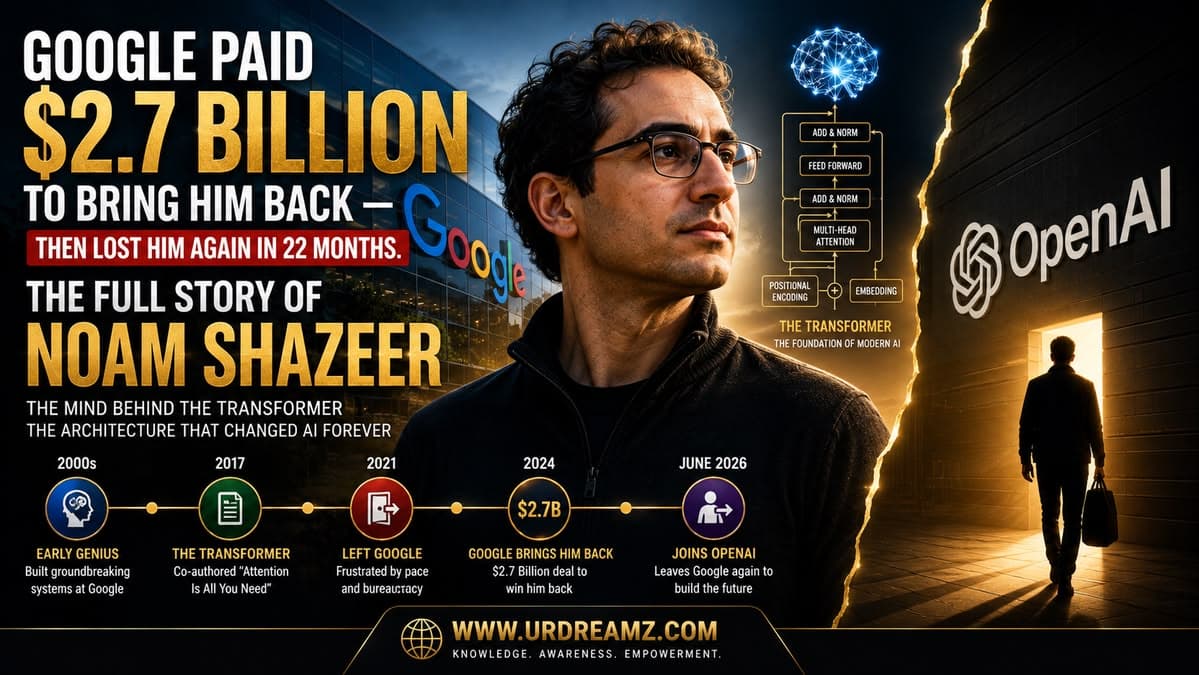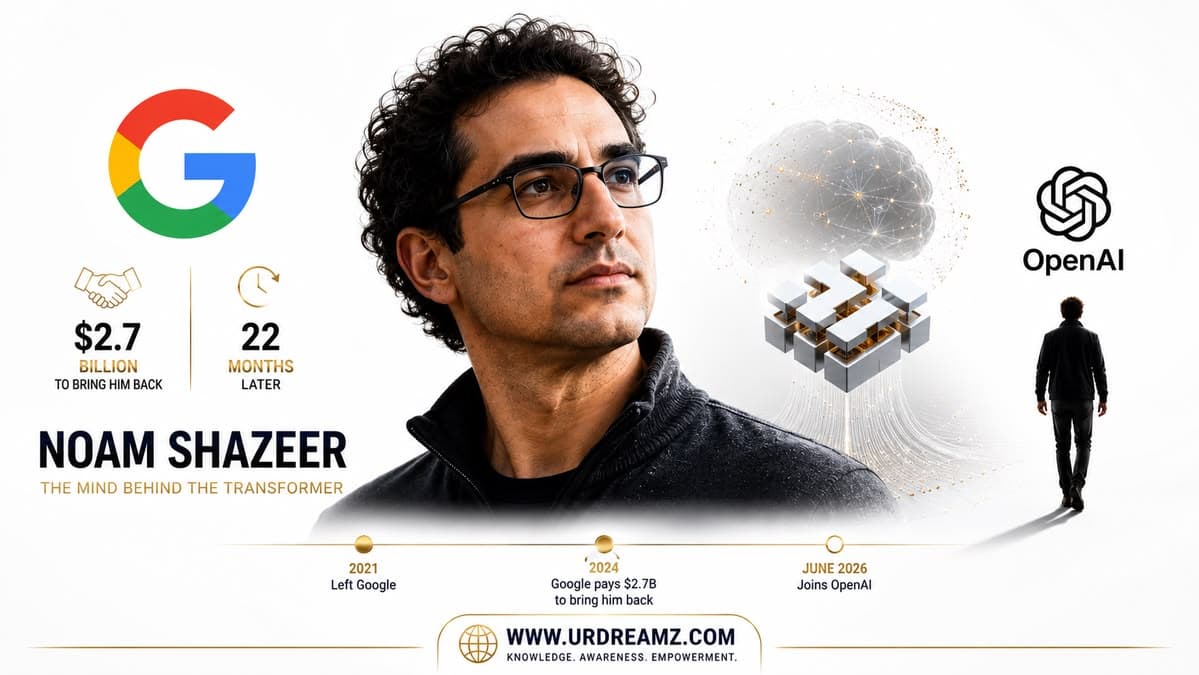
Google Paid $2.7 Billion to Bring Him Back — Then Lost Him Again in 22 Months. The Full Story of Noam Shazeer
Let me tell you about one of the strangest hiring stories in modern tech history. Imagine your company has a genius sitting quietly in the building — someone whose research is about to reshape the entire world of technology — and instead of backing his idea, you tell him "no, we're not launching that." He gets frustrated, walks out the door, and builds his own version of it anyway. It becomes a massive hit. A few years later, you realize just how badly you misjudged the situation, so you write a check for $2.7 billion to get him back. And then, less than two years later, he leaves again — this time straight into the arms of your biggest rival.
That's not a hypothetical. That's the real, documented story of Noam Shazeer, one of the most important — and least publicly known — people in the entire AI industry. If you've ever used ChatGPT, Gemini, or Claude, you have, in a very real sense, used something Shazeer helped invent. This is the full story of who he is, why Google let him go, why they paid a fortune to win him back, and why, in June 2026, he walked away again.
What makes this story worth sitting with isn't just the eye-watering dollar figure attached to it, though that alone makes headlines. It's what the whole arc — frustration, departure, independent success, a record-setting return, and then a second exit — quietly teaches about how the modern tech industry actually treats its most valuable people, and how even the largest companies on Earth can badly misjudge what it takes to keep them.
1. Who Is Noam Shazeer, and Why Does He Matter So Much?
Here's the thing most people don't realize: the entire modern AI boom — every chatbot, every large language model, every "type a prompt and get a smart answer" tool you've ever used — is built on top of a single piece of technology called the Transformer architecture. It was introduced in a landmark 2017 research paper titled "Attention Is All You Need," and Noam Shazeer was one of its co-authors.
Think about that for a second. GPT, the technology behind ChatGPT. Gemini, Google's flagship AI. Claude, made by Anthropic. Nearly every major large language model built since 2017 traces its core design directly back to that one paper. Shazeer isn't just "an engineer who works in AI" — he's one of the small handful of people whose research quite literally created the foundation the entire industry now stands on.
To put his reputation in perspective, Time Magazine named him one of the 100 most influential people in the AI world in September 2023 — recognition that came, notably, while he was outside of any major tech giant, running his own startup rather than working under a famous corporate banner. That's a meaningful detail, because it means his influence in the field was never dependent on which company's name happened to be on his business card.
1.1 What the Transformer Architecture Actually Does, in Plain Language
You don't need a computer science degree to understand why the 2017 paper mattered so much. Before the Transformer architecture existed, AI language systems processed text more or less in a straight line, one word at a time, which made it hard for them to understand how a word at the beginning of a long sentence related to a word much later on. The Transformer introduced a mechanism, referred to as "attention," that let a model look at an entire piece of text at once and figure out which words mattered most to each other, no matter how far apart they appeared. This turned out to be the missing piece that made today's large, remarkably capable AI language models possible. Every time you type a question into ChatGPT, Gemini, or Claude and get a coherent, context-aware answer back, you're benefiting from this exact breakthrough, and Shazeer was one of the small group of researchers who helped write the paper that made it real.
2. The Early Years: Two Decades Inside Google
Shazeer's relationship with Google goes back a long way — he joined the company back in 2000, at a time when Google was still a search engine trying to prove itself, long before anyone was talking about "AI" the way we do now. One of his early, lesser-known contributions was improving Google Search's spelling correction system — the little "did you mean...?" suggestion that quietly saved millions of people from typos every single day. It's a small detail, but it says something about the kind of engineer he was: quietly embedded in some of the most-used systems on Earth, long before he became famous for anything.
Over the following years, Shazeer became deeply involved in Google's machine learning and language modeling research, eventually contributing to the 2017 Transformer paper that would go on to change everything. By the time artificial intelligence became the hottest topic in the entire tech industry, Shazeer wasn't a newcomer chasing a trend — he was one of the people who had quietly helped build the foundation the trend was standing on.
3. The Chatbot Google Didn't Want to Launch
Here's where the story gets genuinely frustrating, at least from Shazeer's side of it. Around 2020 and 2021, Shazeer and his colleagues had been working on advanced conversational AI technology inside Google — the kind of chatbot that could hold a genuinely engaging, human-like conversation. But Google, being Google, was extremely cautious. A company with billions of users and a reputation to protect doesn't take safety and PR risk lightly, and leadership wasn't ready to put a highly conversational AI chatbot in front of the public.
From the outside looking in, that caution probably made sense to a lot of people at Google. But if you're the person who built the thing and you believe in it, watching it sit on a shelf while the world moves on without it can be its own kind of unbearable. Shazeer reportedly grew frustrated with how slowly Google was moving to actually ship what he and his team had built, and in 2021, he made the decision to leave the company entirely.
4. Walking Away to Build It Himself: The Birth of Character.AI
So what do you do when the company you've spent two decades with won't launch your idea? If you're Noam Shazeer, you leave and build it yourself. Along with fellow Google researcher Daniel De Freitas, Shazeer co-founded a new startup called Character.AI, built around the same core idea Google had been sitting on: AI characters you could talk to naturally, almost like chatting with a real person.
Character.AI didn't just quietly exist — it exploded. The app let people create and chat with AI-generated personas, everything from fictional characters to historical figures to entirely original personalities, and it developed an enormous, deeply engaged user base, particularly among younger users. At certain points, reports indicated Character.AI was pulling in more web traffic in the United States than Google's own Gemini product — which, if you think about it, is a genuinely remarkable thing to happen to the very company that once decided the underlying technology wasn't ready for prime time.
Character.AI's success wasn't just about clever engineering; it tapped into something people clearly wanted that the bigger players hadn't fully delivered yet — a genuinely conversational, personality-driven AI experience rather than a stiff, purely functional assistant. Users spent enormous amounts of time on the platform, often returning daily to chat with characters they'd grown attached to, a level of engagement that traditional search or productivity tools rarely achieve. For Shazeer, it was proof that his instincts about what he'd built inside Google had been right all along — the market simply confirmed, at scale, what Google's internal caution had held back.
5. The Race Heats Up: OpenAI, ChatGPT, and the AI Boom
While Shazeer was building Character.AI outside of Google's walls, the broader AI landscape was shifting dramatically. OpenAI launched ChatGPT and captured the world's imagination almost overnight. Anthropic entered the picture with Claude. Suddenly, every major tech company was scrambling to prove it had a credible answer to the question: "What's your AI story?"
And this is where things got genuinely uncomfortable for Google. Here was a company that had literally employed one of the co-inventors of the Transformer architecture — the very technology every competitor was now racing to build products on top of — and that same person had left, frustrated, to build a rival product elsewhere. It's hard to imagine a more pointed reminder of a missed opportunity than watching the technology you helped invent power your competitors' breakout successes while your own former employee builds something impressive right under your nose.
6. Google's $2.7 Billion Course Correction
By 2024, Google had clearly decided it needed to fix this. In August 2024, news broke of a deal, reportedly worth around $2.7 billion, under which Google would license Character.AI's underlying technology and, crucially, bring Shazeer and De Freitas back into the fold, joining Google DeepMind to help co-lead the Gemini AI project alongside veteran Google AI leaders Jeff Dean and Oriol Vinyals.
This wasn't a traditional acquisition in the classic sense — it was structured as a licensing arrangement rather than an outright purchase of the company, a structure that has become increasingly common in the AI industry when a giant company wants to secure both the technology and, just as importantly, the specific people who built it. Microsoft had done something structurally similar with the AI startup Inflection, paying a licensing fee reported to be around $650 million to bring over much of its leadership and technology. Amazon made a comparable move with the startup Adept, hiring its co-founder and CEO along with several key team members. Shazeer's return to Google, in other words, was part of a broader pattern the entire industry had already been experimenting with: if you can't buy the whole company cleanly, buy the technology and rehire the brains behind it.
There's a practical reason companies have gravitated toward this structure rather than simply acquiring a promising AI startup outright: regulators around the world have grown increasingly wary of big tech companies buying up smaller AI competitors, worried about concentrating too much power and talent in too few hands. A licensing-plus-rehire deal sidesteps a lot of that scrutiny while still achieving much of what a full acquisition would accomplish — Google got access to the technology it needed and, more importantly, got the people who understood it best back in the building.
7. Back at Google: VP of Engineering and Co-Lead of Gemini
Once back inside Google, Shazeer took on the role of Vice President of Engineering and became a co-lead of the Gemini AI models, working directly on the technology meant to be Google's answer to ChatGPT. By most public accounts, his return had real impact — Gemini's development accelerated, and Shazeer's deep technical credibility on exactly the kind of architecture Gemini needed made him an obvious anchor for the team.
His return also coincided with a broader reorganization of Google's AI efforts, as the company had spent the previous couple of years merging its once-separate AI research divisions, Google Brain and DeepMind, into a single unified Google DeepMind organization specifically to compete more effectively in the fast-moving AI race. Bringing Shazeer back into this newly consolidated structure, working alongside long-tenured Google AI leaders like Jeff Dean, one of the company's most senior technical figures, and Oriol Vinyals, another prominent AI researcher, was widely seen as a signal that Google was finally treating the AI competition with the seriousness it demanded, rather than the more cautious, deliberate pace that had defined its approach back in 2021.
For a while, the story looked like a genuine redemption arc: Google had made a mistake letting a foundational AI mind walk out the door in 2021, and it had corrected that mistake in the most direct way a company can — by paying an enormous sum of money and putting him right back at the center of its most important product. It looked, for a couple of years, like a happy ending.
8. June 18, 2026: The Announcement Nobody at Google Wanted to See
Then, on June 18, 2026, Shazeer posted something on social media platform X that sent a genuine shockwave through the tech industry. In his own words, he wrote that he was excited to share he'd be joining OpenAI, adding that it had been a difficult decision to move on and that he was incredibly proud of what he and the team at Google had built together.
Let that timeline sink in for a moment. Google brought Shazeer back in August 2024. He announced his departure for OpenAI in June 2026. That's a window of roughly twenty-two months — well under two years — between a $2.7 billion effort to retain one of the most important minds in AI, and that same person walking out the door to join the company's most direct competitor.
The post itself was notably gracious in tone, more of a warm farewell than a dramatic exit statement, which in some ways made the news feel even more significant. There was no public falling out, no leaked internal disagreement, no bitter parting words — just a respected engineer thanking his former team and moving on to a new chapter, which is precisely the kind of understated announcement that tends to get replayed and dissected across the tech industry for weeks afterward, since it leaves so much unsaid about the real reasons behind the decision.
9. Why OpenAI, and Why Now?
The move landed at a particularly significant moment for OpenAI. According to reporting from industry outlets covering the announcement, OpenAI has been racing to keep pace with rival Anthropic's most advanced models, and both companies have been widely anticipated to be moving toward eventual public offerings. Landing someone with Shazeer's specific expertise — particularly in the technical area of model pretraining, which sits at the very core of how large language models are actually built and improved — was described by industry reporters as a genuinely major win for OpenAI in the ongoing war for elite AI talent.
There have also been reports suggesting OpenAI's leadership had been interested in bringing Shazeer on board for a long time — years, according to some accounts — meaning this wasn't a sudden, opportunistic poach so much as the culmination of a much longer courtship finally coming together at the right moment. It's worth remembering that this kind of long-running interest is common in the upper echelons of AI research; the pool of people who've genuinely shaped foundational technology is so small that competing labs tend to know exactly who they want and simply wait, sometimes for years, for the right circumstances to make an approach worthwhile.
10. How the Tech World Reacted
The reaction across the tech and AI community was immediate and, frankly, a little brutal for Google. Commentary framed the story almost exactly the way it reads on paper: a company had paid nearly three billion dollars to retain someone, only to lose him again in under two years. Several industry voices pointed out that even Google's own colleagues at Gemini publicly wished Shazeer well on his way out — a mix of genuine respect for his contributions and a kind of resigned acknowledgment that this is simply how the current AI talent market works.
Online reactions ranged from genuine congratulations from fellow researchers, including messages from people now at OpenAI welcoming him to the team, to a wave of commentary specifically focused on Google's side of the story — pointed jokes and serious analysis alike about what it means when even a multi-billion-dollar deal isn't enough to guarantee someone stays. Some commentators framed it less as a story about any individual company failing and more as a broader signal of just how competitive and fluid the AI talent market has become, where even the most well-resourced companies on the planet can't fully insulate themselves from losing key people to a better offer, a more exciting mission, or simply a change of heart.
What makes the story land so hard isn't just the size of the number attached to it. It's the symbolism. This wasn't some replaceable mid-level engineer. This was one of the actual co-authors of the paper that made the entire modern AI industry possible, walking out of the building that had specifically paid billions of dollars to make sure he wouldn't.
11. The Bigger Lesson: You Can't Simply Buy Loyalty
Here's the part of this story that goes beyond just being an interesting piece of tech industry gossip. It's a genuinely useful lesson about hiring, retention, and what actually keeps talented people in a company for the long run. Money clearly matters — nobody is pretending a $2.7 billion deal is a small gesture. But this story is proof that money alone, even an enormous amount of it, doesn't guarantee someone will stay.
People who reach the level Shazeer has reached aren't just looking at a paycheck. They're looking at whether their work feels meaningful, whether the organization around them moves at the pace they want to move at, whether they have real ownership and voice in the direction of the products they're building, and whether the culture around them genuinely matches how they want to work. Retaining top talent, especially at the very highest, rarest tier of a fast-moving industry like AI, is a completely different skill from simply being able to afford to hire them. It requires ongoing attention — not a single transaction, however large, but a continuous effort to keep giving that person a reason to stay.
12. Timeline: The Full Noam Shazeer Story
| Year | Event |
|---|---|
| 2000 | Shazeer joins Google, later contributing to projects including Search's spelling correction system |
| 2017 | Co-authors the landmark "Attention Is All You Need" paper, introducing the Transformer architecture |
| 2020–2021 | Works on advanced conversational AI inside Google; frustrated by the company's caution about launching it publicly |
| 2021 | Leaves Google to co-found Character.AI with Daniel De Freitas |
| 2022–2023 | Character.AI grows into a major AI chatbot platform with a large, highly engaged user base |
| September 2023 | Named one of Time Magazine's 100 most influential people in AI |
| August 2024 | Google announces a roughly $2.7 billion deal to license Character.AI's technology and bring Shazeer back as Gemini co-lead |
| 2024–2026 | Shazeer serves as VP of Engineering, co-leading Google's Gemini AI models |
| June 18, 2026 | Shazeer announces on X that he's leaving Google to join OpenAI |
13. Not the First Time the Industry Has Seen This Play Out
If you're wondering whether this kind of "license the technology, rehire the founders" deal is unique to Shazeer's story, it isn't — it's actually become a recognizable pattern across the AI industry over the past couple of years.
| Company | Startup Involved | What Happened |
|---|---|---|
| Microsoft | Inflection AI | Paid a reported licensing fee of around $650 million and brought over much of Inflection's leadership team |
| Amazon | Adept AI | Hired the startup's co-founder and CEO along with several other key team members |
| Character.AI | Paid a reported $2.7 billion to license the technology and bring back Noam Shazeer and Daniel De Freitas |
These deals share a common structure precisely because straightforward acquisitions in the AI space can attract heavy regulatory scrutiny. Structuring a deal as a technology license plus a hiring arrangement, rather than a full company purchase, has become a favored workaround — but as Shazeer's story shows, even when a company successfully executes this kind of deal, it still doesn't guarantee the talent will stick around for the long haul.
14. What This Story Really Reveals About the AI Talent War
Step back from the individual names for a second, and this story tells you something important about where the AI industry actually stands right now. The scarcest resource in this entire race isn't computing power, funding, or even raw data anymore — arguably, it's the small number of people on Earth who genuinely understand how to design and improve the systems at the frontier of what's possible. There are only so many people who can credibly claim to have shaped the foundational architecture the entire field runs on, and every major company is competing fiercely for their attention.
When talent this rare exists, ordinary rules of corporate loyalty and long-term retention start to bend. A person like Shazeer isn't choosing between two similar jobs with a modest salary difference — he's choosing between working environments, missions, teams, and levels of creative freedom at companies that are each racing to define the next decade of technology. In that kind of environment, even a multi-billion-dollar retention deal is just one variable among several, not a guarantee.
15. Frequently Asked Questions (FAQs)
Who is Noam Shazeer?
Noam Shazeer is an American computer scientist and one of the co-authors of the 2017 "Attention Is All You Need" paper, which introduced the Transformer architecture underlying most modern large language models, including GPT, Gemini, and Claude.
When did Shazeer first join Google?
He first joined Google in 2000, working on various projects including improvements to the search engine's spelling correction system.
Why did Shazeer leave Google in 2021?
Reports indicate he grew frustrated after Google declined to publicly launch an advanced conversational AI chatbot he and his team had developed, leading him to leave and start his own venture instead.
What is Character.AI?
Character.AI is a chatbot platform Shazeer co-founded with Daniel De Freitas in 2021, allowing users to create and converse with AI-generated personas, which grew into a major, highly engaged AI application.
How much did Google pay to bring Shazeer back?
Google's deal, announced in August 2024, was reported to be worth around $2.7 billion, structured as a license for Character.AI's technology combined with bringing Shazeer and Daniel De Freitas back to Google.
What role did Shazeer have after returning to Google?
He served as Vice President of Engineering and a co-lead of Google's Gemini AI models, working alongside veteran Google AI leaders Jeff Dean and Oriol Vinyals.
When did Shazeer leave Google for OpenAI?
He announced his departure on June 18, 2026, roughly twenty-two months after returning to Google in August 2024.
Why is Shazeer's move considered such a big deal?
Because he is one of the co-inventors of the Transformer architecture that underpins nearly all major AI language models today, and his departure came less than two years after Google paid billions of dollars specifically to retain him.
Has anything like this happened with other AI startups?
Yes. Microsoft made a similar licensing-and-rehiring deal with Inflection AI, and Amazon did something comparable with Adept AI, reflecting a broader industry pattern of licensing technology and bringing back key personnel rather than pursuing a full acquisition.
Does this mean Google made a bad decision paying $2.7 billion?
Not necessarily — Shazeer's return did contribute meaningfully to Gemini's development during his time back at Google, and the deal also secured Character.AI's underlying technology. His eventual departure highlights the limits of any single retention deal, but it doesn't erase the value the arrangement generated in the meantime.
What does this story say about hiring top talent in general?
It illustrates that compensation alone, even at an extraordinary scale, doesn't guarantee long-term retention of top talent — factors like creative freedom, mission alignment, team culture, and the pace of innovation around a person often matter just as much, if not more.
Conclusion
When you lay the whole story out from beginning to end, it almost reads like a lesson designed on purpose: Google had one of the architects of modern AI sitting right there inside the company, hesitated on his idea, watched him leave and build something remarkable on his own, spent an enormous fortune trying to correct that mistake, and then watched him walk away again anyway. It's tempting to read this as simply a story about money — about how even $2.7 billion couldn't buy loyalty. But the more accurate lesson is a little more uncomfortable than that.
Hiring brilliant people is hard. Keeping them is a completely different, arguably harder skill — one that has very little to do with the size of the check you're willing to write and everything to do with whether the environment you build around them continues to give them a reason to stay. Noam Shazeer's story, from a frustrated exit in 2021, to a record-breaking return in 2024, to another high-profile departure in 2026, is a real, documented case study in exactly that lesson. In an industry where the rarest resource on Earth right now is the small handful of people who can genuinely push the frontier of what AI can do, no amount of money guarantees you'll keep them — you have to keep earning it, every single day they choose to stay.