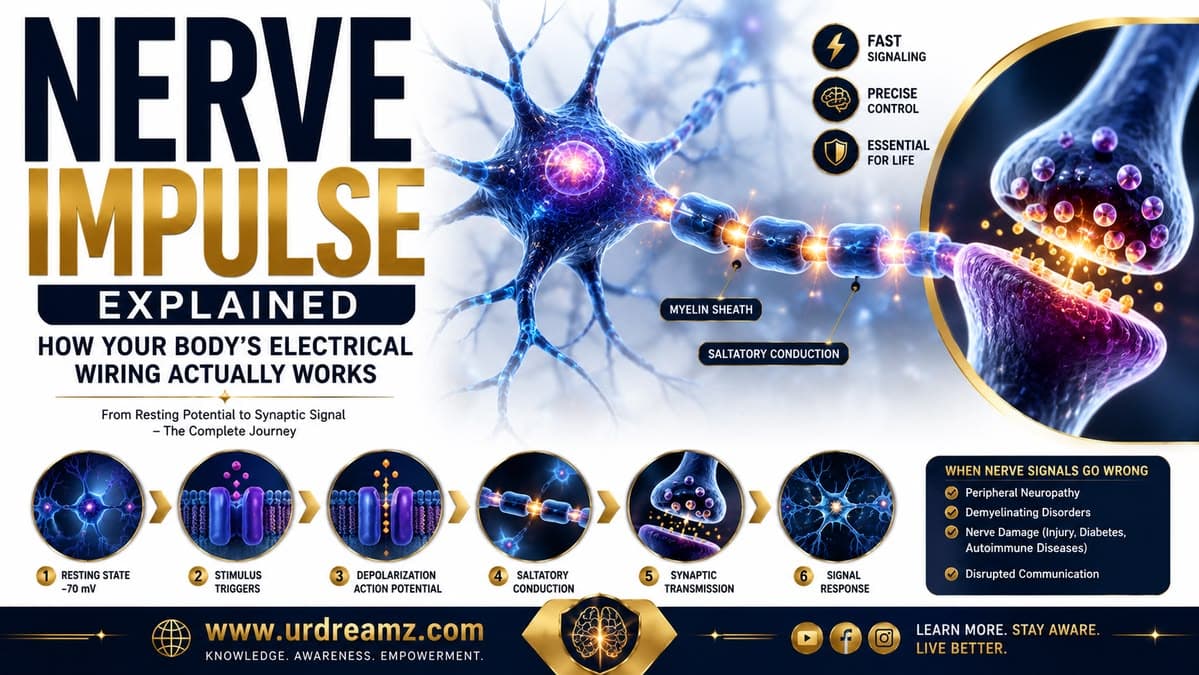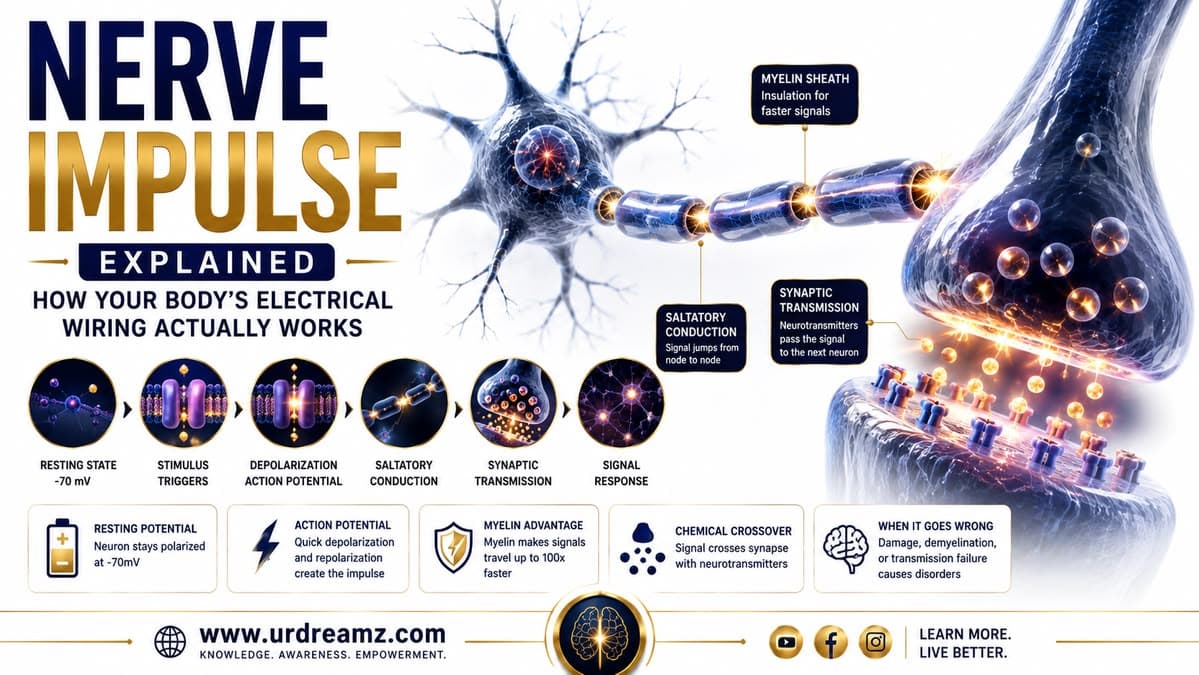
Nerve Impulse Explained: How Your Body's Electrical Wiring Actually Works
Picture your body's nervous system as a power grid, and your brain as the central station running the whole thing. Every second, that grid is carrying electrical signals from your skin, your muscles, your eyes, and your organs, back and forth to a control center that decides what to do about all of it. A mosquito lands on your arm and bites you, and before you've even consciously registered "mosquito," your brain has already received the signal, processed it, and sent a response back telling your hand to move.
That entire round trip — sensation to brain to response — happens through something called a nerve impulse, also known as an action potential. This guide breaks down exactly how that signal works, starting from the resting, quiet state of a single nerve cell, all the way through to how that signal jumps from one neuron to the next, and what happens when this system doesn't work the way it should.
1. Why This Topic Matters: The Body's Communication Network
Every single thing you feel, think, or do — from reading this sentence to pulling your hand away from something hot — depends on nerve impulses firing correctly, in the right order, at the right speed. Understanding how this system actually works turns something most people take completely for granted into one of the most genuinely impressive pieces of engineering in the human body.
2. The Power Grid Analogy
Think of the brain as a central power station, and the nervous system as the wiring that carries electricity out to every corner of a city. Signals flow both ways along this wiring — sensory information traveling in toward the brain, and instructions traveling back out toward muscles and organs — all through the same basic electrical mechanism, just running in different directions depending on the job.

3. Correcting a Commonly Repeated Number
You may have seen a claim online suggesting that if every nerve in the human body were connected end to end, they'd stretch some extraordinary distance — sometimes numbers in the tens of millions of kilometers get thrown around. It's worth clarifying this, since the real figures, while still impressive, are considerably more modest than that.
4. What the Real Estimates Actually Say
The most commonly cited, conservative estimate — counting only the major nerve trunks and bundles — puts total nerve length at around 72 kilometers, or roughly 45 miles. Broader estimates that also try to account for every microscopic axon and dendrite branch throughout the brain and body push that figure considerably higher, into the range of roughly 100,000 to 200,000 kilometers, though these wider estimates come with much greater scientific uncertainty, since counting every individual microscopic fiber isn't something that can be measured with full precision.
5. Comparing That to Earth's Circumference
Earth's circumference is roughly 40,000 kilometers. Even using the more conservative 72-kilometer nerve estimate, that's obviously nowhere near circling the planet — but using the broader estimate of 100,000 to 200,000 kilometers for all neural branches combined, that total would indeed be enough to circle the Earth several times over, which is likely where some of the more exaggerated online claims originally got mixed up or inflated further.
6. How Much of This Network Sits in the Brain
A very large share of the nervous system's total fiber length is concentrated within the brain itself, where neurons branch extraordinarily densely into vast numbers of short local connections. The remaining network, running through the spinal cord and out into the rest of the body as peripheral nerves, is what allows the brain to stay in constant contact with every other tissue and organ.
7. Cranial and Spinal Nerves: The 12 and 31 Pairs
The nervous system connects to the rest of the body through 12 pairs of cranial nerves, which travel directly to and from the brain, and 31 pairs of spinal nerves, which branch out from the spinal cord to reach the rest of the body. Together, these 43 nerve pairs form the main highway system connecting the central nervous system to virtually every tissue you have.
8. The Mosquito Bite Example
Here's a genuinely relatable way to see this system in action: a mosquito lands on your arm and bites you, and almost instantly, you feel it and react. That near-instant chain — sensation detected at the skin, signal sent racing up through peripheral nerves to the spinal cord and brain, brain processes it, and a response signal races back down to your hand — is your entire nervous system working exactly as designed, all within a fraction of a second.
9. What Is a Neuron?
A neuron is the basic functional unit of the nervous system, specialized to generate and transmit electrical and chemical signals. Neurons can fire and relay a signal to the brain and back in under a thousandth of a second, which is why your reaction to something like a sudden touch feels essentially instantaneous.
10. Dendrites Explained
Dendrites are the branch-like extensions of a neuron responsible for receiving incoming signals from other cells, functioning essentially as the neuron's antenna, picking up incoming information and passing it toward the cell body.
11. Cell Body (Soma) Explained
The cell body, also called the soma or cyton, contains the neuron's nucleus and is responsible for the cell's overall metabolic functions, integrating incoming signals from the dendrites before passing relevant information along toward the axon.
12. Axon Explained
The axon is a long, slender projection responsible for carrying the electrochemical impulse away from the cell body toward its destination — whether that's another neuron, a muscle, or a gland. Some axons are remarkably long, occasionally spanning over a meter in the body's longest nerves.
13. Myelin Sheath Explained
The myelin sheath is a fatty, insulating layer wrapped around many axons, dramatically increasing the speed at which nerve impulses can travel. Without this insulation, electrical signals would leak and weaken far more as they traveled, similar to how an uninsulated electrical wire loses efficiency.
14. Schwann Cells Explained
Schwann cells are the specific cells responsible for producing the myelin sheath around peripheral nerve axons, wrapping around the axon in a spiral pattern to form the insulating layers that make faster conduction possible.
15. Nodes of Ranvier Explained
Nodes of Ranvier are small, regularly spaced gaps in the myelin sheath where the axon membrane is exposed. These gaps play a critical role in speeding up nerve impulses, covered in more detail in the section on saltatory conduction later in this guide.
16. Axon Terminals Explained
Axon terminals are the branched endpoints at the far end of an axon, responsible for releasing neurotransmitters that carry the signal across the gap to the next neuron, muscle cell, or gland.
17. The Resting State: What "Polarized" Means
When a neuron isn't actively firing a signal, it's described as being in a polarized, resting state — meaning there's a stable difference in electrical charge between the inside and outside of the cell membrane, maintained continuously even when nothing is happening.
18. Resting Membrane Potential Explained
The resting membrane potential refers to this baseline electrical charge difference, typically measured at around -70mV, meaning the inside of the neuron is 70 millivolts more negative than the outside. This value stays remarkably stable and consistent while the neuron is at rest, ready to fire whenever a strong enough signal arrives.
19. Why the Inside Is Negative and the Outside Is Positive
This charge difference exists because of how sodium and potassium ions are distributed across the neuron's membrane at rest: potassium is concentrated more heavily inside the cell, sodium is concentrated more heavily outside, and various negatively charged proteins remain trapped inside the cell as well, all contributing to the inside carrying a net negative charge relative to the outside.
20. The Sodium-Potassium Pump Explained
The sodium-potassium pump is a specialized protein embedded in the neuron's membrane, responsible for actively maintaining this resting ion imbalance. With each cycle, it pushes 3 sodium ions out of the cell while bringing 2 potassium ions in, continuously working against the ions' natural tendency to spread evenly.
21. Why This Pump Needs ATP
Because the sodium-potassium pump moves ions against their natural concentration gradients — pushing sodium out even though it's already more concentrated outside, and pulling potassium in even though it's already more concentrated inside — this process requires energy. That energy comes from ATP, the cell's basic energy currency, which is why this pump is described as a form of active transport rather than passive movement.
22. Ion Concentration Gradients Explained
A concentration gradient simply describes an uneven distribution of a substance across a space — in this case, sodium and potassium ions being unevenly distributed across the neuron's membrane. These gradients store potential energy, similar to water held behind a dam, ready to be released rapidly once the right gates open.
23. What Is a Stimulus?
A stimulus is any change or signal — a touch, a chemical, a temperature change — that has the potential to affect a neuron's membrane and trigger a response. Not every stimulus, however, is strong enough to actually cause a nerve impulse to fire.
24. Inadequate Stimulus Explained
An inadequate, or subthreshold, stimulus is one that's too weak to trigger a full nerve impulse. This is exactly why you don't consciously register every tiny, constant sensation your body experiences — a gentle breeze on your skin, or water running over your hand during a normal shower, generally doesn't generate a strong enough signal to reach your brain as a distinct, urgent sensation, because these stimuli simply don't carry enough strength to cross the threshold needed to fire a full response.
25. Threshold Explained
Threshold refers to the specific level of depolarization — generally around -55mV — that a stimulus must reach in order to actually trigger a full nerve impulse. Anything strong enough to reach this level, like an unexpected touch or a sudden sharp sensation, is considered an adequate, or suprathreshold, stimulus.
26. The All-or-None Law
The all-or-none law describes a defining feature of the nerve impulse: once a stimulus reaches the threshold, a full, complete action potential fires every time, at essentially the same strength regardless of how much stronger the stimulus was beyond the threshold. If the stimulus doesn't reach threshold at all, no impulse fires whatsoever — there's no partial or weaker version of a nerve impulse.
27. Depolarization Explained Step by Step
Once threshold is reached, voltage-gated sodium channels along the neuron's membrane open rapidly, allowing sodium ions to rush into the cell down their concentration gradient. Because sodium carries a positive charge, this sudden influx flips the neuron's internal charge from negative to positive — this rapid flip is what's actually meant by depolarization.
28. Why Sodium Channels Open First
Sodium channels are specifically designed to respond to the initial rise in voltage caused by a strong enough stimulus, opening quickly once threshold is crossed. This rapid opening is what allows depolarization to happen so quickly, within a fraction of a millisecond.
29. The Peak of the Action Potential
As sodium continues flooding in, the neuron's internal charge rises rapidly from its resting -70mV, briefly crossing zero and continuing upward to a peak typically somewhere between +30mV and +40mV, depending on the specific neuron, before the next phase begins.
30. Repolarization Explained
At the peak of the action potential, sodium channels close and inactivate, while voltage-gated potassium channels open instead. Potassium, now more concentrated inside the cell, rushes back out, carrying positive charge with it and causing the neuron's internal charge to fall rapidly back toward negative — this falling phase is called repolarization.
31. Hyperpolarization (The Overshoot) Explained
Potassium channels often stay open slightly longer than needed to reach exactly -70mV, causing the neuron's charge to briefly dip even further negative than its normal resting level — sometimes down to around -90mV — before settling back. This brief overshoot is called hyperpolarization.
32. Return to Resting State
Following hyperpolarization, the sodium-potassium pump gets back to work restoring the original ion balance, gradually returning the neuron's membrane potential to its stable -70mV resting baseline, ready to respond to the next stimulus.
33. The Refractory Period Explained
The refractory period refers to the brief span of time following an action potential during which the neuron is temporarily unable, or less able, to fire another impulse. This built-in pause ensures that impulses travel in one direction along the axon, rather than bouncing back and forth.
34. Absolute vs Relative Refractory Period
| Phase | What Happens |
|---|---|
| Absolute Refractory Period | A new action potential is completely impossible, regardless of stimulus strength, since sodium channels are still inactivated |
| Relative Refractory Period | A new action potential is possible, but only with a stronger-than-normal stimulus, since the neuron is still partially hyperpolarized |
35. How the Impulse Physically Travels Down the Axon
Once triggered at one point on the axon, the local depolarization causes nearby sodium channels further along the membrane to open as well, effectively propagating the impulse forward like a wave moving down the length of the fiber, one small stretch of membrane at a time.
36. Continuous Conduction Explained
In neurons without a myelin sheath, the nerve impulse must trigger this depolarization process at every single point along the entire membrane, moving steadily and continuously down the axon's full length. This method is functional but comparatively slow, typically traveling at around 0.5 to 2 meters per second.
37. Saltatory Conduction Explained
In myelinated neurons, the insulating myelin sheath prevents ion movement across most of the axon's length, meaning depolarization can only actually occur at the exposed Nodes of Ranvier. Rather than firing continuously along the entire membrane, the impulse effectively "jumps" from node to node — this jumping pattern is called saltatory conduction.
38. Why Myelin Makes Transmission So Much Faster
Because saltatory conduction only requires the impulse to actively regenerate itself at widely spaced nodes rather than continuously along the entire axon, it travels dramatically faster than continuous conduction, while also using considerably less metabolic energy per unit of distance covered.
39. Comparing Conduction Speeds
| Conduction Type | Typical Speed |
|---|---|
| Continuous Conduction (unmyelinated) | Roughly 0.5 to 2 meters per second |
| Saltatory Conduction (myelinated) | Roughly 100 to 130 meters per second |
This speed difference is enormous in practical terms — it's the reason reflexes and rapid muscle responses depend so heavily on healthy, well-myelinated nerve fibers.
40. Reaching the Synapse
Once the impulse travels the full length of the axon and reaches the axon terminal, it needs a way to actually pass the signal on to the next cell — whether that's another neuron, a muscle fiber, or a gland. This handoff point is called the synapse.
41. Calcium's Role at the Axon Terminal
When the electrical impulse reaches the axon terminal, it triggers voltage-gated calcium channels to open, allowing calcium ions to flow into the terminal. This calcium influx is the direct trigger for the next step: the release of neurotransmitters.
42. Neurotransmitters Explained
Neurotransmitters are chemical messengers stored in small sacs, called vesicles, within the axon terminal. When calcium flows in, these vesicles move toward the cell membrane and release their neurotransmitter contents into the small gap separating this neuron from the next cell.
43. Common Neurotransmitters
| Neurotransmitter | General Role |
|---|---|
| Acetylcholine | Muscle activation and various functions in the central nervous system |
| Dopamine | Reward, motivation, and movement regulation |
| Serotonin | Mood regulation, alongside various other physiological functions |
44. Chemical Synapse Explained
A chemical synapse is the most common type of connection between neurons, relying on neurotransmitters crossing a small gap, typically around 20 to 40 nanometers wide, to reach and bind with receptors on the next cell. This process is slightly slower than direct electrical transmission, but allows for far more complex, adjustable signaling.
45. Electrical Synapse Explained
An electrical synapse, by contrast, allows ions to flow directly between two cells through specialized channels called gap junctions, without needing any chemical messenger in between. This makes electrical synapses extremely fast and capable of transmitting signals in both directions, and they're notably common in heart muscle, helping coordinate rapid, synchronized contractions.
46. How the Next Neuron Gets Activated
Once neurotransmitters bind to receptors on the receiving neuron, they can trigger sodium channels there to open as well, allowing sodium to rush into that next cell and potentially starting an entirely new action potential — effectively continuing the same signal forward along the pathway.
47. From Hand to Brain and Back: The Full Pathway
Putting the entire process together: a stimulus strong enough to reach threshold triggers depolarization in a sensory neuron in your hand; the impulse races along the axon, using saltatory conduction if myelinated; it crosses one or more synapses on its way up through the spinal cord to the brain; the brain processes the information and generates a response; a new impulse travels back down through motor neurons; and that impulse crosses the neuromuscular junction to trigger a muscle response — all of this typically completing in a fraction of a second.
48. Membrane Transport: How Substances Cross at All
Everything described so far depends on ions being able to cross the neuron's membrane in a controlled way. This happens through several distinct transport mechanisms, each suited to different types of molecules.
49. Simple Diffusion Explained
Simple diffusion allows small, nonpolar molecules — such as oxygen, carbon dioxide, and steroid hormones — to pass directly through the lipid membrane, moving from an area of higher concentration to lower concentration, without requiring any protein channel or energy input.
50. Facilitated Diffusion Explained
Facilitated diffusion allows larger or charged molecules — including sodium, potassium, chloride ions, and glucose — to cross the membrane using specific channel or carrier proteins, still moving down their concentration gradient and still without requiring energy, but needing a protein "doorway" to get through.
51. Osmosis and Aquaporins Explained
Osmosis specifically describes the movement of water molecules across a membrane, generally through specialized channel proteins called aquaporins, moving from an area of higher water concentration toward lower water concentration.
52. Active Transport Explained
Active transport, exemplified by the sodium-potassium pump discussed earlier, moves substances against their natural concentration gradient — from an area of lower concentration to higher concentration — which requires energy in the form of ATP, along with a dedicated carrier or pump protein.
53. What Can Go Wrong: Nerve Conduction Disorders
When any part of this finely tuned system is disrupted — whether at the level of ion channels, myelin, or the neuron itself — nerve impulses can slow down, weaken, or fail to transmit properly, resulting in a range of nerve conduction disorders.
54. Diabetic Neuropathy Explained
Diabetic neuropathy is one of the most common causes of nerve conduction problems, resulting from prolonged high blood sugar levels gradually damaging peripheral nerves, particularly in the hands and feet, over time.
55. Other Common Causes of Nerve Damage
| Cause | How It Affects Nerve Conduction |
|---|---|
| Physical trauma | Can directly damage or sever nerve fibers |
| Autoimmune disorders | The immune system can mistakenly attack myelin or nerve tissue |
| Infections | Certain infections can directly damage nerve tissue |
| Certain medications | Some drugs list nerve-related side effects |
| Vitamin deficiencies | Particularly B12, which is important for healthy nerve function |
56. Symptoms of Nerve Conduction Problems
Common symptoms include numbness, tingling or a "pins and needles" sensation, burning pain, muscle weakness, and in some cases sharp or shooting pain, frequently starting in the hands or feet and sometimes gradually progressing if the underlying cause isn't addressed.
57. Myths vs Facts
| Myth | Fact |
|---|---|
| All the nerves in your body would stretch 60 million kilometers if connected end to end | Conservative estimates put major nerve trunks at about 72 km; even the broadest estimates including every microscopic branch land around 100,000–200,000 km |
| A weaker stimulus produces a weaker nerve impulse | The all-or-none law means a nerve impulse either fires at full strength once threshold is reached, or doesn't fire at all |
| Nerve impulses always travel at the same speed | Speed varies enormously depending on myelination, from about 0.5 m/s in unmyelinated fibers to over 100 m/s in myelinated ones |
| Every touch or sensation reaches conscious awareness | Subthreshold, inadequate stimuli don't reach the threshold needed to fire a full impulse, which is why you don't consciously notice every minor sensation |
| Nerve damage is always permanent | Some forms of nerve damage, particularly from reversible causes like certain vitamin deficiencies, can improve once the underlying cause is treated |
58. Quick Glossary
| Term | Meaning |
|---|---|
| Resting Membrane Potential | The stable -70mV charge difference across a neuron's membrane at rest |
| Depolarization | The rapid reversal of a neuron's charge from negative to positive during firing |
| Threshold | The minimum depolarization level, around -55mV, needed to trigger a full nerve impulse |
| Saltatory Conduction | Fast nerve signal transmission that jumps between Nodes of Ranvier in myelinated fibers |
| Synapse | The junction where a nerve impulse passes from one cell to the next |
| Refractory Period | The brief window after firing during which a neuron cannot immediately fire again |
59. Frequently Asked Questions
What is a nerve impulse in simple words?
A nerve impulse is an electrical and chemical signal that travels along a neuron, letting one part of the body communicate with another, such as sending a touch sensation from your hand to your brain.
What is also called a nerve impulse?
A nerve impulse is also commonly called an action potential, referring to the rapid change in electrical voltage across a neuron's membrane.
What are the three main stages of a nerve impulse?
The three main stages are the resting state (polarization), depolarization (the action potential firing), and repolarization, when the neuron returns to its resting state.
What triggers a nerve impulse?
A nerve impulse is triggered when a stimulus strong enough to reach the threshold potential, generally around -55mV, causes voltage-gated sodium channels to open, allowing sodium ions to rush into the neuron.
How is a nerve impulse transmitted step by step?
It begins at resting potential (-70mV), a stimulus opens sodium channels causing depolarization, the impulse propagates along the axon, potassium channels open to cause repolarization, a brief hyperpolarization may occur, and the sodium-potassium pump restores the original resting state before the impulse reaches the synapse and triggers neurotransmitter release.
What is the difference between saltatory and continuous conduction?
Saltatory conduction occurs in myelinated neurons, where the impulse jumps between gaps called the Nodes of Ranvier, making it very fast (up to about 120 m/s). Continuous conduction occurs in unmyelinated neurons, where the impulse moves steadily along the entire membrane, making it much slower (roughly 0.5 to 2 m/s).
What is the sodium-potassium pump and why does it need ATP?
The sodium-potassium pump is a protein that actively moves 3 sodium ions out of the neuron for every 2 potassium ions it brings in, working against their natural concentration gradients. Because this movement goes against the gradient rather than with it, it requires energy in the form of ATP.
What is the threshold potential and why does it matter?
The threshold potential, typically around -55mV, is the minimum level of depolarization a stimulus must reach to trigger a full action potential. Stimuli that don't reach this level, called inadequate or subthreshold stimuli, fail to produce a nerve impulse at all, following what's known as the all-or-none law.
What is the refractory period?
The refractory period is the brief window after a neuron fires during which it cannot immediately fire again. The absolute refractory period makes a new impulse impossible, while the relative refractory period allows a new impulse only with an unusually strong stimulus.
How does the nerve impulse cross to the next neuron?
When the impulse reaches the axon terminal, calcium ions flow in, triggering the release of neurotransmitters into the synaptic gap. These chemicals cross the gap and bind to receptors on the next neuron, potentially starting a new impulse there.
What is the difference between a chemical synapse and an electrical synapse?
A chemical synapse relies on neurotransmitters crossing a small gap between neurons, and is slower but far more common. An electrical synapse allows direct ion flow between cells through gap junctions, making it extremely fast and bidirectional, and is common in cardiac muscle.
What diseases affect nerve impulse conduction?
Conditions affecting nerve conduction include diabetic neuropathy, autoimmune disorders, certain infections, physical trauma to nerves, and some medication side effects, all of which can disrupt how effectively nerve impulses travel.
What are common symptoms of nerve conduction problems?
Common symptoms include numbness, tingling, burning sensations, muscle weakness, and in some cases sharp or shooting pain, often starting in the hands or feet before potentially progressing further.
How long is the total length of nerves in the human body?
Estimates vary considerably depending on what's being measured. A commonly cited figure for major nerve trunks is around 72 kilometers (45 miles), while broader estimates that include every microscopic axon and dendrite branch range from roughly 100,000 to 200,000 kilometers.
What is depolarization in simple terms?
Depolarization is the rapid reversal of a neuron's electrical charge, from negative inside to positive inside, caused by sodium ions rushing into the cell in response to a strong enough stimulus.
60. Conclusion
The nerve impulse is, in the end, a remarkably elegant piece of biological engineering — a tightly choreographed sequence of ions rushing in and out of a cell membrane, timed precisely enough to carry information from your fingertip to your brain and back in less time than it takes to consciously notice you've been touched. Every part of it matters: the quiet, carefully maintained resting potential; the all-or-none certainty of a threshold being crossed; the insulating myelin that turns a slow crawl into a lightning-fast jump between nodes; and the chemical handoff at the synapse that lets one cell's signal become the next cell's problem to carry forward.
None of this requires conscious thought or effort on your part — it simply runs, continuously, for your entire life, adjusting its speed and pathway based on exactly what the moment calls for. Understanding it doesn't just satisfy curiosity about biology; it's the same basic mechanism doctors are checking for when they run a nerve conduction study, and the same system that can quietly start breaking down in conditions like diabetic neuropathy long before symptoms become impossible to ignore. Knowing how it's supposed to work is really the first step toward noticing when something about it isn't.