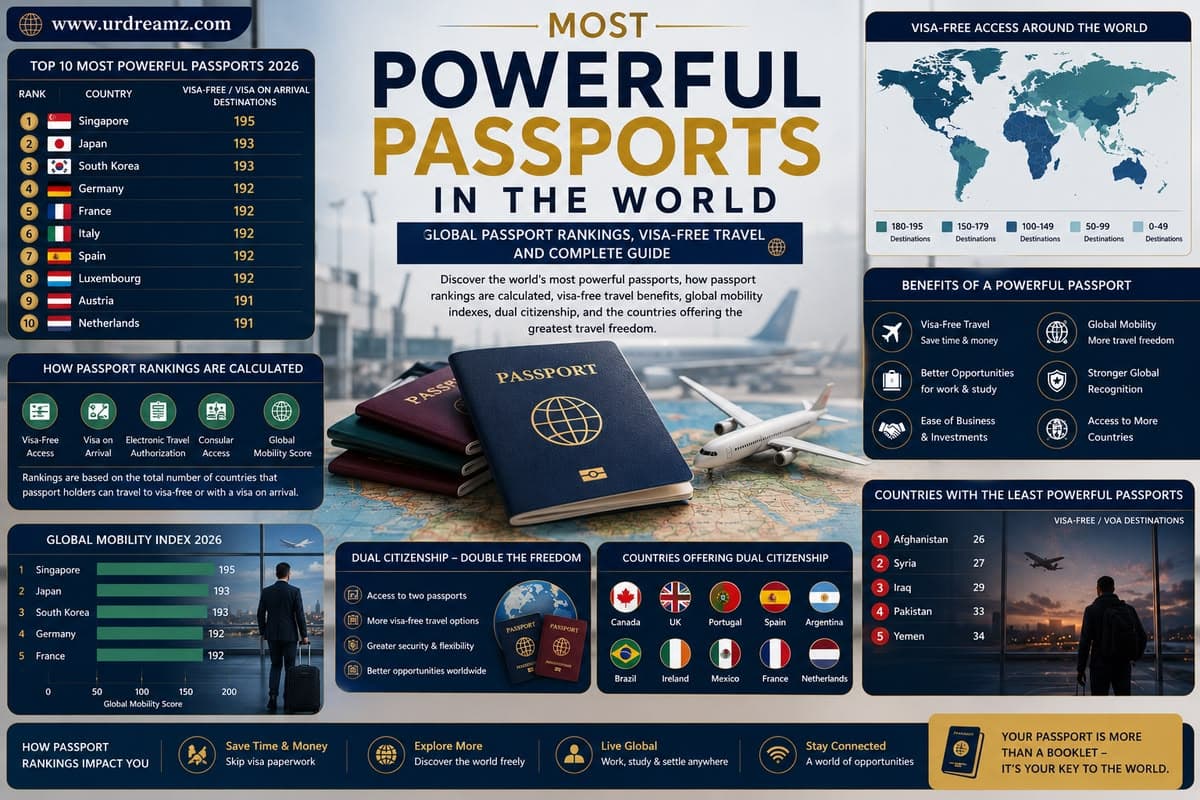
Most Powerful Passports in the World: Global Passport Rankings, Visa-Free Travel and Complete Guide
A passport is more than a travel document - it's a measurable form of global privilege. A Singaporean citizen can walk into the vast majority of the world's airports without arranging a single visa in advance, while an Afghan citizen faces that requirement almost everywhere they go. This guide breaks down exactly how passport power is measured, which passports rank strongest and weakest right now, why the rankings shift throughout the year, and everything else - from dual citizenship to biometric passports - tied to this genuinely fascinating slice of global mobility data.
1. Why Passport Power Matters
A passport determines far more than how you get through airport security - it shapes how easily you can work abroad, invest internationally, respond to a sudden business opportunity, or simply take a spontaneous holiday. The stronger the passport, the fewer bureaucratic barriers stand between its holder and the rest of the world, which is exactly why passport strength has become such a closely watched, genuinely consequential global ranking.
2. What Is a Passport Ranking?
A passport ranking measures how many countries and territories a passport holder can enter without arranging a visa in advance - either visa-free entirely, or through a simpler visa-on-arrival or electronic authorization process. The more destinations a passport unlocks this way, the higher it ranks.
3. The Henley Passport Index Explained
The Henley Passport Index, created in 2005 and now marking its 20th year, is the original and most widely cited passport ranking, produced by Henley & Partners using exclusive data from the International Air Transport Association's Timatic database. It ranks 199 passports against 227 possible travel destinations and is updated monthly to reflect real-world changes in visa policy.
4. How Passport Rankings Are Calculated
Each passport receives a score equal to the number of destinations its holders can enter without needing a visa approved in advance - this includes fully visa-free entry, visa-on-arrival, and electronic travel authorizations that don't require prior government approval. Destinations requiring a traditional pre-approved visa or e-Visa are not counted toward the score.
5. Henley vs Arton Capital: Why Rankings Differ
Henley isn't the only index - Arton Capital's Passport Index is a second widely cited ranking, and the two occasionally disagree at the very top. In 2026, for example, Arton's index placed the UAE in first place with a score of 179, while Henley kept Singapore in first place with 192. The difference comes down to methodology: Arton updates in real time from government sources and covers a slightly different set of destinations, which is exactly why you may see conflicting "world's most powerful passport" headlines depending on which index a given article is quoting.
6. Table: World's Most Powerful Passports (2026)
Based on the June 2026 update of the Henley Passport Index, here is how the strongest passports in the world currently rank.
| Rank | Country / Countries | Visa-Free Score |
|---|---|---|
| 1 | Singapore | 192 |
| 2 | Japan, South Korea, United Arab Emirates | 188 |
| 3 | Sweden | 187 |
| 4 | Multiple European countries (including Germany, France, Italy, Spain) | 186 |
| 6 | United Kingdom, Hungary, Malaysia, Poland | 183 |
| 7 | Australia, Canada | 182 |
| 8 | Iceland, Lithuania | 181 |
| 10 | United States, Iceland | 179-180 |
It's worth being upfront about something rarely explained clearly: these exact numbers shift slightly almost every month as the index updates, so a screenshot from January, April, or June of the same year can show noticeably different scores for the same country without anything being "wrong" - it simply reflects a different snapshot in time of an actively moving ranking.
7. Singapore: The World's Most Powerful Passport
Singapore has held the top spot for several consecutive years running, currently offering visa-free or visa-on-arrival access to 192 destinations - roughly 85 percent of the entire world. This dominance reflects Singapore's extensive diplomatic relationships, economic stability, and a long track record of low visa-overstay rates among its citizens, all factors that encourage other countries to extend easier entry terms.
8. Japan, South Korea and the UAE: Tied for Second
Japan and South Korea have been consistent top-tier performers for well over a decade, each currently offering 188 visa-free destinations. The UAE joining them in second place is one of the most remarkable stories in the index's 20-year history - the Emirati passport has climbed 57 places and added 149 visa-free destinations since 2006, the single strongest improvement of any passport tracked by Henley over that period.
9. Sweden and the European Contenders
Sweden currently holds third place outright with 187 destinations, just ahead of a large cluster of European countries - including Germany, France, Italy, and Spain - tied at 186. This dense European presence near the very top of the index reflects decades of reciprocal visa-free agreements built around the European Union and the Schengen Area.
10. The UAE's Remarkable 20-Year Rise
No passport has improved faster over the past two decades than the UAE's. What began as a comparatively weak passport in the mid-2000s has been transformed through deliberate, sustained diplomatic effort into one of the top three most powerful passports on earth - a genuine case study in how quickly passport power can shift when a country prioritizes building reciprocal travel agreements.
11. Where the United Kingdom Ranks
The UK currently sits around sixth place with 182 to 183 visa-free destinations, having recorded one of its steepest annual declines in recent memory, alongside the US, in 2026 - a reminder that even historically dominant passports aren't guaranteed to hold their position indefinitely.
12. Where the United States Ranks
The United States currently ranks around tenth place with roughly 179 to 180 visa-free destinations. The US passport has drifted down the rankings over the past several years, a trend commentators have linked to shifting diplomatic relationships and reciprocity decisions made by other governments rather than any single policy change.
13. Where Canada and Australia Rank
Canada and Australia both currently sit around seventh to eighth place, each offering roughly 181 to 183 visa-free destinations - consistently strong, stable performers that rarely see dramatic swings in either direction year over year.
14. Table: World's Weakest Passports
| Rank (from bottom) | Country | Visa-Free Score |
|---|---|---|
| Last | Afghanistan | 23 |
| Second-to-last | Syria | 26 |
| Third-to-last | Iraq | 29 |
| Fourth-to-last | Pakistan | 31 |
| Fifth-to-last | Yemen | 31 |
15. Afghanistan: The World's Least Powerful Passport
Afghanistan sits at the very bottom of the 2026 Henley Passport Index, with holders able to access just 23 destinations without a prior visa - a direct reflection of the country's ongoing political isolation and instability, which makes other governments far less willing to extend visa-free reciprocity.
16. Why the Gap Between Strongest and Weakest Keeps Growing
The gap between Singapore at 192 destinations and Afghanistan at 23 now stands at roughly 168 to 170 destinations - the widest gap recorded in the index's 20-year history. Henley's own analysis attributes this widening divide to passport privilege becoming increasingly concentrated among economically powerful, politically stable nations, while politically unstable or isolated countries see comparatively little improvement over time.
17. Strongest Passports in Europe
Europe dominates the upper half of the global index almost entirely, with a striking number of EU and Schengen-area countries clustered between second and sixth place worldwide - Sweden, Germany, France, Italy, and Spain among the strongest, all benefiting from decades of reciprocal, borderless travel arrangements across the continent.
18. Strongest Passports in Asia
Asia claims the outright top spot through Singapore, with Japan and South Korea close behind in a tie for second - meaning two of the world's three strongest passport positions currently belong to Asian nations, a pattern that has held steady for roughly a decade.
19. Strongest Passports in the Middle East
The UAE is unambiguously the strongest passport in the Middle East and one of the strongest in the entire world, a dramatic turnaround driven by sustained diplomatic investment. Other Gulf nations trail meaningfully behind, though several have also made steady gains in recent years.
20. Strongest Passports in Africa
African passports generally rank in the middle-to-lower half of the global index, though South Africa is consistently cited as the continent's strongest performer, sitting within the global top 50 - a notable outlier compared to many neighboring nations further down the ranking.
21. Strongest Passports in North America
Canada and the United States lead North America, both sitting comfortably within the global top ten, with Canada typically edging slightly ahead of the US in recent index updates.
22. Strongest Passports in South America
Chile is consistently the strongest performer in South America, ranking within the global top 15 in recent Henley updates, with Argentina and Brazil following as strong regional contenders slightly further down the list.
23. Strongest Passports in Oceania
Australia and New Zealand lead Oceania comfortably, both sitting within the global top ten, reflecting strong diplomatic ties across Europe, North America, and much of Asia.
24. Table: Regional Passport Leaders
| Region | Leading Passport |
|---|---|
| Europe | Sweden (tied with several others near the top) |
| Asia | Singapore |
| Middle East | United Arab Emirates |
| Africa | South Africa |
| North America | Canada |
| South America | Chile |
| Oceania | Australia / New Zealand |
25. Where Does Pakistan's Passport Rank?
Pakistan's passport currently ranks among the weakest in the world on the Henley Index, with a visa-free score in the low 30s, placing it just above Iraq, Syria, and Afghanistan. This reflects the same broad pattern seen throughout the lower half of the index - political and economic factors, rather than any single policy, tend to drive reciprocal visa-free access, or the lack of it.
26. Where Does India's Passport Rank?
India's passport ranks in the middle tier of the global index, generally offering visa-free or visa-on-arrival access to somewhere in the range of the mid-50s number of destinations, and has shown gradual improvement in recent index updates as India has expanded its diplomatic and trade relationships.
27. Visa-Free Travel Explained
Visa-free travel means a passport holder can enter a destination for tourism or short business purposes with no visa application process required at all - simply arriving with a valid passport is enough, sometimes alongside a basic arrival form.
28. Visa on Arrival Explained
Visa on arrival means a traveler doesn't need to apply in advance, but must complete a simple visa process - usually a form and a fee - immediately upon arriving at the destination's airport or border crossing, before being allowed to enter.
29. eVisa Explained
An eVisa is an electronic travel authorization applied for online before departure, typically approved within a short window and then linked electronically to the traveler's passport, removing the need to visit an embassy in person while still requiring advance approval, unlike true visa-free or visa-on-arrival access.
30. Table: Visa-Free vs Visa on Arrival vs eVisa
| Type | When It's Arranged | Counted in Henley Score? |
|---|---|---|
| Visa-free | No visa process at all | Yes |
| Visa on arrival | At the border, on arrival | Yes |
| Electronic Travel Authorization (no prior approval needed) | Online, but automatic or near-instant | Yes |
| eVisa (requiring prior approval) | Online, before departure, with an approval wait | No |
31. Why Passport Rankings Change Throughout the Year
The Henley Index updates monthly, meaning rankings and exact visa-free scores shift gradually as individual countries sign new reciprocal agreements, tighten policy, or adjust electronic authorization rules - which is exactly why different articles, screenshots, or reports from January, April, and June of the same year can show slightly different numbers for the very same country without any of them being inaccurate.
32. What Makes a Passport Powerful
Passport strength is ultimately shaped by diplomatic relationships, political stability, economic influence, and a country's track record on visa compliance - governments extend visa-free access most readily to nations they trust won't produce high rates of visa overstays or security concerns, which is why passport power so closely tracks a country's broader global standing.
33. Dual Citizenship Explained
Dual citizenship means being a legally recognized citizen of two countries simultaneously, holding both nations' rights and, often, both passports. Not every country permits this - some require citizens to formally renounce a previous nationality before naturalizing elsewhere, so eligibility depends entirely on the specific countries involved.
34. Benefits of a Second Passport
A second passport can meaningfully expand visa-free travel access, provide a valuable fallback option during political or economic instability at home, unlock additional tax or business advantages in certain jurisdictions, and simply offer greater long-term flexibility for where to live, work, and invest.
35. Citizenship by Investment Explained
Citizenship by investment programs allow individuals to obtain full citizenship, and the accompanying passport, in exchange for a substantial financial investment in the host country - typically real estate, government bonds, or a direct contribution to a national development fund, rather than through years of standard residency.
36. Popular Citizenship by Investment Countries
Several Caribbean nations, along with a handful of European countries, have built well-established citizenship by investment programs specifically to attract this kind of capital, often processing applications considerably faster than traditional naturalization while still requiring thorough background checks before approval.
37. Permanent Residency vs Citizenship
Permanent residency grants the right to live and work indefinitely in a country but stops short of full citizenship - no right to vote, no right to that country's passport, and residency status can potentially be revoked under certain conditions, unlike citizenship, which is far more difficult to take away once granted.
38. Golden Visa Programs Explained
Golden visa programs grant residency rights, rather than full citizenship, in exchange for a qualifying investment, typically in real estate or a local business. Several European countries have offered these programs as a pathway toward eventual permanent residency or, in some cases, citizenship after a required holding period.
39. Best Passports for Digital Nomads
Passports from strong-mobility countries - Singapore, much of the EU, the UK, Canada, and Australia among them - give digital nomads the broadest possible visa-free access to work remotely from multiple countries throughout the year without constantly navigating separate visa applications.
40. Digital Nomad Visas Explained
Beyond simple visa-free tourism access, dozens of countries now offer dedicated digital nomad visas, allowing remote workers to legally reside for an extended period - often six months to two years - while working for an employer or clients based entirely outside that country.
41. Biometric Passports Explained
A biometric passport embeds a small electronic chip storing the holder's photo and, in many cases, fingerprint data, allowing border control systems to verify identity more securely and efficiently than a traditional printed passport alone.
42. Electronic Passports (ePassports) Explained
An ePassport is the modern standard combining a traditional printed passport book with an embedded RFID chip, allowing automated e-Gates at many major airports to verify a traveler's identity in seconds rather than requiring a manual check by a border officer.
43. Passport Validity Rules and the Six-Month Rule
Many countries require a passport to remain valid for at least six months beyond the intended date of entry, regardless of how long the actual visit will be - a rule that catches out travelers surprisingly often, since a passport can otherwise look perfectly valid on the day of travel while still triggering a border denial.
44. How to Renew a Passport
Passport renewal generally requires submitting a completed application, a recent photo meeting official specifications, the expiring passport itself, and the appropriate fee, either by mail, in person at a passport office, or increasingly through an online renewal system in countries that support it - with processing times varying considerably by country and season.
45. What to Do If Your Passport Is Lost Abroad
Losing a passport overseas generally requires reporting the loss to local police first, then contacting the nearest embassy or consulate of your home country to apply for an emergency travel document, which typically allows a return home even without the original passport.
46. Common Passport Ranking Myths vs Facts
| Myth | Fact |
|---|---|
| Passport rankings never change during the year | The Henley Index updates monthly, and scores shift regularly |
| Every index agrees on the world's strongest passport | Henley and Arton Capital use different methodologies and occasionally disagree at the very top |
| Visa-free access means no rules apply at all | Travelers may still need to meet entry requirements like proof of onward travel or sufficient funds |
| A weak passport can never improve | The UAE's 57-place rise over 20 years shows dramatic improvement is entirely possible |
47. How Passport Power Affects Business and the Economy
Stronger passports directly support tourism, foreign investment, and international business activity by reducing friction for travelers, while nations with historically weak passports often face real economic disadvantages when their citizens or business travelers struggle to secure timely visas for trade meetings, conferences, or investment opportunities abroad.
48. The Future of Passport Rankings
Expect continued volatility at the top of the rankings as Gulf nations, in particular the UAE, keep investing heavily in reciprocal travel agreements, while some historically dominant Western passports may continue drifting slightly as global diplomatic relationships shift - alongside a broader move toward biometric verification and pre-cleared digital travel credentials that could eventually reshape what "visa-free" even means.
49. Frequently Asked Questions
Which passport is the strongest in the world right now?
Singapore, with visa-free or visa-on-arrival access to 192 destinations according to the June 2026 Henley Passport Index update.
Why do different sources report different "number one" passports?
Because more than one index exists - Henley and Arton Capital use different data sources and methodologies, and can rank the top spot differently in the same year.
Which passport is the weakest in the world?
Afghanistan currently ranks last, with visa-free access to just 23 destinations.
Where does Pakistan's passport rank?
Pakistan currently ranks among the weakest passports globally, with a visa-free score in the low 30s.
Do passport rankings change during the year?
Yes - the Henley Index updates monthly, so scores and rankings shift gradually as countries adjust visa policies.
Can I have dual citizenship?
It depends on the specific countries involved - some allow dual citizenship freely, while others require renouncing a previous nationality before naturalizing.
50. Conclusion
Passport power is one of the clearest, most measurable reflections of a country's diplomatic standing, economic strength, and political stability - and as the UAE's remarkable two-decade rise shows, it is genuinely possible for that standing to shift dramatically over time. Whether your own passport opens 192 doors or 23, understanding exactly how these rankings work, why they shift, and what tools like dual citizenship or digital nomad visas can add to your own mobility is the real, practical value behind an otherwise abstract-sounding global ranking.