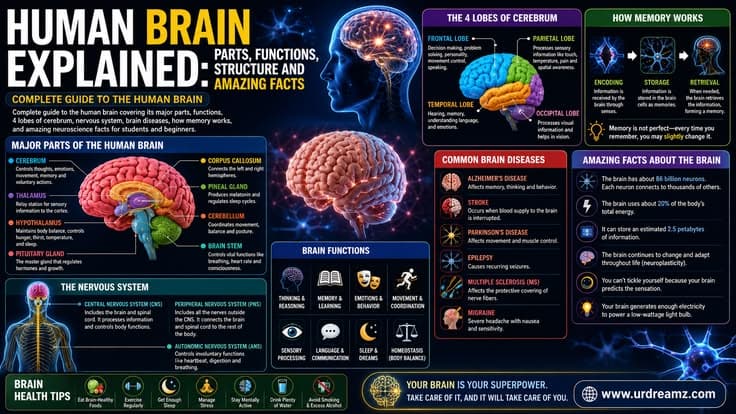
Human Brain Explained: Parts, Functions, Structure and Amazing Facts
The human brain is the most extraordinary object in the known universe. Weighing approximately 1.3 kilograms, a little under 3 pounds, this three-pound organ is responsible for every thought you have ever had, every emotion you have ever felt, every skill you have ever learned, and every memory you have ever stored. It coordinates your heartbeat, regulates your breathing, processes visual information in milliseconds, generates your personality, and allows you to read these very words right now. Despite centuries of scientific study, the human brain remains the least understood organ in the body, and research into its mysteries continues to produce extraordinary new discoveries every year. This complete guide explains everything you need to know about how your brain is built, how it works, and how to keep it healthy.
1. What Is the Human Brain and Why Is It Unique
The human brain is the command center of the entire nervous system. It sits protected inside the skull, surrounded by three protective membranes called meninges and cushioned by cerebrospinal fluid that acts as a shock absorber. From the moment you are born until the moment you take your last breath, the brain never truly rests. Even during deep sleep, it continues processing, consolidating memories, regulating hormones, and maintaining the vital functions that keep your body alive.
What makes the human brain uniquely extraordinary compared to the brains of other animals is not just its size but its complexity. The ratio of brain size to body size in humans is larger than in any other species. More importantly, the outer layer of the human brain, called the cerebral cortex, is dramatically more developed than in other mammals, giving humans capabilities that no other creature possesses: abstract reasoning, language, mathematics, art, planning for the future, and the ability to understand their own existence.
The brain begins developing just three weeks after conception and continues developing well into a person's mid-twenties. This extended developmental period is one reason why human children require such intensive care and education for so many years compared to other animals whose brains develop much more rapidly after birth.
2. Human Brain Key Facts and Measurements
| Measurement or Fact | Value or Description | Context |
|---|---|---|
| Average Weight in Adults | Approximately 1.3 to 1.4 kilograms (about 3 pounds) | Roughly 2 percent of total body weight but uses 20 percent of the body's energy |
| Number of Neurons | Approximately 86 billion neurons | Each neuron can form up to 10,000 connections with other neurons |
| Total Number of Synaptic Connections | Estimated 100 trillion or more | More connections than stars in the Milky Way galaxy |
| Cerebral Cortex Thickness | 2 to 4 millimeters in most areas | Despite its thinness, contains billions of nerve cells organized in six layers |
| Brain Surface Area (Unfolded) | Approximately 2,500 square centimeters | Equivalent to about four A4-sized pages laid flat |
| Processing Speed | Estimated up to 120 meters per second for nerve signals | Signal speed varies by fiber type, from 0.5 m/s to 120 m/s |
| Energy Consumption | About 20 watts continuously | A dim light bulb uses more power than the brain |
| Water Content | Approximately 73 percent water | Even mild dehydration can impair cognitive function and concentration |
| Estimated Storage Capacity | Approximately 2.5 petabytes (2.5 million gigabytes) | Enough to store millions of movies or billions of photographs |
| Development Completion | Full maturity around age 25 | The prefrontal cortex is the last region to fully develop |
One of the most striking facts about the brain is how much energy it demands relative to its size. Although the brain represents only about 2 percent of the body's total weight, it consumes approximately 20 percent of the body's total energy and oxygen supply. This is why maintaining stable blood sugar through healthy eating has such a direct impact on cognitive performance, concentration, and mood.
3. Major Parts of the Human Brain and Their Functions
The human brain is divided into several major structural regions, each responsible for distinct but interconnected functions. Understanding these regions helps clarify how different injuries, diseases, or conditions affect different aspects of thought, movement, personality, and bodily function.
| Brain Region | Location | Size and Weight Share | Primary Functions | What Happens If Damaged |
|---|---|---|---|---|
| Cerebrum | Upper and front portion of the skull, the largest visible structure | Approximately 85 percent of total brain weight | Voluntary movement, intelligence, reasoning, language, memory, sensory interpretation, personality, and all conscious thought | Depending on which area is damaged: paralysis, loss of speech, personality changes, memory impairment, or sensory loss |
| Cerebellum | Lower back of the brain, sitting beneath the occipital lobes of the cerebrum | About 10 percent of brain volume but contains over 50 percent of all neurons | Coordinates voluntary movement, maintains balance and posture, fine-tunes motor skills for precision and smoothness | Unsteady walking, tremors, slurred speech, poor coordination, and difficulty with precise movements |
| Brainstem | At the base of the brain connecting the cerebrum above to the spinal cord below | Small in volume but controls the most fundamental survival functions | Regulates heartbeat, breathing, blood pressure, swallowing, coughing, sneezing, and all involuntary life-sustaining functions | Brainstem damage is frequently fatal because it disrupts breathing and heartbeat |
| Hypothalamus | Deep inside the brain, just below the thalamus and above the brainstem | Very small, about the size of an almond | Maintains homeostasis by regulating body temperature, hunger, thirst, sleep cycles, and emotional responses. Controls the pituitary gland | Disruption of temperature regulation, sleep disorders, hormonal imbalances, appetite dysfunction |
| Pituitary Gland | At the base of the brain, attached to the hypothalamus by a stalk | Pea-sized, but the most influential gland in the entire body | The master endocrine gland that directs all other hormone-producing glands. Controls growth, metabolism, blood pressure, reproduction, and stress response | Growth disorders, hormonal imbalances, infertility, thyroid dysfunction, adrenal problems |
| Thalamus | Central position deep within the brain, above the brainstem | Egg-shaped paired structures | Acts as the brain's sensory relay station, receiving signals from the eyes, ears, skin, and taste receptors and directing them to the appropriate cerebral cortex regions | Sensory processing problems, movement disorders, altered consciousness or coma in severe cases |
| Limbic System | A ring of structures around the thalamus in the inner brain | A network rather than a single structure | Processes emotions, forms and retrieves long-term memories, drives motivation and reward behavior, and regulates the stress response | Emotional disorders, memory impairment, PTSD, addiction vulnerability |
4. The Four Lobes of the Cerebrum Explained
The cerebrum, the largest and most visible part of the brain, is divided into two halves called hemispheres, connected by a thick band of nerve fibers called the corpus callosum. Each hemisphere is further divided into four distinct regions called lobes, each named after the skull bone closest to it. Each lobe handles a different category of brain function, though in reality all lobes work in constant communication with each other to produce integrated thought and behavior.
| Lobe | Location | Primary Functions | Key Structures Within | What Damage Causes |
|---|---|---|---|---|
| Frontal Lobe | The foremost region of the brain, sitting directly behind the forehead | Executive functions: planning, reasoning, decision-making, judgment, impulse control, and working memory. Governs voluntary muscle movement and contains the primary motor cortex. Controls personality and social behavior. Houses Broca's area which enables speech production | Prefrontal cortex, primary motor cortex, Broca's area, premotor cortex | Personality changes, impaired decision-making, loss of impulse control, weakness or paralysis on the opposite side of the body, difficulty speaking (Broca's aphasia) |
| Parietal Lobe | Behind the frontal lobe, forming the upper rear portion of the brain | Processes and interprets sensory information from the body including touch, pressure, temperature, and pain. Manages spatial awareness and understanding of where your body is positioned relative to surrounding objects. Integrates information from multiple senses simultaneously | Primary somatosensory cortex, somatosensory association area | Loss of sensation on the opposite side of the body, difficulty recognizing objects by touch, spatial disorientation, problems with reading and mathematics in some cases |
| Temporal Lobe | The lower sides of the brain, positioned near the temples above the ears | Processes auditory information including sound recognition and music. Manages long-term memory storage and retrieval. Contains Wernicke's area which is critical for understanding spoken and written language. Contributes to emotional processing and face recognition | Primary auditory cortex, Wernicke's area, hippocampus (partial), amygdala (partial) | Hearing difficulties, inability to understand language despite being able to speak (Wernicke's aphasia), memory loss, difficulty recognizing familiar faces |
| Occipital Lobe | The rearmost region of the brain at the back of the skull | Dedicated entirely to processing visual information from the eyes. Interprets shapes, colors, motion, and spatial relationships between objects. Enables face recognition and reading by translating raw visual signals into meaningful images | Primary visual cortex, visual association areas | Visual field defects, inability to recognize objects or faces despite normal eye function, difficulty distinguishing colors, visual hallucinations |
An important insight from modern neuroscience is that while each lobe has its primary specializations, complex human abilities like reading a book require all four lobes to work simultaneously. Reading involves the occipital lobe to see the letters, the temporal lobe to decode their sounds, the frontal lobe to understand their meaning, and the parietal lobe to track position on the page. This simultaneous integration across all brain regions is what allows human cognition to be so flexible and powerful.
5. Deep Brain Structures: Limbic System, Thalamus and Hypothalamus
Beneath the cerebral cortex lies a collection of ancient, evolutionarily older brain structures that regulate emotion, memory, motivation, and the body's internal environment. These structures are present in some form across most vertebrate species, reflecting their fundamental importance for survival. In humans they have evolved to work in sophisticated coordination with the highly developed cerebral cortex above them.
| Structure | What It Is | Key Functions | Clinical Significance |
|---|---|---|---|
| Hippocampus | A seahorse-shaped structure deep in the temporal lobe, one on each side of the brain | Converts short-term experiences into long-term memories, enables spatial navigation and cognitive mapping of environments | The hippocampus is the first structure damaged in Alzheimer's disease, explaining why memory loss is the earliest and most prominent symptom |
| Amygdala | An almond-shaped cluster of nuclei next to the hippocampus in each temporal lobe | Processes emotions, particularly fear and anger. Triggers the fight-or-flight response. Attaches emotional significance to memories, which is why traumatic events are remembered more vividly than neutral ones | Damage reduces the ability to feel or recognize fear. Overactivity is associated with anxiety disorders and PTSD |
| Thalamus | Two egg-shaped structures meeting at the brain's center, forming the gateway to the cerebral cortex | Relays sensory and motor signals to the appropriate cerebral cortex regions. Acts as the brain's central switchboard for consciousness and attention | Thalamic damage can cause unusual pain syndromes, movement disorders, or in severe cases, prolonged unconsciousness |
| Hypothalamus | A small region below the thalamus that connects the nervous system to the hormonal system via the pituitary gland | Regulates body temperature, hunger, thirst, circadian rhythms, reproductive cycles, and the stress response. It produces hormones that control the pituitary gland's output | Hypothalamic tumors or injuries cause severe hormonal imbalances, eating disorders, and temperature dysregulation |
| Basal Ganglia | A group of nuclei embedded deep in the cerebral hemispheres surrounding the thalamus | Coordinates voluntary movement initiation, habit formation, reward processing, and the smooth execution of learned motor sequences | Parkinson's disease involves the degeneration of dopamine-producing neurons that communicate with the basal ganglia. Huntington's disease also devastates this region |
| Corpus Callosum | A thick band of approximately 200 to 250 million nerve fibers connecting the two cerebral hemispheres | Enables communication and coordination between the left and right hemispheres, allowing each side to share information instantly | When surgically cut to treat severe epilepsy, patients develop split-brain syndrome where the two hemispheres can no longer communicate, creating fascinating but debilitating behavioral effects |
6. How the Human Brain Works: Neurons and Synapses
The fundamental working unit of the brain is the neuron, a specialized cell designed to receive, process, and transmit information using a combination of electrical impulses and chemical signals. The human brain contains approximately 86 billion neurons, and each neuron can form connections with thousands of others, creating a network of staggering complexity.
| Stage | What Happens | Structure Involved | Analogy |
|---|---|---|---|
| 1. Signal Reception | A neuron receives incoming signals from neighboring neurons through branch-like extensions | Dendrites | Like antenna receiving a radio signal |
| 2. Signal Integration | The cell body adds up all incoming signals to determine whether the combined input is strong enough to trigger a response | Cell body (soma) | Like a voting system where enough votes must accumulate before a decision is made |
| 3. Signal Transmission | If the threshold is reached, an electrical pulse called an action potential fires along the length of the neuron at speeds up to 120 meters per second | Axon | Like electricity traveling along a wire |
| 4. Chemical Release | When the electrical signal reaches the end of the axon, it triggers the release of chemical messengers called neurotransmitters | Axon terminals and synaptic vesicles | Like a postal worker releasing packages from a vehicle |
| 5. Synaptic Crossing | Neurotransmitters cross the tiny gap between neurons called the synapse and bind to receptor sites on the next neuron | Synapse | Like a key fitting into a lock |
| 6. Strengthening Through Repetition | Each time a particular pathway is used, the synaptic connections along it become stronger and faster, making future transmission easier | All synaptic connections on repeated pathways | Like a path through a field becoming clearer the more it is walked |
When you learn to ride a bicycle, the initial difficulty comes from weak synaptic connections in the neural pathways responsible for balance and coordination. Each time you practice, those connections are strengthened through a process called synaptic potentiation. After enough repetition, the pathway becomes so well-established that riding a bicycle feels automatic and effortless. This is the neurological basis of all skill learning, habit formation, and expertise. The brain literally rewires itself through experience, a property called neuroplasticity.
7. How the Human Brain Stores Memory
Memory is not stored like a computer file in a single location. Instead, each memory is distributed across multiple brain regions simultaneously, with different aspects of the same experience stored in different places. The sight of a childhood home might be stored in the occipital lobe, the sounds associated with it in the temporal lobe, the emotions linked to it in the amygdala, and the spatial layout in the hippocampus. When you recall that memory, all these pieces are rapidly reconstructed together.
| Memory Type | What It Is | Primary Brain Region | Example | How Long It Lasts |
|---|---|---|---|---|
| Sensory Memory | The brief retention of sensory input before it is processed further | Sensory cortices relevant to each sense | The brief image that lingers when you look away from a bright light | Less than 1 second to a few seconds |
| Working Memory (Short-Term) | The temporary holding and manipulation of information currently being used | Prefrontal cortex primarily | Remembering a phone number long enough to dial it | Seconds to minutes without active rehearsal |
| Episodic Memory | Memory of personal experiences and autobiographical events with their emotional and contextual details | Hippocampus, prefrontal cortex, amygdala | Remembering your graduation day, a childhood birthday, a holiday trip | Can last a lifetime if encoded with strong emotion or meaning |
| Semantic Memory | Memory of facts, concepts, and general knowledge independent of personal experience | Temporal and frontal cortices | Knowing that the Earth orbits the Sun, knowing what a triangle is | Stable over decades with occasional reinforcement |
| Procedural Memory | Memory of how to perform skills and habits that have become automatic | Cerebellum, basal ganglia, motor cortex | Knowing how to swim, ride a bicycle, type on a keyboard | Highly durable, often the last memory type lost in neurological disease |
| Emotional Memory | The emotional charge attached to memories that determines how strongly and vividly they are recalled | Amygdala in combination with hippocampus | A powerful memory of a frightening event, a deeply joyful moment | Emotionally charged memories are recalled more vividly and durably than neutral ones |
One of the most fascinating aspects of how the brain handles memory is its intelligent compression system. The brain does not try to record every moment of life with equal precision. Instead it prioritizes memories that are emotionally significant, unusual, repeated frequently, or important for future survival. Routine and boring information is either not encoded at all or gradually deprioritized and forgotten, which is why you remember emotionally significant events from decades ago more clearly than what you had for lunch last Tuesday.
8. Human Brain Storage Capacity: The Data Question
Scientists have estimated that the human brain's theoretical storage capacity is approximately 2.5 petabytes, equivalent to 2.5 million gigabytes or about 2.5 billion megabytes. This estimate, published by researchers at the Salk Institute in a landmark 2016 study, was based on calculating the number of synaptic connections in the brain and the range of signal strengths each could potentially store.
| Comparison | Approximate Data Size | Brain's Equivalent Storage |
|---|---|---|
| A standard 2-hour HD movie | About 4 gigabytes | Brain could store approximately 625 million movies |
| A smartphone photograph | About 3 to 5 megabytes | Brain could store approximately 500 billion to 800 billion photos |
| An average book as text | About 1 megabyte | Brain could store approximately 2.5 trillion books worth of text |
| A typical music album | About 100 megabytes | Brain could theoretically store 25 billion music albums |
| The entire internet (estimated 2023) | Approximately 120 zettabytes | The internet is millions of times larger than the brain's estimated capacity |
It is important to note that the 2.5 petabyte estimate is a theoretical upper bound based on synaptic architecture and should not be interpreted as a fixed number. The brain does not store information in the same way a computer does. Unlike a hard drive that writes discrete files in specific locations, the brain distributes memories across overlapping neural networks, compresses redundant information, and continuously reorganizes its storage based on relevance and emotional weight. The brain also constantly discards information it considers unnecessary, which is not a flaw but an intelligent feature that prevents cognitive overload.
9. Ten Primary Functions of the Human Brain
The brain controls virtually every process in the human body, ranging from the most fundamental survival functions to the most sophisticated aspects of human intellect and creativity. Understanding what the brain does helps appreciate how remarkable it is when it functions normally, and how significant even partial damage can be.
| # | Function | Brain Regions Involved | What This Means in Daily Life |
|---|---|---|---|
| 1 | Sensory Processing | Specific cortex regions for each sense plus association areas | Receiving signals from your eyes, ears, skin, nose and tongue and converting them into meaningful perception of the world |
| 2 | Motor Control | Motor cortex, cerebellum, basal ganglia | Every deliberate physical movement you make from walking to writing to playing an instrument |
| 3 | Autonomic Regulation | Brainstem, hypothalamus | Keeping your heart beating, lungs breathing, digestion working, and blood pressure stable without any conscious effort |
| 4 | Cognition and Decision Making | Prefrontal cortex, parietal cortex, hippocampus | Planning your day, solving problems, weighing options, focusing attention, and making judgments |
| 5 | Memory Storage and Retrieval | Hippocampus, cerebral cortex, cerebellum | Learning new information, remembering past experiences, recalling facts, and performing learned skills automatically |
| 6 | Emotion Generation and Regulation | Amygdala, prefrontal cortex, limbic system | Feeling happiness, fear, love, sadness, and anger, and managing emotional responses in social situations |
| 7 | Homeostasis Maintenance | Hypothalamus, brainstem | Keeping your body temperature at 37 degrees, triggering hunger when glucose drops, creating thirst when dehydrated |
| 8 | Communication and Language | Broca's area (speech production), Wernicke's area (language comprehension) | Speaking, understanding spoken language, reading, writing, and all verbal and written communication |
| 9 | Balance and Spatial Coordination | Cerebellum, vestibular system via brainstem | Walking without falling, catching a ball, navigating a crowded room, knowing where your body parts are without looking |
| 10 | Hormone Secretion and Endocrine Control | Hypothalamus and pituitary gland | Regulating growth, metabolism, reproductive cycles, sleep, stress hormones, and immune function through the hormonal system |
10. The Human Nervous System Explained
The brain does not work alone. It is the central command organ of the nervous system, a vast communication network that extends throughout every part of the body. The nervous system as a whole is responsible for collecting information from the environment and body, processing that information, and directing appropriate responses.
| Division | Components | Primary Role | Example of Function |
|---|---|---|---|
| Central Nervous System (CNS) | Brain and spinal cord | Processes all incoming information and generates all outgoing commands for the body | Deciding to move your hand when you see a hot surface |
| Peripheral Nervous System (PNS) | All nerves outside the brain and spinal cord, including cranial nerves and spinal nerves | Carries sensory information to the CNS and motor commands from the CNS to muscles and organs | The nerves in your fingertip that detect pain and report it to the spinal cord and brain |
| Somatic Nervous System | Sensory neurons carrying signals to CNS plus motor neurons carrying commands to skeletal muscles | Controls voluntary, conscious body movements and relays conscious sensory information | Deciding to pick up a cup and moving your arm and hand muscles accordingly |
| Autonomic Nervous System | Nerves controlling the heart, digestive system, glands, and smooth muscle throughout the body | Controls involuntary, unconscious body functions that operate continuously without conscious input | Your heart rate increasing when you stand up or your pupils dilating in a dark room |
| Sympathetic Division | Part of the autonomic nervous system | Activates the fight-or-flight response, preparing the body for immediate physical action in response to perceived danger | Heart pounds, breathing quickens, pupils dilate, digestion slows when you face a sudden stressful situation |
| Parasympathetic Division | Part of the autonomic nervous system | Promotes the rest-and-digest state, returning the body to calm baseline functioning after stress has passed | Heart rate slows, digestion resumes, breathing normalizes when you feel safe and relaxed |
11. The Brain vs Computer: Key Differences
While the brain is often compared to a computer, the comparison is only superficially accurate. The two systems have fundamentally different architectures, operating principles, and capabilities. Understanding these differences helps appreciate what makes the human brain truly extraordinary rather than just a biological version of something we have already built.
| Feature | Human Brain | Computer |
|---|---|---|
| Processing Architecture | Massively parallel: billions of neurons process multiple streams of information simultaneously | Sequential or limited parallel: processes instructions in ordered steps |
| Memory Storage | Distributed across overlapping neural networks, not stored in fixed locations | Stored in discrete locations with precise addresses in RAM or hard drive |
| Energy Consumption | About 20 watts for the entire brain | Modern computers use hundreds to thousands of watts |
| Adaptability | Continuously rewires itself through learning and experience (neuroplasticity) | Fixed hardware that cannot rewire itself without physical intervention |
| Error Handling | Tolerates damage and works around it, maintaining partial function even with significant injury | A single corrupted component can cause total system failure |
| Creativity | Generates genuinely novel ideas, metaphors, art, music, and solutions never before encountered | Can only recombine patterns from its training data, cannot originate genuinely new ideas |
| Emotional Processing | Integrates emotion with decision-making, creating motivation, values, and moral judgment | No genuine emotional processing, only simulation of emotional language patterns |
| Speed of Learning | Can learn new concepts from a single powerful experience, especially emotionally significant ones | Typically requires millions of training examples to learn even simple tasks |
| Consciousness | Generates subjective conscious experience and self-awareness | No genuine consciousness, only information processing without inner experience |
| Forgetting | Strategically forgets irrelevant information to maintain cognitive efficiency | Does not forget stored data unless programmed to delete it |
12. Do We Really Use Only 10 Percent of Our Brain
One of the most persistent myths about the human brain is the idea that humans only use about 10 percent of their brain capacity. This claim has appeared in popular culture, self-help books, and even some educational settings, but it is completely false according to modern neuroscience.
| Claim | Reality | Scientific Evidence |
|---|---|---|
| Humans only use 10 percent of their brain | Completely false. Over the course of a day, virtually every brain region is used at some point | Brain imaging studies (fMRI and PET scans) consistently show activity throughout the entire brain during normal daily activities |
| Unused brain regions could be activated to unlock superhuman abilities | False. There is no dormant reservoir of untapped mental capacity | Brain regions that genuinely go unused after injury due to lack of input quickly degrade and are repurposed by the brain's plasticity mechanisms |
| The brain has massive unused storage capacity | Partially true but misleading. While theoretical capacity is large, the brain actively manages what it stores and discards | The brain's compression and prioritization systems mean that not all theoretical capacity is used for standard memory storage |
| We could improve performance if we could use more of our brain | The brain is already highly optimized. Trying to force more simultaneous activity often reduces rather than improves performance | Neural efficiency research shows that more intelligent people typically show less, not more, widespread brain activity when solving problems because they process more efficiently |
The likely origin of this myth is a misinterpretation of early neuroscience research and the fact that at any given single moment, not all neurons are firing simultaneously. This is a feature rather than a limitation because having all neurons fire at once would produce an epileptic seizure, not enhanced intelligence. The brain operates on a principle of selective activation where only the neurons relevant to the current task fire while others rest and recover.
13. Ten Common Brain Diseases and Disorders
The brain's extraordinary complexity also makes it vulnerable to a wide range of diseases and disorders. Some are caused by genetic factors, others by injury, infection, or the accumulation of damage over time. Understanding these conditions helps with early recognition and emphasizes why protecting brain health throughout life is so important.
| # | Condition | What It Is | Key Symptoms | Primary Brain Area Affected |
|---|---|---|---|---|
| 1 | Alzheimer's Disease | A progressive neurodegenerative disease characterized by the accumulation of abnormal protein deposits called amyloid plaques and tau tangles that destroy brain cells | Progressive memory loss starting with recent events, confusion, disorientation, personality changes, and eventually loss of language and basic self-care abilities | Hippocampus first, then spreading to the entire cortex |
| 2 | Parkinson's Disease | A movement disorder caused by the progressive death of dopamine-producing neurons in the substantia nigra region of the brainstem and midbrain | Resting tremors (shaking), muscle rigidity, slowed movement, balance problems, and in later stages, cognitive decline | Substantia nigra and basal ganglia circuits |
| 3 | Epilepsy | A neurological disorder characterized by recurrent, unprovoked seizures caused by abnormal electrical discharges in the brain | Seizures ranging from brief staring spells to full-body convulsions, depending on where in the brain the abnormal activity originates | Variable, can originate in any brain region |
| 4 | Brain Tumor | An abnormal growth of cells inside or around the brain that may be benign (non-cancerous) or malignant (cancerous) | Headaches that worsen over weeks, nausea, seizures, vision changes, personality shifts, and neurological deficits depending on tumor location | Depends on tumor location within the brain |
| 5 | Stroke | A sudden interruption of blood flow to part of the brain, caused either by a blocked artery (ischemic stroke) or a ruptured blood vessel (hemorrhagic stroke) | Sudden facial drooping, arm weakness, speech difficulty, vision loss, and severe headache. Uses B.E.F.A.S.T recognition acronym | Depends on which artery is affected and which brain region it supplies |
| 6 | Multiple Sclerosis (MS) | An autoimmune disease where the immune system mistakenly attacks and destroys the myelin sheath that insulates nerve fibers throughout the brain and spinal cord | Muscle weakness, vision problems, fatigue, balance difficulties, numbness, tingling, and cognitive slowing | White matter throughout the brain and spinal cord |
| 7 | Meningitis | A potentially life-threatening infection and inflammation of the meninges, the three protective membranes that surround the brain and spinal cord | Severe sudden headache, high fever, stiff neck, sensitivity to light and sound, nausea, and in bacterial cases, a distinctive non-blanching rash | Meninges surrounding the brain and spinal cord |
| 8 | Migraine | A neurological condition involving abnormal brain electrical activity and blood vessel changes that produce episodic severe headaches, often with additional neurological symptoms | Intense throbbing headache usually on one side, nausea, extreme sensitivity to light and sound, and sometimes visual disturbances called aura before the headache begins | Trigeminal nerve pathways, cortex, blood vessels |
| 9 | Huntington's Disease | A fatal inherited neurodegenerative disease caused by a genetic mutation that progressively destroys nerve cells in the brain's striatum and cortex | Involuntary jerky movements (chorea), progressive cognitive decline, personality changes, depression, and eventually complete loss of function | Striatum (caudate nucleus) and cerebral cortex |
| 10 | Cerebral Palsy | A group of permanent movement and posture disorders caused by damage to the developing brain, either before birth, during birth, or in early infancy | Impaired movement and coordination, stiff or floppy muscle tone, tremors, difficulty with precise movements, and sometimes associated cognitive and sensory challenges | Motor cortex and white matter pathways, varying by individual |
14. How to Keep Your Brain Healthy and Sharp
The brain, like the heart, responds directly to lifestyle choices. Research in neuroscience consistently shows that certain daily habits protect brain cells, stimulate the growth of new neural connections, and reduce the risk of cognitive decline with aging. The following evidence-based strategies support lifelong brain health.
| Strategy | What to Do | Why It Protects the Brain | Research Support |
|---|---|---|---|
| Regular Aerobic Exercise | At least 150 minutes of moderate cardio weekly, such as brisk walking, swimming, or cycling | Increases blood flow to the brain, stimulates the growth of new neurons in the hippocampus through BDNF (brain-derived neurotrophic factor), and reduces dementia risk | Strong evidence from multiple longitudinal studies showing 30 to 40 percent reduced dementia risk with regular exercise |
| Quality Sleep | Seven to nine hours of uninterrupted sleep nightly with a consistent schedule | Sleep is when the brain clears metabolic waste through the glymphatic system, including the amyloid proteins linked to Alzheimer's disease. Also consolidates memories formed during waking hours | People with chronic poor sleep show significantly higher rates of Alzheimer's biomarkers in their cerebrospinal fluid |
| Cognitive Challenge | Regularly learn new skills, read challenging material, solve puzzles, or engage in new creative activities | Mental challenge builds cognitive reserve, the brain's resilience to damage. People with high cognitive reserve can tolerate more physical brain damage before showing symptoms | Higher education and lifelong learning are the strongest known non-genetic protective factors against Alzheimer's disease |
| Social Engagement | Maintain active, meaningful social connections and regular interaction with others | Social interaction engages multiple brain regions simultaneously, provides cognitive stimulation, reduces chronic stress hormones, and supports emotional regulation | Social isolation is associated with significantly accelerated cognitive decline and higher dementia risk in older adults |
| Heart-Healthy Diet | Follow a Mediterranean or DASH-style diet rich in omega-3 fatty acids, antioxidants, and whole foods while limiting processed foods | The brain is highly vulnerable to inflammation and oxidative damage. A nutrient-rich diet provides antioxidants that protect neurons and omega-3 fatty acids that support cell membrane integrity | The MIND diet (Mediterranean-DASH Intervention for Neurodegenerative Delay) has shown up to 53 percent reduced Alzheimer's risk with strict adherence |
| Stress Management | Regular practice of stress reduction techniques such as meditation, deep breathing, yoga, or time in nature | Chronic stress elevates cortisol which damages the hippocampus over time, shrinking its volume and impairing memory. Stress management protects hippocampal volume and function | Mindfulness meditation shows measurable structural brain changes including increased gray matter density in the prefrontal cortex |
| Avoid Tobacco and Excessive Alcohol | Never smoke and limit alcohol to no more than one drink daily | Tobacco compounds restrict blood flow to the brain and generate free radicals that damage neurons. Excessive alcohol is directly neurotoxic and causes structural brain shrinkage over time | Heavy drinking reduces total brain volume and is a major modifiable risk factor for early dementia |
15. Amazing Brain Facts You Should Know
The human brain is full of extraordinary facts that seem almost impossible to believe but are confirmed by modern neuroscience. These remarkable facts help illustrate just how extraordinary the organ in your skull truly is.
| Fact | Details |
|---|---|
| The brain generates approximately 70,000 thoughts per day | This amounts to about one thought every 1.2 seconds throughout all waking hours |
| Your brain cannot feel pain | The brain contains no pain receptors. Headaches originate from pain receptors in the meninges, blood vessels, muscles, and nerves around the brain, not the brain tissue itself |
| The brain is approximately 60 percent fat | The human brain is the fattiest organ in the body. Most of this fat is in the myelin sheaths that insulate nerve fibers, enabling fast signal transmission |
| New neurons can grow in the adult brain | Until the 1990s scientists believed you were born with all the neurons you would ever have. We now know that neurogenesis, the birth of new neurons, occurs in the hippocampus throughout adult life, particularly stimulated by aerobic exercise |
| The brain never truly stops working | Even during the deepest stages of sleep the brain remains highly active, processing emotions, consolidating memories, clearing waste products, and regulating all body systems |
| Yawning cools the brain | Research suggests that yawning serves as a thermoregulatory mechanism to cool the brain when its temperature rises, which is why you yawn more when tired or overstimulated |
| The brain changes throughout life | Neuroplasticity, the brain's ability to reorganize itself by forming new neural connections, continues throughout the entire lifespan. The brain you have today is physically different from the brain you had five years ago |
| Boredom is a sign of an under-stimulated brain | The feeling of boredom represents the brain signaling that it needs more stimulating input. Chronically bored individuals tend to have lower cognitive resilience in later life |
| Laughter engages multiple brain regions simultaneously | Genuinely finding something funny requires the frontal lobe to process context and incongruity, the temporal lobe to understand language, the motor cortex to produce laughter, and the limbic system to generate pleasure |
| The brain can rewire after damage | In cases of brain injury, particularly in children, neighboring brain regions can sometimes take over functions from the damaged area through remarkable adaptive plasticity, allowing partial or even complete functional recovery |
The human brain remains the greatest scientific frontier of our time. Despite centuries of study and remarkable advances in neuroimaging technology, we still do not fully understand how consciousness arises from neural activity, why we dream, what the precise mechanisms of creativity are, or how subjective experience emerges from physical matter. These enduring mysteries make the brain not just the most complex organ in the body but the most fascinating object in science.
Internal links for further reading:
- Heart Health Explained: Causes of Heart Disease, Warning Signs and Prevention Guide
- Blood Pressure Lifestyle Management: Stress Reduction, Sleep, Daily Habits and Long-Term Heart Health
- High Blood Pressure Explained: Symptoms, Causes, Risks and Complete Treatment Guide
Medical Disclaimer: This article provides general educational information about the human brain and is not intended as medical advice, diagnosis, or treatment. If you or someone you know is experiencing neurological symptoms, cognitive changes, or any brain-related health concerns, please consult a qualified neurologist or healthcare provider promptly.