What If the Human Brain Could Connect Directly to the Internet? Brain-Computer Interfaces, AI, Consciousness and the Future of Human Intelligence Explained
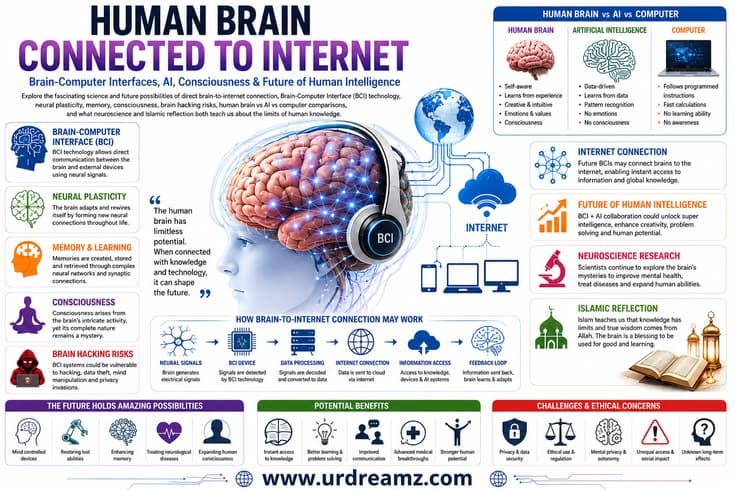
Explore the fascinating science and future possibilities of direct brain-to-internet connection, Brain-Computer Interface (BCI) technology, neural plasticity, memory, consciousness, brain hacking risks, human brain vs AI vs computer comparisons, and what neuroscience and Islamic reflection both teach us about the limits of human knowledge.
1. What If the Human Brain Connected Directly to the Internet?
This is purely an educational and hypothetical "what if" scenario, but here is the genuinely interesting part: scientists and technology companies around the world are already conducting real, practical research in exactly this direction. Today, we access information through phones, computers, and the internet acting as intermediaries between our minds and the world's knowledge. But imagine, for a moment, a day arrives when the human brain could connect directly to the internet, and information could flow straight into the brain without needing a phone or a computer screen at all. What would such a world actually look like?
This question sits at the intersection of several of today's fastest-moving fields of research: neuroscience, artificial intelligence, computer engineering, cybersecurity, and even philosophy and ethics. It is the kind of question that sounds like science fiction at first glance, yet the building blocks of the technology that could eventually make it possible already exist in laboratories today, in early and limited forms. Understanding where this technology currently stands — and where it realistically might be headed — requires walking through the science step by step, while keeping a clear and honest distinction between what is proven, what is plausible, and what remains purely speculative.
2. Brain-Computer Interface (BCI): What It Is and How It Works
The human brain is made up of approximately 86 billion neurons, which communicate with one another through electrical and chemical signals. This staggeringly complex biological network is what gives rise to every thought, memory, movement, and emotion a person experiences. Today, scientists are working on a technology called the Brain-Computer Interface (BCI), whose core purpose is to establish a direct line of communication between the brain and a computer — bypassing the normal channels of speech, typing, or physical movement entirely.
What makes this genuinely fascinating is that experimental brain-computer interfaces already exist in the world today that are helping paralyzed individuals write words on a computer screen or move a cursor purely through thought. These systems typically work by implanting or placing sensors that detect the electrical activity generated by specific regions of the brain, then translating those electrical patterns into digital commands a computer can interpret and act upon. Although this technology remains at an extremely early stage, the scientific community broadly views it as one of the most significant frontiers of future technological progress — a field that connects neuroscience, robotics, computer science, and medicine into a single emerging discipline.
It is worth being precise about where the science currently stands. Today's BCI systems are nowhere near capable of full two-way internet connectivity with the human brain. What exists now are narrow, task-specific interfaces — typically allowing a user to control a cursor, select letters, or move a robotic limb. The leap from "moving a cursor with thought" to "downloading the internet into your mind" is an enormous one, and no current technology is anywhere close to bridging that gap. Understanding this distinction is essential before exploring the more speculative possibilities that follow.
3. Can Knowledge Be Downloaded Into the Brain in Seconds?
Suppose you wanted to learn Japanese. Today, this requires years of dedicated effort, practice, and patience. But if the brain could connect directly to the internet, one theoretical possibility often imagined is that millions of pages of information could, in principle, reach your brain within a matter of seconds — although current science does not yet possess any such capability. In this same imagined future, medical students might acquire complete anatomical maps of the human body in mere moments, and engineers could instantly visualize and apply complex formulas without years of study.
This is an exciting thought experiment, and it captures much of why the idea of brain-internet connectivity captures public imagination so powerfully. The promise of near-instant learning, of eliminating years of effort needed to master a skill or language, speaks to a very old human desire — the desire to know more, faster, and with less struggle. But this same thought experiment also exposes one of the deepest and most important scientific and philosophical questions raised by this entire idea, which is the subject of the next section.
4. Information vs Understanding: Why They Are Not the Same
Here an important scientific and intellectual question arises: information and understanding are not the same thing. A computer can hold an immense amount of information, yet it does not possess wisdom, consciousness, ethics, or the human capacity for judgment and decision-making in the way a person does. Downloading data into the brain would not automatically mean that a person instantly gains the skill or biological capacity to use that data effectively, because the brain's learning process — what neuroscientists call neural plasticity — inherently takes time.
Neural plasticity refers to the brain's ability to reorganize itself by forming new neural connections throughout life, and it is this very process that allows learning, memory formation, and skill acquisition to occur. Skill, in particular, is not simply stored information — it is a pattern of neural pathways strengthened through repetition, practice, and lived experience. A surgeon's steady hands, a musician's sense of timing, a native speaker's intuitive grasp of grammar — none of these are reducible to facts that could be "downloaded." They are embodied capabilities built through time, repetition, and the brain's gradual physical reorganization. This single distinction — between raw information and genuine understanding or skill — is perhaps the most important philosophical takeaway from the entire brain-internet thought experiment, and it has direct relevance to ongoing debates about artificial intelligence, machine learning, and what computers can and cannot truly "know."
5. The Memory Revolution and the Risk of Forgetting How to Remember
If the brain became connected to the internet, we might no longer need to remember many things at all in the traditional sense. But this carries a real risk: the human brain might begin relying less on its own natural memory systems — in much the same way that today, many of us no longer memorize phone numbers because our mobile phones store them for us automatically. This phenomenon, sometimes discussed by cognitive scientists as a form of "cognitive offloading," is already observable in modern life and offers a useful preview of what a more extreme, brain-integrated version of the same trend might look like.
The question this raises is not merely theoretical. Memory is not just a storage mechanism; it plays an active role in creativity, problem-solving, and the formation of personal identity. A future in which biological memory atrophies in favor of externally stored or instantly retrievable information would represent a genuine trade-off — convenience and speed on one side, against the deep cognitive and even psychological benefits of an actively exercised, biologically grounded memory on the other. Whether such a trade-off would ultimately benefit or harm human cognitive development remains an open and serious question for future research.
6. Brain Hacking, Neural Privacy and Cybersecurity Risks
The single biggest danger in this entire scenario is cybersecurity. If the brain were connected to the internet, could someone's thoughts be stolen? Could memories be altered? Could false information be inserted directly into a person's brain? These are not idle science-fiction concerns — they are exactly the kinds of questions that researchers in the field of neuroethics are taking seriously today, working specifically on how to protect brain-computer interfaces from external cyberattacks and hacking attempts.
Consider the stakes involved. A hacked email account is a serious problem — financial loss, identity theft, reputational damage. A hacked brain interface, even in a limited future form, raises categorically different concerns: the potential manipulation of memory, the implantation of false beliefs, or unauthorized access to a person's most private thoughts. Current BCI cybersecurity research already grapples with much smaller-scale versions of these problems — protecting medical-grade BCI implants from interference, ensuring data transmitted from brain sensors is encrypted, and establishing protocols for what happens if a device malfunctions or is compromised. As these systems grow more capable, the cybersecurity challenge will scale right alongside them, and many ethicists argue that protective frameworks must be developed proactively, well before any large-scale brain-internet connectivity becomes remotely feasible, rather than retroactively after problems emerge.
7. Will Humans Become Superhuman? Brain vs Supercomputer
Some experts believe that the merging of humans and artificial intelligence could give rise to an entirely new kind of human being — sometimes referred to in futurist circles as a "post-human" or enhanced human. But even the world's most powerful supercomputers have not been able to fully replicate the human brain. The human brain contains approximately 100 to 500 trillion synaptic connections, with billions of signals being exchanged between neurons at every single moment. Science has come to understand many of the brain's individual functions in impressive detail, but the true nature of consciousness, imagination, emotion, and self-awareness remains one of the great unsolved mysteries of modern science.
This gap between raw computational power and genuine biological intelligence is worth dwelling on, because it is often misunderstood in popular discussions of AI and the brain. A supercomputer can perform vastly more raw numerical calculations per second than a human brain ever could. Yet the brain accomplishes its staggering range of functions — perception, emotion, creativity, social reasoning, intuitive judgment — using only about 20 watts of power, roughly the energy of a dim light bulb, while a comparable supercomputer simulation would require enormous power plants' worth of electricity. This dramatic efficiency gap is one of the reasons many neuroscientists and computer scientists remain genuinely humbled by biological intelligence, even as artificial intelligence systems achieve superhuman performance on specific, narrow tasks.
8. Human Brain vs Artificial Intelligence: The Complete Comparison
The comparison between the human brain and artificial intelligence has become one of the most widely discussed topics in modern science and technology, and for good reason — it touches on questions of identity, capability, and the future of human relevance in an increasingly AI-driven world. While AI systems, including large language models and neural networks, have achieved remarkable feats of pattern recognition, language generation, and narrow problem-solving, fundamental differences remain between machine intelligence and human cognition.
Artificial intelligence excels at processing enormous datasets at speeds no human could match, recognizing statistical patterns across millions of examples, and performing specific, well-defined tasks with tireless consistency. However, AI systems do not possess genuine understanding in the way humans do; they identify statistical correlations within their training data rather than grasping meaning, context, or consequence the way a human mind does. Human intelligence, by contrast, is deeply intertwined with emotion, lived experience, ethical reasoning, creativity that draws on entirely novel combinations of ideas, and a continuous, embodied sense of self that persists across time. A human being can feel genuine curiosity, experience moral conflict, or find unexpected inspiration while staring out a window — capacities that current AI systems do not possess in any meaningful sense, regardless of how convincingly they may simulate conversational engagement.
| Aspect | Human Brain | Artificial Intelligence |
|---|---|---|
| Learning Method | Experience, emotion, repetition, neural plasticity | Statistical pattern recognition from training data |
| Energy Use | About 20 watts | Often megawatts for large model training |
| Consciousness | Present (though not fully understood scientifically) | Not established to be present |
| Creativity | Generates genuinely novel ideas from lived experience | Recombines patterns found in training data |
| Emotional Understanding | Deeply felt and embodied | Simulated; not genuinely experienced |
| Speed on Narrow Tasks | Slower than specialized AI on specific tasks | Extremely fast on well-defined tasks |
| Adaptability to Novel Situations | Highly adaptable, even with little prior data | Often struggles outside its training distribution |
| Self-Awareness | Present | Not established to be present |
The honest scientific consensus today is that AI cannot replace the human brain in any holistic sense, even though it can outperform humans dramatically on specific narrow tasks like chess, certain pattern-recognition challenges, or rapid data retrieval. Whether AI will ever achieve genuine consciousness or subjective experience remains deeply contested among philosophers and scientists, with no resolution in sight, and this uncertainty itself is part of why brain-AI comparisons remain such a rich and ongoing area of debate.
9. Human Brain vs Computer: Processing Power, Memory, Storage and Energy
The comparison between the human brain and a conventional computer is one of the oldest and most enduring topics in popular science writing, and it remains genuinely useful because it highlights both the impressive achievements of modern computing and the equally impressive, very different achievements of biological evolution. A computer processes information using binary logic — a sequence of ones and zeros executed at extraordinary clock speeds — while the brain operates through a massively parallel network of electrochemical signals firing across billions of neurons simultaneously. These are fundamentally different computational architectures, which is why direct one-to-one comparisons are often misleading, even though they remain a popular and illuminating exercise.
On raw processing speed for specific, well-defined calculations — multiplying large numbers, searching massive databases, rendering complex graphics — computers vastly outperform the human brain, often by many orders of magnitude. However, the human brain demonstrates extraordinary parallel processing capability for tasks like visual recognition, language comprehension, and social inference, often completing these in fractions of a second using processes that remain difficult for even the most advanced AI systems to replicate with the same flexibility and contextual nuance. When it comes to memory, comparing brain storage capacity to a computer's hard drive is notoriously difficult, since memories in the brain are not stored as discrete files in a single location but are instead distributed across networks of synaptic connections, with estimates of the brain's total memory capacity varying enormously depending on the methodology used, ranging from estimates in the low terabytes to vastly higher figures depending on how "capacity" is defined.
| Factor | Human Brain | Computer |
|---|---|---|
| Processing Architecture | Massively parallel, electrochemical | Sequential/parallel binary logic circuits |
| Speed (Narrow Defined Tasks) | Slower for pure calculation | Vastly faster for defined calculations |
| Speed (Pattern Recognition, Context) | Extremely fast and flexible | Fast, but less flexible outside training |
| Memory Storage Method | Distributed across synaptic connections | Discrete files on storage media |
| Energy Consumption | Approximately 20 watts | Hundreds of watts to megawatts (large systems) |
| Error Tolerance | Highly fault-tolerant; graceful degradation | Can fail completely from small faults |
| Self-Repair | Capable of neuroplastic adaptation | Cannot self-repair hardware damage |
The energy efficiency gap deserves particular emphasis, since it is one of the most striking and consistently cited facts in brain-computer comparisons. The human brain operates on roughly the energy of a dim household light bulb, while training or running large-scale AI models or supercomputer simulations of comparable cognitive functions can require energy consumption on the scale of entire power plants. This efficiency gap is part of why fields like neuromorphic computing — designing computer chips that mimic the brain's structure and energy efficiency — have become such an active and promising area of hardware research, since replicating even a fraction of the brain's efficiency would represent a massive leap forward for computing technology generally.
10. Human Brain vs Artificial Neural Networks
Artificial neural networks, the architecture underlying most of today's most powerful AI systems including large language models and image recognition systems, were directly inspired by simplified models of how biological neurons connect and communicate. However, despite the name, artificial neural networks are dramatically simplified abstractions compared to actual biological neurons. A biological neuron is an extraordinarily complex living cell, capable of changing its own structure, releasing dozens of different neurotransmitter chemicals, and adjusting its behavior based on a vast range of biological and environmental factors. An artificial neuron, by contrast, is typically a simple mathematical function — multiplying inputs by weighted values and passing the result through an activation function.
Despite this simplicity, artificial neural networks have proven remarkably powerful at certain kinds of tasks, particularly pattern recognition across massive datasets. Deep learning — networks with many layers of these artificial neurons — has enabled breakthroughs in image recognition, language translation, and generative AI. Yet the learning processes remain fundamentally different: biological learning happens continuously, in real time, integrated with emotion, motivation, sensory experience, and physical embodiment, while artificial neural network training typically happens in discrete, computationally expensive phases, separated from any embodied experience of the world, using data that has been collected and curated in advance rather than experienced firsthand.
| Feature | Biological Neuron | Artificial Neuron |
|---|---|---|
| Structure | Living cell with dendrites, axon, synapses | Mathematical function (weighted sum + activation) |
| Signal Type | Electrochemical, multiple neurotransmitters | Numerical values passed through layers |
| Learning Process | Continuous, embodied, experience-driven | Discrete training phases on curated datasets |
| Adaptability | Can physically rewire (neural plasticity) | Requires retraining to adapt to new patterns |
| Energy Per Operation | Extremely low | Higher, especially at scale |
11. Human Brain vs Animal Brain: Dogs, Dolphins and Beyond
Comparing the human brain to animal brains offers a different but equally illuminating perspective on intelligence, since it shows how cognition has evolved differently across species facing different environmental and survival pressures. The human brain, while not the largest in absolute terms among animals, possesses an unusually large and complex prefrontal cortex relative to body size, which is closely associated with abstract reasoning, long-term planning, and complex social cognition.
Dogs, for instance, possess brains highly specialized for social bonding with humans, scent detection at a level humans cannot approach, and reading human emotional and behavioral cues with remarkable sensitivity, even though their overall problem-solving abilities on abstract tasks are more limited than a human's. Dolphins represent one of the most striking cases of non-human intelligence, displaying self-recognition in mirror tests, complex social structures, sophisticated communication through clicks and whistles, and problem-solving abilities that place them among the most cognitively advanced animals on the planet alongside great apes and elephants. Even animals with comparatively simple brains, such as sheep, demonstrate forms of memory and facial recognition — sheep can recognize and remember individual human and sheep faces for extended periods, a finding that surprised researchers when first documented and that continues to reshape assumptions about which animals are capable of which cognitive feats.
| Species | Notable Cognitive Strength | Comparison Point to Humans |
|---|---|---|
| Dogs | Social bonding, scent detection, reading human cues | More specialized, less abstract reasoning |
| Dolphins | Self-recognition, complex communication, social cognition | Comparable social complexity, different sensory focus |
| Sheep | Long-term facial recognition memory | Surprisingly capable memory despite smaller brain |
| Great Apes | Tool use, problem-solving, social hierarchy navigation | Closest cognitive relatives to humans |
| Humans | Abstract reasoning, language, long-term planning | Unique combination of scale and prefrontal complexity |
The broader lesson from comparative animal cognition research is that intelligence is not a single linear scale with humans simply at the top and everything else below. Instead, intelligence appears to be a multidimensional set of specialized capabilities, shaped by evolutionary pressures specific to each species' environment and survival needs. This nuanced understanding has become increasingly influential in how scientists think about both animal cognition and the development of artificial intelligence, since it suggests that "general intelligence" may be less a single capability to maximize and more a complex bundle of specialized skills that must each be understood on their own terms.
12. The Mystery of Consciousness: What Science Still Cannot Explain
Among all the topics touched on by the brain-internet thought experiment, none is more profound or more genuinely unresolved than the question of consciousness. Consciousness — the subjective, first-person experience of being aware, of feeling, of having an inner mental life — remains one of the deepest unsolved problems in modern science, often referred to by philosophers as the "hard problem of consciousness." Scientists have made enormous progress mapping which brain regions are active during which mental states, but explaining why and how subjective experience arises from purely physical processes in the brain remains fundamentally unresolved.
This question becomes especially relevant in any discussion of brain-computer interfaces or artificial intelligence, because it raises a question that no current technology can answer: could a sufficiently advanced computer system ever become genuinely conscious, in the same sense that a human is conscious, rather than merely simulating the outward signs of awareness? Philosophers, neuroscientists, and AI researchers remain deeply divided on this question. Some argue that consciousness is fundamentally tied to biological processes and could never arise in silicon-based systems; others argue that consciousness might be an emergent property of sufficiently complex information processing, regardless of the physical substrate involved. No experiment currently exists that could definitively settle this debate, and it remains one of the most actively discussed open questions at the intersection of neuroscience, philosophy, and artificial intelligence research.
What is clear is that self-awareness, imagination, and the felt quality of emotional experience — what philosophers call "qualia" — have not been replicated or fully explained by any current scientific framework, biological or artificial. This is part of why many scientists approach grand claims about AI consciousness, brain uploading, or full brain-internet merger with significant caution: the most fundamental piece of the puzzle, consciousness itself, remains a genuine scientific mystery rather than a solved engineering problem.
13. Medical Uses of BCI: Helping Paralyzed Patients
While speculative discussions of brain-internet merger and superhuman cognition capture public imagination, the most concrete and genuinely transformative real-world applications of brain-computer interface technology today are medical. For individuals living with paralysis, severe spinal cord injuries, or conditions like ALS (amyotrophic lateral sclerosis) that progressively impair motor function, BCI technology offers something close to miraculous: a way to communicate, control devices, and regain a measure of independence despite the loss of normal motor control.
Current medical BCI systems typically work by detecting electrical signals from specific brain regions associated with intended movement, even when the actual physical movement cannot occur due to nerve or muscle damage. These signals are then decoded by software and translated into commands that can move a cursor on a screen, select letters to spell out words, or in more advanced experimental systems, control robotic prosthetic limbs or exoskeletons. For patients who have lost the ability to speak or move, even a slow, effortful form of digital communication restored through BCI technology can represent an enormous improvement in quality of life and personal autonomy.
| Medical Application | What It Enables | Current Stage |
|---|---|---|
| Cursor/Letter Selection | Communication for paralyzed/locked-in patients | Demonstrated in research and limited clinical use |
| Robotic Limb Control | Restoring some physical interaction capability | Active experimental and clinical trial stage |
| Exoskeleton Control | Assisting mobility for spinal cord injury patients | Experimental, advancing steadily |
| Speech Restoration | Converting neural signals into synthesized speech | Promising early research results |
| Sensory Feedback | Restoring some sense of touch via neural stimulation | Early-stage experimental research |
This medical dimension is crucial context for the broader brain-internet thought experiment, because it grounds an otherwise speculative discussion in real, ongoing, ethically motivated research. The scientists and engineers developing these systems are not primarily chasing the science-fiction dream of instant internet-downloaded knowledge; they are working to solve genuinely urgent human problems faced by people who have lost fundamental abilities most of us take for granted. Whatever speculative future possibilities BCI technology might eventually unlock, its current and most defensible value lies squarely in this medical and assistive technology space.
14. Neuroethics: Why This Technology Needs Ethical Boundaries
The phrase "neuroethics" refers to the ethical, legal, and social questions raised by advances in neuroscience and neurotechnology. As brain-computer interfaces and related technologies advance, neuroethics has emerged as a formal field of inquiry precisely because the stakes involved in brain technology are categorically higher than in many other areas of technological development. A hacked phone compromises data; a hacked brain interface could compromise a person's fundamental sense of self and autonomy.
Some of the central questions in neuroethics include: who owns the neural data generated by a brain-computer interface — the individual whose brain produced it, the company whose device recorded it, or the medical institution that facilitated the procedure? Should cognitive enhancement technologies, if they ever become feasible, be available only to the wealthy, or should they be treated as a form of public health infrastructure? How do we prevent the militarization of BCI technology, or its use in coercive interrogation or surveillance contexts? These are not hypothetical questions; each corresponds to a line of research or development already occurring somewhere in the world, which is why ethicists and scientists are working together on these questions in real-time.
Most neuroethicists emphasize that the appropriate time to establish ethical and legal frameworks for brain-interfacing technology is before that technology becomes widely available, not after problems emerge. This principle of "anticipatory governance" has been adopted by several major neuroscience research centers and international science bodies, including the International Neuroethics Society, which works to ensure that ethical considerations keep pace with technological development rather than lagging behind it.
15. Quran and Reflection: Knowledge, Limits and Humility
The hypothetical question of connecting the human brain directly to the internet raises deep questions about the nature of knowledge, the limits of human capacity, and the proper relationship between humans and the universe — questions that have been explored for centuries in religious and philosophical traditions as well as in science.
In the Islamic tradition, the Quran repeatedly emphasizes that human knowledge is inherently limited and that genuine wisdom includes recognizing what one does not know. The verse "And you have not been given of knowledge except a little" (Quran 17:85) points directly to this idea: no matter how much knowledge accumulates, the human capacity for full comprehension remains fundamentally finite. The Quran also states: "Were the sea to be ink for the words of my Lord, the sea would be exhausted before the words of my Lord were exhausted" (Quran 18:109), a metaphor that illustrates the infinite nature of divine knowledge and the corresponding limits of any created being's capacity to fully encompass it.
From this perspective, the possibility of brain-internet connectivity raises a question that transcends technology: even if the brain could theoretically access all information available, could human consciousness meaningfully hold it all? Could it process and understand it all in a way that leads to genuine wisdom rather than mere data accumulation? These are not only technical questions but also spiritual and existential ones, reminding us that even the most advanced future technology would still operate within the boundaries of what a finite human mind can genuinely integrate and make meaning of.
The Quranic emphasis on reflection (tadabbur) and contemplation (tafakkur) suggests that the value of knowledge lies not merely in acquiring it but in thinking deeply about it, internalizing it, and allowing it to shape character and conduct. This is yet another way to understand the distinction raised earlier between raw information and genuine understanding, and it offers a perspective on why even a future of instant information access would still require the patient work of understanding, reflection, and wisdom — capacities that remain uniquely human, regardless of how the technology around them evolves.
16. Future Outlook: Transhumanism, Singularity and What Comes Next
Discussions of brain-internet connectivity inevitably intersect with two broader intellectual movements: transhumanism and the concept of the technological singularity. Transhumanism is a philosophical and cultural movement that advocates for the use of technology to enhance human intellectual, physical, and psychological capacities beyond what is currently possible without assistance. Many transhumanists view brain-computer interfaces as a natural and desirable step in this enhancement trajectory, one that could allow humans to integrate directly with artificial intelligence and dramatically expand cognitive capabilities.
The technological singularity refers to a hypothetical future point at which technological growth becomes so rapid and so profound that it becomes impossible for unaided human intelligence to predict what comes next. Some theorists, most notably inventor and futurist Ray Kurzweil, have argued that the convergence of artificial intelligence, biotechnology, and nanotechnology could lead to a singularity within this century. In this scenario, brain-internet connectivity might not be a separate development but part of a broader integration of human and machine intelligence.
However, many scientists and philosophers are critical of singularity narratives, arguing that they depend on assumptions about the trajectory of technological progress that are not well supported by evidence. Predicting the future of technology decades in advance is notoriously difficult, and many of the specific claims associated with singularity predictions have been criticized as overconfident. Still, the mere possibility that such developments could occur is sufficient reason to take the ethical and existential questions they raise seriously, which is exactly what neuroethicists and other researchers in these fields are doing.
The most likely trajectory over the next few decades is not a sudden merger of human brains with the internet but rather a gradual, incremental expansion of BCI capabilities in medical and assistive contexts, accompanied by steady improvements in the bandwidth, resolution, and non-invasiveness of BCI systems. This gradualist path does not make the grand hypothetical questions any less interesting or relevant; it simply suggests that the transformation, if it comes at all, will be slow enough that humans will have time to adapt to it along the way, rather than waking up one day to a world that has suddenly become unrecognizable.
17. Conclusion: The Real Power Beyond Information
The idea of connecting the human brain directly to the internet is a thought experiment that sits at the intersection of science, philosophy, ethics, and technology. It raises questions that are genuinely fascinating to explore: Could we learn languages instantly? Could we store all of human knowledge in our minds? Would we become smarter, or would we simply become better-stored?
But there is something else this thought experiment teaches us. It reminds us that human knowledge is not just a collection of facts — it is understanding, wisdom, and ethical judgment built over time and through experience. The internet contains immense information. But the human capacity to turn information into wisdom requires reflection, experience, and self-awareness. This is a point that Islamic tradition also emphasizes deeply: knowledge is not simply acquisition; it is reflection, understanding, and acting in accordance with what is known. The Quran repeatedly calls on people to think, to reflect, and to seek understanding. It does not simply encourage memorization or data gathering, but a deeper integration of knowledge into life and character.
In this sense, even if technology one day made it possible to connect the human brain directly to the internet, the most essential aspect of human intelligence and dignity might still lie in the parts that cannot be transferred, uploaded, or downloaded at all. It lies in the consciousness that experiences, the heart that seeks meaning, and the soul that turns toward its Creator in humility and recognition of its own limits. The real power is not information — it is what we do with it, how we understand it, and how we live by it.
That remains, and perhaps always will remain, uniquely human.
Related Articles
- Human Brain Explained: Parts, Functions, Structure and Amazing Facts
- Artificial Intelligence vs Human Brain: Complete Comparison Guide
- Neuroscience of Memory and Learning: How Your Brain Actually Works
- Future of Artificial Intelligence: What to Expect by 2030
- Neuroethics and Brain-Computer Interfaces: Ethical Guide