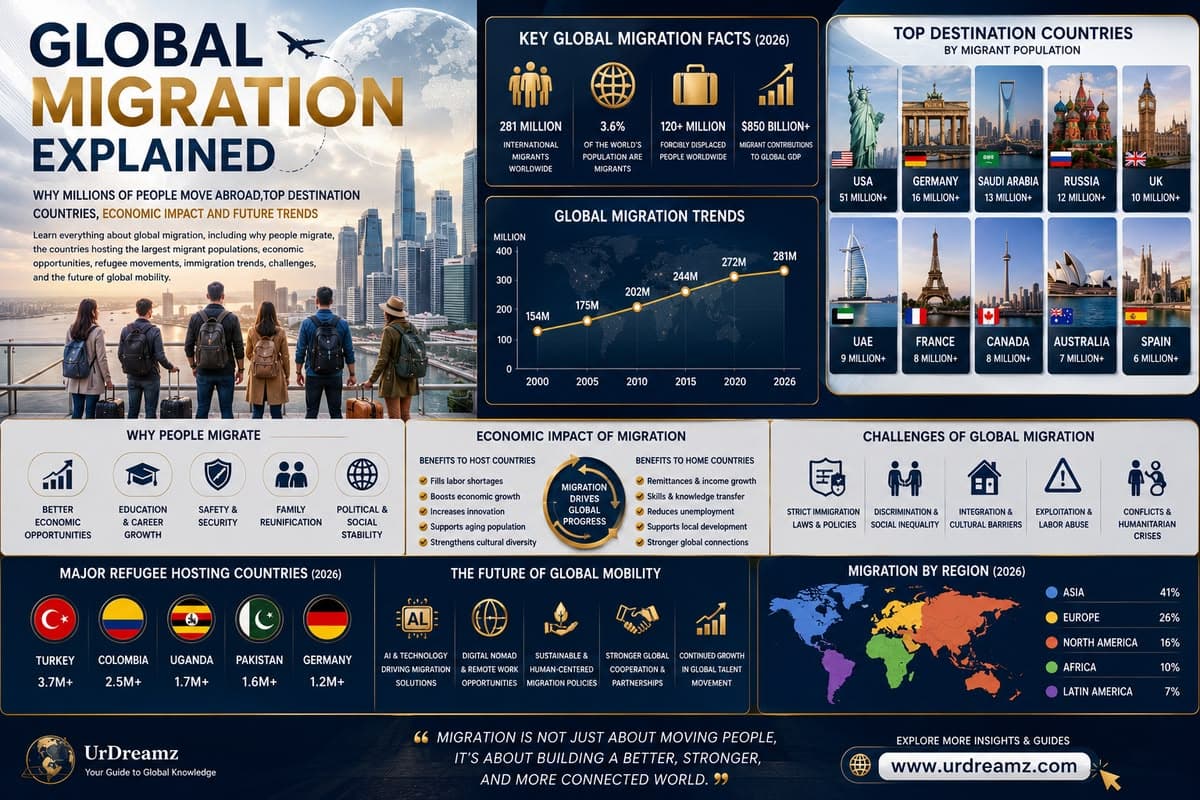
Global Migration Explained: Why Millions of People Move Abroad, Top Destination Countries, Economic Impact and Future Trends
Right now, more than 300 million people are living in a country other than the one they were born in - roughly the population of a fourth major country layered invisibly across every other nation on earth. Migration is one of the most consistent forces shaping the modern world, quietly reshaping economies, labor markets, and entire societies decade after decade. This guide covers the complete picture: why people actually migrate, which countries host the largest migrant populations today, what refugees and asylum seekers really are, how migration reshapes economies on both ends, and where global mobility is realistically heading next.
1. What Is Migration?
Migration is the movement of people from one place to live in another, either within their own country or across international borders, usually with the intention of settling for an extended period or permanently. It is one of humanity's oldest and most consistent behaviors, driven throughout history by the same basic search for safety, opportunity, and a better quality of life that continues to drive it today.
2. Migration vs Immigration vs Emigration
Migration is the broad, neutral umbrella term covering movement in either direction. Emigration describes leaving your home country - Pakistan, for example, emigrating to Canada - while immigration describes arriving in and settling within a new country, viewed from that destination country's perspective. In other words, the exact same journey is emigration from the country someone leaves and immigration into the country they arrive in.
3. Types of Migration: An Overview
Migration takes several distinct forms depending on distance, motivation, and duration - internal or international, voluntary or forced, temporary or permanent, and economic, educational, or humanitarian in nature. Understanding these categories matters because the policies, challenges, and support systems that apply to each type differ significantly.
4. Internal vs International Migration
Internal migration happens entirely within a country's own borders - a common example being rural-to-urban migration, where people move from villages to cities in search of work. International migration crosses national borders entirely, which is what most people mean when they discuss "migration" in a global context, and what this guide focuses on primarily.
5. Voluntary vs Forced Migration
Voluntary migration is a choice made in pursuit of opportunity - a job, an education, a better lifestyle. Forced migration happens when people have no real alternative, driven from their homes by war, persecution, natural disaster, or an immediate threat to survival. This distinction underpins much of international law and humanitarian policy, since forced migrants, particularly refugees, are entitled to specific legal protections that voluntary migrants are not.
6. Economic Migration Explained
Economic migration is movement driven primarily by the search for better income, employment, or overall financial opportunity than what's available at home. It remains the single largest category of global migration by volume, spanning everything from a construction worker moving to the Gulf states to a software engineer relocating to Silicon Valley.
7. Labor Migration Explained
Labor migration refers specifically to people moving abroad to fill jobs, often in sectors facing local labor shortages - construction, agriculture, domestic work, and healthcare are especially common examples. Many destination countries run dedicated labor migration programs specifically to recruit foreign workers into these high-demand roles.
8. Skilled Migration Explained
Skilled migration targets highly qualified professionals - engineers, doctors, IT specialists, scientists - and many countries run dedicated points-based or sponsorship immigration systems specifically designed to attract this group, since skilled migrants tend to integrate quickly into the workforce and contribute disproportionately to tax revenue and innovation.
9. Family Reunification Migration
Family reunification allows people already settled in a country to sponsor close relatives - spouses, children, sometimes parents - to join them. In several major immigration countries, family-based immigration accounts for a substantial share of total annual admissions, reflecting how strongly family ties motivate long-term relocation decisions.
10. Education-Driven Migration
Millions of students move abroad every year purely to study, drawn by stronger universities, better research opportunities, or post-study work pathways not available at home. For many, this begins as temporary education migration and later transitions into permanent skilled migration once studies are complete and a graduate secures local employment.
11. Climate Migration Explained
Climate migration refers to movement driven by environmental change - rising sea levels, drought, extreme weather, or gradual land degradation making a region unlivable or economically unviable. It is one of the fastest-growing and least legally defined categories of migration, since international law currently offers far weaker formal protections for climate migrants than it does for war refugees.
12. Political Instability and Conflict-Driven Migration
War, persecution, and political instability force millions of people to leave home each year, not by choice but out of genuine necessity. This category overlaps heavily with refugee movements and tends to spike sharply and quickly whenever a new conflict or political crisis erupts in a specific region.
13. Push and Pull Factors of Migration
| Push Factors (Reasons to Leave) | Pull Factors (Reasons to Choose a Destination) |
|---|---|
| Limited job opportunities or low wages | Stronger economy and higher earning potential |
| War, conflict, or political persecution | Political stability and safety |
| Poor access to healthcare or education | Strong healthcare and education systems |
| Environmental disaster or climate stress | Favorable climate and living conditions |
| Family or social pressure to seek opportunity abroad | Existing family or community already settled there |
14. Why People Migrate: The Full Picture
In practice, most real migration decisions combine several of the categories above rather than fitting neatly into just one - a skilled worker might be pulled by better pay while also pushed by a lack of opportunity at home, and a student might combine genuine educational ambition with a longer-term plan to eventually immigrate permanently. Reducing any single migration story to one clean cause almost always oversimplifies a deeply personal, usually multi-layered decision.
15. Global Migration Statistics Today
According to United Nations Population Division estimates, roughly 304 million people were living outside their country of birth as of the most recent global count, up from around 275 million just a few years earlier and nearly double the number recorded in 1990. Migrants now make up close to 3.7 percent of the world's total population - a modest overall share, but one concentrated heavily in a relatively small number of major destination countries.
16. Table: Top 25 Countries by Migrant Population
Based on recent UN-linked international migrant stock estimates, here are the countries currently hosting the largest migrant populations in the world.
| Rank | Country | Estimated Migrant Population |
|---|---|---|
| 1 | United States | 52.38 million |
| 2 | Germany | 16.75 million |
| 3 | Saudi Arabia | 13.68 million |
| 4 | France | 11.99 million |
| 5 | United Kingdom | 11.85 million |
| 6 | Egypt | 9.99 million |
| 7 | Spain | 8.87 million |
| 8 | Canada | 8.81 million |
| 9 | United Arab Emirates | 8.16 million |
| 10 | Russia | 7.61 million |
| 11 | Australia | 7.11 million |
| 12 | Turkey | 7.08 million |
| 13 | Italy | 6.55 million |
| 14 | Ukraine | 5.06 million |
| 15 | India | 4.80 million |
| 16 | Pakistan | 4.18 million |
| 17 | Iran | 3.84 million |
| 18 | Malaysia | 3.81 million |
| 19 | Jordan | 3.48 million |
| 20 | Japan | 3.41 million |
| 21 | Kuwait | 3.32 million |
| 22 | Thailand | 3.18 million |
| 23 | Colombia | 3.06 million |
| 24 | Hong Kong | 3.06 million |
| 25 | Netherlands | 2.96 million |
A few of these figures reflect recent, fast-moving humanitarian situations as much as traditional economic migration - Egypt's relatively high ranking, for example, reflects a sharp rise in refugees and displaced people from neighboring Sudan in recent years, alongside longer-standing migrant communities. Jordan's position on this list similarly reflects its long-standing role hosting large refugee populations from surrounding regional conflicts, not purely economic migration.
17. The United States: The World's Largest Migrant Destination
The United States has been the world's top migration destination since at least 1970, and its migrant population has grown more than fourfold since then. It hosts nearly one in six of the world's international migrants - more than the next several countries combined - driven by decades of family reunification, economic opportunity, and education-based immigration from Mexico, India, China, the Philippines, and dozens of other origin countries.
18. Germany and Saudi Arabia: Numbers Two and Three
Germany's migrant population has grown dramatically since 2000, nearly doubling as the country absorbed large numbers of workers, students, and refugees from Poland, Turkey, Russia, Syria, and elsewhere. Saudi Arabia, meanwhile, has built its enormous migrant population almost entirely around labor migration, drawing millions of workers primarily from India, Pakistan, Indonesia, and Bangladesh into its construction, domestic work, and service sectors.
19. Europe's Rising Role in Global Migration
France, the United Kingdom, Spain, and Italy have all seen their migrant populations climb substantially over the past three decades, with Spain's migrant population growing nearly fivefold since 1990 alone. Much of this growth reflects a combination of intra-European Union mobility, labor migration, and, more recently, refugee resettlement tied to conflicts in the Middle East and Ukraine.
20. The Gulf States and Labor Migration
The UAE and Kuwait stand out not just for their raw migrant numbers but for how dominant migrants are as a share of their total population - in the UAE's case, foreign-born residents make up the large majority of everyone living in the country. This reflects a deliberate economic model built almost entirely around importing labor to power rapid infrastructure development, hospitality, and service industries.
21. Migration Across Asia and the Middle East
Beyond the Gulf, countries like Malaysia, Thailand, Japan, and Hong Kong host large migrant populations driven by a mix of regional labor migration, historical trade and colonial ties, and, increasingly, skilled migration into finance and technology sectors. Turkey's substantial migrant population reflects its role as both a labor destination and a major host for refugees fleeing the war in Syria.
22. Pakistan and Overseas Migration
Pakistan sits in an interesting dual position in global migration: it hosts a significant migrant population of its own, largely linked to decades of Afghan displacement, while simultaneously being one of the world's largest sources of outbound labor migration, sending millions of workers to the Gulf states, Europe, and beyond.
23. Overseas Pakistanis and Remittances
Millions of overseas Pakistanis, concentrated heavily across Saudi Arabia, the UAE, the UK, and the United States, send billions of dollars home in remittances every year, making remittance income one of the most significant and stable sources of foreign currency for Pakistan's broader economy, often exceeding the country's earnings from several major export categories combined.
24. Brain Drain: What It Means for Pakistan
Brain drain describes the departure of highly skilled professionals - doctors, engineers, IT specialists - to countries offering better pay and career opportunities, leaving the origin country with a shortage of exactly the expertise it needs most. Pakistan, like many developing economies, faces an ongoing and widely discussed brain drain challenge, particularly in medicine and technology, even as remittances from these same skilled emigrants continue benefiting the broader economy.
25. Gulf Jobs and Pakistani Workers Abroad
The Gulf states remain the single largest destination for Pakistani labor migration, employing millions of Pakistani workers across construction, transport, domestic work, and increasingly, semi-skilled and skilled professional roles. This labor corridor has remained one of the most consistent and economically significant migration relationships in the world for several decades running.
26. Refugees Explained
A refugee is someone who has fled their home country due to a well-founded fear of persecution based on race, religion, nationality, political opinion, or membership in a particular social group, and who is unable or unwilling to return due to that fear. Refugee status carries specific legal protections under international law, including protection from being forcibly returned to danger.
27. Asylum Seekers Explained
An asylum seeker is someone who has fled their country and formally requested protection in another country but whose refugee claim has not yet been legally decided. In other words, every refugee was once an asylum seeker, but not every asylum seeker is ultimately recognized as a refugee - the claim still has to be individually assessed and approved.
28. Refugee vs Asylum Seeker vs Immigrant
| Term | Key Distinction |
|---|---|
| Immigrant | Moves to another country generally by choice, for economic, educational, or family reasons |
| Asylum seeker | Has fled and requested protection, but their claim is still under review |
| Refugee | Has been formally recognized as fleeing genuine persecution and granted legal protection |
29. UNHCR and Global Humanitarian Protection
The UN Refugee Agency, UNHCR, is the primary international body responsible for coordinating protection and assistance for refugees and other forcibly displaced people worldwide, working alongside national governments to manage refugee camps, resettlement programs, and legal protection frameworks across dozens of active crisis regions at any given time.
30. Major Displacement Situations Today
At any given moment, several large-scale conflicts and crises are simultaneously driving forced displacement worldwide, and the specific hotspots shift over time as conflicts start, escalate, or resolve. Tracking current UNHCR and World Migration Report updates is the most reliable way to understand exactly which situations are driving the largest refugee movements at any given point in time, rather than relying on any single historical snapshot.
31. Economic Impact of Migration on Host Countries
Migrants typically fill critical labor gaps, pay taxes, start businesses, and contribute to consumer demand in their host economies, and multiple studies across major destination countries have found that immigration, on net, tends to expand the overall economy rather than shrink it, even though the benefits and costs are not always distributed evenly across every local community.
32. Economic Impact of Migration on Origin Countries
For origin countries, migration is a genuine trade-off: remittances provide a critical and often stabilizing source of foreign income, but the departure of skilled workers can create real gaps in healthcare, education, and other essential sectors back home, particularly when emigration is concentrated among the most highly trained professionals.
33. Remittances: A Global Economic Lifeline
Global remittances sent by migrants back to their home countries now total hundreds of billions of dollars annually, and for many developing economies, this remittance income exceeds foreign direct investment and international aid combined, making it one of the single most powerful, if underappreciated, forces in global development economics today.
34. Migration and Labor Shortages
Many developed economies facing aging populations and shrinking domestic workforces rely heavily on migration to fill essential labor gaps in healthcare, agriculture, construction, and technology - sectors where the local labor supply alone would be genuinely insufficient to meet demand without ongoing immigration.
35. Migration, Innovation and Entrepreneurship
Immigrants and their children have founded a disproportionately large share of major technology companies and startups in several leading innovation economies, a pattern researchers have linked to the specific risk tolerance, drive, and cross-cultural perspective that migration itself tends to select for.
36. Challenges Faced by Migrants
Common challenges include language barriers, credential recognition problems (where foreign qualifications aren't automatically accepted), discrimination, homesickness, complex and often lengthy legal processes, and the financial and emotional cost of rebuilding a life and social network from scratch in an unfamiliar country.
37. Integration and Cultural Adaptation
Successful long-term integration typically depends on a combination of factors: language acquisition, access to fair employment matching a migrant's actual skills, social connection with both their own community and the broader host society, and supportive, welcoming local policies - integration is very rarely something that happens automatically without effort on both sides.
38. The Immigration Process Explained
While specific requirements vary enormously by country, most immigration pathways generally involve choosing an appropriate visa category, meeting eligibility requirements (skills, job offer, family relationship, or investment), submitting documentation, and often waiting through a processing period that can range from months to several years depending on the country and pathway.
39. Work Visas Explained
A work visa grants legal permission to live and work in a foreign country for a defined period, usually tied to a specific employer or occupation category, and often serves as a stepping stone toward permanent residency in countries that allow visa holders to eventually transition to longer-term status.
40. Student Visas Explained
A student visa permits temporary residence specifically for the purpose of full-time study at an approved institution, and in many popular study destinations, it also comes with limited permission to work part-time and, after graduation, a defined window to apply for a post-study work visa.
41. Permanent Residency Explained
Permanent residency grants the right to live and work indefinitely in a country without the ongoing renewal requirements of a temporary visa, though it typically stops short of full citizenship rights like voting or holding a passport from that country.
42. Citizenship Explained
Citizenship is the most complete legal status a country can grant, typically including the right to vote, hold a passport, run for office, and remain in the country permanently and unconditionally - usually obtained either by birth, descent, or a formal naturalization process completed after a required period of residency.
43. Permanent Residency vs Citizenship
| Factor | Permanent Residency | Citizenship |
|---|---|---|
| Right to live and work indefinitely | Yes | Yes |
| Right to vote | Usually no | Yes |
| Right to hold that country's passport | No | Yes |
| Can be revoked | Under certain conditions | Generally much harder to revoke |
44. Best Countries for Skilled Workers
Countries like Canada, Australia, Germany, and increasingly the Gulf states have built dedicated points-based or sponsorship-driven systems specifically to attract skilled workers, often prioritizing occupations facing acute local shortages such as healthcare, engineering, and information technology.
45. Study Abroad as a Migration Pathway
For many young people, studying abroad is as much a long-term migration strategy as it is an educational choice, since graduating from a foreign university often opens direct pathways to post-study work visas and, eventually, permanent residency in the country where they studied.
46. Digital Nomads: The New Face of Migration
Digital nomads represent a genuinely new migration category - remote workers who relocate temporarily or repeatedly across countries while continuing to work for an employer or clients elsewhere, a pattern significant enough that dozens of countries have introduced dedicated digital nomad visas specifically to attract this growing group.
47. Common Migration Myths vs Facts
| Myth | Fact |
|---|---|
| Most migrants are refugees fleeing war | The large majority of global migrants move for economic, educational, or family reasons, not forced displacement |
| Migration mostly flows from poor to rich countries | A significant share of migration happens between developing countries themselves |
| Immigration always hurts local wages and jobs | Most economic research finds immigration expands the overall economy, though effects vary by sector and region |
| Migrants rarely integrate into host societies | Integration outcomes vary widely, and are shaped heavily by host-country policy and support, not just migrant effort alone |
48. The Future of Global Migration
Global migration is expected to keep growing in absolute numbers, driven by widening economic disparities between regions, aging populations in wealthy countries creating persistent labor demand, and worsening climate pressures in vulnerable regions - even as many destination countries simultaneously tighten specific immigration policies in response to domestic political pressure.
49. Climate Change and Future Migration Trends
Climate-driven displacement is widely expected to become one of the largest categories of forced migration in the coming decades, as rising sea levels, water scarcity, and extreme weather events make certain regions progressively less livable - a trend that current international law is still only beginning to formally address.
50. Technology, AI and Smart Borders
Immigration systems worldwide are increasingly adopting AI-driven visa processing, biometric border technology, and digital identity systems, aiming to speed up legitimate migration while tightening security - a shift that will likely define how migration is managed and experienced over the next decade at least as much as any single policy change.
51. Frequently Asked Questions
What is the difference between migration, immigration, and emigration?
Migration is the general term for movement between places; emigration describes leaving your home country, while immigration describes arriving in and settling within a new one.
Which country has the most immigrants?
The United States, with an estimated 52.38 million migrants, hosting nearly one in six of the world's international migrants.
What is the difference between a refugee and an asylum seeker?
An asylum seeker has fled and requested protection but their claim hasn't yet been formally decided, while a refugee has already had that claim recognized under international law.
Why do so many Pakistanis migrate abroad?
Primarily for economic opportunity, with the Gulf states as the largest destination, alongside growing skilled migration to Europe, North America, and Australia.
What is brain drain?
Brain drain describes the emigration of highly skilled professionals to countries offering better pay and opportunity, leaving their home country with a shortage of that same expertise.
How do remittances help a country's economy?
Remittances provide a stable, often substantial source of foreign currency income, in many developing economies exceeding both foreign direct investment and international aid combined.
52. Conclusion
Migration is neither purely a crisis nor purely an opportunity - it's a fundamental, ongoing feature of how the modern world actually works, shaping economies, labor markets, and family life across virtually every country on earth. Understanding why people migrate, where they go, and what that movement means for both origin and destination countries is essential to making sense of a genuinely global economy that, more than ever, depends on people crossing borders in search of a better life.