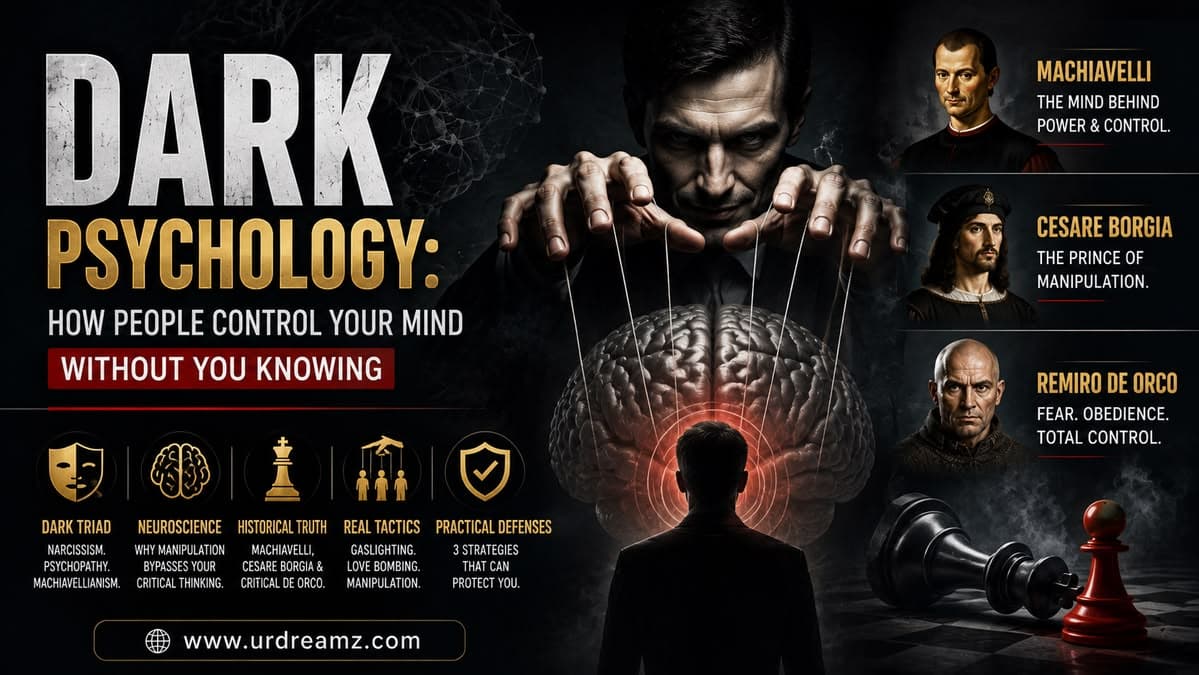
Dark Psychology: How People Control Your Mind Without You Knowing
Picture a street lined with people asking for money. Most simply hold out a hand and ask. But one person sits with a drum and a flute, playing a specific rhythm, a specific melody, over and over. Who walks away with more money by the end of the day? Almost certainly the second person — and the reason has very little to do with music appreciation and everything to do with psychology. That rhythm is not entertainment. It is a tool, deliberately or instinctively aimed at a very specific part of your brain. This is the world of Dark Psychology — the deliberate use of real psychological principles, stripped of ethics, to manipulate, influence, and control other people for personal gain. This guide explains exactly what it is, the neuroscience behind why it works, the three personality patterns that define it, a five-hundred-year-old political story that still teaches its core lesson today, the specific tactics manipulators use, and — most importantly — three real, practical ways to protect yourself.
1. The Street Musician: An Everyday Example of Psychological Influence
Imagine walking down a busy street where several people are asking passersby for money. Most simply extend a hand and ask directly. But one person sits slightly apart, playing a small drum alongside a flute, repeating a specific rhythm and melody again and again as people pass. By the end of the day, this second person will almost certainly have collected significantly more money than those who simply asked plainly. Why? The honest answer has very little to do with the quality of the music and everything to do with what that specific rhythm is doing inside the brains of everyone who walks past.
This is not a coincidence, and it is not really about charity or generosity in the way most people assume. It is a demonstration, hiding in plain sight on any city street, of how specific sensory input — in this case, a particular sound pattern — can influence decision-making before a person has consciously registered what is happening. Understanding exactly what is happening in the brain during this moment is the first step to understanding the much larger and more serious subject of Dark Psychology.
What makes this example so useful as a starting point is that it involves no words, no direct claims, and no obvious deception of any kind — just a specific pattern of sound repeated at the right rhythm. And yet it reliably outperforms a straightforward request for money. This tells us something important right away: manipulation does not always require lying, tricking, or even direct interaction. Sometimes it simply requires understanding, whether through study or intuition built from experience, exactly which internal systems in another person's brain respond most strongly to a given kind of stimulus, and then deliberately supplying that stimulus.
2. What Is the Mesolimbic System?
Deep inside the human brain sits a network of interconnected structures known as the mesolimbic system, sometimes described as part of the brain's broader "reward pathway." This system plays a central role in how humans experience motivation, pleasure, anticipation, and emotional reward. When something in the environment is perceived as pleasurable, exciting, or emotionally significant — even something as simple as a specific repeating rhythm — the mesolimbic system activates, triggering a cascade of chemical and emotional responses that shape behavior, often well before conscious, rational thought has a chance to catch up.
This same reward pathway is the biological system implicated in a wide range of human behaviors that involve strong pull or craving, from the enjoyment of music and social connection to the mechanisms behind addiction to substances or behaviors. Its evolutionary purpose was originally to reinforce behaviors genuinely useful for survival — eating, bonding socially, reproducing — by attaching a pleasurable, motivating emotional signal to them. The unfortunate side effect of having such a powerful, deeply wired reward system is that it can also be deliberately triggered by stimuli that have nothing to do with genuine survival benefit, including a carefully chosen rhythm, a flattering comment, or a carefully staged display of affection, each capable of activating the same underlying reward circuitry regardless of whether the activation actually serves the listener's genuine best interest.
3. Dopamine, Motivation, and the Amygdala
One of the key chemical messengers released when the mesolimbic system activates is dopamine, a neurotransmitter closely associated with motivation, pleasure, and reward-seeking behavior. At the same time, a specific rhythm or emotionally charged stimulus can also activate the amygdala, the brain's emotional processing center, which plays a central role in how strongly and quickly a person responds emotionally to a given situation. When both of these systems become activated simultaneously — as can happen with a compelling, repetitive rhythm — the resulting internal experience is one of heightened emotional engagement and reward anticipation, occurring largely outside of conscious awareness.
4. How Rhythm and Sound Hijack Critical Thinking
Returning to the street musician example: the specific frequency, rhythm, and pattern of the sound being played is capable of directly activating this mesolimbic and amygdala response in listeners walking by. Once this activation occurs, something remarkable — and slightly troubling — happens to the listener's normal decision-making process. The part of the brain responsible for careful, rational evaluation — the part that might otherwise pause and ask, "Is this person actually in need? Could this be a scam?" — becomes measurably less influential in that moment, effectively overridden by the heightened emotional and reward-based activity happening elsewhere in the brain.
5. Why Your Rational Brain Goes Quiet
This phenomenon is sometimes described, in plain language, as those rational thoughts being "overwritten" by hyperactivation of the amygdala and mesolimbic system in response to a specific stimulus. It is not that the rational, questioning part of the brain disappears entirely — it simply becomes temporarily less dominant compared to the surge of emotional and reward-related activity competing for the brain's attention in that exact moment. This is precisely the underlying neurological mechanism that skilled — or sometimes simply intuitive — manipulators are, whether knowingly or not, exploiting.
6. A Chilling Historical Thought Experiment
Long before modern neuroscience could explain exactly why this works, people had already intuited the underlying principle. Consider an old, unsettling thought experiment that has circulated in discussions of manipulation and control: if you were to walk up to a stranger, threaten them, and forcibly take their ATM card, you would gain, at best, a single limited benefit — access to whatever funds happen to be in that account at that moment, and likely significant legal consequences soon after. But if, instead, you were able to gain genuine psychological influence over that same person's mind — earning their trust, their loyalty, their belief — the potential "return" becomes almost unlimited and ongoing. That person might not even realize they are being used, and might willingly continue supporting you, materially and otherwise, indefinitely, without ever recognizing what is actually happening.
This comparison highlights a genuinely important strategic distinction that separates crude coercion from true psychological manipulation. Physical threat or force produces a single, one-time transaction, carries obvious legal risk, and leaves the victim fully aware that they have been wronged, likely prompting them to report the crime and seek protection going forward. Genuine psychological influence, by contrast, produces a renewable, ongoing resource, typically carries no obvious legal exposure since no laws against "being persuasive" exist in most circumstances, and — most disturbingly — frequently leaves the victim without any clear awareness that they have been exploited at all, meaning they take no protective action and may even continue defending the person exploiting them if challenged by others.
7. Why the Human Brain Is "The Biggest ATM"
This unsettling comparison illustrates a genuinely important point: the human brain, and the trust, loyalty, and resources a person is willing to offer once their mind has been genuinely influenced, represents an almost limitless resource compared to any single act of physical theft or coercion. This is exactly the target that Dark Psychology attacks — not a person's wallet directly, but the deeper psychological and emotional systems that determine how a person thinks, trusts, and behaves over the long term.
8. What Is Dark Psychology, Really?
Dark Psychology is not a description of some sinister force operating outside normal human understanding — it is, at its core, the application of well-established, legitimate psychological principles toward harmful, manipulative, and self-serving ends. In simple terms, it is using a genuine understanding of how the human mind works — how people form trust, how emotions drive decisions, how attention and memory function — for the purpose of manipulating and exploiting other people for personal gain, rather than for helping, healing, or genuinely understanding them.
A useful way to think about this distinction is to compare it to any other powerful tool or body of knowledge that can be used for either constructive or destructive purposes. A deep understanding of human persuasion can be used by a genuine educator to make a difficult concept easier to grasp, by a therapist to help a client feel safe enough to open up about painful experiences, or by an honest advertiser to clearly communicate a product's real benefits. That same underlying knowledge, applied instead with the deliberate intention to deceive, exploit, or control someone against their genuine interests, becomes what is popularly labeled Dark Psychology. The knowledge itself is neutral; the harmful, exploitative intent behind its application is what earns the label "dark."
9. Dark Psychology Is Not a Real Field of Study
It is worth being clear about something important: Dark Psychology is not a formally recognized academic subfield within psychology, the way clinical psychology, developmental psychology, or cognitive psychology are. Rather, it is a popular, descriptive term used to group together a collection of manipulative tactics, personality traits, and behavioral patterns that share a common thread — the deliberate, unethical misuse of psychological understanding for harmful, self-serving purposes. The tools being misused — persuasion, reading body language, understanding empathy and motivation — are entirely legitimate parts of normal psychology; what makes their use "dark" is the harmful intent and lack of ethical constraint behind their application.
10. Introducing the Dark Triad
Within the broader concept of Dark Psychology, researchers have identified a specific cluster of three interrelated, though distinct, personality traits that most consistently appear together in individuals who habitually manipulate and exploit others. This cluster is known as the Dark Triad, and it consists of narcissism, psychopathy, and Machiavellianism. While these traits can appear individually, they are frequently found together to varying degrees within the same individual, and together they form the psychological foundation most closely associated with manipulative and exploitative behavior.
| Trait | Core Feature | Primary Driver |
|---|---|---|
| Narcissism | Grandiose self-importance, need for admiration | Validation and attention |
| Psychopathy | Emotional coldness, lack of remorse | Personal goals over others' wellbeing |
| Machiavellianism | Strategic, calculated manipulation | Achieving objectives by any means |
The term "Dark Triad" was first formally introduced into psychological literature by researchers Delroy Paulhus and Kevin Williams, who identified that these three traits, while conceptually distinct, tend to correlate with one another across large population studies, meaning a person scoring high on one trait is statistically more likely to also score elevated on the other two. Importantly, these traits exist on a spectrum in the general population rather than functioning as a strict, binary diagnosis — most people show low to moderate levels of these traits, and only a smaller subset of individuals score high enough across all three to be considered a genuinely significant behavioral concern.
11. Trait One: Narcissism
The first trait, narcissism, is characterized by an excessive need for admiration, a grandiose sense of self-importance, and a deep-seated belief that one's own contributions, opinions, and presence deserve significantly more attention and validation than those of others around them. A narcissistic individual in any social setting — a gathering, a meeting, a group conversation — tends to position themselves as the emotional and conversational center of attention, expecting others to affirm and praise their input while showing comparatively little genuine interest in what other people in the room have to say or contribute.
It is worth distinguishing ordinary, healthy confidence from clinically significant narcissism. Most people enjoy some degree of recognition and feel good when praised — this alone does not indicate a personality disorder. What separates genuine narcissism from healthy self-esteem is the consistency, intensity, and rigidity of the pattern: a narcissistic individual's need for admiration does not fluctuate based on context or genuinely adjust when it becomes socially inappropriate, and their underlying self-worth appears to depend almost entirely on a continuous external supply of praise and attention, rather than being grounded in a stable, internally-generated sense of value that does not require constant reinforcement from others.
12. What Narcissism Looks Like in Everyday Life
In practical terms, a narcissistic individual is fundamentally self-focused — they consistently steer conversations back toward themselves, seek continuous praise and validation from those around them, and show little authentic empathy or sympathy for the struggles, feelings, or perspectives of others. This is not simply a personality quirk or ordinary confidence; in its more pronounced form, it reflects a genuine personality disorder in which the needs, feelings, and perspectives of other people are consistently minimized or disregarded in favor of the narcissist's own need for admiration and importance. On both a national and international scale, this pattern is frequently visible in public figures who consistently center themselves in every situation, regardless of context.
13. Trait Two: Psychopathy
The second trait, psychopathy, describes a pattern of profound emotional coldness, combined with a singular, often ruthless focus on achieving a specific personal goal or mission, regardless of the human cost involved. An individual exhibiting significant psychopathic traits typically demonstrates little to no genuine remorse, guilt, or emotional concern for how their actions affect other people, remaining tightly focused on their own objective even in situations involving serious harm to others.
Clinically, psychopathy is often studied and assessed using structured tools that examine several interrelated dimensions of personality and behavior, including impulsivity, superficial charm, a grandiose sense of self-worth, pathological lying, and a consistent failure to accept responsibility for harmful actions. It is worth noting that psychopathy exists on a spectrum, and not everyone who scores moderately on measures of this trait goes on to commit serious harm to others — some individuals with elevated psychopathic traits channel their emotional detachment and singular focus into high-pressure careers or competitive environments where a degree of emotional distance can, in certain narrow contexts, be professionally advantageous, even though the same underlying trait becomes genuinely dangerous when combined with a willingness to directly harm others.
14. The Emotional Coldness at the Core of Psychopathy
What distinguishes psychopathy most clearly from ordinary determination or ambition is this specific emotional disconnect: a person with strong psychopathic traits can witness someone else's suffering, distress, or even a life-threatening situation, and continue pursuing their own agenda without experiencing the empathetic emotional response that would normally cause most people to pause, feel concern, or intervene. This is not simply a lack of kindness — it reflects a genuine, measurable difference in how such individuals process and respond to the emotional experiences of others.
15. Trait Three: Machiavellianism
The third trait, Machiavellianism, shares some overlap with psychopathy but carries its own distinct character: it describes a strategic, calculated willingness to use any means necessary — whether ethical or unethical, honest or deceptive — to achieve a specific personal goal. A person exhibiting strong Machiavellian traits is singularly focused on the outcome they want to achieve, largely indifferent to whether the process used to get there is fair, honest, or morally acceptable, so long as the end goal is ultimately reached.
16. Meet Niccolò Machiavelli: The Man Behind the Term
The term "Machiavellianism" traces directly back to a real historical figure: Niccolò Machiavelli, an Italian philosopher, diplomat, and political theorist. Machiavelli is best known for authoring one of the most influential — and controversial — political texts in Western history, a short but enormously consequential book that continues to be studied, referenced, and debated more than five centuries after it was written.
17. "The Prince": The Book That Started It All
Machiavelli's most famous and influential work is titled "The Prince." Written specifically as guidance for rulers and political leaders, the book directly addresses how a ruler should acquire, maintain, and exercise political power effectively — often prioritizing practical political success over conventional standards of moral or ethical behavior. Long before the term "Machiavellianism" was ever coined as a psychological personality trait, this book laid out, in cold, practical terms, exactly the kind of strategic thinking that modern psychology would later come to describe using that very name.
"The Prince" was written in the early 1500s and dedicated to the Medici family, who at the time held significant political power in Florence, where Machiavelli himself had previously served as a diplomat and government official before losing his position amid political upheaval. Some historians have suggested the book may have been partly an attempt by Machiavelli to win back political favor and employment by demonstrating his practical understanding of statecraft to the ruling family. Regardless of its original motivation, the book's unflinching, unsentimental approach to describing how power is actually gained and maintained — rather than how idealistic political philosophy suggested it should be gained — is precisely what made it both immediately controversial and enduringly influential across the centuries that followed.
18. The Lion and the Fox: Machiavelli's Central Metaphor
One of the most famous and enduring pieces of advice found in "The Prince" is Machiavelli's assertion that an effective ruler must be able to embody the qualities of both a lion and a fox simultaneously — "A ruler, an emperor, should be a lion and a fox at the same time." In this metaphor, the lion represents raw strength, courage, and the willingness to use direct force when necessary, while the fox represents cunning, cleverness, and the ability to detect and avoid hidden traps and dangers that brute strength alone cannot protect against. According to Machiavelli, a ruler who possesses only one of these two qualities — only strength, or only cleverness — remains dangerously vulnerable, while a ruler who successfully combines both becomes exceptionally difficult to defeat or outmaneuver.
19. Fear Over Love: A Deliberately Cold Strategy
Perhaps Machiavelli's most famously unsettling piece of advice concerns the question of whether a ruler should aim to be loved by their people or feared by them. Machiavelli argued unambiguously that, if a ruler cannot realistically maintain both simultaneously, it is far safer and more strategically effective to be feared than to be loved. His underlying reasoning was that love is an emotional bond that people can withdraw whenever it becomes politically or personally inconvenient for them to maintain — but fear, by contrast, provides a ruler with far more reliable, durable leverage, since people are far less willing to act against someone they genuinely fear, even when their affection has long since faded. Under this framework, fear becomes the psychological foundation upon which a ruler can build and enforce laws, policies, and control.
20. Why Machiavelli Removed Morality From Politics
Perhaps the most controversial and enduring claim found throughout "The Prince" is Machiavelli's assertion that morality — ethical, moral considerations — has essentially no place in the practical exercise of political power. According to this view, a ruler focused purely on political survival and effectiveness should not concern themselves with whether a given action is ethically right or wrong in any traditional moral sense; the only relevant consideration should be whether that action successfully achieves and secures the ruler's political objectives. This complete separation of political strategy from conventional morality is precisely the intellectual foundation that gave rise to the modern psychological concept of Machiavellianism, centuries later.
21. The Story of Cesare Borgia and the Romagna
To illustrate his political philosophy in concrete terms, Machiavelli included a real historical example in "The Prince" involving a ruler named Cesare Borgia. Borgia had recently conquered a region known as the Romagna, an area notorious at the time for widespread lawlessness, violent crime, and social disorder. Newly conquered territories governed by such chaos and instability are notoriously difficult for any new ruler to bring under effective, lasting control, making Borgia's situation a genuine practical challenge rather than a purely theoretical one.
22. Enter Remirro de Orco: The Enforcer
To bring order to this chaotic region, Borgia appointed a governor named Remirro de Orco, specifically chosen for his reputation as a ruthlessly efficient and merciless enforcer of order. Borgia's instructions were direct and brutal in their simplicity: pacify the region by whatever means necessary — cruelty, harsh punishment, mass violence if required — with the singular goal of restoring order and creating a stable, governable environment. De Orco was, in effect, handed near-total authority to use extreme, uncompromising force to achieve this outcome.
23. The Brutal Cleanup Operation
Remirro de Orco carried out this mandate with ruthless efficiency, employing harsh, often brutal methods to suppress crime, punish wrongdoing, and impose order across the region over a period of two to three months. By the time he returned to report back to Borgia, the Romagna had indeed been transformed — the widespread lawlessness and violence that had plagued the region were largely brought under control, creating exactly the stable, governable environment Borgia had originally sought. From a purely practical standpoint, de Orco had accomplished precisely what he had been sent to do.
24. The Turning Point: When the Enforcer Becomes a Liability
However, this success came at a significant reputational cost — not to Borgia directly, but to de Orco himself. The harsh, often excessive methods he had used to restore order had generated deep, widespread hatred and resentment among the local population, many of whom had personally suffered under his brutal enforcement tactics or witnessed loved ones suffer under them. This created a genuinely dangerous political problem for Borgia: the very man who had successfully restored order was now so despised by the local population that his continued presence risked becoming a serious liability, threatening to undermine the very stability he had just helped create, and potentially exposing Borgia's own role in authorizing such brutal tactics.
25. The Public Execution and the Masterstroke
Facing this dilemma, Borgia devised what Machiavelli presented as a masterstroke of political strategy. Rather than quietly dismissing de Orco or attempting to manage the growing public resentment through conventional means, Borgia had de Orco publicly executed and delivered his body directly to the outraged populace of the Romagna. According to the account, the enraged local population, having suffered under de Orco's brutal enforcement, took the opportunity to violently tear the body apart with knives, publicly venting the accumulated rage and resentment they had been forced to suppress during his period of harsh rule. With this single, calculated act, Borgia accomplished several objectives simultaneously: he successfully distanced himself from the brutal methods used to restore order, redirected the population's anger away from himself and onto a now-dead scapegoat, and won a wave of public gratitude and goodwill from a population that now viewed him as their protector and liberator from de Orco's tyranny, rather than as the ultimate authority who had authorized it in the first place.
What makes this episode so enduring as a case study, even five centuries later, is how completely it inverts the natural, expected flow of accountability. In an ordinary moral framework, the person who authorized the brutal actions — Borgia — would be the one held responsible and subjected to public anger, while the enforcer who merely carried out orders might be seen more sympathetically as simply following instructions. Machiavelli's account describes the exact opposite outcome: the person who gave the orders emerged as a beloved protector, while the person who followed those same orders became the sole target of public fury and was destroyed for it. This inversion of natural accountability is precisely the pattern that modern observers of political and organizational behavior continue to recognize, centuries later, whenever a leader publicly "cleans house" by removing a subordinate blamed for unpopular decisions the leader themselves originally authorized.
26. Lesson One: Blame Shifting
Machiavelli explicitly presented this story as a teaching example for future rulers, drawing out specific practical lessons from Borgia's handling of the situation. The first key lesson is blame shifting — the strategic redirection of responsibility and public anger away from oneself and onto another party, even one that had, in this case, been directly acting under one's own authority and instructions. This tactic allows a person in a position of power to benefit from harsh or unpopular actions being carried out, while simultaneously avoiding the reputational damage that would normally follow from being personally associated with those same actions.
27. Lesson Two: Public Satisfaction
The second key lesson Machiavelli drew from this episode is what might be called public satisfaction — the deliberate manufacturing of a dramatic, emotionally cathartic moment that allows a population's accumulated anger, resentment, and desire for justice to be visibly and publicly resolved, even if the underlying resolution primarily serves the ruler's own strategic interests rather than genuine, impartial justice. By giving the population de Orco's body to physically vent their rage upon, Borgia provided exactly this kind of emotional release, transforming what could have remained a dangerous, simmering political threat into a moment of public relief and renewed loyalty toward himself.
28. From Political Strategy to Personality Disorder
Although Machiavelli originally presented this reasoning as practical political strategy intended for rulers governing entire territories, centuries of subsequent analysis eventually led psychologists to recognize that this same underlying pattern of thinking and behavior — the willingness to use any means necessary, ethical or unethical, to achieve a personal goal, combined with a readiness to shift blame and manipulate public perception — could also manifest as a distinct personality trait in individual people, entirely outside the context of formal politics. It was only well over a hundred years after Machiavelli's original writing that this pattern of behavior came to be formally recognized and named as Machiavellianism, one of the three core traits of the modern Dark Triad.
This transition from historical political commentary to formal psychological trait occurred specifically in the 1970s, when psychologists Richard Christie and Florence Geis conducted systematic research examining whether the strategic, morality-detached thinking described in "The Prince" could be reliably measured and identified as a stable personality characteristic in ordinary individuals, entirely separate from any political context. Their research confirmed that certain people do consistently exhibit this exact pattern of thinking across a wide range of everyday, non-political situations — workplaces, friendships, romantic relationships, and family dynamics — leading directly to Machiavellianism's formal inclusion as one of the three foundational traits of the modern Dark Triad framework used in psychology today.
29. A Real-World Example: The Corrupt Official
To make this concept more concrete in an everyday context, consider a government official who accepts a bribe and then uses part of that same bribe money to help a hungry, desperate person on the street. On the surface, this action appears to combine both wrongdoing and generosity — but the fundamental problem remains that the entire foundation of the action rests on a genuinely corrupt, dishonest act. Across virtually every major religious and ethical tradition — Islam, Christianity, Judaism, Hinduism, and even secular ethical frameworks such as those found in communist political philosophy — an action built upon a foundation of wrongdoing is not considered justified or morally acceptable simply because some positive outcome happened to follow from it. This example illustrates precisely the kind of "ends justify the means" reasoning that defines Machiavellian thinking, and why it remains ethically problematic regardless of any secondary positive outcomes it might produce.
30. A Real-World Example: The Roadside Dilemma
A different kind of example illustrates a more genuinely defensible form of difficult, consequentialist decision-making. Imagine a person driving a critically injured patient to the hospital in an emergency, who chooses to pass through a red traffic signal because stopping could cost the patient their life. Technically, running the red light is a violation of traffic law — but the underlying reasoning behind this specific violation is generally recognized, across most ethical and legal frameworks, as a legitimate, justifiable exception given the life-or-death circumstances involved. This example is useful precisely because it illustrates the boundary between genuinely justifiable difficult decisions made under extreme circumstances, and the kind of self-serving, ends-justify-the-means reasoning that characterizes true Machiavellian manipulation, where personal gain — not genuine necessity — is the actual underlying motivation.
The distinction between these two examples — the corrupt official and the emergency driver — comes down to a fairly simple test worth internalizing: was the rule-breaking act genuinely necessary to prevent serious, immediate harm to someone else, with no self-serving benefit to the person taking the action beyond the harm actually being prevented? Or was the rule-breaking act primarily undertaken to benefit the person taking it, with any positive side effect for others being incidental, secondary, or even manufactured after the fact purely to provide moral cover? Genuinely Machiavellian reasoning consistently fails this test, since the underlying motivation always traces back to personal advantage rather than a good-faith, necessary response to protect someone else from serious harm.
31. The Mach-IV Test: Measuring Machiavellianism
Modern psychology has developed a standardized assessment tool specifically designed to measure the degree to which an individual exhibits Machiavellian traits, known as the Mach-IV Test. This assessment consists of twenty specific questions, and based on how a person responds to each item, psychologists can calculate an overall score that indicates the relative strength of Machiavellian tendencies within that individual's personality. A trained psychologist reviewing these results can identify whether a person shows meaningful signs of leaning toward Machiavellian thinking and behavior patterns, offering a genuinely useful, evidence-based tool for both clinical assessment and broader psychological research into manipulative personality traits.
The twenty statements that make up the Mach-IV Test cover a range of underlying beliefs and attitudes, such as agreement or disagreement with ideas like the acceptability of deceiving others when it serves one's own interests, skepticism toward the honesty of other people in general, and a general willingness to prioritize practical results over conventional honesty. Respondents typically rate their level of agreement with each statement, and their combined score places them somewhere along a spectrum from low to high Machiavellian orientation. While originally developed as a research tool for studying personality at a population level, the test has since become a widely referenced instrument in both academic psychology and popular discussions of manipulative personality traits.
32. The Dark Tetrad: A Fourth Trait Worth Knowing
While the original Dark Triad consists of narcissism, psychopathy, and Machiavellianism, more recent psychological research has proposed expanding this framework into what is now sometimes called the Dark Tetrad, adding a fourth trait: everyday sadism. This additional trait describes individuals who derive genuine pleasure or enjoyment specifically from witnessing or causing the suffering, distress, or discomfort of other people, even when doing so provides no direct strategic or material benefit to themselves. While related to the original three traits, everyday sadism is considered distinct enough — being motivated purely by enjoyment of cruelty itself, rather than by self-interest, control, or emotional coldness — that many researchers now treat it as a meaningful fourth dimension of the broader dark personality framework.
33. Manipulation Tactic One: Gaslighting
Gaslighting is one of the most well-documented and psychologically damaging manipulation tactics associated with Dark Psychology. At its core, gaslighting involves deliberately denying, distorting, or rewriting an agreed-upon or objectively observable reality, with the specific goal of causing the targeted person to doubt their own memory, judgment, and perception of events. Over repeated exposure, a person subjected to sustained gaslighting can begin to genuinely question their own grip on reality, becoming increasingly dependent on the manipulator's version of events rather than trusting their own direct experience and observations.
The term itself originates from a 1938 stage play, later adapted into a well-known film, in which a husband systematically manipulates his wife into believing she is losing her sanity — partly by dimming the gas-powered lights in their home and then insisting, when she notices the change, that she is imagining it. This original story captures the essence of the tactic perfectly: the manipulator is not simply lying about a single fact, but is engaged in a sustained, deliberate campaign to undermine the target's basic trust in their own perception and cognitive reliability, making them easier to control precisely because they can no longer confidently trust their own judgment.
34. A Real Example of Gaslighting
Consider a situation where a particular individual is widely and reliably known within a community to be a thief, with clear, consistent evidence supporting this reputation. A manipulator approaches someone unfamiliar with this reputation and insists, with complete confidence, that this same individual is actually an honest, trustworthy, upstanding person — deliberately and directly contradicting the well-established, factual reality. Over time, through repeated, confident insistence, the manipulator can cause the other person to genuinely doubt their previously accurate understanding, leading them to think something like, "Maybe I was wrong about this person after all." This deliberate rewriting of an agreed-upon reality, and the resulting self-doubt it creates in the target, is precisely what defines gaslighting as a manipulation tactic.
35. Manipulation Tactic Two: Love Bombing
Love bombing is a manipulation tactic in which a person deliberately overwhelms a target with intense, excessive affection, attention, and emotional investment early in a relationship — far beyond what would normally develop at that stage of a healthy, gradually-building connection. As the target becomes increasingly emotionally attached to and dependent on this constant stream of attention and validation, a psychological shift occurs: the target's own sense of emotional well-being becomes closely tied to and dependent upon the continued presence and approval of the manipulator.
What makes love bombing particularly effective, and particularly difficult to recognize while it is happening, is that it does not feel like manipulation from the receiving end — it feels like being genuinely cherished, wanted, and prioritized in a way that may be new or especially meaningful to the target. This is precisely why the tactic works so reliably: it does not require the target to lower their guard against something that feels threatening, because nothing about intense, constant affection registers as a threat in the moment it is being received. The manipulative function of love bombing only becomes visible in hindsight, once the pattern shifts from consistent overwhelming affection toward inconsistent, withdrawn attention specifically calibrated to keep the target anxious and working to regain the same level of validation they received at the start.
36. A Real Example of Love Bombing
Consider a relationship in which one person consistently showers the other with intense affection, constant communication, and undivided attention during the early stages of the relationship. Over time, the person receiving this attention becomes genuinely dependent on it — noticing that their entire emotional state and sense of daily well-being now hinges on whether or not the other person reaches out and engages with them. Once the manipulator recognizes this dependency has been fully established, they will often begin deliberately withdrawing their attention and affection, creating emotional instability and anxiety in their now-dependent partner. At this stage, having successfully created genuine emotional dependency, the manipulator gains significant leverage — often using this dependency to extract compliance, favors, or tolerance of mistreatment that the target would never have accepted earlier in the relationship, before this dependency was established.
37. Manipulation Tactic Three: The Manufactured Persona
A third significant manipulation tactic involves the deliberate construction of a carefully curated public image or persona, designed specifically to project trustworthiness, expertise, or moral authority — regardless of whether this image genuinely reflects the person's actual character, expertise, or intentions. A manipulator using this tactic might present themselves publicly as a motivational figure, spiritual guide, or expert offering genuine help and inspiration to others in society, deliberately cultivating this reputation as a tool for gaining trust and influence. Many people, drawn in by this carefully constructed public image, become genuinely convinced of the person's sincerity and expertise, making them significantly more vulnerable to subsequent manipulation and exploitation once that trust has been fully established.
This tactic is particularly effective in group or community settings, where a manufactured persona can generate a kind of collective social proof — once a sufficient number of people publicly express admiration or trust toward a manipulative figure, newcomers are far more likely to extend that same trust automatically, simply because so many others already appear to have done so, without independently verifying whether that trust is actually warranted. This dynamic helps explain how manipulative figures with a carefully manufactured public persona can sometimes build remarkably large and devoted followings, even when closer, individual scrutiny of their actual claims or behavior would reveal significant inconsistencies or red flags that a more skeptical, individual evaluation would likely catch.
38. Why These Tactics Work So Well
All three of these tactics — gaslighting, love bombing, and the manufactured persona — share a common underlying mechanism connecting them directly back to the neuroscience discussed earlier in this article. Each tactic, in its own way, works by engaging a target's emotional and reward-processing systems — self-doubt and anxiety in the case of gaslighting, dependency and attachment in the case of love bombing, and trust and admiration in the case of the manufactured persona — in ways that temporarily reduce the influence of careful, rational, critical evaluation. This is precisely why intelligent, otherwise capable people can still fall victim to these tactics: the manipulation is not targeting a person's intelligence directly, but rather the deeper emotional and neurological systems that, under the right conditions, can override even a genuinely sharp, analytical mind.
39. Defense One: Awareness
The first and arguably most foundational defense against manipulation is simple awareness — genuinely understanding that these tactics exist, recognizing their specific patterns, and remaining alert to the possibility that they could be deployed against you, even by people who appear friendly, trustworthy, or emotionally invested in your well-being. For example, a person who understands what love bombing looks like will be far more likely to notice, early on, when a new relationship's pace of intense affection and attention feels unusually accelerated or disproportionate — allowing them to consciously slow down and evaluate the relationship more carefully, rather than being swept along purely by the accompanying emotional excitement. Awareness does not eliminate the emotional pull these tactics create, but it provides the crucial mental framework needed to recognize what is happening while it is still happening, rather than only recognizing it in hindsight, after significant harm has already occurred.
Building genuine awareness is an ongoing practice rather than a single realization. It involves actively learning about common manipulation patterns, reflecting honestly on past relationships or situations where you may have felt confused, off-balance, or uncharacteristically compliant, and staying curious rather than defensive when something about an interaction feels subtly "off," even if you cannot immediately articulate exactly why. Many people who have experienced significant manipulation later describe having felt a vague, nagging sense that something was wrong long before they could consciously identify the specific tactic being used against them — awareness is, in large part, the practice of taking that early internal signal seriously rather than dismissing it.
40. Defense Two: Setting Boundaries
The second key defense is the deliberate practice of setting clear personal boundaries — establishing, in advance, specific limits regarding what behavior, requests, or treatment you are and are not willing to accept from others, and consistently enforcing those limits regardless of emotional pressure applied against them. For example, a person who has clearly decided in advance that they will not tolerate having their memory or perception of events directly contradicted and dismissed will be far better equipped to firmly push back the moment gaslighting begins, rather than gradually eroding under sustained pressure over time. Boundaries function as a kind of pre-established defensive structure — they do not require you to figure out, in the heat of an emotionally charged moment, exactly how to respond, because the appropriate response has already been decided and internalized well in advance of the manipulation attempt actually occurring.
A genuinely important part of setting effective boundaries is understanding that a manipulator will very often test them, sometimes repeatedly, to see whether the stated limit is actually enforced or merely a suggestion that can be gradually worn down through persistence, guilt, or emotional pressure. This is precisely why consistency matters so much: a boundary that is enforced firmly on the first attempt sends a clear signal that further attempts will be met with the same response, while a boundary that gets quietly relaxed under pressure teaches the manipulator that sufficient persistence or emotional intensity will eventually succeed, actually increasing the likelihood of continued, escalating manipulation attempts going forward.
41. Defense Three: Recognition
The third essential defense is recognition — the practical, real-time ability to correctly identify a specific manipulation tactic as it is actually happening, connecting a real, live situation back to the patterns and knowledge gained through awareness. For example, a person who notices a public figure consistently shifting blame onto others while carefully cultivating public sympathy and admiration for themselves — echoing the exact blame-shifting and public-satisfaction pattern found in the historical Borgia story — is exercising genuine recognition, actively applying learned patterns to real, unfolding circumstances rather than passively absorbing the manipulation without noticing what is actually taking place. Recognition is what transforms abstract, theoretical awareness into practical, real-time protection.
Developing strong recognition skills often benefits from paying close attention to consistent behavioral patterns over time, rather than judging any single interaction in isolation. A single instance of someone withdrawing attention, or a single disagreement about how an event unfolded, does not necessarily indicate manipulation — healthy relationships and honest disagreements happen naturally, without manipulative intent. What distinguishes genuine manipulation is the presence of a repeating, deliberate pattern specifically designed to benefit the manipulator at the target's expense, often accompanied by an escalating cycle in which the target's own autonomy, confidence, or independent judgment steadily diminishes over time. Learning to observe patterns across weeks and months, rather than reacting only to isolated incidents, is often what ultimately allows recognition to become genuinely reliable and actionable.
42. Putting All Three Defenses Together
These three defenses — awareness, boundaries, and recognition — are most effective when used together, functioning as complementary layers of protection rather than standalone solutions. Awareness provides the underlying knowledge base; boundaries provide a pre-established, consistent response framework; and recognition provides the real-time application connecting the two together as situations actually unfold in daily life. Since Dark Psychology, at its core, targets and attempts to influence the human brain and its underlying emotional and decision-making processes, building genuine, practiced defenses at exactly this same psychological level is what makes lasting, effective manipulation by others significantly more difficult to achieve, even by determined, skilled manipulators.
| Defense | What It Provides | When It Matters Most |
|---|---|---|
| Awareness | Knowledge of manipulation patterns and tactics | Before an interaction begins |
| Boundaries | Pre-decided limits and consistent responses | During an interaction, under pressure |
| Recognition | Real-time identification of tactics as they occur | In the moment, connecting theory to practice |
It is also worth acknowledging that building these defenses is a gradual, ongoing process rather than something achieved permanently after a single article or realization. Skilled manipulators, particularly those with strong Dark Triad traits, are often highly adaptive, adjusting their tactics when an initial approach fails to produce the desired result. This means genuine protection requires not a one-time fix, but an ongoing willingness to stay curious, question uncomfortable feelings rather than suppress them, and continue reinforcing boundaries even when doing so feels socially uncomfortable or risks disappointing someone whose approval you value.
43. Frequently Asked Questions
- Q1: What is Dark Psychology?
- Dark Psychology is the use of legitimate psychological principles and understanding of human behavior for harmful, manipulative, or exploitative purposes, typically for personal gain at another person's expense.
- Q2: Is Dark Psychology a real, recognized field of study?
- No. It is not a formally recognized academic subfield of psychology, but rather a popular term describing the unethical misuse of established psychological principles and tactics.
- Q3: What is the Dark Triad?
- The Dark Triad refers to three interrelated personality traits — narcissism, psychopathy, and Machiavellianism — that are most closely associated with manipulative and exploitative behavior.
- Q4: What is the Dark Tetrad?
- The Dark Tetrad expands on the Dark Triad by adding a fourth trait, everyday sadism, which describes deriving pleasure from causing or witnessing others' suffering.
- Q5: Who was Machiavelli, and why is Machiavellianism named after him?
- Niccolò Machiavelli was an Italian philosopher and political theorist whose book "The Prince" advocated for strategic, morally unconstrained approaches to gaining and maintaining political power, inspiring the later psychological trait bearing his name.
- Q6: What is the lesson of the Cesare Borgia and Remirro de Orco story?
- The story illustrates blame shifting and manufactured public satisfaction — using a subordinate to carry out harsh actions, then publicly sacrificing that subordinate to redirect blame and win public favor.
- Q7: What is gaslighting?
- Gaslighting is a manipulation tactic involving denying or distorting an objectively known reality to make a person doubt their own memory, judgment, and perception of events.
- Q8: What is love bombing?
- Love bombing is a manipulation tactic where someone overwhelms a target with excessive early affection and attention to create emotional dependency, which is later exploited for control.
- Q9: What is the Mach-IV Test?
- The Mach-IV Test is a standardized 20-question psychological assessment used to measure the degree of Machiavellian personality traits in an individual.
- Q10: Why do manipulation tactics work even on intelligent people?
- These tactics target the brain's emotional and reward-processing systems, such as the mesolimbic system and amygdala, which can temporarily override rational, critical thinking regardless of a person's general intelligence.
- Q11: What are the three main defenses against manipulation?
- The three key defenses are awareness (understanding manipulation tactics exist), setting boundaries (establishing limits in advance), and recognition (identifying tactics as they happen in real time).
- Q12: Can a person have narcissistic, psychopathic, and Machiavellian traits at the same time?
- Yes. These three traits frequently overlap and appear together to varying degrees within the same individual, which is why they are studied together as the Dark Triad.
- Q13: Is it possible to fully protect yourself from all manipulation?
- While no defense is completely foolproof, consistently practicing awareness, boundaries, and recognition together significantly reduces vulnerability to manipulation tactics over time.
- Q14: How is psychopathy different from Machiavellianism?
- Psychopathy centers on emotional coldness and lack of remorse toward others' suffering, while Machiavellianism centers on strategic, calculated willingness to use any means, ethical or not, to achieve a specific goal.
- Q15: What does the "lion and the fox" metaphor mean in Machiavelli's writing?
- The lion represents strength and courage, while the fox represents cunning and the ability to detect hidden dangers; Machiavelli argued an effective ruler needed both qualities simultaneously.
44. Conclusion
Dark Psychology is not some exotic, rare phenomenon confined to extreme criminal cases or historical political intrigue — it operates in ordinary daily life, from a street musician's carefully chosen rhythm to a five-hundred-year-old political story that still perfectly describes how public figures manage blame and public perception today. At its core, every manipulation tactic examined in this guide — gaslighting, love bombing, the manufactured persona, and the underlying Dark Triad traits of narcissism, psychopathy, and Machiavellianism — works by engaging the brain's emotional and reward-processing systems in ways that quietly reduce the influence of careful, rational thought. Understanding this mechanism is not about becoming permanently suspicious of every person you meet; it is about building the specific, practical tools — awareness, boundaries, and recognition — that allow you to notice when your own mind is being deliberately targeted, and to respond deliberately rather than being carried along by tactics you never consciously agreed to be subjected to.