Cristiano Ronaldo Biography: Early Life, Career Journey, Records, Achievements, Net Worth, the Car Crash That Revealed His Discipline, and His Emotional World Cup Farewell
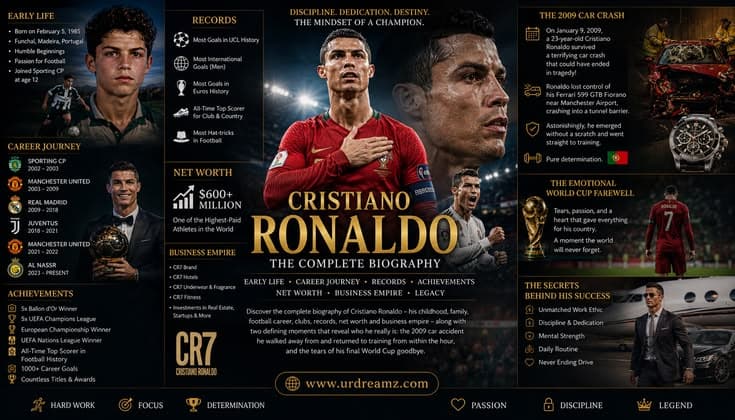
Cristiano Ronaldo dos Santos Aveiro is not just one of the greatest footballers of all time - he is arguably the single most complete case study in modern sports discipline, longevity, and self-reinvention. This is the complete story of how a skinny kid from a poor neighborhood in Madeira became a global icon, told through his career, his records, his business empire, and two moments that say more about his character than any statistic ever could: a car accident he barely blinked at, and the tears of a World Cup dream finally, quietly ending.
1. Who Is Cristiano Ronaldo?
Cristiano Ronaldo is a Portuguese professional footballer widely regarded as one of the two greatest players of his generation, alongside Lionel Messi. Over more than two decades at the top level, he has played for Sporting CP, Manchester United, Real Madrid, Juventus, and Al Nassr, while captaining the Portugal national team through some of the most successful years in its history. He is known equally for his goal-scoring records, his extraordinary physical conditioning well into his late thirties, and his instantly recognizable brand identity, CR7.
2. Early Life and Childhood
Ronaldo was born on February 5, 1985, in Santo António, a working-class parish in Funchal, on the Portuguese island of Madeira. He was the youngest of four children in a family that struggled financially for much of his childhood. His father, José Dinis Aveiro, worked as a municipal gardener and kit man for a local football club, while his mother, Maria Dolores dos Santos, worked as a cook to help support the family. Money was tight enough that, according to accounts from those early years, there were periods when the family genuinely worried about being able to put food on the table.
Football was present in the household from the start, largely because of his father's job at the local club, Andorinha. Ronaldo began playing organized football there as a young child, and his talent was obvious early enough that he was signed by Nacional, a bigger club on the island, before eventually being scouted by Sporting CP in Lisbon at the age of 12. Moving to the mainland alone at such a young age, far from his family, was a defining early hardship - by his own later accounts, homesickness during those first years at Sporting's academy was intense, and it took real emotional resilience to push through it rather than return home.
3. Football Journey: Sporting CP
At Sporting CP's academy, Ronaldo's rapid technical development combined with a work ethic that reportedly stood out even among other exceptionally talented youth players. He made his first-team debut for Sporting in 2002 as a teenager, and it took only one standout performance against Manchester United in a 2003 pre-season friendly - where he reportedly ran United's defense ragged - to convince manager Sir Alex Ferguson to sign him almost immediately afterward.
4. The Manchester United Era
Ronaldo joined Manchester United in 2003 at 18 years old, initially known more for flashy dribbling and step-overs than end product. Under Ferguson's guidance, he was pushed to add end-product to his game - specifically goals - and the transformation over the following seasons was dramatic. By the 2007-08 season, he had developed into arguably the best player in the world, scoring 42 goals in all competitions, winning the Premier League, the UEFA Champions League, and his first Ballon d'Or. His six years at Old Trafford established the foundation for everything that followed: a Premier League winner, a Champions League winner, and a bona fide global superstar by the time he left for Real Madrid in 2009 for what was then a world-record transfer fee.
5. The Real Madrid Golden Years
Ronaldo's nine seasons at Real Madrid, from 2009 to 2018, are widely considered the peak of his career. He became the club's all-time top scorer, a title he still holds, and won four UEFA Champions League titles, including three in a row between 2016 and 2018. During this stretch, he won four of his five Ballon d'Or awards, repeatedly broke his own goal-scoring records, and developed the intense, almost obsessive fitness and recovery regimen that would later become a defining part of his public image.
6. Juventus and the Move to Serie A
In 2018, Ronaldo made another world-record-fee move, this time to Juventus in Italy, partly to test himself in a new league and partly to help the Italian giants finally win the Champions League title that had eluded them for years. While that specific European title never came during his three seasons in Turin, he still won two Serie A titles and continued scoring at an extraordinary rate for a player already in his mid-thirties, further cementing his reputation for defying the normal aging curve of elite athletes.
7. Return to Manchester United and the Move to Al Nassr
Ronaldo returned to Manchester United in 2021 in a much-publicized homecoming, though this second spell ended controversially in 2022 following a widely discussed televised interview in which he was openly critical of the club's direction and his role within it. Shortly afterward, he signed with Al Nassr in Saudi Arabia, a move that was initially met with skepticism from parts of the football world but has since been credited with accelerating the growth and global visibility of Saudi professional football, part of the broader wave of top players moving to the Saudi Pro League in recent years.
8. Portugal National Team Career
Ronaldo has represented Portugal at senior level since 2003 and has long been the country's captain, becoming the all-time leading goalscorer in men's international football history. His crowning international achievement came at UEFA Euro 2016, where Portugal won its first-ever major international trophy, even though Ronaldo himself was forced off injured early in the final due to a knee problem - he remained on the touchline afterward, visibly emotional, coaching and encouraging his teammates from the sideline for the rest of the match, a moment widely remembered as one of the most human images of his entire career.
9. Major Records and Achievements
Across his career, Ronaldo has won five Ballon d'Or awards, five UEFA Champions League titles, league titles in England, Spain, and Italy, and is widely reported as football's all-time leading goalscorer at both club and international level when combining official statistics across his career. He holds the record for most goals scored in the UEFA Champions League, the most international goals ever scored by a men's player, and remains one of only a handful of players to have scored in five different FIFA World Cup tournaments.
10. The 2009 Car Accident: A Story That Reveals His Real Discipline
Statistics explain what Ronaldo has done. This next story explains why. In 2009, while still at Manchester United, a then 23-year-old Ronaldo lost control of his Ferrari 599 GTB Fiorano near Manchester Airport, crashing into a tunnel barrier at high speed on his way to the club's training ground. The car, worth roughly two hundred thousand dollars, was completely written off - by all accounts a serious, frightening crash, the kind that understandably would have shaken most people badly enough to take the rest of the day off, if not longer.
Ronaldo walked away from the wreck without serious injury. Then, instead of going home to recover from the shock, he made his way to Manchester United's training complex and joined his teammates for that day's session within roughly half an hour to forty minutes of the crash. No dramatic absence, no headline about him "taking time to recover" - just a footballer who had nearly been seriously hurt showing up to train like it was any other morning. It's a small story compared to his trophies, but it's arguably the single most honest window into what actually built his career: an almost involuntary refusal to let anything, even a genuinely dangerous accident, interrupt the routine that got him to the top in the first place. Trophies get remembered. That kind of instinctive discipline is what actually wins them.
11. Ronaldo's Workout and Diet Routine
Ronaldo's physical conditioning has become almost as famous as his goal tally, largely because of how far past the "normal" athletic aging curve he has continued to perform. His training routine reportedly combines intense strength and explosiveness work with a heavy emphasis on recovery - cryotherapy, targeted stretching, and closely monitored sleep, since he has spoken publicly about breaking his sleep into several shorter periods throughout the day rather than one single long block. His diet is famously disciplined and low in processed sugar and alcohol, built around lean protein, vegetables, and controlled portions, an approach he has maintained consistently enough, for long enough, that sports scientists have repeatedly cited his body composition in his late thirties as a genuine outlier for the sport.
12. Net Worth, CR7 Brand and Business Ventures
Beyond football, Ronaldo has built one of the largest personal brands in global sport. His CR7 label spans clothing, underwear, footwear, fragrances, and a growing hotel chain, CR7 Hotels, developed in partnership with major hospitality groups. His long-standing partnership with Nike remains one of the most valuable athlete endorsement deals in sports history, and combined with his playing salary, business ventures, and social media reach - among the largest of any individual on the planet - his net worth is widely reported to be well over half a billion dollars, with some estimates placing it considerably higher once all business interests are factored in.
13. Personal Life and Family
Ronaldo is in a long-term relationship with Georgina Rodríguez, a Spanish-Argentine model and media personality, with whom he shares several of his children. In total, he is a father to multiple children, including twins, and has spoken frequently and emotionally about fatherhood as one of the most grounding parts of his life away from football. He has also been open about his Catholic faith and has been involved in various charitable causes over the years, including hospital donations and support for children's causes, often carried out with relatively little public promotion compared to the scale of the giving itself.
14. His Emotional World Cup Farewell
Not every defining moment in Ronaldo's story is a triumph, and one of the most human moments of his entire career came at the very end of his World Cup journey. At the 2022 FIFA World Cup in Qatar, Portugal was eliminated in the quarterfinals, a result that effectively closed the door on Ronaldo ever lifting the one major trophy that has eluded him across an otherwise unmatched trophy cabinet. He was visibly in tears as he left the pitch, a moment captured and shared around the world, symbolizing just how much winning the World Cup meant to him personally, beyond every individual record he had already broken.
It's worth remembering that moment for what it actually was: raw disappointment from a competitor in his late thirties, fully aware that his realistic window to win football's biggest team prize had likely just closed for good, after trying across five World Cup tournaments spanning almost two decades. Football is an unforgiving sport in exactly that way - it doesn't care how many individual records a player holds, or how much discipline it took to get there. Sometimes the story simply ends without the one trophy the whole career seemed to be building toward, and how a player carries that disappointment publicly says almost as much about them as how they carry a trophy. Ronaldo, by every account from that day, carried it with visible, unguarded emotion rather than a polished, camera-ready reaction - and that honesty is part of why the moment still resonates with fans well beyond Portugal.
15. Success Habits: What Actually Made Ronaldo Great
Pulling together the full arc of his career, a few habits show up again and again as the real explanation behind his longevity, far more than raw natural talent alone.
- Obsessive consistency - showing up to train and compete at maximum effort on ordinary days, not just big ones, which the 2009 car accident story illustrates about as clearly as anything could
- Treating recovery as seriously as training - sleep, nutrition, and physical therapy managed with the same intensity most athletes reserve only for the gym
- Reinventing his game as his body changed - shifting from a flashy dribbling winger in his teens to a positioned, efficient goal-scorer in his late thirties, rather than clinging to a style that no longer fit his physical stage
- Turning public criticism into fuel - repeatedly using doubt about his age, his club moves, or his form as motivation rather than letting it affect his output
- Building beyond the pitch early - developing the CR7 brand and business ventures well before his playing career ended, rather than waiting until retirement to think about life after football
16. Controversies and Criticism: The Other Side of the Story
A complete, honest biography also has to include the moments that don't fit a purely heroic narrative. Ronaldo has had his share of on-field discipline issues over the years, including red cards and clashes with opponents in high-pressure matches. His exits from both Manchester United (in 2022) and, earlier, from Sporting CP as a teenager, were accompanied by public disagreements over money, playing time, or club direction, and his outspoken, sometimes blunt public interviews have occasionally put him at odds with teammates, coaches, or club hierarchies. None of this erases what he has achieved, but a figure this consistently in the public eye for over two decades was never going to avoid controversy entirely, and pretending otherwise would flatten a genuinely complicated, very human career into a cartoon.
17. Ronaldo vs Messi: The Defining Rivalry of a Generation
No Ronaldo biography is complete without addressing his rivalry with Lionel Messi, the defining sporting rivalry of the last two decades. The two pushed each other to extraordinary heights throughout the 2010s, trading Ballon d'Or awards and goal-scoring records in a way that arguably made both of them better than they would have been without the other as a benchmark. Messi ultimately achieved the one thing that remains just out of Ronaldo's reach - lifting the FIFA World Cup, in 2022, the same tournament that ended Ronaldo's own World Cup story in tears. The debate over who is the greater player will likely never be fully settled, and perhaps shouldn't be - both represent two different, equally valid answers to the question of footballing greatness.
18. Legacy in Football History
Whatever side of the Ronaldo-Messi debate anyone falls on, Ronaldo's broader legacy is already secure: a player who redefined what physical longevity at the top level could look like, who turned personal branding into a genuine business empire without ever appearing to lose focus on the sport itself, and who, across more than two decades, gave football fans everywhere - not just in Portugal - moments of both triumph and raw, visible humanity. From a car crash he shrugged off within the hour to a World Cup dream he couldn't quite finish, his story is a reminder that even history's most dominant athletes are still, underneath the records, just people chasing something that doesn't always end the way they hoped.
Frequently Asked Questions
Where was Cristiano Ronaldo born?
He was born in Santo António, Funchal, on the Portuguese island of Madeira, on February 5, 1985.
Which clubs has Cristiano Ronaldo played for?
Sporting CP, Manchester United (two spells), Real Madrid, Juventus, and Al Nassr.
How many Ballon d'Or awards has Ronaldo won?
Five Ballon d'Or awards across his career.
Has Cristiano Ronaldo won the FIFA World Cup?
No - despite appearing in five World Cup tournaments, the World Cup remains the one major trophy that has eluded him, with Portugal's 2022 quarterfinal exit likely marking the end of that chapter of his career.
What is Cristiano Ronaldo's net worth?
Widely reported estimates place his net worth well over half a billion dollars once his salary, endorsements, and business ventures like the CR7 brand are combined.
What is the story behind Ronaldo's 2009 car accident?
He crashed his Ferrari near Manchester Airport on the way to training, walked away without serious injury, and made it to that day's Manchester United training session within roughly half an hour to forty minutes of the crash.
What can we learn from Cristiano Ronaldo's success?
Consistency in ordinary moments, treating recovery as seriously as training, and adapting his game as his body changed are widely cited as the real foundations behind his unusually long career at the top.