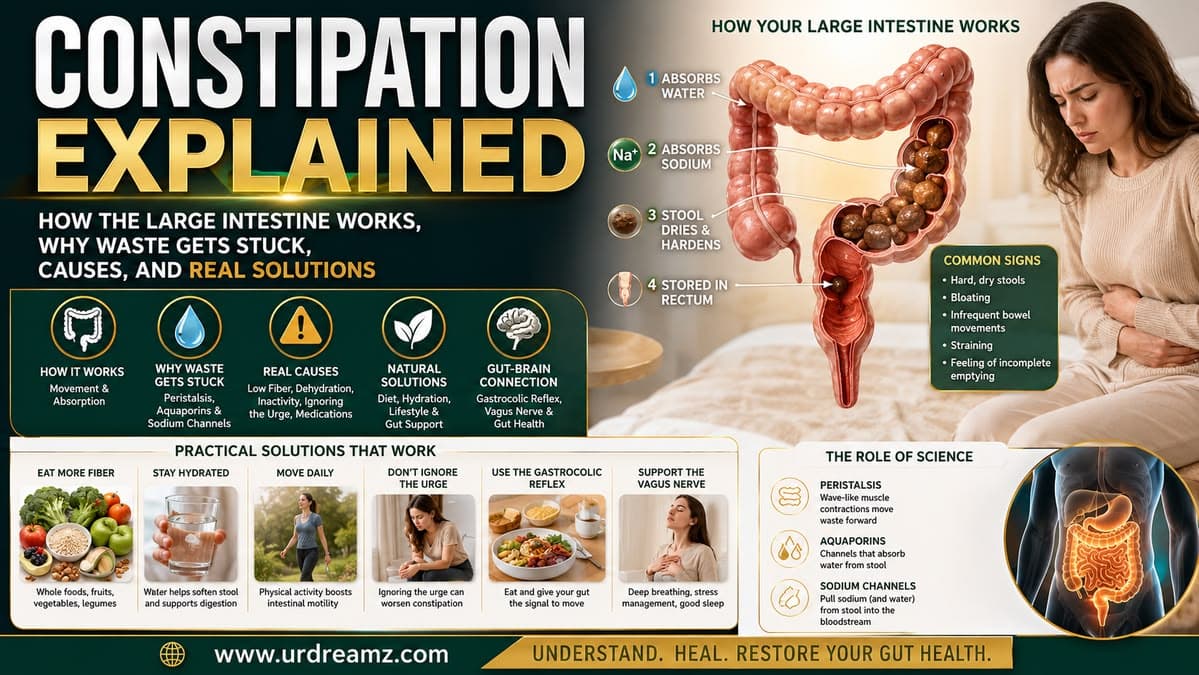
Constipation Explained: How the Large Intestine Works, Why Waste Gets Stuck, Causes, and Real Solutions
Constipation is one of the most common digestive complaints in the world, yet most people never learn what's actually happening inside their body when it occurs. It isn't just "not going enough" — it's a specific breakdown in a finely tuned system involving muscle contractions, water-absorbing channels, and nerve signals that normally work together seamlessly. This guide walks through exactly how the large intestine moves and processes waste, what goes wrong during constipation at a cellular level, the real causes behind it, and practical, evidence-based ways to fix it.
This is educational content, not a diagnosis. Constipation lasting more than a few weeks, or accompanied by severe pain, bleeding, or unexplained weight loss, should always be evaluated by a doctor.
1. What Is Constipation?
Constipation is generally defined as having fewer than three bowel movements a week, or passing stool that is hard, dry, and difficult to pass, often accompanied by straining and a feeling of incomplete emptying. It's one of the most common digestive complaints affecting people of every age, and while usually not serious, it can meaningfully affect daily comfort and quality of life when it becomes frequent or chronic.
2. Small Intestine vs Large Intestine
| Organ | Approximate Length | Main Job |
|---|---|---|
| Small Intestine | About 20 to 22 feet | Digests food and absorbs nutrients into the bloodstream |
| Large Intestine (Colon) | About 5 to 6 feet | Absorbs water and forms, stores, and moves out remaining waste |
3. The Journey From Small to Large Intestine
By the time digested material leaves the small intestine, nearly all of its usable nutrients — proteins, sugars, and fats — have already been absorbed into the bloodstream. What remains is largely water, fiber, and other waste products, which then passes into the large intestine to be processed, dried, and eventually eliminated.
4. The Cecum: Where the Large Intestine Begins
The cecum is the actual first part of the large intestine, a pouch-like structure that receives waste material directly from the small intestine. Everything the large intestine does — absorbing water, moving material forward, and eventually forming stool — begins here.
5. Clearing Up the Appendix
It's worth being precise here: the appendix is a small, narrow, blind-ended pouch attached to the cecum, not the actual starting segment of the large intestine itself, and waste does not pass through it as part of normal digestion. The cecum is the true entry point; the appendix is simply attached alongside it.
6. Ascending Colon Explained
From the cecum, waste moves upward through the ascending colon, located on the right side of the abdomen. This is where a significant portion of water absorption begins as material continues its journey toward elimination.
7. Transverse Colon Explained
The transverse colon runs horizontally across the upper abdomen, connecting the ascending and descending colon. Waste continues to lose water content as it passes through this segment, gradually becoming firmer.
8. Descending Colon Explained
The descending colon runs down the left side of the abdomen, continuing to move increasingly solid waste material toward the final stretch of the large intestine.
9. Sigmoid Colon Explained
The sigmoid colon is a short, S-shaped section connecting the descending colon to the rectum, acting as a kind of holding and final-processing area before waste moves into position for elimination.
10. Rectum and Anal Canal Explained
The rectum is where formed stool is stored temporarily until the body is ready for a bowel movement, and the anal canal is the final short passage through which stool exits the body. Nerve endings in the rectal wall are what trigger the sensation of needing to go, once enough material has accumulated.
11. Peristalsis Explained
Peristalsis is the wave-like muscular contraction that moves material through the digestive tract, including the entire length of the large intestine. Without this coordinated muscular movement, waste material would simply sit in place rather than progressing toward elimination.
12. How Peristalsis Actually Moves Waste Forward
Peristalsis works through a coordinated pattern: the intestinal muscle behind a section of waste contracts and tightens, while the muscle just ahead of it relaxes and widens, creating a continuous, forward-moving wave that pushes contents steadily along the colon. This rhythmic contract-and-release pattern repeats continuously along the entire length of the large intestine.
13. Where Constipation Actually Begins
Constipation fundamentally begins when the speed of peristalsis slows down. When waste material moves more slowly than normal through the colon, it spends more time in contact with the colon wall — and the longer it stays, the more water gets pulled out of it, exactly the process explained in the sections that follow.
14. Water Absorption in the Colon
One of the large intestine's primary jobs is reclaiming water from waste material before it's eliminated, preventing the body from losing more fluid than necessary. This water absorption happens through specialized channels built directly into the cells lining the colon wall.
15. Aquaporins Explained
Aquaporins are specialized proteins embedded in the colon's cell membranes that function as dedicated water channels, allowing water molecules to move efficiently out of waste material and into the surrounding tissue and bloodstream. Several types exist throughout the colon, generally labeled AQP1 through AQP8, each playing a role in this ongoing water reclamation process.
16. Sodium Channels: ENaC Explained
ENaC, short for Epithelial Sodium Channel, is a protein channel in the colon lining that actively pulls sodium out of waste material and into the surrounding cells. Because water naturally follows sodium through osmosis, this sodium movement pulls additional water out of the stool right along with it.
17. Sodium Channels: NHE Explained
NHE, or Sodium-Hydrogen Exchanger, is another transport protein in the colon lining that works alongside ENaC to move sodium out of waste material. Together, these sodium transport systems significantly amplify how much water the colon is able to reclaim from stool as it moves through.
18. Why Stool Hardens When Transit Slows
Under normal conditions, waste moves through the colon at a pace that allows a healthy, moderate amount of water absorption, leaving stool soft enough to pass comfortably. When peristalsis slows down — for any of the reasons covered later in this guide — waste sits in the colon for far longer, giving aquaporins and sodium channels significantly more time to pull water out. The result is stool that becomes progressively harder, drier, and more difficult to pass the longer it remains in the colon.
19. The Official Definition of Constipation
Medically, constipation is generally defined as fewer than three bowel movements per week, though what counts as "normal" varies somewhat from person to person — someone who typically goes daily and suddenly drops to once every two or three days, accompanied by harder stool and straining, may also be experiencing constipation relative to their own usual pattern.
20. Common Symptoms of Constipation
| Symptom | Why It Happens |
|---|---|
| Hard, dry, or lumpy stool | Excess water has been reabsorbed due to slowed transit |
| Straining during bowel movements | Firmer stool requires more effort to pass |
| Bloating and abdominal discomfort | Waste material accumulating in the colon |
| A feeling of incomplete emptying | Stool may be partially retained even after passing some |
| Reduced bowel movement frequency | Slowed peristalsis means less material reaches the rectum on schedule |
21. Cause 1: Low Fiber Intake
Fiber is a type of carbohydrate that the body cannot fully break down in the stomach or small intestine, meaning it travels largely intact into the large intestine. Once there, it adds bulk to stool and helps stimulate the colon's muscular contractions, making it one of the most important dietary factors in maintaining regular bowel movements.
22. Why Refined Grains Make It Worse
Heavily processed, refined foods — such as commercial white bread — have typically had most of their natural fiber content removed during manufacturing, leaving significantly less bulk-forming material available for the colon to work with. Whole grain alternatives retain considerably more of their original fiber content, generally making them a better choice for supporting regular digestion.
23. Cause 2: Dehydration
The body requires roughly 8 glasses of water daily under normal conditions, with meaningfully higher needs in hot weather or with increased physical activity. When fluid intake is insufficient, the body prioritizes water for the bloodstream and vital functions, leaving less available for the colon to work with — worsening the very water-absorption process that already tends to harden stool.
24. Cause 3: Low Physical Activity
People with predominantly sedentary routines — office workers, professional drivers, and others who spend long hours seated — are at meaningfully higher risk of constipation, since physical movement is directly linked to healthy bowel motility. A largely inactive lifestyle removes one of the natural stimulants that helps keep peristalsis functioning at a normal pace.
25. The Exercise, Cortisol, and Serotonin Connection
Physical activity does more than move the body — it helps regulate cortisol, the body's primary stress hormone, which can otherwise interfere with normal bowel motility when chronically elevated. Exercise also supports healthy serotonin activity, a neurotransmitter that plays a meaningful role in regulating gut movement, which is part of why regular movement is so consistently linked to more regular bowel habits.
26. Cause 4: Ignoring the Natural Urge
Repeatedly delaying a bowel movement when the urge arises — because of being away from home, at work, or simply inconvenient timing — allows waste to remain in the colon longer than it otherwise would, giving water absorption more time to harden the stool. Over time, this habit can also blunt the body's natural sensitivity to the urge itself, making the whole cycle progressively worse.
27. Cause 5: Certain Medications
Several categories of medication are well known to cause or worsen constipation as a side effect, most notably opioid pain medications such as tramadol and codeine, but also some antidepressants, iron supplements, and certain blood pressure medications.
28. How Opioid Medications Slow the Gut
The colon wall contains specialized receptors called mu-opioid receptors, part of the enteric nervous system — sometimes called the gut's own semi-independent nervous system. Opioid medications bind to these receptors directly, effectively quieting the nerve activity that normally drives peristalsis, which is why opioid use is one of the most common and predictable medication-related causes of constipation.
29. Other Medical Causes Worth Knowing
| Condition | How It Contributes |
|---|---|
| Hypothyroidism | Can slow overall metabolic and digestive processes |
| Diabetes | Can affect nerve function involved in gut motility over time |
| Parkinson's disease / MS | Can impair nerve signaling that controls bowel movement |
| Pelvic floor dysfunction | Weak or uncoordinated muscles can impair effective stool passage |
| Bowel structural issues | Growths or narrowing can physically obstruct normal passage |
30. Soluble Fiber Explained
Soluble fiber dissolves in water, forming a gel-like substance that helps soften stool and makes it easier to pass. Oats, beans, and many fruits are good sources of this type of fiber.
31. Insoluble Fiber Explained
Insoluble fiber does not dissolve in water and instead adds bulk directly to stool, helping stimulate the colon's muscular contractions and speeding up transit time. Whole wheat, many vegetables, and wheat bran are common sources of this type of fiber.
32. Prunes and Sorbitol Explained
Prunes contain a natural sugar alcohol called sorbitol, which is poorly absorbed by the small intestine and draws water into the colon through osmosis as it travels through, functioning as a gentle, natural laxative. This is part of why prunes and prune juice are so consistently recommended as a practical, food-based remedy for constipation.
33. Hydration: How Much Is Actually Needed
Most healthy adults benefit from roughly 8 glasses of water daily under normal conditions, with higher needs during hot weather, exercise, or increased fiber intake, since fiber actually needs adequate water to function properly — without enough fluid, added fiber can sometimes make constipation worse rather than better.
34. Brisk Walking and Daily Movement
Around 30 minutes of brisk walking daily is a simple, low-effort way to stimulate healthy bowel motility, supporting the natural muscular contractions that move waste through the colon. Consistency matters more than intensity here — a daily habit tends to outperform occasional, more strenuous exercise for this specific purpose.
35. The Morning Warm Water Routine
Drinking a couple of glasses of warm water first thing in the morning is a commonly recommended habit for supporting regularity, partly because warmth itself can gently stimulate digestive activity, and partly because it takes advantage of the gastrocolic reflex explained in the next section.
36. The Gastrocolic Reflex Explained
The gastrocolic reflex is the body's natural response to food or liquid entering the stomach: as the stomach stretches, it sends a signal to the colon to increase its muscular activity, encouraging existing waste to move forward and often prompting the urge to have a bowel movement. This is exactly why many people feel the urge to go shortly after eating or drinking something warm, particularly in the morning.
37. The Defecation Reflex Explained
Once waste material reaches the rectum and stretches its walls, nerve endings there send a signal up toward the spinal cord and brain, creating the conscious sensation that it's time to use the bathroom. This is known as the defecation reflex, and responding to it promptly — rather than delaying it — helps keep the whole system functioning as intended.
38. The Vagus Nerve and Gut-Brain Connection
The vagus nerve is a long, wide-reaching nerve that connects the brain to much of the body, including extensive branches throughout the digestive tract, which is why it's sometimes referred to as the "wandering nerve." It plays a meaningful role in regulating digestive activity, and because it's also closely tied to the body's stress response, keeping it functioning well — through stress management, adequate rest, and overall nervous system health — can genuinely support more regular bowel activity over time.
39. Best Foods for Constipation Relief
| Food | Why It Helps |
|---|---|
| Prunes / Prune Juice | Contains sorbitol, a natural osmotic laxative |
| Oats and Whole Grains | Rich in both soluble and insoluble fiber |
| Beans and Lentils | High in fiber and adds meaningful bulk to stool |
| Leafy Greens (Spinach, Broccoli) | Provides fiber and water content |
| Apples and Pears (with skin) | Contain pectin fiber and natural water content |
| Chia and Flax Seeds | High in soluble fiber, helps soften stool |
| Kiwi | Contains an enzyme that supports digestive movement |
40. Foods That Can Make Constipation Worse
| Food Category | Why It Can Worsen Constipation |
|---|---|
| Refined white bread and pastries | Low in fiber due to processing |
| Fried and heavily processed foods | Slow overall digestion |
| Excess dairy (in sensitive individuals) | Can slow bowel movements for some people |
| Excess red meat without fiber balance | Low fiber content relative to volume |
41. Over-the-Counter Options
| Type | How It Works |
|---|---|
| Fiber Supplements (e.g. psyllium) | Adds bulk and helps stool retain water |
| Osmotic Laxatives (e.g. polyethylene glycol) | Draws water into the colon to soften stool |
| Stool Softeners (e.g. docusate sodium) | Adds moisture directly into stool |
| Stimulant Laxatives (e.g. senna) | Directly stimulates colon contractions; best for short-term use only |
These are generally intended for occasional or short-term use; a pharmacist or doctor can help identify the right option if constipation persists.
42. Sample One-Day Routine to Support Regularity
| Time | Action |
|---|---|
| Morning | Two glasses of warm water shortly after waking |
| Breakfast | High-fiber meal such as oatmeal with fruit |
| Throughout the day | Steady water intake, roughly 8 glasses total |
| Midday | 30 minutes of brisk walking or equivalent movement |
| Evening | Fiber-rich dinner, avoiding heavy, fried foods |
| Any time the urge arises | Respond promptly rather than delaying |
43. When to See a Doctor
Constipation lasting more than two to three weeks despite diet and lifestyle changes, along with severe abdominal pain, rectal bleeding, unexplained weight loss, or a sudden, unexplained change in bowel habits, should be evaluated by a doctor rather than managed with home remedies alone, since these can occasionally point to an underlying condition that needs proper diagnosis.
44. Myths vs Facts
| Myth | Fact |
|---|---|
| You must have a bowel movement every single day to be healthy | Normal frequency varies by person; what matters more is consistency with your own usual pattern and stool comfort |
| The appendix is part of the digestive pathway | The cecum is the actual entry point of the large intestine; the appendix is a separate attached pouch |
| Fiber alone always fixes constipation | Fiber needs adequate water to work properly, and without enough fluid it can sometimes worsen symptoms |
| Laxatives are always safe for daily long-term use | Stimulant laxatives in particular are generally intended for short-term, occasional use |
| Constipation is always just a diet problem | Medications, inactivity, ignoring the urge, and underlying medical conditions can all be significant contributing causes |
45. Quick Glossary
| Term | Meaning |
|---|---|
| Peristalsis | The wave-like muscular contractions that move material through the digestive tract |
| Aquaporin | A protein channel that allows water to move across cell membranes in the colon |
| ENaC | Epithelial Sodium Channel; pulls sodium (and water) out of stool |
| Gastrocolic Reflex | The colon's increased activity triggered by food or liquid entering the stomach |
| Defecation Reflex | The nerve signal triggered when the rectum stretches, prompting the urge to go |
| Sorbitol | A natural sugar alcohol, found in prunes, that draws water into the colon |
46. Frequently Asked Questions
What is considered constipation?
Generally, fewer than three bowel movements a week, or stool that is hard, dry, and difficult to pass with straining, counts as constipation.
What actually causes stool to harden?
When peristalsis slows down, waste stays in the colon longer, giving water-absorbing channels like aquaporins and sodium transporters more time to pull water out, resulting in harder, drier stool.
Is the appendix part of digestion?
No, the appendix is a small pouch attached to the cecum, not part of the actual digestive transit pathway; the cecum itself is the true starting point of the large intestine.
What is the fastest way to relieve constipation naturally?
Prune juice, warm water in the morning, adequate hydration alongside fiber, and brisk physical activity are among the most reliably effective natural approaches.
Why do opioid pain medications cause constipation?
Opioids bind to receptors in the gut's own nervous system, slowing the nerve signals that normally drive peristalsis, which reduces colon motility.
Does ignoring the urge to go really cause constipation?
Yes, repeatedly delaying a bowel movement allows waste to remain in the colon longer, giving water absorption more time to harden the stool, and can dull the body's natural urge signal over time.
How much fiber do I actually need daily?
Most health guidelines recommend roughly 25 to 34 grams of fiber daily for adults, ideally from a mix of soluble and insoluble sources.
When should constipation be checked by a doctor?
If it lasts more than two to three weeks despite lifestyle changes, or comes with severe pain, bleeding, or unexplained weight loss, it's time to see a doctor.
47. Conclusion
Constipation isn't just an inconvenience — it's the visible result of a very specific, very physical process: peristalsis slowing down, water-absorbing channels working overtime, and stool losing the moisture it needs to pass comfortably. Understanding that process changes how the problem looks. It's not a mystery or a personal failing; it's a system that responds directly and predictably to fiber, hydration, movement, and how consistently you listen to your own body's signals.
The good news is that most of the levers that actually matter here — what you eat, how much water you drink, how much you move, and whether you respond to the urge when it arises — are entirely within your control, and small, consistent changes in each of these areas tend to add up to real, lasting improvement. For constipation that doesn't respond to these changes, or that comes with any more serious warning signs, a doctor can help identify whether something more specific is going on beneath the surface.