Chemotherapy Explained: Why Hair Falls Out, How Doxorubicin Works, and the Newer Treatments Replacing It
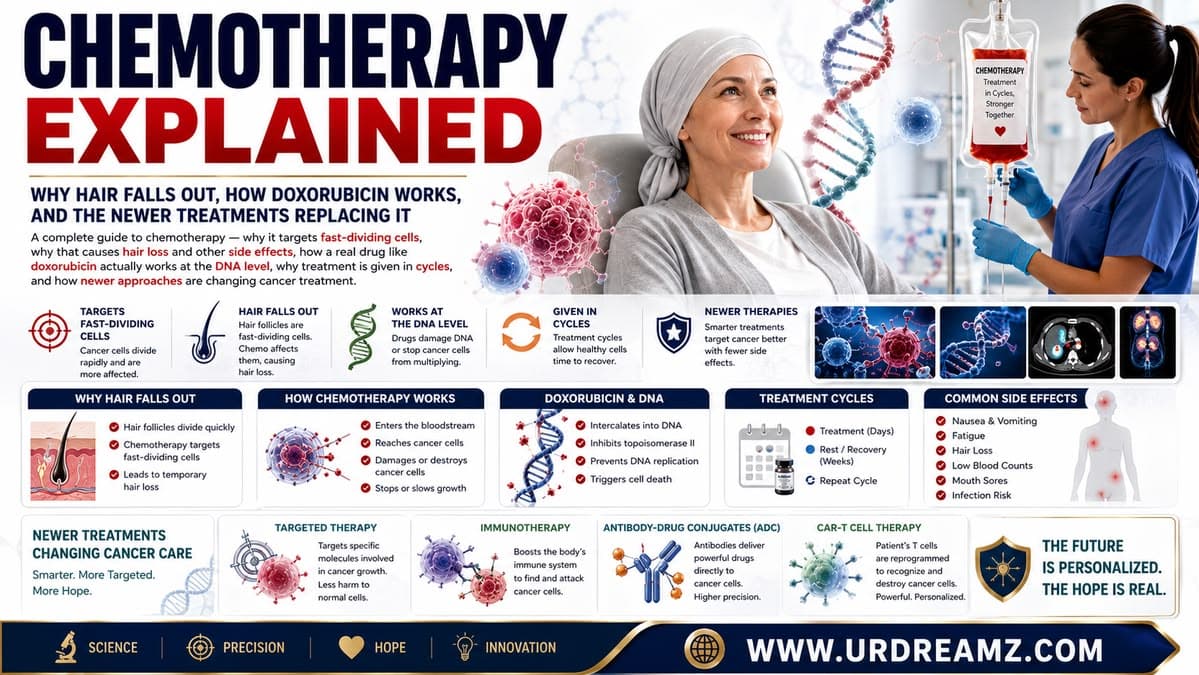
Chemotherapy might be the most misunderstood word in cancer care. People know it as "the cancer treatment that makes your hair fall out," but few understand why — and understanding why changes how the whole treatment makes sense. Chemotherapy doesn't fail to distinguish cancer cells from healthy ones because it's poorly designed; it fails because of what it was built to look for in the first place: cells that divide quickly. Cancer cells divide quickly. So do a handful of healthy tissues. That single overlap explains almost every major side effect chemotherapy is known for.
This guide walks through exactly how chemotherapy works at the cellular and molecular level, using a real chemotherapy drug as an example, why it's given in cycles, why doctors still recommend it despite the side effects, and how newer treatments — targeted therapy, immunotherapy, antibody-drug conjugates, and CAR-T cell therapy — are increasingly offering more precise alternatives. This is educational content, not medical advice; treatment decisions always belong between a patient and their oncology team.
1. What Is Chemotherapy?
Chemotherapy is a cancer treatment that uses powerful drugs to kill cancer cells or stop them from dividing and growing, typically delivered through an IV infusion, pills, or injections. It remains one of the most widely used cancer treatments in the world, often combined with surgery, radiation, or newer therapies as part of a broader treatment plan.
2. Breaking Down the Word: Chemo + Therapy
The word itself is a straightforward combination: "chemo" refers to chemicals, and "therapy" means treatment. Chemotherapy is, quite literally, treating disease through chemical compounds — in this case, compounds specifically designed to interfere with how cells divide.
3. The Core Idea: Attacking Fast-Dividing Cells
Cancer's defining feature is uncontrolled, rapid cell division. Chemotherapy drugs are built around this fact, designed to interfere with the machinery cells use to divide, effectively instructing the drug to travel through the body and disrupt cell division wherever it finds it happening quickly.
4. Why This Approach Has a Fundamental Blind Spot
Here's the catch: chemotherapy drugs don't have any way to recognize "cancer" as a category. They can only detect and respond to one specific pattern — cells dividing rapidly — and that pattern isn't unique to cancer. Several types of healthy tissue divide just as quickly as cancer cells under normal, non-cancerous circumstances, and chemotherapy affects all of them indiscriminately.
5. Five Places in the Body Where Healthy Cells Also Divide Fast
| # | Tissue Type | Why It Divides Quickly |
|---|---|---|
| 1 | Cancer Cells | The intended target; divide uncontrollably |
| 2 | Hair Follicles | Continuously produce new cells to grow hair |
| 3 | Bone Marrow | Constantly produces new red cells, white cells, and platelets |
| 4 | Gut Epithelial Lining | Regularly replaces itself due to constant wear from digestion |
| 5 | Gonads (Reproductive Cells) | Continuously produce sperm or support egg maturation |
6. Cancer Cells: The Actual Intended Target
Cancer cells are the reason chemotherapy exists in the first place — cells that have lost their normal controls on growth and division, multiplying far faster than the healthy tissue around them. This is exactly the pattern chemotherapy drugs are designed to disrupt.
7. Hair Follicles Explained
Hair follicles rank among the fastest-dividing cell populations in the entire body, continuously generating new cells to keep hair growing. Because chemotherapy can't distinguish this rapid, healthy division from cancer's rapid, harmful division, hair follicle cells get caught directly in its path — which is precisely why hair loss is such a common and recognizable chemotherapy side effect.
8. Bone Marrow Explained
Bone marrow is the tissue inside bones responsible for continuously producing the body's entire blood supply — red blood cells, white blood cells, and platelets — all through rapid, ongoing cell division. This makes bone marrow one of the tissues most heavily affected by chemotherapy, with consequences that ripple through nearly every system in the body.
9. The Epithelial Lining of the Gut Explained
The lining of the mouth, stomach, and intestines — known as epithelial tissue — is under constant physical and chemical wear from digestion, and the body compensates by replacing these cells rapidly and continuously. This fast turnover makes gut lining tissue another major target caught in chemotherapy's blind spot.
10. Gonads Explained
The gonads — the testes in men and ovaries in women — involve ongoing cell division related to sperm production and egg maturation. Because this division happens quickly, reproductive tissue is another one of the healthy systems that chemotherapy can inadvertently affect.
11. The "Bullet From a Gun" Analogy
A useful way to understand chemotherapy's blind spot: a bullet fired from a gun doesn't distinguish between friend and enemy — it simply travels in the direction it was aimed and strikes whatever is in its path. Chemotherapy behaves similarly at the cellular level; it isn't aimed at "cancer" specifically, only at the pattern of rapid division, and anything matching that pattern is affected, regardless of whether it's harmful or healthy.
12. A Real Example: How Doxorubicin Works
Doxorubicin is a widely used chemotherapy drug, often delivered through an IV drip, that illustrates exactly how this mechanism plays out in practice. Rather than "knowing" where cancer is located, doxorubicin is chemically built to interfere with a specific process every dividing cell depends on — regardless of whether that cell happens to be cancerous, a hair follicle, gut lining, bone marrow, or reproductive tissue.
13. DNA Intercalation Explained
Doxorubicin works partly through a process called DNA intercalation, in which the drug molecule physically inserts itself between the base pairs of a cell's DNA strand. This insertion distorts the DNA's normal structure, interfering with the cell's ability to accurately read and copy its own genetic material — a necessary step before any cell can divide.
14. Topoisomerase II Explained
Topoisomerase II is an enzyme that helps manage the physical structure of DNA during cell division, briefly cutting and rejoining DNA strands to relieve tension and allow the DNA to be copied correctly. It's an essential part of how any dividing cell — cancerous or healthy — successfully replicates its genetic material.
15. Why Blocking This Enzyme Stops Cell Division
Doxorubicin interferes directly with Topoisomerase II, preventing it from properly completing its role in DNA replication. Combined with DNA intercalation, this effectively halts the cell's ability to divide — which is precisely the intended effect on cancer cells, and precisely the unintended effect on every other fast-dividing tissue caught in the same path.
16. Why Chemo Can't Tell Cancer From Healthy Fast-Dividing Cells
Doxorubicin, like most traditional chemotherapy drugs, has no built-in mechanism to check whether a given cell is cancerous before acting on it — it simply targets the DNA replication process itself, which looks essentially the same whether the cell dividing is a tumor cell, a hair follicle cell, or a bone marrow cell. This is the central limitation that defines nearly every chemotherapy side effect discussed in this guide.
17. Common Side Effects Traced to Each Fast-Dividing Tissue
| Affected Tissue | Resulting Side Effect |
|---|---|
| Hair Follicles | Hair loss (scalp and body) |
| Bone Marrow | Lower blood counts, fatigue, higher infection risk, easy bruising |
| Gut Lining | Mouth sores, nausea, digestive discomfort |
| Gonads | Temporary or, in some cases, longer-term fertility effects |
18. Hair Loss Explained
Hair loss during chemotherapy happens because hair follicle cells are among the fastest-dividing cells in the body, placing them directly in the path of drugs designed to stop rapid cell division. Importantly, this hair loss comes from the treatment, not the cancer itself — hair typically begins regrowing once chemotherapy ends and the follicles resume their normal division cycle.
19. Mouth and Gut Sores Explained
Sores in the mouth, throat, or digestive tract during chemotherapy occur because the rapidly regenerating epithelial lining in these areas is disrupted, leaving the tissue thinner and more vulnerable to irritation and breakdown before it can be replaced as quickly as it normally would be.
20. Bone Marrow Suppression Explained
Bone marrow suppression refers to chemotherapy's impact on the bone marrow's ability to continuously produce new blood cells, since the very cell division process it relies on is exactly what chemotherapy is designed to interrupt. This single effect explains several of chemotherapy's most significant and closely monitored side effects.
21. Effect on Red Blood Cells
Reduced red blood cell production during chemotherapy can lead to anemia, contributing to the deep, persistent fatigue many patients describe — a tiredness that feels meaningfully different from ordinary exhaustion, since it reflects the body's reduced oxygen-carrying capacity rather than simple sleep deprivation.
22. Effect on White Blood Cells and Infection Risk
Lower white blood cell counts significantly weaken the immune system's ability to fight off infection, which is why chemotherapy patients are generally advised to avoid crowds, practice careful hand hygiene, and pay close attention to any signs of fever or infection during treatment.
23. Effect on Platelets
Reduced platelet counts impair the blood's ability to clot normally, increasing the risk of easy bruising or prolonged bleeding from even minor injuries, which is why blood counts are monitored closely throughout a course of chemotherapy.
24. Fertility-Related Side Effects
Because chemotherapy can affect the rapidly dividing cells involved in sperm and egg production, fertility can be temporarily or, in some cases, more lastingly affected, depending on the specific drugs, dosage, and duration of treatment. Fertility preservation options are often discussed with patients before treatment begins, particularly for younger patients, when time and circumstances allow.
25. Why Chemotherapy Is Given in Cycles
Chemotherapy is typically administered in cycles — active treatment periods followed by a break, often around a month — rather than as one continuous, ongoing dose. This pattern exists specifically to give the body's healthy fast-dividing tissues room to recover between rounds.
26. The Logic Behind the Rest Period
During the rest period between chemotherapy cycles, healthy tissues like bone marrow, gut lining, and hair follicles get a window of time to repair and replace the cells that were affected during active treatment, while the cancer-suppressing effect of the previous dose continues working. This balance — enough treatment to suppress cancer growth, enough rest to allow healthy tissue recovery — is central to how chemotherapy schedules are designed.
27. Why Doctors Still Recommend Chemo Despite the Side Effects
Given how disruptive these side effects can be, it's a reasonable question: why use a treatment this broadly damaging in the first place? The answer comes down to a comparison of risks — left untreated, cancer itself poses a far greater, more immediate danger to health and life than the temporary side effects chemotherapy causes along the way.
28. The Risk-vs-Risk Reasoning
Choosing chemotherapy generally isn't a choice between "risk" and "no risk" — it's a choice between a smaller, largely temporary and manageable risk, and a much larger, ongoing risk from untreated cancer growth and spread. Framed this way, accepting chemotherapy's side effects becomes a deliberate trade-off toward the significantly smaller of two risks, not simply an unfortunate side cost.
29. Why Chemotherapy Is Called "Conventional Treatment"
Chemotherapy is often referred to as a conventional or traditional cancer treatment because it's been a foundational part of cancer care for decades, developed well before the more precisely targeted therapies covered later in this guide. It remains an essential and often first-line treatment for many cancers, even as newer, more selective alternatives continue to emerge alongside it.
30. Targeted Therapy Explained
Targeted therapy uses drugs designed to recognize and bind to specific proteins or genetic markers found on cancer cells, rather than acting broadly against any fast-dividing cell in the body. Once the drug locates and attaches to this specific marker, it can disrupt the cancer cell's growth process directly, with meaningfully less impact on unrelated healthy tissue.
31. How Targeted Therapy Differs From Chemotherapy
The key difference comes down to precision: chemotherapy reacts to a general pattern — fast cell division — found in both cancerous and healthy tissue, while targeted therapy looks for a specific molecular signature unique to cancer cells. This generally means fewer of the widespread side effects associated with traditional chemotherapy, though targeted therapy is only effective against cancers that actually carry the specific target the drug is designed for.
32. Immunotherapy Explained
Immunotherapy works by helping the body's own immune system better recognize and attack cancer cells, rather than introducing an external chemical to directly kill them. Certain immunotherapy drugs help "unmask" cancer cells that have found ways to hide from immune detection, allowing the immune system to identify and destroy them using its own natural defenses.
33. Antibody-Drug Conjugates Explained
An antibody-drug conjugate combines two components into a single treatment: an antibody engineered to seek out and bind specifically to cancer cells, and a potent cell-killing chemical attached directly to that antibody. Once the antibody locates and attaches to its target, the attached chemical is delivered directly into the cancer cell, allowing for a targeted, cell-killing effect with reduced impact on healthy tissue elsewhere in the body.
34. CAR-T Cell Therapy Explained
CAR-T cell therapy, short for Chimeric Antigen Receptor T-Cell Therapy, is one of the most advanced and rapidly emerging cancer treatments available today. It works by genetically modifying a patient's own T cells — a key type of immune cell — to specifically recognize and attack their particular cancer.
35. How CAR-T Cell Therapy Actually Works, Step by Step
| Step | What Happens |
|---|---|
| 1 | T cells are collected from the patient's own blood |
| 2 | The T cells are genetically engineered in a lab to carry a chimeric antigen receptor (CAR) |
| 3 | This receptor is specifically designed to recognize a marker found on the patient's cancer cells |
| 4 | The modified T cells are multiplied in large numbers |
| 5 | The engineered T cells are infused back into the patient's body |
| 6 | The modified T cells seek out, recognize, and attack cancer cells carrying that specific marker |
36. Real-World Example: Pakistan's First CAR-T Success
In 2026, Pakistan's Armed Forces Bone Marrow Transplant Centre carried out the country's first successful CAR-T cell therapy, treating a 21-year-old patient with a relapsed form of B-cell leukemia that had returned despite earlier treatment. The patient received the therapy in June 2026 and achieved a complete, measurable-residual-disease-negative remission within just 14 days, before being discharged the following month — a genuinely remarkable outcome for a case where conventional treatment options had already been exhausted.
37. Why CAR-T Isn't Used for Every Cancer
CAR-T cell therapy is currently used primarily for certain blood cancers, including specific types of leukemia, lymphoma, and multiple myeloma, since these cancers involve cell markers that are relatively well understood and easier to target with this approach. Solid tumors present additional challenges for CAR-T therapy, and research into expanding its use to more cancer types is actively ongoing.
38. When Chemotherapy Is Still the Better Option
For certain cancers — including many cases of testicular cancer and some other highly chemotherapy-responsive tumors — chemotherapy remains an extremely effective, often first-line treatment, sometimes offering better outcomes than newer alternatives for that specific cancer type. Chemotherapy's broad mechanism, while less precise, can also be an advantage in some cancers where a wide-reaching effect is genuinely useful.
39. When Newer Therapies Are Better Options
For cancers involving blood cells, bone marrow, or breast tissue in particular, chemotherapy's broad effect on fast-dividing healthy cells can cause disproportionately significant collateral damage, which is exactly where more targeted approaches like targeted therapy, immunotherapy, antibody-drug conjugates, or CAR-T therapy can offer real advantages — attacking cancer cells more precisely while sparing more of the body's healthy fast-dividing tissue.
40. Comparing All Five Treatment Types
| Treatment | How It Targets Cancer | Precision Level |
|---|---|---|
| Chemotherapy | Attacks any fast-dividing cell | Low — affects healthy fast-dividing tissue too |
| Targeted Therapy | Binds to specific proteins on cancer cells | High |
| Immunotherapy | Helps the immune system recognize and attack cancer | High |
| Antibody-Drug Conjugate | Antibody delivers a toxic payload directly to cancer cells | High |
| CAR-T Cell Therapy | Genetically engineered immune cells target specific cancer markers | Very high |
41. Life During Chemotherapy: What to Expect
Many people continue working and maintaining parts of their normal routine during chemotherapy, though flexibility and extra rest, particularly right after treatment sessions, are usually necessary. Light activity like short walks or gentle movement can help manage fatigue and stress, while avoiding crowded spaces and practicing careful hygiene helps reduce infection risk while blood counts are lower than normal.
42. Recovery After Chemotherapy Ends
Once chemotherapy is complete and a patient achieves remission, the fast-dividing healthy tissues that were affected during treatment — hair follicles, bone marrow, gut lining, and reproductive tissue — generally begin recovering over the following weeks and months, since the underlying cell division process itself was never permanently destroyed, only temporarily disrupted.
43. Myths vs Facts
| Myth | Fact |
|---|---|
| Cancer itself causes hair loss | Hair loss is a side effect of chemotherapy targeting fast-dividing hair follicle cells, not the cancer directly |
| Chemotherapy specifically seeks out and identifies cancer cells | It targets the pattern of rapid cell division generally, affecting healthy fast-dividing tissue along the way |
| Newer therapies have made chemotherapy obsolete | Chemotherapy remains highly effective and often preferred for certain cancers, including many testicular cancers |
| CAR-T therapy works for every type of cancer | It's currently used primarily for certain blood cancers; solid tumor applications are still developing |
| All chemotherapy side effects are permanent | Most side effects, including hair loss and bone marrow suppression, are temporary and improve after treatment ends |
44. Quick Glossary
| Term | Meaning |
|---|---|
| DNA Intercalation | A drug molecule inserting itself between DNA base pairs, disrupting normal DNA function |
| Topoisomerase II | An enzyme that manages DNA structure during cell division |
| Bone Marrow Suppression | Reduced blood cell production caused by chemotherapy's effect on bone marrow |
| Targeted Therapy | Treatment that binds to specific molecular markers on cancer cells |
| CAR-T Cell Therapy | A treatment using genetically engineered immune cells to attack cancer |
| Remission | A significant reduction or disappearance of detectable cancer signs after treatment |
45. Frequently Asked Questions
Why does chemotherapy cause hair loss?
Hair follicle cells divide very rapidly, similar to cancer cells, so chemotherapy drugs designed to stop fast cell division affect hair follicles along with cancer cells, causing temporary hair loss.
Does hair loss mean the cancer is getting worse?
No, hair loss is a side effect of the treatment itself, not a sign of how the cancer is responding; hair typically regrows once chemotherapy ends.
How does doxorubicin actually kill cancer cells?
Doxorubicin inserts itself into DNA (intercalation) and blocks an enzyme called Topoisomerase II, both of which prevent a cell from successfully completing DNA replication needed for division.
Why is chemotherapy given in cycles instead of continuously?
The rest periods between cycles allow healthy fast-dividing tissues, like bone marrow and gut lining, time to recover before the next round of treatment.
What is the difference between chemotherapy and targeted therapy?
Chemotherapy attacks any rapidly dividing cell, while targeted therapy is designed to recognize and bind to specific markers found only on cancer cells, generally causing fewer widespread side effects.
What is CAR-T cell therapy?
CAR-T cell therapy genetically modifies a patient's own immune cells to recognize and attack their specific cancer, and is currently used mainly for certain blood cancers like leukemia and lymphoma.
Is chemotherapy still used if newer treatments exist?
Yes, chemotherapy remains highly effective and is often the preferred treatment for certain cancers, including many testicular cancers, even as newer therapies expand treatment options for other cancer types.
Do chemotherapy side effects go away after treatment?
Most side effects, including hair loss and lowered blood counts, are temporary and improve in the weeks and months after treatment ends, though some effects can vary depending on the specific drugs and duration used.
46. Conclusion
Chemotherapy's side effects aren't a design flaw or a sign of a poorly made treatment — they're the direct, logical consequence of the only thing these drugs can actually detect: cells dividing quickly. Cancer cells fall into that category, and so do a handful of essential healthy tissues, which is exactly why hair loss, fatigue, mouth sores, and lowered blood counts show up together so predictably across nearly every chemotherapy patient's experience.
What's genuinely exciting is how far cancer treatment has moved beyond that original blind spot. Targeted therapy, immunotherapy, antibody-drug conjugates, and CAR-T cell therapy each represent a different way of teaching treatment to recognize cancer specifically, rather than simply reacting to a pattern cancer happens to share with healthy tissue. Pakistan's first successful CAR-T case is a genuinely striking example of just how far that precision has come in a very short time.
None of this makes chemotherapy obsolete — for many cancers, it remains the most effective option available, and the right treatment always depends on the specific cancer, its stage, and the individual patient. But understanding why chemotherapy works the way it does, and why it costs what it costs the body along the way, turns a frightening, blunt-force treatment into something genuinely explainable — a deliberate trade-off, made in the service of a much larger fight.