What Is SEO? A Simple, Practical and Slightly Fun Guide
Imagine you open a tiny shop in a huge market with ten thousand other shops. The street has no signboard, your name is not written anywhere and nobody knows you exist. Even if you sell the best tea in town, your chairs stay empty.
Introduction: The Friendly Guide at the Market Entrance
Now imagine a friendly guide stands at the market entrance and tells every hungry visitor: "Best tea? Go to shop number 4,812, third lane on the left." Suddenly your chairs are full.
On the internet, that guide is a search engine like Google, and SEO is everything you do so the guide chooses your shop. That is the whole idea. The rest of this article simply fills in the details, and we will keep it simple, practical and a little bit fun.
By the end you will know the SEO meaning and full form, the 5 components of SEO, how many types of SEO exist, what SEO keywords are, what "poor SEO" looks like, whether SEO is free, and you will see a real SEO example you can copy.
What Is SEO? (SEO Meaning in Plain Words)
SEO stands for Search Engine Optimization. It is the practice of improving a website, a blog or even a single page so that it shows up higher in unpaid (also called organic) search results when people look for something.
Break the full form into three pieces: search engine (Google, Bing, YouTube search, and increasingly AI search tools), optimization (making something work as well as it possibly can), and result (more of the right people finding you without you paying for every click).
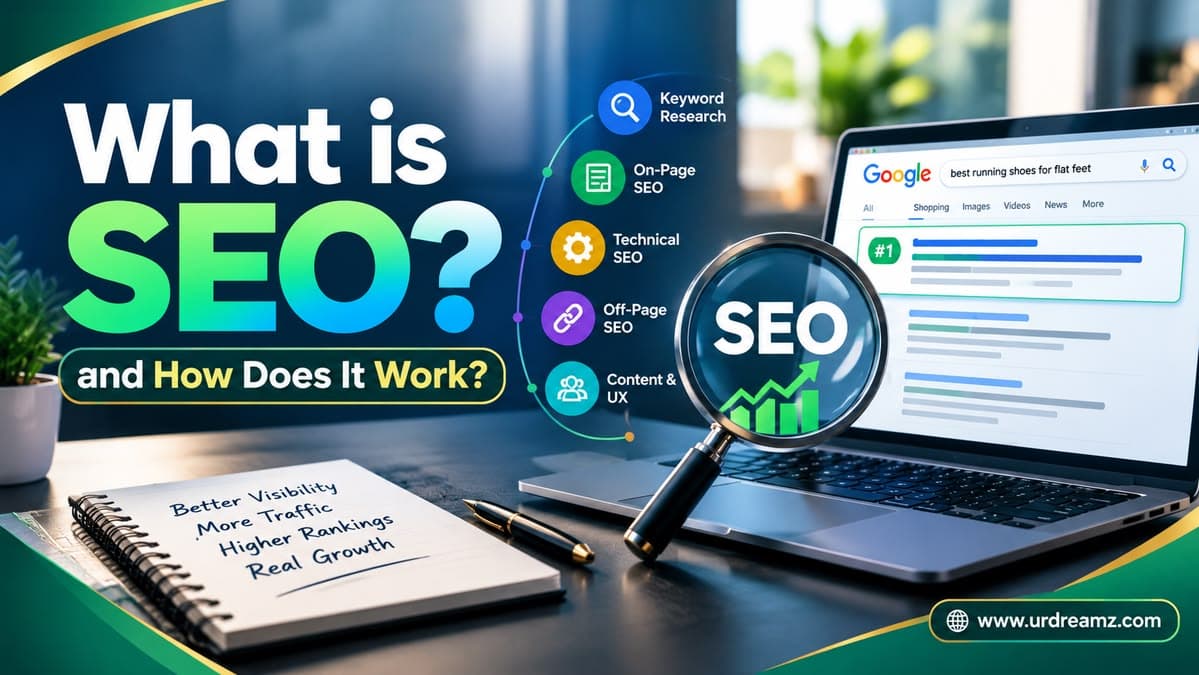
When you type "best running shoes for flat feet" into Google, you get a page of results. SEO is the work behind the pages that appear near the top. It is not magic and it is not a trick. It is a mix of useful content, clean website setup and trust.
If you ever wondered what people mean by "SEO basics meaning" or "what does SEO basics mean", here is the one-line answer: SEO basics are the core habits that make your content easy for search engines to understand and easy for people to enjoy. That includes picking the right topics, writing helpful pages, keeping your site fast and tidy, and earning links from other sites.
You will also see the phrase "SEO 101" online. That is just a friendly way of saying "the beginner class", the same way a college course called "Economics 101" is the first one you take.
Why Do Search Engines Need SEO at All?
A search engine has one job: show the best possible answer first. But it cannot read your mind or "see" your page the way you do. It reads code and text, follows links, and uses signals to guess which page is most helpful.
SEO is how you give those signals clearly. Think of it as translating your page into a language the search engine understands, while keeping it lovely for humans. If you want the full behind-the-scenes story, read our guide on how SEO works: crawling, indexing and ranking.
The 5 Components of SEO
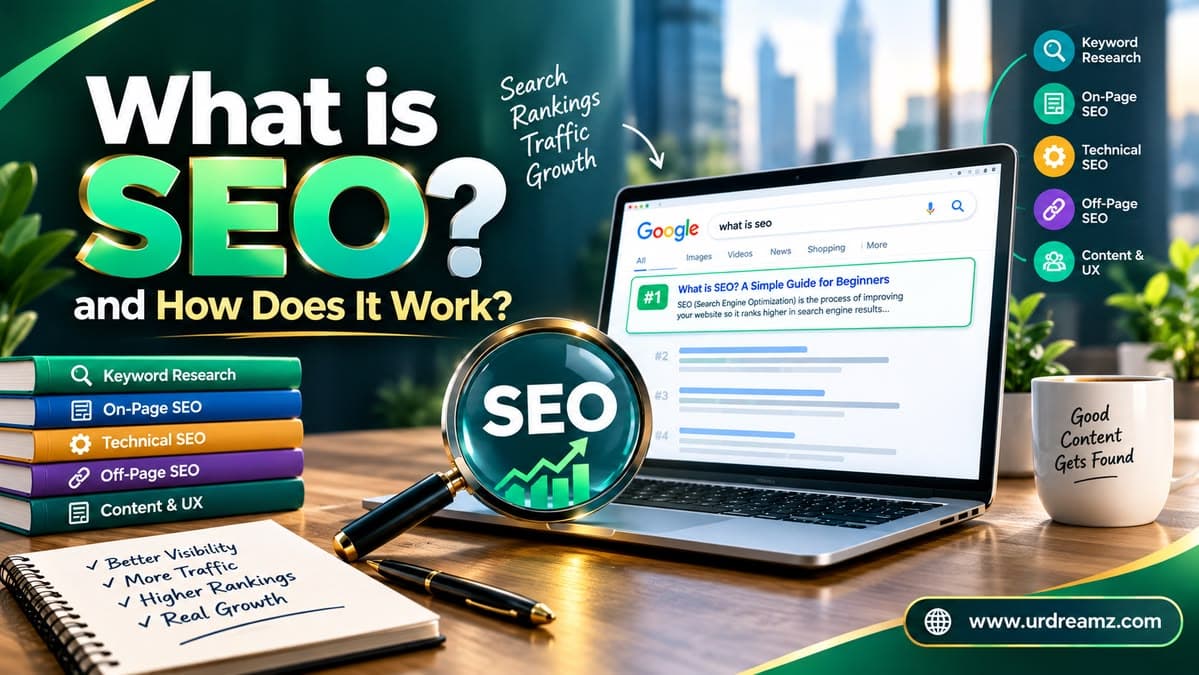
People ask "what are the 5 components of SEO?" all the time. Different experts group things slightly differently, but this is the most useful way to remember them:
1. Keyword research and search intent. Keywords are the words people type. Research tells you what they want and how they phrase it. Search intent is the "why" behind the search: do they want to learn, compare, buy or find a place?
2. On-page SEO. Everything you control on the page: the title, headings, content, images, internal links and the short description shown in results.
3. Technical SEO. The engine room: site speed, mobile friendliness, secure HTTPS, a sitemap, clean URLs and making sure search engines can crawl and index your pages.
4. Off-page SEO. Mostly backlinks, which are links from other websites to yours. Each good link works like a vote of trust. Brand mentions and reputation count too.
5. Content (and user experience). Helpful, original, easy-to-read pages that fully answer a question. Layout, readability and loading time are part of the experience.
A simple way to remember: Find the words, write the page, fix the engine, earn the trust, keep readers happy.
How Many Types of SEO Are There?
The common answer is four main types: on-page SEO (what you do on your pages), off-page SEO (what happens outside your site, mostly links and mentions), technical SEO (how well your site works behind the scenes), and local SEO (helping nearby customers find a physical or service-area business).
Many guides add content SEO as a fifth area because content is so important that it deserves its own box. You will also hear names like ecommerce SEO, YouTube SEO, mobile SEO and international SEO. These are not new "types" so much as the same ideas applied to a specific place or platform.
If you only remember one comparison: on-page is what you say, off-page is what others say about you. You need both. A great page that nobody links to grows slowly, and a heavily linked page with poor content does not stay on top.
What Are SEO Keywords?
SEO keywords are the words and phrases people type or speak into a search engine, and that you naturally use in your content so the right people can find you. Examples include "what is SEO", "how to start a food blog", "best budget laptop for students" and "plumber near me".
There are three handy groups: short keywords (head terms) like "SEO", with huge volume and huge competition; long-tail keywords like "how to learn SEO for free as a beginner", with lower volume, much easier to win, and a visitor who knows exactly what they want; and question keywords like "is SEO difficult to learn?", perfect for blog posts and FAQ sections.
A quick note that confuses beginners: there used to be a "meta keywords" tag where site owners listed keywords in the page code. Google has said for years that it does not use it for ranking, so do not waste time on it. We cover why in our guide on white hat vs black hat SEO.
Where should keywords go? Use your main keyword naturally in the title, the first paragraph, one or two headings, the URL and the image alt text. Then write like a human. If a sentence sounds strange when you read it aloud, you have stuffed too many keywords into it.
A Real SEO Example (Step by Step)
Let's say Ayesha runs a small blog about home baking and wants to rank for "how to make soft cupcakes". Before SEO, her post is titled "My Sunday Baking" and has three photos and one paragraph. Google has no idea it is about soft cupcakes.
After SEO: she finds that people also search "why are my cupcakes dry" and "cupcakes without oven"; she renames the post "How to Make Soft Cupcakes (Even Without an Oven)"; she adds clear headings for ingredients, steps, common mistakes, and a short FAQ; she compresses her photos so the page loads fast on a phone and writes alt text like "soft vanilla cupcakes cooling on a rack"; she links to her own "baking tips" post and asks a local food page to link to her recipe; and she submits her sitemap to Google Search Console and watches clicks grow.
Nothing in that list is sneaky. It is simply making a good page easier to find. That is a perfect SEO example for beginners: helpful content + clear signals + patience.
What Is "Poor SEO"?
Poor SEO means a page or site that is hard for search engines to understand or not useful to readers. Typical signs include titles like "Home" or "Untitled" on every page, very short, copied or "thin" content, keywords stuffed into every sentence, slow, broken or hard-to-use mobile pages, pages blocked from search by mistake (a "noindex" tag left on), no internal links, no useful structure, and buying cheap links or using tricks that risk a penalty.
Poor SEO does not just mean low rankings. It means missed customers. The good news: almost every one of these problems is fixable, and we list the most common ones with fixes in SEO mistakes to avoid.
Is SEO Free? Can SEO Be Organic?
This is where people get confused, so let's separate three ideas. Organic means the traffic comes from unpaid search results, not ads. SEO is the way you earn organic traffic, so yes, SEO is organic by definition. Free? You do not pay Google for each click from organic results, but SEO is not "zero cost". It costs your time, and often money for tools, a writer, a designer or a helper. Instant? No. Ads can bring visitors tomorrow. SEO is slower, but good pages can keep working for years without paying per click.
So the honest answer to "is SEO free?" is: free of click fees, not free of effort. You can start with free tools like Google Search Console and a notebook full of ideas, and spend money later only if it saves time.
SEO Compared with Other Marketing
You will bump into words like SEM, ads and social media. If SEO feels similar to them, here is the short version: SEO earns unpaid results, SEM includes paid search ads too, and social media is about people you already reach through a feed. Our comparison SEO vs SEM shows when to pick which.
Are the SEO Basics Different in 2026 (Compared with 2023, 2024 or 2025)?
The fundamentals are the same: helpful content, clear structure, a healthy site and trust. What changes each year is the surroundings: new Google updates, more AI answers in results and new tools. So if you find an older "SEO basics 2023" or "SEO basics 2024" guide, its core lessons still hold, but check anything about tools, features and AI against a recent source.
Common Beginner Myths About What SEO Is
"SEO is tricking Google." No. Modern SEO is about being genuinely useful and clear. "I must stuff keywords." No. Write for people first. "SEO is a one-time job." No. Search habits, competitors and Google itself keep changing. "Only big websites can rank." No. Small, focused sites win with specific topics and honest answers. "SEO needs coding." Not for the basics. A little HTML helps later, but you can learn it step by step.
Your First 7-Day SEO Starter Plan
Day 1: Write down what your site is about and who it helps. Day 2: List 10 questions your audience asks. Day 3: Set up Google Search Console and Google Analytics. Day 4: Fix your titles and short descriptions on your top 5 pages. Day 5: Write or improve one article that fully answers one question. Day 6: Add internal links between related pages. Day 7: Check your site on mobile and speed up anything slow.
Done every week, this habit alone puts you ahead of many beginners. When you are ready for more, follow the complete SEO basics guide and checklist.
Final Thoughts
SEO is simply the craft of being easy to find and worth finding. Learn the five components, understand the types, choose keywords that match real questions and keep improving a little every week. That is all "SEO basics" really means.