Top Places to Visit in the USA: Complete Travel Guide to America's Best Tourist Destinations
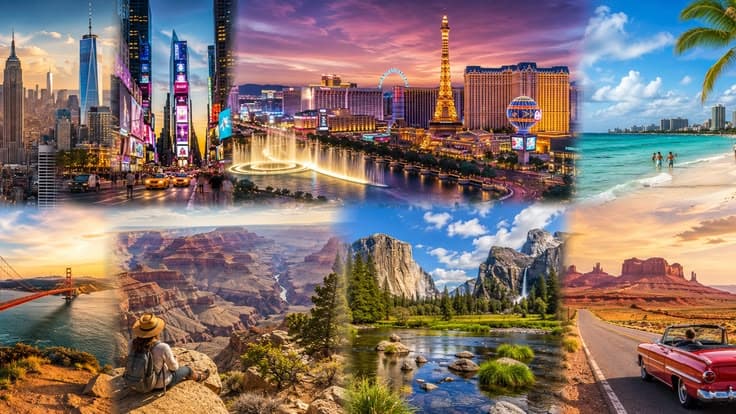
America is not just one destination — it is an entire world contained within a single country. From the neon-lit skyline of New York City to the silence of the Grand Canyon at sunrise, from the volcanic beaches of Hawaii to the jazz-filled streets of New Orleans, the United States offers a staggering range of experiences that no other country can match. This complete guide covers everything you need to plan your perfect American journey.
Why the USA Should Be on Every Traveler's List
The United States spans nearly 10 million square kilometers across 50 diverse states, making it one of the most geographically and culturally varied countries on earth. You can ski fresh powder in the Rocky Mountains in the morning and watch the sunset over a Pacific beach the same evening. You can walk through neighborhoods where four different languages are spoken within a single block, or drive for hours in the American Southwest and see nothing but perfect silence and red rock formations stretching to the horizon.
In 2026, America continues to rank among the world's most visited travel destinations. U.S. News & World Report lists New York City, Washington D.C., and Honolulu among the best cities to visit globally. Tripadvisor's Travelers Choice Awards regularly feature American landmarks like Central Park, the 9/11 Memorial, and national parks in their worldwide top attractions.
Whether you are planning your first visit or your fifteenth, this guide organizes America's best into clear regions and categories so you can find exactly the experience you are looking for.
| Category | Top Pick | Best For | Best Time to Visit |
|---|---|---|---|
| Iconic City | New York City, New York | Culture, museums, Broadway, food | April to June, September to November |
| Natural Wonder | Grand Canyon, Arizona | Hiking, photography, helicopter tours | March to May, September to November |
| Beach Destination | Maui, Hawaii | Swimming, snorkeling, relaxation | April to May, September to November |
| National Park | Yellowstone, Wyoming | Wildlife, geysers, nature photography | May to September |
| Entertainment Capital | Las Vegas, Nevada | Casinos, shows, dining, day trips | March to May, September to November |
| Family Destination | Orlando, Florida | Theme parks, family fun | January to April, September to November |
| Road Trip Route | Pacific Coast Highway, California | Scenic driving, coastal stops | September to October |
| Cultural Melting Pot | New Orleans, Louisiana | Food, jazz, history, festivals | February to May |
The East Coast — History, Culture and Urban Energy
America's East Coast is where the country's story began, and the region remains one of the most densely packed with iconic landmarks, world-class museums, and vibrant city life. From the sprawling five boroughs of New York to the magnolia-lined streets of Charleston, the East Coast rewards both the cultural traveler and the history enthusiast.
New York City, New York
No conversation about visiting America begins anywhere other than New York. The city is simultaneously everything you have heard and far more than any description can capture. Manhattan alone contains dozens of neighborhoods, each with its own identity — the art galleries and boutiques of Chelsea, the literary cafes of the West Village, the towering skyscrapers of Midtown, the immigrant food cultures of Flushing and Jackson Heights in Queens.
The Statue of Liberty and Ellis Island tell the story of millions of immigrants who passed through American shores. Central Park provides 843 acres of green escape in the middle of one of earth's most intense cities. The 9/11 Memorial and Museum stands as a profound site of remembrance. Broadway remains the global gold standard for live theatrical performance.
For first-time visitors, the subway system is one of the best ways to navigate the city — it runs 24 hours a day and reaches every major attraction. The New York CityPass saves significant money on entry to top museums and landmarks.
Washington D.C. — The Nation's Capital
Washington D.C. is one of the most walkable and budget-friendly major cities in America because virtually all of its most celebrated attractions are completely free to enter. The Smithsonian Institution operates 19 museums and galleries along the National Mall, covering everything from air and space to American history to natural history to African American culture.
The National Mall itself is a two-mile stretch of open parkland connecting the Lincoln Memorial at one end to the Capitol Building at the other, with the Washington Monument rising from the center. Walking this route at dawn or dusk, when the reflecting pool mirrors the sky, is one of the genuinely moving experiences in American travel.
Charleston, South Carolina
Charleston is arguably the most charming city on the East Coast for travelers who want something slower than New York but richer in history and character than most alternatives. The historic district is the largest in the United States, featuring over 1,400 historic buildings. The streets lined with antebellum mansions, church steeples, and flowering gardens create an atmosphere unlike anywhere else in America.
The food scene in Charleston is exceptional — the lowcountry cuisine combining African, Caribbean, and European influences into dishes like shrimp and grits, she-crab soup, and Frogmore stew. The city's dark history as the largest slave trading port in America is an important and honestly presented part of any visit here.
| City | State | Must-See Attraction | Best Known For | Avg. Days Needed |
|---|---|---|---|---|
| New York City | New York | Statue of Liberty, Central Park, Broadway | Culture, food, skyline, arts | 4 to 7 days |
| Washington D.C. | District of Columbia | National Mall, Smithsonian Museums | History, politics, free museums | 3 to 4 days |
| Boston | Massachusetts | Freedom Trail, Fenway Park | American Revolution history, universities | 2 to 3 days |
| Charleston | South Carolina | Historic District, Rainbow Row | Southern charm, architecture, food | 2 to 3 days |
| Miami | Florida | South Beach, Art Deco District, Little Havana | Beaches, nightlife, Latin culture | 3 to 4 days |
The American South — Music, Food and Unforgettable Character
The American South is one of the most misunderstood and underrated regions for international travelers. The food alone — smoky barbecue, crispy fried chicken, buttery biscuits, gumbo, jambalaya — justifies the visit entirely. Add to this the birthplace of jazz, blues, country music, and rock and roll, and you have a region of genuinely unique cultural depth.
New Orleans, Louisiana
New Orleans is unlike any other American city, and most visitors find it unlike any other city they have been to anywhere in the world. Three hundred years of French, Spanish, African, and Caribbean cultural collision has produced something entirely its own: a distinct cuisine, a distinct music, a distinct architecture, and a distinct attitude toward life.
The French Quarter is the historic core, packed with ornate ironwork balconies, open-air bars, and live music spilling out onto every corner. Frenchmen Street in the Marigny neighborhood is where serious jazz lovers go — smaller venues, local musicians, and none of the tourist excess of Bourbon Street. The Garden District showcases the city's antebellum mansions surrounded by oak trees dripping with Spanish moss.
The food scene centers on Creole and Cajun traditions. Dishes like crawfish étouffée, red beans and rice, beignets at Café Du Monde, and po'boy sandwiches are as much a part of experiencing New Orleans as any museum or monument.
Nashville, Tennessee
Nashville has transformed in recent years from a regional country music hub into one of America's fastest-growing and most visited cities. The Grand Ole Opry remains the most famous country music stage in the world. Broadway — Nashville's version — is a street of honky-tonk bars where live music plays continuously from noon until the early morning hours.
Beyond music, Nashville has developed a food and creative culture that rival cities three times its size. The hot chicken sandwich, invented here, has become a national food phenomenon. The Gulch neighborhood and East Nashville offer independent restaurants, coffee shops, and boutiques that attract a younger creative crowd.
America's Natural Wonders and National Parks
The National Park System is arguably America's greatest civic achievement. Established in 1872 with Yellowstone as the first national park in the world, the system now protects 63 national parks covering over 84 million acres. These parks protect some of the most spectacular landscapes on earth — landscapes that in other countries would be built over, mined, or developed. In America, they are free for anyone to visit with a basic entry pass.
Grand Canyon, Arizona
There are natural wonders in the world that photographs cannot adequately prepare you for, where the actual scale of what you are seeing defeats comprehension until you are standing in front of it. The Grand Canyon is the preeminent American example of this phenomenon. It is 277 miles long, up to 18 miles wide, and over a mile deep — carved over millions of years by the Colorado River through layers of rock that record two billion years of geological history.
The South Rim is accessible year-round and provides the classic viewpoint experience. The North Rim is open only from mid-May to mid-October and offers a more remote experience with fewer crowds. Serious hikers attempt the Bright Angel Trail or the South Kaibab Trail to descend into the canyon — but rangers warn repeatedly against attempting to hike to the river and back in a single day, as heat and exhaustion have claimed lives.
Yellowstone National Park, Wyoming
Yellowstone was the world's first national park, established in 1872, and it remains one of the most astonishing places on the planet. The entire park sits atop one of the world's largest active volcanic systems, which explains its extraordinary concentration of geothermal features — more than half of the world's geysers, hot springs, mudpots, and fumaroles are found here.
Old Faithful erupts approximately every 90 minutes and has done so reliably for over a century. The Grand Prismatic Spring is the largest hot spring in the United States and one of the most photographed natural features in America — a 370-foot-wide pool of electric blue water surrounded by rings of orange, yellow, and brown bacteria creating a rainbow effect visible from the air.
Yellowstone also supports the largest intact temperate ecosystem remaining in the Northern Hemisphere. Bison herds of hundreds of animals are commonly seen from the road. Bears, wolves, elk, and pronghorn are regularly spotted by patient visitors. The Lamar Valley in the northeastern section of the park is considered the best wildlife viewing area in North America.
Yosemite National Park, California
Yosemite sits in the Sierra Nevada mountains of California and is famous for its dramatic granite geology — sheer walls of rock rising thousands of feet from the valley floor. El Capitan, a 3,000-foot vertical granite monolith, is the world's most celebrated rock climbing destination and has been made famous globally by documentary films about the climbers who attempt its faces. Half Dome, the split granite peak visible from nearly everywhere in Yosemite Valley, is one of the most recognizable mountain silhouettes in the world.
Yosemite Falls drops 2,425 feet and is the tallest waterfall in North America. The ancient giant sequoias in Mariposa Grove are among the largest living organisms on earth. The problem with Yosemite is its extraordinary popularity — the park now requires advance timed-entry permits during peak season, so planning well ahead is essential.
| National Park | State | Signature Feature | Most Popular Activity | Annual Visitors | Entry Fee |
|---|---|---|---|---|---|
| Great Smoky Mountains | Tennessee / North Carolina | Misty forested mountain ridges | Scenic drives, hiking, wildlife | 12+ million (most visited) | Free |
| Grand Canyon | Arizona | 1-mile deep Colorado River gorge | Rim walks, hiking, helicopter tours | 6+ million | $35 per vehicle |
| Yellowstone | Wyoming / Montana | Old Faithful, Grand Prismatic Spring | Geyser viewing, wildlife watching | 4+ million | $35 per vehicle |
| Zion | Utah | Towering sandstone canyon walls | The Narrows, Angels Landing hike | 4+ million | $35 per vehicle |
| Yosemite | California | El Capitan, Half Dome, waterfalls | Rock climbing, hiking, photography | 3.5+ million | $35 per vehicle |
| Glacier | Montana | Going-to-the-Sun Road, glacial lakes | Scenic drives, hiking | 3+ million | $35 per vehicle |
| Grand Teton | Wyoming | Jagged alpine peaks above Jackson Hole | Wildlife viewing, hiking, photography | 3+ million | $35 per vehicle |
Zion National Park, Utah
Zion is a canyon carved by the Virgin River through layers of cream, pink, and red Navajo sandstone. The walls rise 2,000 feet above the canyon floor, creating an enclosed, cathedral-like atmosphere that makes the space feel both intimate and overwhelming. The Narrows hike takes you directly into the river as it flows through a slot canyon only 20 feet wide in places — one of the most distinctive hikes in all of American outdoor recreation. Angels Landing is a strenuous but exhilarating ridge hike that ends on a rocky summit with 270-degree views of the canyon — but sections require holding chains bolted into the rock face, and the trail is not for those uncomfortable with heights.
Glacier National Park, Montana
Glacier is considered by many experienced national park visitors to be the most beautiful park in America. The Going-to-the-Sun Road is a 50-mile scenic highway that crosses the Continental Divide at Logan Pass and provides views of glacial lakes, mountain peaks, and alpine meadows that are difficult to describe without sounding hyperbolic. The park is called Glacier for its historic glaciers, though their retreat due to climate change means the landscape is genuinely changing and visitors in 2026 are seeing something different from what visitors saw 30 years ago.
The West Coast — California, Oregon and the Pacific
The American West Coast runs from the Mexican border near San Diego in the south all the way to the Canadian border in Washington state — a stretch of coastline containing some of the most diverse and spectacular scenery in the Western Hemisphere. California alone contains 9 national parks, multiple world-class cities, and hundreds of miles of Pacific coastline.
San Francisco, California
San Francisco occupies one of the most dramatic urban settings in America — a city of hills and water, where neighborhoods tumble down steep slopes to meet the bay. The Golden Gate Bridge is the city's signature icon, a 4,200-foot suspension span painted in International Orange that has become one of the most photographed structures in the world. Walking or cycling across it provides views of the bay, the Marin Headlands, and the city that are genuinely spectacular.
Alcatraz Island sits in the middle of the bay and operated as a maximum-security federal penitentiary from 1934 to 1963 — its inmates included Al Capone and the Birdman of Alcatraz. The audio tour narrated by former guards and prisoners is consistently rated one of the best museum experiences in the United States. Tickets sell out weeks in advance in peak season.
The city's neighborhoods each have a distinct character: Chinatown is the oldest in North America, the Mission District is the heart of the city's Latin American community, the Castro pioneered LGBTQ+ rights in America, and the Haight-Ashbury neighborhood is preserved as a living memorial to the 1960s counterculture movement.
Los Angeles, California
Los Angeles is a city that runs on dreams — the dream of movie stardom, the dream of perfect weather, the dream of reinvention. The entertainment industry is fully embedded in the city's DNA, from the Hollywood Walk of Fame to the back-lot studio tours at Warner Brothers and Universal that reveal the actual mechanics behind the films and television that the rest of the world watches.
The Griffith Observatory offers the best free view of the Los Angeles basin, the Pacific Ocean, and on clear days, Santa Catalina Island offshore. Santa Monica Beach provides the quintessential California coastal experience — the pier, the Pacific, the mountains behind. The Getty Center museum sits on a hilltop and is free to visit, housing one of the most impressive art collections in the western United States.
The Pacific Coast Highway — California's Greatest Drive
Highway 1, known as the Pacific Coast Highway, is one of the great road trips of the world. The most celebrated section runs from San Francisco south to Los Angeles, passing through some of the most dramatic coastal scenery in North America.
The town of Carmel-by-the-Sea is a pocket of European-style architecture and galleries with no chain restaurants and an ordinance against wearing high heels without a permit — a deliberate effort to preserve the town's charm. Big Sur is the highlight of the drive — a stretch of coastline where the Santa Lucia Mountains plunge directly into the Pacific, with no development between the mountains and the sea. Bixby Creek Bridge is among the most photographed structures on the route. McWay Falls drops directly onto a pristine beach accessible only by view from the road.
The American Southwest — Desert, Rock and Open Skies
The American Southwest — primarily Arizona, Utah, Nevada, and New Mexico — contains a concentration of geological wonders unmatched anywhere in the world. Ancient sea floors have been exposed by millions of years of erosion to reveal a landscape of red rock arches, slot canyons, hoodoos, mesas, and buttes that appear almost too dramatic to be real.
Las Vegas, Nevada
Las Vegas is one of the most visited cities in the United States and one of the most purely entertaining places on earth if you approach it with the right mindset. The Strip — approximately 4.2 miles of Las Vegas Boulevard South — is lined with resort hotels, each one more architecturally extravagant than the last. The Bellagio fountains alone draw crowds at all hours. The Sphere, opened in 2023, is a 580-foot-wide spherical entertainment venue covered in 1.2 million LED lights that has become the most talked-about new structure in American architecture.
Las Vegas is also an outstanding base for day trips into some of the most spectacular landscapes in America. The Grand Canyon's South Rim is approximately 4.5 hours away. Red Rock Canyon National Conservation Area is 17 miles west of the Strip and provides a completely different desert experience from the artificial world of the casinos. Valley of Fire State Park offers sandstone formations in shades of orange, red, and purple that are extraordinary for photography.
Sedona, Arizona
Sedona is built among red sandstone buttes and mesas that glow in colors ranging from deep red to pure orange at sunrise and sunset. The Cathedral Rock reflection in Oak Creek is perhaps the most reproduced photograph from Arizona. Sedona has also developed a reputation as a wellness destination, with spas and retreats drawing visitors seeking something different from the typical tourist experience. The hiking trails are genuinely excellent — Chapel of the Holy Cross, built directly into the red rock, is one of the most dramatic religious buildings in the United States.
| From | To | Distance | Drive Time | Must Stop |
|---|---|---|---|---|
| Las Vegas | Grand Canyon South Rim | 280 miles | 4.5 hours | Hoover Dam, Route 66 town of Kingman |
| Las Vegas | Zion National Park | 160 miles | 2.5 hours | Red Rock Canyon day stop |
| Zion NP | Bryce Canyon NP | 85 miles | 1.5 hours | Dixie National Forest scenic route |
| Phoenix | Sedona | 115 miles | 2 hours | Highway 89A scenic route through Verde Valley |
| Salt Lake City | Arches National Park | 235 miles | 3.5 hours | Price Canyon, San Rafael Swell |
Hawaii — America's Island Paradise
Hawaii is the only state in the United States located in the Pacific Ocean, and it is among the most extraordinary natural environments anywhere on earth. The eight main Hawaiian islands were formed by volcanic activity over the hotspot that still powers active eruptions on the Big Island today. Each island has its own distinct character, and experienced Hawaiian travelers recommend choosing two or three islands for a two-week visit rather than trying to see all of them.
Oahu — The Gathering Place
Oahu is where most first-time visitors to Hawaii land, and Honolulu and the Waikiki district provide the most developed tourist infrastructure in the islands. Diamond Head State Monument is a dormant volcanic crater rising 760 feet above sea level — the hike to the rim provides panoramic views of Waikiki, the Pacific, and the Koolau Mountains. The Pearl Harbor National Memorial preserves the sites of the 1941 attack that brought the United States into World War II, including the USS Arizona Memorial — a haunting, beautiful structure built directly over the sunken battleship.
Maui — The Valley Isle
Maui is widely considered the most complete Hawaiian island experience for first-time visitors — a combination of exceptional beaches, dramatic geography, excellent whale watching from December to April, and the Road to Hana. That 64-mile highway curves around the northeastern coast of Maui through dense rainforest, past 54 bridges and 600 curves, to some of the most remote and beautiful coastal scenery in the islands — including the black sand beach at Wai'anapanapa State Park and the bamboo forest leading to the pools at Oheo Gulch.
Haleakala National Park contains a massive dormant volcanic crater that rises 10,023 feet above sea level. Watching the sunrise from the summit is one of the most popular and genuinely moving experiences in all of Hawaiian travel — but it requires arriving before dawn, dressing in warm layers (temperatures at the summit can be near freezing), and booking a timed-entry permit well in advance.
Kauai — The Garden Isle
Kauai is the oldest of the main Hawaiian islands and the most dramatically lush, receiving abundant rainfall that has carved deep valleys and fed the waterfall-covered cliffs of the Na Pali Coast. The Na Pali Coast is inaccessible by road — the 17-mile stretch of 3,000-foot sea cliffs can only be experienced by boat tour, helicopter, or the strenuous 11-mile Kalalau Trail. Waimea Canyon, 14 miles long and over 3,600 feet deep, earns its description as the Grand Canyon of the Pacific with its similar color palette of reds, purples, and greens.
| Island | Nickname | Best For | Must-See | Vibe |
|---|---|---|---|---|
| Oahu | The Gathering Place | History, beaches, nightlife, accessibility | Pearl Harbor, Diamond Head, North Shore | Urban + tropical |
| Maui | The Valley Isle | Beaches, whale watching, Road to Hana | Haleakala sunrise, Wai'anapanapa beach | Romantic, scenic, complete |
| Kauai | The Garden Isle | Hiking, dramatic scenery, Na Pali Coast | Na Pali Coast, Waimea Canyon | Wild, lush, remote |
| Big Island | The Orchid Isle | Volcanoes, diverse landscapes, stargazing | Hawaii Volcanoes NP, Mauna Kea | Adventurous, geological wonder |
| Molokai | The Friendly Isle | Authentic Hawaiian culture, sea cliffs | Kalaupapa National Historical Park | Quiet, authentic, off the beaten path |
Florida — Sunshine, Theme Parks and Pristine Beaches
Florida is the third most populous state in America and one of its most visited, drawing travelers with a combination of warm year-round weather, pristine Gulf Coast beaches, world-famous theme parks, and the unique natural environment of the Everglades. The state is so long and climatically diverse that the panhandle in the north is effectively a different experience from the tropical Keys at the southern tip.
Orlando — Theme Park Capital of the World
No city on earth has built its tourism infrastructure around family entertainment more completely than Orlando. Walt Disney World alone covers 47 square miles — roughly the size of San Francisco — and contains four major theme parks, two water parks, a shopping and entertainment district, and nearly 30 resort hotels. Universal Orlando Resort has established itself as a serious competitor, particularly for older children and adults, with the Wizarding World of Harry Potter providing an immersive experience that remains one of the most ambitious theme park achievements ever built.
Miami — Energy, Art and Culture
Miami is one of the most culturally distinctive cities in the United States, shaped primarily by decades of Cuban immigration that has given the city its bilingual character and extraordinary food culture. Little Havana preserves the history and traditions of Cuban exile communities, and Calle Ocho on the last Friday of each month becomes one of the largest outdoor street parties in the country.
South Beach is the world-famous stretch of Art Deco architecture and white sand that forms the most photographed neighborhood in Miami. The Art Deco Historic District contains the largest concentration of 1930s resort architecture in the world, carefully preserved and painted in the pastel palette that has become the visual shorthand for Miami everywhere.
Wynwood is the city's arts district, where once-derelict warehouses have been transformed into a permanent outdoor gallery — the Wynwood Walls — covered in large-scale murals by some of the world's leading street artists. The neighborhood has since expanded into galleries, restaurants, and boutiques that make it one of the most interesting areas in Miami for visitors beyond the beach.
The Florida Keys and the Everglades
The Florida Keys are a chain of islands connected by the Overseas Highway — a 113-mile drive over 42 bridges that is one of the most cinematic road experiences in the continental United States. Key West at the end of the chain is a subtropical island city with a creative, bohemian culture influenced by its history as a home to Ernest Hemingway and Tennessee Williams.
The Everglades National Park protects the largest subtropical wilderness in the United States — a slow-moving river of grass 60 miles wide and 100 miles long. Airboat tours through the wetlands provide encounters with American alligators, roseate spoonbills, manatees, and dozens of species of wading birds in their natural habitat.
The Best Beaches in the United States
America's coastline extends approximately 95,000 miles when including all tidal inlets and bays, giving the country an extraordinary range of beach experiences — from the turquoise, calm waters of the Gulf of Mexico to the powerful Pacific surf, from the rocky Atlantic shores of New England to the volcanic black sand beaches of Hawaii.
| Beach | Location | Water Temperature | Best For | What Makes It Special |
|---|---|---|---|---|
| Poipu Beach | Kauai, Hawaii | Warm year-round | Swimming, snorkeling, wildlife | Ranked #1 by Dr. Beach; monk seals rest here |
| Siesta Beach | Siesta Key, Florida | Warm (Gulf Coast) | Families, swimming, walking | 99% pure quartz sand that stays cool underfoot |
| Lanikai Beach | Oahu, Hawaii | Warm year-round | Swimming, kayaking, photography | Powdery white sand, twin offshore islands view |
| Clearwater Beach | Clearwater, Florida | Warm (Gulf Coast) | Families, wide sand, accessibility | Consistently ranked among top US beaches for families |
| Cannon Beach | Oregon | Cold (Pacific) | Photography, walking, tide pools | Iconic Haystack Rock, dramatic misty scenery |
| La Jolla Cove | San Diego, California | Cool to mild | Snorkeling, wildlife, kayaking | Marine protected area; sea lions and seals rest here |
| South Beach | Miami, Florida | Warm (Atlantic) | Scene, people-watching, nightlife | Art Deco backdrop, iconic cultural significance |
Essential USA Travel Tips — Practical Advice Before You Go
America is large, complex, and full of regional variation that can surprise even experienced international travelers. Understanding a few key practical realities before you arrive makes the experience dramatically smoother.
Entry Requirements
Citizens of countries in the Visa Waiver Program — including the UK, Australia, most of Western Europe, Japan, South Korea, and several others — can enter the United States for up to 90 days without a visa, but must obtain an approved ESTA (Electronic System for Travel Authorization) online at least 72 hours before departure. The ESTA costs 21 US dollars and remains valid for two years once approved. Citizens of countries not in the Visa Waiver Program must apply for a B-2 Tourist Visa at the nearest American embassy or consulate, which involves completing the DS-160 form and attending an in-person interview.
Money and Tipping Culture
The American tipping system is one of the most significant cultural differences for international visitors. In restaurants, a tip of 18 to 20 percent of the pre-tax bill is standard and genuinely expected — servers in most American states earn a base hourly wage as low as $2.13 per hour, with tips forming the bulk of their income. Similar expectations apply to bartenders, taxi drivers, rideshare drivers, hotel porters, and hair stylists. Not tipping is considered a significant social offense in most situations.
Prices displayed in American stores, restaurants, and hotels are almost never the final price you pay — sales tax ranging from 0 to 10 percent depending on the state is added at the point of purchase. Hotel rooms often carry additional resort fees, destination fees, and local tourism taxes that can add 20 to 35 percent to the displayed room rate.
Transportation Around the Country
The United States is designed around the automobile. Outside of New York City, Boston, Chicago, Washington D.C., and San Francisco, public transportation is limited and often impractical for tourists. Renting a car is strongly recommended for exploring California, the Southwest, Florida outside Miami, and any national park. You will need an international driving permit if your license is not in English. American roads drive on the right side, and most rental cars are automatic transmission.
For travel between cities, domestic flights are the most practical option given the country's size. Budget airlines like Southwest and Spirit operate alongside major carriers and can provide very affordable fares if booked well in advance. Amtrak operates a national rail network, but schedules and punctuality vary significantly by route.
| Category | Details | Important Notes |
|---|---|---|
| Visa (Visa Waiver Countries) | ESTA required — apply online 72+ hours before departure | Costs $21, valid 2 years, maximum stay 90 days |
| Visa (Other Countries) | B-2 Tourist Visa via US Embassy interview | DS-160 form, interview appointment, processing time varies |
| Currency | US Dollar (USD) | Cards accepted nearly everywhere; carry $50-100 cash for markets |
| Tipping | 18-20% at restaurants, $1-2 per drink at bars | Not optional — servers earn very low base wages |
| Sales Tax | 0-10% depending on state, not included in displayed prices | Oregon and New Hampshire have no sales tax |
| Electricity | 120V, Type A and B plugs (2 and 3 prongs) | European, Asian, Middle Eastern visitors need adapter and converter |
| Driving | Right side of road, mostly automatic transmission rentals | International Driving Permit recommended if license not in English |
| Emergency Number | 911 for all emergencies (police, fire, ambulance) | Works from all phones including those without SIM cards |
The Ultimate USA Bucket List — 25 Experiences Not to Miss
These are the experiences that define what makes America worth traveling across the world to see — the moments that stay with visitors for decades after the trip ends.
| # | Experience | Location | Why It's Unforgettable |
|---|---|---|---|
| 1 | Stand on the rim of the Grand Canyon at sunrise | Arizona | The scale defeats comprehension — photographs do not prepare you |
| 2 | Watch Old Faithful erupt in Yellowstone | Wyoming | A clockwork natural event in the world's first national park |
| 3 | Drive the Pacific Coast Highway through Big Sur | California | Mountains meeting sea in the most dramatic coastal scenery in America |
| 4 | See a Broadway show in Times Square | New York City | The global gold standard for live theatrical performance |
| 5 | Hike the Narrows in Zion National Park | Utah | Walking through a river inside a canyon 20 feet wide and 2,000 feet tall |
| 6 | Watch the Haleakala sunrise above the clouds | Maui, Hawaii | A high-altitude volcanic crater at dawn is one of the most spiritual sights in America |
| 7 | Listen to live jazz on Frenchmen Street | New Orleans, Louisiana | American jazz in its birthplace, in a small venue, performed by masters |
| 8 | Walk across the Golden Gate Bridge | San Francisco, California | One of the greatest engineering achievements of the 20th century, still breathtaking |
| 9 | See the Northern Lights in Alaska | Fairbanks, Alaska | The aurora borealis in its full intensity above one of the least light-polluted places in America |
| 10 | Road trip Route 66 from Chicago to Los Angeles | Multiple states | The original American road trip, historic diners and roadside Americana across 2,400 miles |
Planning Your Perfect USA Trip — Final Advice
The single biggest mistake first-time visitors make in America is trying to see too much of a country this large in too little time. A traveler who spends 10 days trying to see New York, Las Vegas, the Grand Canyon, California, and Hawaii ends up exhausted and unable to truly experience any of them. A traveler who spends 10 days in just New York and Washington D.C. comes home understanding America far more deeply.
Choose a region, go deep into it, and let the place reveal itself. Take the side roads when the main highway runs through something interesting. Eat at the local diner recommended by your hotel receptionist rather than the chain restaurant with familiar branding. Talk to people — Americans are, across the board, genuinely friendly and love explaining what makes their part of the country special.
America rewards curiosity, rewards spontaneity, and rewards the traveler who comes without preconceptions and allows the country to be as complicated and surprising and magnificent as it actually is. The map at the top of this guide shows just a portion of the East Coast — a reminder that even a single coast of this country contains enough to fill a lifetime of travel.
Book your parks passes in advance. Reserve national park campsites and lodges months ahead. Get your ESTA well before departure. And pack comfortable walking shoes — the best of America reveals itself on foot.