The Rise of Solopreneurs: How One Person Businesses Are Changing the Future of Entrepreneurship
Something remarkable is happening in the world of business. Across every continent, a new generation of entrepreneurs is building profitable, scalable companies — completely alone. No co-founders. No employees. No investors demanding equity. Just one person, a laptop, and a growing stack of AI tools that have quietly made the old rules of business obsolete.
These individuals are called solopreneurs, and in 2026, they represent one of the most powerful and fastest-growing forces reshaping entrepreneurship. According to McKinsey, nearly two-thirds of companies have experimented with AI agents — and the solo founders who are adopting these tools earliest are the ones building the most scalable, highest-margin businesses on the planet.
This comprehensive guide covers everything: what a solopreneur is and how the model works, how it differs from traditional entrepreneurship and freelancing, the best business ideas for solo founders in 2026, the AI tools that make it all possible, step-by-step strategies for getting started, how to build passive income, and why the future of business may belong to people who choose to stay small on purpose.
What Is a Solopreneur? Complete Definition and Overview
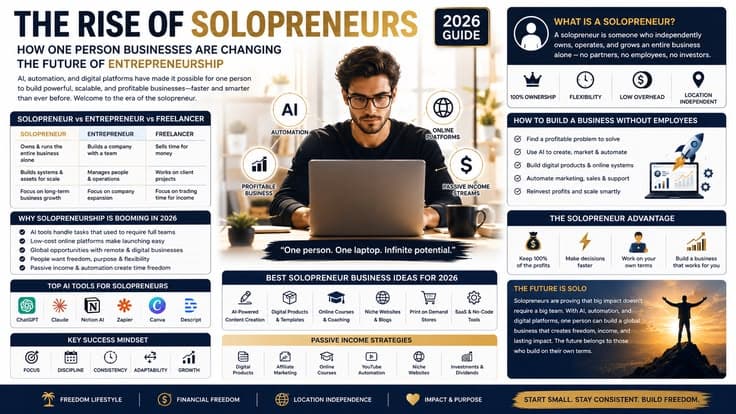
A solopreneur (a combination of the words "solo" and "entrepreneur") is a business owner who independently designs, builds, and operates their entire business without partners, co-founders, or full-time employees. They are both the owner and the entire workforce of their company — handling strategy, operations, marketing, sales, and customer service, typically leveraging technology and AI to scale their output far beyond what a single person could accomplish manually.
According to the U.S. Chamber of Commerce, a solopreneur is "an individual building and running a business on their own without any employees." They handle every aspect of the business, from research and development to sales and marketing. But in 2026, what was once an enormous challenge has become manageable — even advantageous — because of AI.
| Feature | Solopreneur | Traditional Entrepreneur | Freelancer |
|---|---|---|---|
| Business Goal | Sustainable lifestyle income with full control | Aggressive growth, market dominance, exit | Project-based income, trading time for money |
| Team Structure | Solo — uses AI and freelancers for tasks | Builds a full team, departments, hierarchy | Solo — but income stops when work stops |
| Funding Model | Self-funded, bootstrapped, low overhead | Angel investors, VCs, venture debt | No external funding needed |
| Revenue Model | Scalable — digital products, courses, SaaS, affiliates | Revenue from products, services, subscriptions at scale | Hourly or project-based billing |
| Risk Level | Low — minimal overhead, no payroll | High — large payroll, investor obligations | Medium — depends on client flow |
| Income Potential | $50,000 to $2M+ per year for top performers | Unlimited — but requires team and capital | Capped by available hours |
| Equity Retained | 100% | Shared with investors and co-founders | N/A |
| Lifestyle Flexibility | Very High — full schedule control | Low — driven by investor timelines | Medium — client-dependent |
Common examples of solopreneurs include content creators monetizing through sponsorships and digital products, online coaches selling high-ticket courses, independent SEO or digital marketing consultants running retainer-based agencies, micro-SaaS founders who built a single tool and charge recurring subscriptions, and affiliate bloggers earning passive commission income. What unites all of these is the fundamental model: one person, leveraged systems, scalable income.
Why the Solopreneur Model Is Booming in 2026
The solopreneur movement has accelerated dramatically over the past three years, driven by three convergent forces: the maturation of AI tools powerful enough to replace entire departments, the normalization of remote and digital-first work cultures, and a generational shift in how people think about work, ownership, and freedom.
According to Fortune (May 2026), solo founders are using AI agents and coding tools to automate the workflows that would once have required dedicated hires — replacing not just the productivity of those roles but the expertise those positions carried. A solopreneur in 2026 can realistically run operations that would have required 5 to 10 employees just three years ago, at a fraction of the cost.
| Driver | How It Benefits Solopreneurs |
|---|---|
| AI Writing Tools | One person can produce the content output of an entire marketing team |
| No-Code Platforms | Solopreneurs can build apps and SaaS products without hiring developers |
| AI Automation (Zapier, Make) | Routine operations run on autopilot — lead capture, invoicing, follow-ups |
| Global Remote Work Norm | Solopreneurs can serve clients worldwide without a physical office |
| Digital Product Platforms | Gumroad, Teachable, and Shopify allow one person to sell to millions |
| Creator Economy Growth | Audiences monetize directly — no intermediaries needed |
| AI Research Tools | Market research, competitor analysis, and trend spotting done in minutes |
| Affordable Cloud Infrastructure | Enterprise-grade software available for $20 to $100 per month |
Best Solopreneur Business Ideas in 2026
The best solopreneur business ideas in 2026 share three qualities: they require no inventory, they are highly scalable through digital leverage, and they can be automated enough to generate income even when the founder is not actively working. Here are the most profitable models available today:
1. AI Consulting and Implementation
Small and medium businesses are desperate to integrate AI into their operations but lack the technical expertise to do so. A solopreneur who can set up AI workflows, build custom chatbots, implement automated lead-generation systems, and create AI-powered content pipelines can charge $2,000 to $15,000 per client engagement. This is one of the fastest-growing solopreneur niches of 2026 because demand far outstrips supply of qualified practitioners.
2. Specialized Ghostwriting and Content Strategy
Companies and executives are investing heavily in personal branding and thought leadership. A solo ghostwriter who specializes in LinkedIn content for C-suite executives, SEO blog content for SaaS companies, or email newsletter copy for DTC brands can earn $5,000 to $30,000 per month on retainer. AI writing tools dramatically increase output capacity, allowing one person to serve 5 to 10 clients simultaneously.
3. Digital Products and Online Courses
Creating digital assets — ebooks, templates, online courses, AI prompt packs, Notion workspaces — is the purest expression of the solopreneur model. You create the product once and sell it an infinite number of times with zero marginal cost per unit. Platforms like Gumroad, Teachable, and Lemon Squeezy handle delivery and payment processing automatically. A well-positioned digital product in a high-demand niche can generate $3,000 to $50,000 per month in completely passive income.
4. Micro-SaaS
Micro-SaaS refers to lightweight software products that solve a highly specific problem for a defined audience. A single developer — or even a non-developer using no-code tools like Bubble, Lovable, or Cursor — can build and launch a functional web application. The recurring subscription revenue model means income compounds over time as the customer base grows. Successful micro-SaaS businesses regularly generate $4,000 to $40,000 per month with a single founder managing everything.
5. Fractional Executive Services
Startups and small businesses need senior strategic guidance but cannot afford full-time C-suite salaries. A solopreneur with corporate leadership experience can offer Fractional CMO (Chief Marketing Officer), Fractional COO (Chief Operating Officer), or Fractional CFO services — typically at $3,000 to $10,000 per month per client, with the ability to manage three to five clients simultaneously. This is among the highest-earning solopreneur models available.
6. Niche Content Creation and Audience Monetization
YouTube channels, newsletters, podcasts, and niche blogs that build loyal audiences around specific topics can generate income from multiple streams simultaneously — ad revenue, affiliate commissions, sponsorships, and digital product sales. The solopreneur creates content consistently, builds an audience over 12 to 24 months, and then monetizes that attention across multiple channels. Top solopreneur content businesses earn $10,000 to $200,000 per month.
7. Freelance Agency (Service Arbitrage)
A solopreneur can operate what appears to be a full-service agency — handling clients, projects, and deliverables — by outsourcing execution to specialist freelancers on Upwork or Fiverr while managing the client relationship directly. This model allows one person to bill $10,000 to $50,000 per month in agency revenue while personally spending only 20 to 30 hours per week on coordination and strategy.
| Business Model | Startup Cost | Time to First Revenue | Income Potential | Scalability |
|---|---|---|---|---|
| AI Consulting | $500-$2,000 | 2-8 weeks | $5,000-$30,000/month | Medium (time-limited) |
| Ghostwriting and Content | $0-$500 | 1-4 weeks | $3,000-$20,000/month | Medium |
| Digital Products and Courses | $200-$2,000 | 1-3 months | $1,000-$100,000/month | Very High |
| Micro-SaaS | $500-$5,000 | 2-6 months | $2,000-$50,000/month | Very High |
| Fractional Executive | $500-$1,000 | 2-6 weeks | $10,000-$50,000/month | Low-Medium |
| Content Creator / Newsletter | $100-$1,000 | 6-24 months | $500-$200,000/month | Extremely High |
| Freelance Agency | $0-$1,000 | 1-4 weeks | $5,000-$50,000/month | Medium |
How Solopreneurs Make Money: Revenue Models Explained
One-person businesses make money by packaging their unique skills or knowledge into high-margin offers that leverage technology to scale. The key distinction between a solopreneur and a freelancer is the deliberate move away from directly trading time for money toward building systems and assets that generate income independently of active work hours.
Service-Based Revenue
The fastest route to income: sell specialized expertise directly to clients on a project or monthly retainer basis. Because overhead is minimal, profit margins are high — often 80 to 95 percent of revenue. Examples include consulting, coaching, copywriting, web design, and social media management. The limitation is that income is somewhat tied to the founder's available hours, which is why most successful solopreneurs eventually productize their services.
Digital Product Revenue
Create once, sell forever. Digital products — ebooks, templates, courses, software tools, AI prompt packs — are the ultimate solopreneur income vehicle because they have near-zero marginal cost per sale. A Notion template selling for $29 that gets 500 downloads per month generates $14,500 in recurring monthly revenue with no additional work beyond initial creation and marketing.
Subscription and Membership Revenue
Monthly recurring revenue (MRR) is the holy grail of solopreneur business models. Paid newsletters (typically $7 to $49 per month), membership communities ($29 to $299 per month), and SaaS subscriptions ($9 to $499 per month) all generate predictable, compounding monthly income that grows as the customer base grows. A solopreneur with 500 paying newsletter subscribers at $19 per month earns $9,500 monthly with minimal ongoing effort.
Affiliate Marketing Revenue
Recommending products and services through tracking links embedded in content, emails, and social media generates commission income with zero product creation or customer service required. SaaS affiliate programs paying 20 to 40 percent recurring commissions are particularly powerful — refer 100 customers to a $99/month SaaS product at 30 percent commission and earn $2,970 per month indefinitely as long as those customers remain subscribers.
Sponsored Content and Brand Deals
Solopreneurs who build engaged audiences in specific niches attract brand partnerships. A YouTube channel with 50,000 subscribers in the personal finance niche can charge $2,000 to $10,000 per sponsored video. A newsletter with 20,000 subscribers in the AI tools space can command $500 to $3,000 per dedicated sponsor email. As audience size and engagement grow, brand deal rates increase exponentially.
Top AI Tools Every Solopreneur Should Use in 2026
AI is not just a productivity enhancement for solopreneurs — it is the fundamental enabler of the entire model. Without AI, a single person genuinely cannot compete with larger teams. With AI, a single person can execute the work of five to ten people across every function of a business simultaneously. The key is choosing the right tools for each business function rather than adopting every new platform indiscriminately.
| Category | Tool | Primary Function | Cost | Best For |
|---|---|---|---|---|
| Daily Assistant | Claude (Anthropic) | Long-form writing, business strategy, analysis | Free / $20/month Pro | Content, emails, strategy docs |
| Daily Assistant | ChatGPT (OpenAI) | Brainstorming, research, coding assistance | Free / $20/month Plus | General tasks, idea generation |
| Content Creation | Jasper AI | Marketing copy, ad creatives, email sequences | $39/month | High-volume marketing content |
| Design and Visuals | Canva Magic Studio | Graphics, presentations, social media content | Free / $13/month Pro | Non-designers creating professional visuals |
| Research | Perplexity AI | Real-time web research with citations | Free / $20/month Pro | Market research, competitive analysis |
| Operations | Notion AI | Workspace, SOPs, project management, docs | Free / $10/month Plus | Organizing business systems and knowledge |
| Automation | Zapier | Connecting apps and automating workflows | Free / $19/month Starter | Eliminating repetitive manual tasks |
| Meeting Notes | Otter.ai | Transcription and meeting summaries | Free / $10/month Pro | Client calls, interviews, planning sessions |
| Social Media | Buffer AI | Scheduling and AI content suggestions | Free / $6/month Essentials | Consistent social media presence |
| Lead Generation | Apollo.io | Prospect research and email outreach | Free / $49/month | B2B solopreneurs finding clients |
| App Building | Lovable / Cursor | Building web apps from text prompts | $20/month | Micro-SaaS founders without coding skills |
| Scheduling | Calendly | Automated client booking and reminders | Free / $10/month | Eliminating calendar back-and-forth |
How Solopreneurs Use AI Automation in Practice
Content Creation Automation: A solopreneur content creator might use ChatGPT or Claude to outline and draft blog posts, Canva Magic Studio to generate matching graphics, Buffer to automatically schedule and distribute content across five platforms, and Zapier to automatically save published URLs to a content tracking spreadsheet — all with minimal manual intervention.
Lead Generation Automation: A solopreneur B2B consultant might use Apollo.io to identify 500 ideal prospects overnight, an AI writing tool to generate personalized cold email variations, an automated email sequence tool to send and follow up, and a CRM integration via Zapier to automatically log responses and schedule calls — turning what would be a full-time sales team's work into a mostly automated background process.
Client Onboarding Automation: When a new client makes a payment, Zapier automatically creates a client folder in Google Drive, sends a welcome email sequence, creates a project board in Notion, generates a contract using DocuSign templates, and adds the client to the newsletter list — all without the solopreneur lifting a finger.
Customer Support Automation: A solopreneur running a digital product business might use an AI chatbot on their website (built using Intercom or Zendesk AI) to answer the 20 most common customer questions 24/7, escalating only genuinely novel questions to the founder's inbox — reducing manual support time by 80 percent or more.
How to Start a Solopreneur Business: Step-by-Step Guide
Starting a solopreneur business in 2026 does not require a large budget, a team, or years of preparation. What it requires is a clear niche, a validated offer, a lean technology stack, and the discipline to build and iterate consistently. Here is the complete framework:
Step 1: Identify Your Profitable Niche
Your niche is the intersection of what you know deeply, what people actively pay for, and what you can realistically serve alone. Rather than targeting "small businesses" broadly, a well-defined solopreneur niche might be "email marketing strategy for e-commerce brands doing $500K to $5M in annual revenue" or "Notion workspace design for executive coaches." The more specific your niche, the easier it is to find clients, command premium rates, and build reputation quickly.
Audit your skills by asking: what do people frequently ask for your help with? What professional knowledge do you have that others would pay to access? What problems have you personally solved that others struggle with? Your answers reveal your sellable expertise.
Step 2: Create a Minimum Viable Offer (MVO)
Before spending months building a website, creating a course, or designing a product, validate that people will actually pay for your offer. Draft a one-page offer describing the problem you solve, the transformation you deliver, the timeline, the price, and a guarantee. Then reach out to 10 to 20 people in your target audience and attempt to pre-sell three to five of them before you build anything. This validation process saves months of wasted effort and confirms real market demand.
Step 3: Build Your Lean Technology Stack
You do not need complicated technology to start. At minimum, you need a simple website (WordPress, Squarespace, or even a Notion page), a way to accept payments (Stripe, PayPal, or Gumroad), a basic email marketing tool (ConvertKit/Kit free tier), a video calling platform (Zoom), and a project management tool (Notion or Trello). Add AI tools progressively as your revenue grows and specific automation needs emerge.
Step 4: Build an Audience and Personal Brand
Your personal brand is your primary marketing engine as a solopreneur. Unlike traditional businesses that market a company, solopreneurs market themselves — their unique perspective, expertise, and personality attract clients and customers before any formal sales process begins. Choose one or two platforms where your target audience spends time (LinkedIn for B2B, Twitter/X for tech and finance, Instagram for lifestyle, YouTube for education) and publish consistently. Share what you know, document your journey, and be specific about who you help and how. Simultaneously, build an email list from day one — this is the audience you own permanently regardless of platform algorithm changes.
Step 5: Deliver, Learn, and Productize
Serve your first clients or customers with exceptional care. Pay close attention to the questions they ask, the problems they bring back repeatedly, and the outcomes they celebrate. These patterns reveal what your audience wants most — and they become the basis for your first digital product, course, or template. The solopreneur who starts with services gradually productizes their expertise into scalable digital assets that generate income without requiring their direct time involvement.
Step 6: Scale Through Systems and Automation
Once your service is fully booked and you are repeating processes regularly, systematize everything. Document your workflows, automate repetitive tasks with AI tools and Zapier, and identify which tasks can be delegated to freelancers without losing quality. This progressive automation and delegation is what transitions a solopreneur from an active service business into a scalable, partially passive business system.
Solopreneur vs Traditional Startup: Complete Comparison
One of the most important decisions any aspiring entrepreneur faces is whether to build a solopreneur business or pursue the traditional startup path. Both are legitimate, but they lead to fundamentally different lives, carry different risks, and require different skill sets.
| Factor | Solopreneur | Traditional Startup |
|---|---|---|
| Goal | Sustainable income with full personal control | Rapid growth, market dominance, acquisition or IPO |
| Funding | Self-funded, bootstrapped, minimal capital needed | Angel investment, venture capital, large seed rounds |
| Equity | 100% retained by founder | Diluted through investor rounds and co-founders |
| Team | Solo — occasional freelance specialists | Full-time employees across departments |
| Decision Speed | Instant — one decision-maker | Slow — committees, boards, investor approvals |
| Revenue Timeline | Days to weeks for first payment | Often 1 to 3 years before profitability |
| Financial Risk | Low — minimal overhead and no payroll | High — large burn rate and investor obligations |
| Lifestyle Flexibility | Very high — full schedule autonomy | Low — driven by investor timelines and growth targets |
| Failure Rate | Lower — self-sustaining from early revenue | 90% of startups fail within first 10 years |
| Income Ceiling | $50K to $5M+ per year (for top performers) | Unlimited — but requires years of loss-making growth |
The solopreneur model is not simply a smaller version of a startup — it is a fundamentally different philosophy about the purpose of a business. A startup optimizes for explosive growth and eventual exit value, often sacrificing the founder's lifestyle, health, and creative freedom in the process. A solopreneur business optimizes for personal freedom, financial independence, and doing meaningful work on your own terms. Neither is objectively superior — the right model depends entirely on what you want your life to look like.
How to Create Passive Income as a Solopreneur
Passive income — revenue that arrives without requiring your direct active time for each individual dollar — is the ultimate goal of the solopreneur model. It requires significant upfront effort to build the income-generating asset, but once established, it creates financial freedom and time independence that active service businesses cannot match.
Passive Income Stream 1: Digital Products
Create a high-quality ebook, template pack, Notion workspace, Canva template kit, or AI prompt collection and sell it on Gumroad, Lemon Squeezy, or your own website. Set up automated delivery so every purchase is fulfilled instantly without your involvement. Price between $7 and $197 depending on depth and complexity. Drive traffic through content marketing, SEO, Pinterest, and social media. A successful digital product generating 10 sales per day at $29 per sale earns $8,700 per month passively.
Passive Income Stream 2: Online Courses
Package your specialized knowledge into a structured video course hosted on Teachable, Thinkific, or Kajabi. Record all lessons once, set up automated enrollment and progress tracking, and focus your ongoing effort solely on marketing the course. A $297 online course selling 20 units per month generates $5,940 in monthly recurring passive income.
Passive Income Stream 3: Affiliate Marketing
Embed affiliate links for software tools, courses, books, and products you genuinely use and recommend into your blog posts, email newsletters, and social media content. When readers purchase through your links, you earn commissions — often recurring monthly payments for SaaS referrals. A blogger with 30,000 monthly visitors in the productivity niche recommending five SaaS tools at 30 percent recurring commissions can earn $2,000 to $8,000 per month in affiliate income alone.
Passive Income Stream 4: Newsletter Monetization
A paid newsletter on Substack or ConvertKit Commerce charging $15 per month and growing to 1,000 paying subscribers generates $15,000 per month in predictable recurring revenue. Alternatively, a free newsletter with a large, engaged audience can attract sponsored placements at $500 to $5,000 per email — allowing the solopreneur to earn substantial income while sharing genuinely useful content with their community.
Passive Income Stream 5: Micro-SaaS Subscription Revenue
Build a simple software tool that solves a specific recurring problem — a specialized spreadsheet tool, a browser extension, a niche API, an AI-powered workflow automation — and charge a monthly subscription of $9 to $99 per user. Software businesses have the highest valuation multiples of any solopreneur asset type, meaning they can also be sold for substantial sums if the founder chooses to exit.
Solopreneur Success Stories: One Person, Million-Dollar Businesses
The concept of a one-person business generating seven figures in annual revenue is no longer rare or exceptional — it is increasingly the norm for solopreneurs who combine deep niche expertise with intelligent use of AI and digital leverage.
Ghostwriters and content strategists who built systems to serve ten or more executive clients simultaneously on monthly retainers regularly report $30,000 to $80,000 per month in revenue. Newsletter operators in high-value niches like finance, AI, and B2B SaaS who grew audiences of 50,000 or more subscribers report $15,000 to $100,000 per month in combined sponsorship and subscription revenue. Micro-SaaS founders who built a single, well-positioned tool report $10,000 to $40,000 in monthly recurring revenue with minimal ongoing maintenance. Online course creators in high-demand skills like digital marketing, coding, design, and business strategy regularly report $20,000 to $200,000 in monthly course sales.
What connects all of these success stories is the same foundational strategy: identify a specific valuable problem, build a high-quality solution, systematically market that solution, and use AI and automation to scale the operation beyond what one person could manage manually.
The Future of Solopreneurs: Trends Shaping 2026 to 2035
The solopreneur movement is not a temporary trend — it is a structural shift in how business is organized and how value is created. Several powerful forces will continue accelerating this transformation over the next decade:
| Trend | Description | Impact on Solopreneurs |
|---|---|---|
| AI Solopreneurs | Founders using AI agents to run entire business departments autonomously | One person can now genuinely operate like a 10-person team |
| Autonomous Businesses | Systems that execute, analyze, and improve without constant human oversight | Income generation becomes increasingly passive and self-sustaining |
| One Person Unicorns | Solo founders building $1B-valued businesses using AI leverage | Income ceilings for solopreneurs are effectively removed |
| Micro SaaS Startups | Lightweight software tools built by individuals targeting specific niches | Recurring subscription revenue for solo technical founders |
| No-Code Businesses | Apps and software built without programming knowledge | Any solopreneur can now build software products |
| Creator Economy Businesses | Audience-first businesses monetizing through products, memberships, and deals | Content becomes the primary customer acquisition channel |
| Digital Product Economy | Global shift toward buying and consuming digital rather than physical goods | Solopreneurs can serve global markets with zero shipping costs |
| Solo Founder Movement | Cultural normalization of choosing to stay small and AI-leveraged | Solopreneurship becomes a respected, aspirational career path |
| Internet-First Businesses | Companies built digitally from day one with no physical presence | Solopreneurs serve global clients from anywhere in the world |
| Lean Entrepreneurship | Startups validating before building, shipping minimum viable products fast | Solopreneurs adopt startup thinking without startup overhead |
By 2030, the combination of increasingly capable AI agents, mature no-code development platforms, and growing global acceptance of one-person businesses as legitimate enterprises will make solopreneurship the dominant form of new business creation globally. The barriers that once made large teams necessary — complex software development, extensive content production, sophisticated customer service, multi-channel marketing — are all being systematically eliminated by technology.
Solopreneur Mindset: What It Takes to Succeed Alone
Building a profitable business alone requires not just the right strategy and tools, but a specific mental framework. The solopreneur who succeeds long-term shares a recognizable set of mindset traits that distinguish them from those who struggle.
Systems Thinking: Successful solopreneurs think in systems, not in tasks. Rather than asking "how do I write this email?" they ask "how do I build a system that generates and sends the right emails automatically?" Every recurring task is an automation opportunity waiting to be built.
High Tolerance for Ambiguity: Solopreneurs operate without managers, mentors, or colleagues to confirm their decisions. They must be comfortable making strategy calls with incomplete information and adjusting rapidly when those decisions prove wrong.
Relentless Focus on Leverage: Time is the solopreneur's scarcest resource. Every decision — what to work on, what to delegate, what to automate, what to eliminate — must be evaluated through the lens of leverage. Does this activity scale? Does it compound? Does it produce asymmetric returns relative to the time invested?
Genuine Expertise: In 2026, AI generates commodity-level content and services at near-zero cost. The solopreneur who succeeds is the one whose expertise is genuinely differentiated — deep enough, specific enough, and experiential enough that AI cannot replicate it. Your unique knowledge, perspective, and experience are your most valuable competitive assets.
Patience with the Compounding Curve: Solopreneur businesses grow slowly at first and then accelerate dramatically. Most solopreneurs go through six to eighteen months of modest income before their systems, audience, and reputation reach the critical mass that produces exponential growth. The ones who succeed are the ones who stay consistent through the early plateau.
Frequently Asked Questions About Solopreneurs
Is a solopreneur a CEO? Not exactly. While solopreneurs own their businesses, their role differs from a traditional CEO who delegates to departments and manages a team. A solopreneur single-handedly performs every business function — from product development to customer service to marketing — making them simultaneously the CEO, CMO, CFO, and front-line worker.
How much do solopreneurs make? Income varies enormously by niche, model, and tenure. Entry-level solopreneurs typically earn $2,000 to $8,000 per month in their first year. Established solopreneurs with systems and audience earn $10,000 to $50,000 per month. Top-performing solopreneurs in high-value niches earn $100,000 to $500,000+ per month.
How many solopreneurs fail? Solopreneurs have significantly lower failure rates than traditional startups because they operate with minimal overhead, validate quickly, and do not require investor-driven growth timelines. The most common failure mode is abandoning too early — before the compounding effects of consistent effort have time to materialize.
Can a solopreneur hire employees? Technically yes, but hiring full-time employees changes the model fundamentally — adding payroll obligations, HR responsibilities, and management demands that undermine the core solopreneur advantages of flexibility and low overhead. Most successful solopreneurs use specialist freelancers for specific tasks rather than employees, preserving their lean structure while accessing needed skills.
What is the best AI tool for solopreneurs? The answer depends on your primary bottleneck. For content creation: Claude or ChatGPT. For automation: Zapier or Make. For design: Canva Magic Studio. For research: Perplexity AI. For operations: Notion AI. The highest-impact single investment for most solopreneurs is a premium subscription to a leading AI language model used as a daily virtual co-founder.
Conclusion: The Solopreneur Era Has Arrived
The rise of solopreneurs is not just a business trend — it is a fundamental reimagining of what entrepreneurship can look like. For generations, the dominant narrative of business success involved building large organizations, raising capital, hiring teams, and pursuing exponential scale at any cost to the founder's personal life. That model served its purpose, but it was never the only way.
In 2026, one person with the right expertise, the right digital tools, and the right strategic framework can build a business that generates six or seven figures annually, serves customers across the globe, runs largely on autopilot, and requires nothing more than a laptop and an internet connection. The leverage that once required armies of employees now fits in a browser tab.
The barriers are gone. The tools are available. The market has normalized buying from individual experts, creators, and founders. The question is no longer whether a one-person business can be profitable, sustainable, and scalable — thousands of examples have answered that definitively. The question now is simply: what is your version of it going to be?