Pakistan Crypto Revolution 2026: Regulations, Digital Assets, Web3, Stablecoins, DeFi, RWA Tokenization and the Future of Blockchain Finance
Your complete guide to Pakistan's emerging crypto ecosystem, blockchain adoption, Web3 innovation, digital assets, stablecoins, crypto regulations, taxation, decentralized finance, real-world asset tokenization, and the future of the global blockchain economy in 2026.
1. Future of Cryptocurrency in 2026: The Global Picture
The cryptocurrency market of 2026 bears little resemblance to the speculative casino that many critics dismissed in earlier years. What is emerging is something more fundamental — a new financial infrastructure layer that is quietly embedding itself into traditional banking, global trade, government treasuries, and everyday payment systems. The industry is maturing from retail speculation into institutional-grade infrastructure, and the implications for Pakistan and the broader developing world are profound.
Several converging forces define the 2026 crypto landscape. Institutional maturation has arrived in full: traditional financial institutions including JPMorgan, BlackRock, Fidelity, and Goldman Sachs are not merely offering crypto custody services — they are building tokenized fund products, crypto ETFs with native staking functionality, and blockchain-based settlement rails for interbank transactions. Analysts at Bitwise Investments predict that ETFs and institutional funds are now purchasing such significant portions of new Bitcoin supply that historic four-year price cycles may be permanently altered.
Regulatory standardization has finally begun to take hold globally. The European Union's Markets in Crypto-Assets (MiCA) regulation entered its critical enforcement phase in 2026, requiring all Crypto-Asset Service Providers operating in EU jurisdictions to be fully licensed. The United States passed the GENIUS Act governing stablecoin issuers, and the Digital Assets Market Clarity Act advanced through the Senate Banking Committee, finally establishing clear SEC/CFTC jurisdictional boundaries. Pakistan, as we will explore in detail, enacted its own landmark Virtual Assets Act creating PVARA.
Perhaps most significantly, the narrative has shifted from "crypto as investment" to "blockchain as infrastructure." AI agents are beginning to autonomously transact across blockchain rails using stablecoins. Real-world assets worth trillions of dollars are being tokenized. Stablecoin circulation is projected to surpass $1 trillion globally. These are not speculative projections — they are observable trends reshaping the financial system in real time.
| Crypto Trend | Status in 2026 | Key Driver | Pakistan Impact |
|---|---|---|---|
| Institutional Adoption | Mainstream | Bitcoin ETFs, bank custody services | Foreign investment interest growing |
| RWA Tokenization | Rapid Growth | BlackRock BUIDL, T-Bill tokenization | Opportunity for property and bond tokenization |
| Stablecoin Regulation | Formalized (US, EU) | GENIUS Act, MiCA | Stablecoins for remittances becoming viable |
| AI + Crypto Convergence | Early Market | AI agent payments on blockchain | Tech sector opportunity |
| CBDC Development | Active Exploration | Government digital currency initiatives | Digital Rupee under study |
| DeFi Maturation | Growing | Regulatory compliance frameworks | Financial inclusion potential |
| Global User Base | Approaching 1 billion | Mobile apps, simplified UX | 20M+ Pakistani users already active |
2. Is Crypto Legal in Pakistan? Complete 2026 Guide
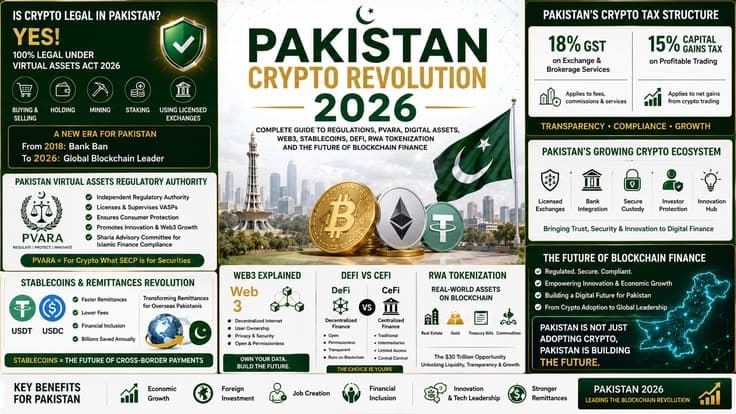
The short answer is yes — cryptocurrency is fully legal in Pakistan as of 2026, following a landmark legislative reversal that transformed the country from one that banned banks from facilitating crypto transactions into one with one of the most comprehensive virtual asset regulatory frameworks in South Asia.
For context, this represents a complete 180-degree shift from 2018, when the State Bank of Pakistan (SBP) issued a circular explicitly prohibiting regulated financial institutions from facilitating cryptocurrency transactions. That ban operated for several years while a large informal crypto market continued to grow — Pakistan consistently ranked among the top nations globally for grassroots crypto adoption, driven by unbanked populations, overseas worker remittances, and tech-savvy younger demographics.
What Is and Is Not Legal
Legal: Buying, selling, and holding cryptocurrencies including Bitcoin, Ethereum, and other major digital assets. Trading through licensed Virtual Asset Service Providers (VASPs). Crypto mining, with government-allocated power infrastructure. Earning income through staking and yield farming (subject to taxation). Businesses accepting crypto as payment for goods and services.
Not Legal: Using cryptocurrency as legal tender in everyday transactions (the Pakistani Rupee remains the sole official currency). Trading through unlicensed or unregistered platforms. Using privacy coins such as Monero or Zcash. Using crypto for money laundering, terrorist financing, or any illicit purpose. Operating a VASP without a valid PVARA license.
The Banking Integration Breakthrough
One of the most practically significant developments is that the SBP now permits regulated commercial banks to open Client Money Accounts (CMAs) for licensed Virtual Asset Service Providers. This solves what was previously the most intractable problem for legitimate crypto businesses in Pakistan — the inability to access formal banking channels. Licensed exchanges can now maintain corporate bank accounts, process PKR deposits and withdrawals, and operate as legitimate financial service providers within the regulated economy.
| Activity | Legal Status | Governing Authority | Requirements |
|---|---|---|---|
| Buying crypto | ✅ Legal | PVARA | Must use licensed exchange; KYC required |
| Selling crypto | ✅ Legal | PVARA / FBR | Capital gains tax applies |
| Holding crypto | ✅ Legal | PVARA | Must declare holdings on tax return |
| Crypto mining | ✅ Legal | PVARA | Income classified as business income; taxable |
| Staking rewards | ✅ Legal | FBR | Treated as income from other sources; taxable |
| P2P trading | ⚠️ Gray Area | PVARA | Compliance risk without PVARA-approved counterparty |
| Unlicensed exchange use | ❌ Illegal | PVARA | Penalties: fines and imprisonment |
| Privacy coins (Monero) | ❌ Banned | PVARA / SBP | Strictly prohibited |
| Crypto as legal tender | ❌ Not permitted | SBP | PKR remains sole legal tender |
3. Pakistan Crypto Regulations: PVARA, Virtual Assets Act 2026, and Tax Framework
Pakistan's Virtual Assets Act, 2026 is the cornerstone legislation that transformed the country's relationship with cryptocurrency. Passed by the National Assembly and ratified by the President, the Act establishes the comprehensive legal framework that governs all virtual asset activities within Pakistani jurisdiction.
Pakistan Virtual Assets Regulatory Authority (PVARA)
PVARA is the primary independent regulatory body established under the Virtual Assets Act. Its mandate is broad: licensing and oversight of all Virtual Asset Service Providers, enforcement of Anti-Money Laundering (AML) and Counter-Terrorist Financing (CTF) standards, consumer protection for crypto users, monitoring of market integrity, and coordination with the FBR on tax compliance. PVARA also maintains a public registry of all licensed operators, allowing Pakistani citizens to verify the legitimacy of any crypto platform they use.
The Sharia Advisory Committee
One of the most globally distinctive features of Pakistan's crypto regulatory framework is its dedicated Sharia Advisory Committee, which reviews digital asset products for compliance with Islamic finance principles. This makes Pakistan one of the first countries in the world to formally integrate halal finance certification into a national crypto regulatory architecture — a recognition that a significant portion of Pakistan's population requires Sharia-compliant financial products as a prerequisite for participation.
Complete Pakistan Crypto Tax Framework (2026)
| Tax Type | Rate | Applicable Activity | Taxable Event | Key Exemption |
|---|---|---|---|---|
| Capital Gains Tax (CGT) | 15% | Buying/selling crypto for profit | Sale, swap, P2P trade | Annual gains below PKR 50,000 |
| General Sales Tax (GST) | 18% | Exchange/brokerage services | Each transaction via licensed platform | Currently evolving — consult FBR |
| Income Tax (Mining) | Progressive slabs | Crypto mining revenue | Block reward receipt | Deductible: electricity, hardware depreciation |
| Income Tax (Staking) | Progressive slabs | Staking, yield farming, DeFi | Reward receipt | Limited deductions available |
| Income Tax (Airdrops) | Progressive slabs | Token airdrops received | Receipt of airdrop | None currently |
| Non-Filer Surcharge | Additional penalty | Non-registered taxpayers | Any crypto income | Only registered filers avoid surcharge |
Important note: Pakistan's crypto tax framework is actively evolving. The 18% GST on exchange services has been particularly controversial, as it applies to a market whose formal exchange infrastructure has not yet fully launched. Always consult a qualified Pakistani tax professional or the FBR's official IRIS portal for current guidance before making financial decisions.
Penalties for Non-Compliance
The Virtual Assets Act contains significant enforcement provisions. Operating a VASP without a valid PVARA license is a criminal offense carrying penalties of up to 5 years imprisonment and fines of up to PKR 50 million. Failure to maintain KYC protocols or report suspicious transactions carries substantial financial penalties. The FBR can freeze accounts, impose financial audits, and pursue criminal prosecution for failure to declare crypto income. The framework is designed to eliminate the gray market that characterized Pakistan's crypto sector for several years.
Strategic Government Initiatives
Beyond regulation and taxation, Pakistan's government has announced several ambitious strategic crypto initiatives. The government has earmarked approximately 2,000 megawatts of surplus electricity capacity specifically for Bitcoin mining and AI data center operations — representing a significant economic bet on digital asset infrastructure as a foreign exchange earner. Strategic exploration of a national Bitcoin reserve is underway. The State Bank is studying the technical and policy feasibility of a Digital Rupee (CBDC) that would coexist alongside the emerging private crypto ecosystem.
4. Global Crypto Adoption Trends 2026
The scale of global cryptocurrency adoption in 2026 would have seemed implausible even five years ago. Global crypto ownership is approaching one billion users — a figure that, if accurate, would represent more than one in eight people on earth holding some form of digital asset. Pakistan sits prominently in this adoption story, consistently ranking among the top nations globally for crypto activity relative to its formal financial sector participation.
Pakistan's Unique Adoption Profile
Pakistan's 20+ million crypto users share a profile quite different from typical Western crypto adopters. A significant portion are unbanked or underbanked — estimated at 100+ million adults who lack access to traditional banking services. For this demographic, crypto and stablecoins represent not an investment opportunity but a financial access solution: a way to store value, send money across borders, and participate in the digital economy without requiring a formal bank account.
Overseas Pakistani workers sending remittances home represent another major use case. Pakistan receives approximately $30 billion in annual remittances — one of the largest such flows in the developing world. The fees on traditional remittance corridors (often 5–8% per transfer) represent billions of dollars annually extracted from some of Pakistan's most economically vulnerable families. USDT and USDC stablecoin transfers over blockchain networks can accomplish the same transfer at a fraction of the cost and in minutes rather than days.
Key Global Adoption Drivers
- Real-World Asset (RWA) tokenization: Institutional investors are expanding tokenized offerings to include private loans, government bonds, ETFs, and equities — bridging traditional and decentralized finance
- User experience improvements: Mobile-first crypto applications have dramatically simplified onboarding, removing the technical barriers that previously limited adoption to technically sophisticated users
- Regulatory clarity: As comprehensive frameworks like MiCA (EU), GENIUS Act (US), and Virtual Assets Act (Pakistan) come into force, institutional confidence increases and enterprise adoption accelerates
- Invisible integration: Consumers increasingly interact with crypto-backed infrastructure without realizing it — blockchain-settled loyalty programs, stablecoin payment rails embedded in e-commerce, AI agent transactions
- Decentralized prediction markets: Platforms like Polymarket have demonstrated billion-dollar trading volumes, proving mainstream demand for decentralized, blockchain-settled financial instruments
5. Stablecoins and Digital Currency: The Future of Money
Stablecoins represent perhaps the most practically significant innovation in the cryptocurrency space — not because they are speculative investments, but precisely because they are not. A stablecoin is a digital token pegged to the value of a stable reference asset (typically the US dollar) and maintained on a blockchain network. They combine the price stability of traditional fiat currency with the programmability, speed, global accessibility, and 24/7 availability of cryptocurrency.
How Stablecoins Work
The stability mechanism differs by stablecoin type. Fiat-collateralized stablecoins like Tether (USDT) and USD Coin (USDC) maintain their peg by holding reserves of actual US dollars (or highly liquid equivalents like Treasury bills) equal to or exceeding the total supply of tokens in circulation. Commodity-backed stablecoins like PAX Gold (PAXG) are pegged to physical commodities — each PAXG token represents exactly one troy ounce of gold stored in a professional vault. Crypto-collateralized stablecoins like DAI maintain stability through over-collateralization using other crypto assets as backing. Algorithmic stablecoins — the most controversial category following the Terra/LUNA collapse — use software mechanisms to maintain pegs without direct collateral backing.
Why Stablecoins Are Reshaping Global Finance
Stablecoin payment volumes in 2026 are extraordinary. Annual on-chain stablecoin transfer volume now exceeds the combined annual settlement volumes of Visa and Mastercard — though comparison is imperfect since blockchain includes more types of transfers. More significant than raw volume is the nature of what stablecoins enable: instant global settlement with no banking hours, no correspondent banking requirements, no minimum transfer amounts, and fees measured in cents rather than percentages.
For Pakistan specifically, stablecoins offer a transformative path for the remittance problem. A Pakistani worker in Saudi Arabia, the UAE, or the UK can transfer USDT to a family member's wallet in Karachi in under a minute for a few cents. The family member can then convert to PKR through a licensed local exchange. The entire process costs less than 0.5% versus the 5–8% charged by traditional money transfer operators. As PVARA-licensed exchanges come online, this use case is expected to grow dramatically, potentially generating significant regulatory revenue through transaction taxes while simultaneously reducing costs for millions of Pakistani families.
| Stablecoin Type | Examples | Backing Mechanism | Stability Level | Best Use Case |
|---|---|---|---|---|
| Fiat-Collateralized | USDT, USDC, BUSD | USD reserves / T-bills | Very High | Payments, remittances, trading |
| Commodity-Backed | PAXG, XAUT (Tether Gold) | Physical gold in vaults | High | Inflation hedge, gold investment |
| Crypto-Collateralized | DAI, LUSD | Over-collateralized crypto | Moderate | DeFi protocols, decentralized use |
| Algorithmic | FRAX (partially) | Algorithm + partial reserves | Variable (risky) | Experimental, yield generation |
| Institutional/Regulated | PYUSD (PayPal), RLUSD (Ripple) | Bank reserves + regulatory oversight | Very High | Enterprise payments, banking integration |
CBDC vs Stablecoin: The Key Difference
Central Bank Digital Currencies (CBDCs) are digital versions of national currencies issued and controlled directly by central banks. Pakistan's State Bank is studying a Digital Rupee concept. Unlike stablecoins issued by private companies, a CBDC would be a direct liability of the State Bank — legal tender with the full backing of the government. The key differences are control (government vs. private company), programmability (CBDCs can include spending restrictions; stablecoins generally cannot), privacy (CBDCs enable government transaction monitoring; stablecoins vary), and geographic scope (CBDCs are national; stablecoins are global by design).
6. Web3 Technology Explained for Beginners
Web3 is one of the most discussed and most misunderstood concepts in technology. At its core, Web3 refers to a proposed new generation of the internet built on blockchain technology, designed to shift control, ownership, and economic value away from centralized technology corporations and return it to individual users. Understanding Web3 requires first understanding how we got here.
The Evolution of the Internet: Web1 → Web2 → Web3
Web 1.0 (Read-Only, 1991–2004): The original internet was a collection of static websites. You could read information published by others, but you could not create content, interact, or participate. It was a passive information consumption medium — a digital library without a librarian.
Web 2.0 (Read-Write, 2004–present): The social media era transformed the internet into an interactive medium. You can now create content, share it, build communities, and interact in real time. The problem is that the platforms enabling this participation — Google, Facebook, YouTube, Twitter, Amazon — own the infrastructure and, crucially, they own your data. You are not a customer; you are the product. Your attention, behavior, and personal information are monetized by these platforms in ways you did not explicitly consent to and from which you do not share the economic benefit. Your content can be deleted, demonetized, or restricted at any time by a platform's unilateral decision.
Web 3.0 (Read-Write-Own, emerging): Web3 adds a third dimension: ownership. In a Web3 paradigm, you not only create and interact — you own your digital identity, your content, your data, and your digital assets. Smart contracts replace platform intermediaries. Tokens represent genuine ownership stakes. Your digital assets can be carried across platforms, sold, or passed to heirs — just like physical property.
The Core Pillars of Web3
Decentralization: Rather than data residing on servers owned by a single corporation, Web3 applications distribute data across networks of independent computers (nodes). No single entity controls the network, making it resistant to censorship, single points of failure, and corporate gatekeeping.
Trustless Transactions: In Web2, you trust corporations to handle your transactions and data fairly. In Web3, trust is replaced by cryptographic verification and smart contracts — self-executing code that automatically enforces agreed terms without requiring either party to trust the other. "Don't trust, verify" is the operating principle.
Permissionless Access: Anyone with an internet connection and a wallet can participate in Web3 applications — no account approval required, no credit history needed, no geographic restrictions based on which bank you have access to. This is particularly powerful for the approximately 1.4 billion adults globally who remain unbanked.
Native Digital Value: Web3 has native payment rails built in. Sending value globally is as simple as sending an email — instant, global, and with minimal friction.
7. Web3 Blockchain: The Infrastructure Layer
Blockchain is the technological foundation that makes Web3 possible. While Web3 describes the vision — a decentralized, user-owned internet — blockchain is the specific technical implementation that makes that vision achievable. Understanding how they relate is essential for anyone seeking to build, invest in, or use Web3 applications.
What Is a Blockchain?
A blockchain is a cryptographically secured, distributed database that stores records in linked "blocks" of data. Each block contains a set of transactions, a timestamp, and a cryptographic "hash" (a digital fingerprint) of the previous block. This linking of blocks creates a chain — hence the name. Once data is recorded in a block and added to the chain, altering it would require recalculating every subsequent block and gaining control of the majority of the network simultaneously. In practice, this makes blockchain records immutable for all practical purposes.
Smart Contracts: The Key Innovation
Smart contracts are the feature that transforms blockchains from mere record-keeping databases into programmable financial and governance infrastructure. A smart contract is a piece of code stored on a blockchain that automatically executes predefined actions when specific conditions are met — without any human intermediary needed to trigger or verify the execution. The concept was first popularized by Ethereum's creator Vitalik Buterin, and Ethereum remains the dominant smart contract platform by value locked.
Major Blockchain Networks Powering Web3
| Blockchain | Consensus | Key Strength | Primary Use Case | Notable Projects |
|---|---|---|---|---|
| Ethereum | Proof of Stake | Largest developer ecosystem; most DeFi TVL | DeFi, NFTs, RWA tokenization | Uniswap, Aave, USDC, BlackRock BUIDL |
| BNB Smart Chain | Proof of Staked Authority | Low fees; high transaction speed | DeFi, DEXs, retail crypto | PancakeSwap, Venus |
| Solana | Proof of History + PoS | Very high throughput; low fees | Consumer apps, NFTs, payments | Phantom, Jupiter, Helium |
| TRON | Delegated PoS | Dominant stablecoin network (USDT) | Stablecoin transfers, payments | USDT (largest supply on TRON) |
| Polygon | PoS + ZK-rollups | Ethereum scaling; enterprise adoption | Enterprise blockchain, gaming | Immutable X, Aave |
| Avalanche | Avalanche Consensus | Fast finality; subnet architecture | Institutional DeFi, RWA | Trader Joe, RWA.xyz |
8. Decentralized Finance (DeFi) Explained
Decentralized Finance — universally abbreviated as DeFi — is the category of financial services and applications built on blockchain networks that operate without traditional financial intermediaries. No banks, no brokers, no clearinghouses, no compliance departments making decisions about who can participate. In DeFi, the rules are encoded in smart contracts, executed automatically, and open to anyone.
How DeFi Works in Practice
Consider a simple DeFi lending transaction. In traditional finance, you would deposit money in a bank savings account, the bank would lend your deposit to other customers at a higher interest rate, keep the margin as profit, and return you a small fraction. The bank intermediates, takes the spread, and makes the credit decisions.
In DeFi lending on a platform like Aave, you deposit your crypto assets (say, USDC) into a smart contract-governed liquidity pool. Other users borrow from that pool by depositing their own assets as collateral. The smart contract calculates interest rates algorithmically based on supply and demand. Interest accumulates in real time — literally second by second — and flows directly to depositors. There is no bank taking a spread; the protocol takes a small fee that is often redistributed to protocol governance token holders. The entire process is transparent, auditable, and operates 24/7 without human intervention.
Core DeFi Categories and Examples
Decentralized Exchanges (DEXs): Peer-to-peer marketplaces where users trade cryptocurrencies directly without a centralized exchange. Uniswap on Ethereum and PancakeSwap on BNB Chain are the category leaders. DEXs use Automated Market Makers (AMMs) rather than traditional order books — liquidity providers deposit token pairs into pools and earn fees from trades that flow through those pools.
Lending and Borrowing Protocols: Aave and Compound allow users to supply assets to earn interest or borrow against crypto collateral. These protocols typically require over-collateralization — borrowers must deposit more value than they borrow — to protect lenders in volatile markets.
Yield Aggregators: Platforms like Yearn Finance automatically move user funds across multiple DeFi protocols to maximize yield without requiring users to manually manage their positions. These are essentially automated fund managers governed by code rather than human portfolio managers.
Prediction Markets: Polymarket allows users to bet on real-world outcomes — elections, sports, economic events — with settlements handled by smart contracts. In the 2024 US Presidential election cycle, Polymarket processed billions in prediction volume, demonstrating mainstream appetite for decentralized financial instruments.
Liquid Staking: Protocols like Lido Finance allow users to stake Ethereum (earning network rewards) while receiving a liquid token (stETH) that can be used elsewhere in DeFi simultaneously — solving the liquidity problem that previously made staking an opportunity cost.
DeFi Benefits and Risks
| Factor | DeFi Advantage | DeFi Risk |
|---|---|---|
| Access | Available to anyone globally 24/7 — no bank account needed | Complex UX may exclude non-technical users |
| Transparency | All transactions publicly auditable on blockchain | Transaction history permanently public |
| Efficiency | Near-instant settlement; minimal fees; no intermediary margin | Smart contract bugs can drain funds instantly |
| Yield | Interest rates can significantly exceed traditional savings accounts | High yields often indicate high risk |
| Control | Users retain custody of their own assets | Lost private keys = permanently lost funds; no recovery |
| Innovation | Permissionless development enables rapid product iteration | Scams and rug pulls common in unaudited protocols |
| Regulation | Operates globally without geographic restrictions | Regulatory uncertainty creates legal risk in many jurisdictions |
9. DeFi vs Centralized Finance: The Complete Comparison
Understanding the distinction between Decentralized Finance (DeFi) and Centralized Finance (CeFi — which includes both traditional banking and centralized crypto exchanges) is essential for anyone navigating the 2026 financial landscape. The two systems are not mutually exclusive; increasingly, they are converging in hybrid models that combine the transparency and programmability of blockchain with the regulatory compliance and consumer protections of traditional finance.
The Structural Differences
In traditional centralized finance, every financial service — banking, lending, insurance, investing, currency exchange — is provided through intermediary institutions that hold custody of your assets, make credit decisions, maintain compliance records, and can freeze, restrict, or terminate your access at any time. These institutions are regulated, insured (in most developed countries), and legally accountable for their treatment of customer assets.
In DeFi, smart contracts replace these intermediaries. Your assets remain in your custody at all times — no company holds them on your behalf. The rules governing any financial transaction are encoded in publicly auditable code. Access cannot be revoked by a third party. But if you lose your private keys, send funds to the wrong address, or interact with a malicious smart contract, there is typically no recovery mechanism.
Centralized crypto exchanges like Binance, Coinbase, and OKX occupy an interesting middle ground — they use blockchain technology for asset settlement but maintain centralized custody of user funds, KYC/AML compliance functions, and customer support infrastructure. The FTX collapse demonstrated the catastrophic downside of centralized crypto custody when it is not adequately regulated or audited.
10. Real World Asset (RWA) Tokenization: The $30 Trillion Opportunity
Real-World Asset tokenization is arguably the most consequential financial innovation of the current decade — not because it creates new speculative opportunities but because it applies blockchain's efficiency gains to the vast majority of the world's existing wealth. The global value of tokenizable real-world assets — real estate, bonds, equities, commodities, private credit, infrastructure — is estimated at $300+ trillion. Even conservative scenarios for tokenization adoption represent transformative capital flows.
How RWA Tokenization Works
The tokenization process converts ownership rights in a physical or financial asset into a digital token on a blockchain. The process involves several distinct steps. First, legal structuring: the underlying asset is placed into a legal holding structure (trust, SPV, or similar) that clearly establishes token holders' rights and protects against bankruptcy risks. Second, verification and oracles: third-party auditors verify the existence, custody, and value of the underlying asset. Blockchain oracle networks (like Chainlink) relay this verified real-world data onto the blockchain in a form that smart contracts can use. Third, minting: smart contracts generate digital tokens representing fractional or whole ownership of the asset. These tokens are then distributed to investors and can be traded on secondary markets.
Asset Classes Being Tokenized in 2026
US Treasury Bills and Fixed Income: This is the largest and fastest-growing RWA category. BlackRock's BUIDL Fund — a tokenized money market fund investing in US government securities — has accumulated billions in assets and represents the most significant institutional validation of blockchain-based investment products. Ondo Finance (ONDO) and Franklin Templeton have also launched competing tokenized treasury products, bringing institutional-grade yield-bearing instruments on-chain.
Real Estate: Property tokenization allows high-value real estate to be divided into fractional digital tokens, enabling investors to purchase a $10 stake in a commercial building in Dubai or a luxury apartment in London. Rental income is distributed proportionally to token holders through smart contracts. For Pakistan, this creates the possibility of real estate investment by Pakistanis who could never otherwise afford entry into overseas property markets.
Commodities — Gold: PAX Gold (PAXG) and Tether Gold (XAUT) each represent one troy ounce of physical gold stored in professional vaults. These are particularly relevant for Pakistani investors with cultural familiarity with gold as a store of value — blockchain-based gold allows the same inflation hedging without the storage, insurance, and liquidity limitations of physical gold.
Private Credit: Centrifuge (CFG) and Maple Finance (MPL) have pioneered on-chain private credit — lending to real-world businesses using blockchain-denominated instruments. This connects DeFi liquidity with the real economy, allowing crypto holders to earn yields from cargo shipping companies, SME loans, and corporate borrowers.
| RWA Category | Market Size (Tokenized) | Key Protocols | Primary Benefit | Pakistan Relevance |
|---|---|---|---|---|
| US Treasuries / Bonds | Multi-billion (fastest growing) | BlackRock BUIDL, Ondo, Franklin Templeton | On-chain yield; institutional grade | Dollar-denominated savings alternative |
| Real Estate | Growing rapidly | RealT, Lofty, Propy | Fractional ownership; global access | Access to overseas property markets |
| Gold | Established market | PAXG, XAUT | Digital gold ownership; instant liquidity | Culturally familiar store of value |
| Private Credit | $1B+ on-chain | Centrifuge, Maple Finance | Real economy yields; SME lending | SME financing innovation opportunity |
| Equities / Stocks | Early market | Backed Finance, Synthetix | 24/7 global stock trading | Overseas market access |
| Carbon Credits | Emerging | Toucan Protocol, KlimaDAO | Transparent sustainability accounting | ESG investment opportunity |
11. Future of Digital Assets and Web3: The Convergence
The future of digital assets and Web3 is being shaped by the convergence of three powerful forces: the maturation of blockchain infrastructure, the integration of artificial intelligence, and the formalization of regulatory frameworks that provide institutional confidence. Together, these forces are moving the industry from its first decade of speculative exploration to its second decade of practical deployment.
1. TradFi and DeFi Convergence
The previously sharp boundary between traditional finance and decentralized finance is dissolving. Major banks are not abandoning traditional finance — they are adding blockchain rails alongside it. JPMorgan's Kinexys (formerly Onyx) processes trillions of dollars in interbank transactions on private blockchain networks. Fidelity and BlackRock are tokenizing fund shares. Visa and Mastercard are processing stablecoin settlements. The endpoint is not a world where DeFi replaces banks, but one where blockchain infrastructure becomes as standard as SWIFT or ACH — invisible infrastructure that the financial system runs on without consumers thinking about it.
2. AI and Web3 Synergies
The intersection of AI and blockchain is creating a new category of autonomous economic actors. AI agents — software programs that can perceive their environment, make decisions, and take actions autonomously — are beginning to use blockchain-based stablecoin wallets to transact on behalf of users or businesses. An AI agent can negotiate services, pay for computational resources, receive payment for completed work, and manage financial positions — all without human intervention and all settled on blockchain rails. This "agentic economy" is nascent but represents one of the most significant long-term demand drivers for blockchain infrastructure.
3. Digital Identity and Sovereignty
Web3's promise of self-sovereign digital identity — where individuals control their own digital credentials, reputation scores, and financial histories without dependence on any single platform — is becoming technically feasible. Decentralized Identifiers (DIDs) and Verifiable Credentials (VCs) standards are being adopted by major technology companies. The practical implication for Pakistan: a Pakistani freelancer could maintain a globally verifiable digital work history and reputation that no single platform can arbitrarily delete, enabling access to international opportunities currently gated by platform-specific reputation systems.
12. Crypto Market Outlook 2026: Predictions and Key Trends
Several analytically grounded predictions characterize the 2026 crypto market outlook. Institutional analysts at Bitwise, Grayscale, and Fidelity Digital Assets have coalesced around a view that 2026 represents a structural inflection point in the asset class — a transition from cyclical boom-bust dynamics toward a more stable, institution-driven market structure.
Bitcoin's Four-Year Cycle Under Pressure
Bitcoin's historical four-year cycle — driven by halvings that reduce mining reward supply — has historically produced predictable boom-bust patterns. Multiple analysts suggest this cycle may be weakening as ETF products and institutional buyers create consistent demand that smooths out the volatility peaks. Fidelity's crypto outlook notes that if traditional cycles continue, the market could bottom around late 2026 — though institutional demand may preclude the depth of correction seen in previous cycles.
Stablecoin Circulation Approaching $1 Trillion
Analysts at Quartz and multiple crypto research firms project stablecoin circulating supply may surpass $1 trillion in 2026 — more than triple the levels of two years prior. This growth is driven by corporate treasury adoption, remittance corridors, DeFi protocols, and the US GENIUS Act providing regulatory clarity for stablecoin issuers that enables bank involvement.
AI Crypto Projects as the New Market Narrative
Projects combining AI capabilities with decentralized infrastructure are driving significant market attention and capital. Fetch.ai (FET), Akash Network (AKT), and similar projects offering decentralized AI computing resources represent the intersection of two dominant technology narratives. For Pakistan's growing tech sector, this represents a potential opportunity to participate in emerging blockchain infrastructure.
| Metric | 2024 Baseline | 2026 Projection | Key Driver |
|---|---|---|---|
| Global crypto users | ~560 million | Approaching 1 billion | Mobile apps, regulatory clarity |
| Stablecoin market cap | ~$170 billion | ~$1 trillion | GENIUS Act, corporate adoption |
| Tokenized RWA market | ~$14 billion | $50–100+ billion | Institutional tokenization programs |
| DeFi Total Value Locked | ~$100 billion | $150–300 billion | Institutional DeFi products |
| Bitcoin ETF AUM | ~$30 billion | $100+ billion | Ongoing institutional inflows |
| Pakistan crypto users | ~15–20 million | 30+ million (projected) | PVARA regulation, licensed exchanges |
13. Conclusion: Pakistan and the Blockchain Future
Pakistan stands at a genuinely historic juncture in its relationship with digital assets. The combination of a young, tech-literate population; one of the world's largest unbanked demographics with strong motivation to access digital financial services; a massive overseas diaspora generating $30 billion in annual remittances; and now a comprehensive regulatory framework under PVARA creates the conditions for Pakistan to become a significant participant in the global blockchain economy rather than a passive bystander.
The regulatory framework is in place. PVARA is operational. The State Bank has lifted banking restrictions for licensed VASPs. The government has allocated infrastructure for crypto mining. Bitcoin mining, stablecoin remittances, RWA tokenization, DeFi participation, and Web3 development — all of these are now legally accessible to Pakistani citizens, businesses, and investors in ways that simply were not possible two years ago.
The challenges are real and should not be minimized. The 18% GST on crypto exchange services creates friction at a moment when the ecosystem needs user adoption. Financial literacy gaps leave many potential participants vulnerable to scams and market volatility. The formal exchange infrastructure is still being built. Regulatory evolution will continue, and tax frameworks will change.
But the direction is clear. Globally, blockchain is moving from the edges of finance to its center. Stablecoins are becoming infrastructure for international trade. RWA tokenization is democratizing access to investment opportunities previously reserved for institutional investors. DeFi is providing financial services to populations that traditional banking cannot profitably serve. Web3 is building the ownership layer that the current internet lacks.
Pakistan's crypto revolution is not complete — it is just beginning. The decisions made by regulators, investors, entrepreneurs, and ordinary users in the next few years will determine whether Pakistan captures the economic opportunities this technological transition creates, or allows them to pass to other early-moving nations.
Disclaimer: This article is for educational and informational purposes only. It does not constitute financial or legal advice. Cryptocurrency investments carry significant risks. Always consult a qualified financial advisor or tax professional before making investment decisions.