Mitchell Starc: The Fast Bowling Machine Who Dominated World Cricket
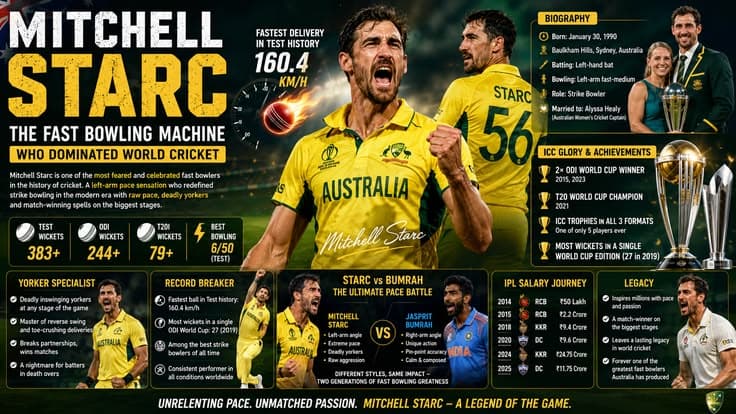
When cricket fans around the world hear the name Mitchell Starc, they immediately picture a towering left-arm fast bowler charging in with relentless aggression, releasing the ball with a perfectly high arm action, and watching it swing devastatingly late into the stumps or toes of the world's best batsmen. Mitchell Aaron Starc — born on January 30, 1990, in Baulkham Hills, Sydney, Australia — is not just a great bowler. He is a generational talent who has reshaped how left-arm fast bowling is understood, celebrated, and feared in the modern era of cricket.
From his humble beginnings as a young wicket-keeper in Sydney's Northern Districts to becoming Australia's most lethal pace weapon, Starc's journey is one of dedication, reinvention, and relentless competitive fire. With a career spanning over 15 years, two ODI World Cup titles, a T20 World Cup medal, the World Test Championship trophy, and a record haul of wickets across all three formats, he stands among the all-time greats of the game.
This comprehensive guide covers everything you need to know: his early life and family background, his rise to international stardom, his jaw-dropping statistics, his explosive IPL story, his comparison with Jasprit Bumrah, his legendary yorker technique, and the mark he has left on world cricket forever.
Quick Bio Facts: Mitchell Starc at a Glance
| Detail | Information |
|---|---|
| Full Name | Mitchell Aaron Starc |
| Date of Birth | January 30, 1990 |
| Age (2026) | 36 years |
| Birthplace | Baulkham Hills, Sydney, New South Wales, Australia |
| Height | 197 cm (6 ft 6 in) |
| Batting Style | Left-handed |
| Bowling Style | Left-arm Fast |
| Role | Bowler |
| Wife | Alyssa Healy (married April 2016) |
| Brother | Brandon Starc (Olympic High Jumper) |
| Domestic Team | New South Wales |
| Test Debut | December 1, 2011 vs New Zealand |
| ODI Debut | October 20, 2010 vs India |
| T20I Debut | September 7, 2012 vs Pakistan |
| Fastest Delivery | 160.4 km/h (fastest ever in Test cricket) |
| IPL Teams | RCB (2014–15), KKR (2018, 2024), Delhi Capitals (2025–26) |
| Education | Homebush Boys High School, Sydney |
Early Life and Family Background
Mitchell Starc grew up in the western suburbs of Sydney in a sporting family that placed enormous value on athletics and competition. From the age of just nine years old, young Mitchell was playing cricket for Northern Districts — but not as the fearsome fast bowler the world knows today. He started out as a wicket-keeper, developing his hand-eye coordination and game sense behind the stumps.
His family background is rich with athletic achievement. His younger brother, Brandon Starc, went on to become a professional high jumper who represented Australia on the global stage, including at the Olympic Games. The Starc household was clearly built for sporting greatness.
It was only when Mitchell hit his mid-teenage years and began growing rapidly — eventually reaching a towering height of 197 cm (6 ft 6 in) — that his coaches recognized the opportunity to convert him into a fast bowler. His long levers, natural rhythm, and ability to generate pace from a high release point made him an ideal candidate. That transition changed cricket history.
Mitchell attended Homebush Boys High School in Sydney, where he represented the school's first-grade cricket team. He also played for the Berala Sports Cricket Club in Sydney during his formative years — an extraordinary detail being that at Berala, he would sometimes both bowl AND keep wickets in the same innings, such was his versatility and enthusiasm for the game.
Perhaps his most famous personal story is his relationship with his wife, Alyssa Healy — niece of legendary Australian wicket-keeper Ian Healy and herself one of the greatest female cricketers in history. The two first met at the age of nine at a junior cricket clinic, both there as wicket-keepers. They would go on to marry in April 2016 and become only the third married couple in history to both play Test cricket — a truly unique cricketing love story.
Domestic Career: The Making of a Champion
Starc's path to the top was not an overnight success story. He earned a rookie contract with New South Wales for the 2008–09 season and made his first-class debut on March 5, 2009, against Western Australia — a match that ended in a draw. NSW finished at the bottom of the Sheffield Shield ladder that season, but the team had found their future bowling spearhead.
The following season, he took 21 wickets in eight Sheffield Shield matches, including a career-best of 5 for 74 against Queensland, and even scored a half-century against Victoria with the bat — hinting at his all-round potential. Western Australia were so impressed they tried to recruit him, but Starc stayed loyal to NSW. That loyalty would define his career values going forward.
In 2010, Starc was selected to play for the Australian Institute of Sport, where his bowling helped the team win the Emerging Players Twenty20 Trophy, beating teams from India, New Zealand, and South Africa. That performance put him squarely on the national selectors' radar.
International Career: From Debut to Dominance
ODI Debut (2010)
Mitchell Starc made his One Day International debut on October 20, 2010, against India. He was just 20 years old, raw but full of promise, his pace alone making him a handful for any batting lineup.
Test Debut (2011)
His Test debut came on December 1, 2011, against New Zealand in Brisbane (cap number 425). In a telling sign of things to come, his maiden Test wicket was none other than Brendon McCullum — a name that would appear memorably again in Starc's greatest career moment years later.
The early part of his international career, however, was disrupted by persistent injuries. Stress fractures, ankle injuries, and side strains repeatedly sidelined him, testing his resolve and causing many to wonder whether his body could withstand the demands of sustained fast bowling at the highest level.
He answered those questions emphatically.
Complete Career Statistics
Bowling Statistics — All Formats
| Format | Matches | Innings | Balls | Wickets | Best Bowling | Average | Economy | Strike Rate | 5-Wicket Hauls |
|---|---|---|---|---|---|---|---|---|---|
| Test | 105 | 202 | 20,013 | 433 | 7/58 | 26.51 | 3.44 | 46.2 | 18 |
| ODI | 130 | 130 | 6,638 | 247 | 6/28 | 23.58 | 5.27 | 26.9 | 9 |
| T20I | 65 | 65 | 1,458 | 79 | 4/20 | 23.81 | 7.74 | 18.5 | 0 |
| IPL | 58 | 55 | 1,179 | 76 | 5/35 | 22.7 | 8.79 | 15.5 | 1 |
| First Class | 158 | 294 | 28,722 | 621 | 8/73 | 26.13 | 3.39 | 46.2 | 26 |
| List A | 161 | 161 | 8,326 | 323 | 6/25 | 22.2 | 5.16 | 25.8 | 12 |
| T20 | 164 | 161 | 3,536 | 228 | 5/35 | 20.7 | 8.02 | 15.5 | 1 |
Batting Statistics — All Formats
| Format | Matches | Innings | Runs | High Score | Average | Strike Rate | 50s |
|---|---|---|---|---|---|---|---|
| Test | 105 | 154 | 2,478 | 99 | 20.47 | 59.3 | 13 |
| ODI | 130 | 77 | 583 | 52* | 11.66 | 77.1 | 1 |
| T20I | 65 | 21 | 98 | 14 | 9.80 | 98.0 | 0 |
| IPL | 58 | 25 | 111 | 29 | 9.2 | 91.7 | 0 |
It is worth noting that Starc's batting high score of 99 in Test cricket — just one run short of a maiden century — remains one of cricket's most tantalizing near-misses. He is a genuine lower-order threat with explosive hitting ability.
ICC World Cup Records: The Ultimate Big-Game Bowler
If there is one arena where Mitchell Starc has transcended ordinary greatness to achieve something truly extraordinary, it is the ICC Cricket World Cup. No bowler in the tournament's history has dominated the competition quite like Starc. He is the all-time leading wicket-taker in ODI World Cup history, a record he claimed by surpassing the legendary Sri Lankan spinner Lasith Malinga during the 2023 tournament in India.
World Cup Performance — Tournament by Tournament
| Tournament | Year | Host Nation | Wickets | Average | Best Figures | Result | Award |
|---|---|---|---|---|---|---|---|
| ICC Cricket World Cup | 2015 | Australia & NZ | 22 | 10.18 | 6/28 vs NZ | 🏆 Winner | Player of the Tournament |
| ICC Cricket World Cup | 2019 | England & Wales | 27 | 18.59 | 5/26 | Semi-final exit | Leading Wicket-taker (All-time WC Record) |
| ICC T20 World Cup | 2021 | UAE & Oman | 11 | 17.09 | 3/29 | 🏆 Winner | Key performer |
| ICC Cricket World Cup | 2023 | India | 18+ | ~22.00 | 3/34 | 🏆 Winner | All-time WC wickets record holder |
World Cup Milestones and Records
| Record | Detail |
|---|---|
| Most wickets in a single ODI World Cup | 27 wickets — 2019 World Cup (England) |
| Fastest bowler to 50 World Cup wickets | Just 19 World Cup matches |
| All-time ODI World Cup leading wicket-taker | Surpassed Lasith Malinga in 2023 |
| Player of the Tournament | ICC Cricket World Cup 2015 |
| Leading wicket-taker in back-to-back World Cups | 2015 AND 2019 — unique achievement |
| World Cup winner | 2015 ODI WC, 2021 T20 WC, 2023 ODI WC |
| ICC trophy winner across all 3 formats | One of only 5 players in history |
The 2015 World Cup Final remains perhaps his single greatest career moment. On the fifth ball of the very first over of the final against New Zealand, Starc sent down a rocket of an inswinging yorker that shattered Brendon McCullum's stumps for a golden duck. That single delivery — arguably the most important ball in a World Cup Final in recent history — encapsulated everything Mitchell Starc is: pure, concentrated, match-winning fast bowling delivered at the exact moment it matters most.
Mitchell Starc's Bowling Speed and Fastest Deliveries
Speed is one of the most fundamental measurements of a fast bowler's greatness, and Mitchell Starc sits in an extraordinarily elite category. His officially recorded fastest delivery stands at 160.4 km/h (99.66 mph), bowled to New Zealand's Ross Taylor during the Perth Test in November 2015. This makes it the fastest delivery ever officially recorded in Test cricket history, according to the Guinness World Records.
Starc joins a rarefied club of fewer than five bowlers in international cricket history to have officially surpassed the 160 km/h mark in a legitimate match context. His pace is not a one-off sprint — throughout his career he has consistently bowled in the 145–155 km/h range, making him one of the most sustained express pace bowlers ever to play the game.
A note worth mentioning: during an ODI against India in Perth in October 2025, a speed gun registered a delivery from Starc at a mind-boggling 176.5 km/h (109 mph), generating enormous excitement across social media. This reading was widely identified as a faulty speed gun malfunction and is not considered a legitimate record — though even without it, Starc's opening spell in that match, which dismissed Virat Kohli for a first-ball duck, was devastating by any measure.
Fastest Bowling Spells in Starc's Career
| Match | Year | Opponent | Top Speed | Highlight |
|---|---|---|---|---|
| Perth Test (WACA) | 2015 | New Zealand | 160.4 km/h | Officially fastest Test delivery ever recorded |
| 2023 ODI World Cup | 2023 | Sri Lanka | 160.4 km/h | Fastest ball of the entire tournament |
| 2015 World Cup Final | 2015 | New Zealand | ~152 km/h | Bowled McCullum with 5th ball — most iconic WC Final moment |
| 2021–22 Ashes (Brisbane) | 2021 | England | ~150 km/h | Bowled Rory Burns with first ball of the entire Ashes series |
| 1st ODI vs India (Perth) | 2025 | India | ~145 km/h avg | Dismissed Virat Kohli for an 8-ball duck; erroneous 176.5 reading |
The Science Behind Mitchell Starc's Deadly Yorkers
Among all of Mitchell Starc's bowling weapons, it is the inswinging yorker that has become his signature — his calling card — the delivery that batsmen around the world lose sleep over. Understanding how Starc produces this masterpiece of fast bowling requires breaking down both the physical mechanics and the mental strategy behind it.
Key Elements of the Starc Yorker
1. Targeting the Base of the Stumps: Unlike many fast bowlers who target a batter's feet, Starc focuses his eyes on the base of the stumps during his approach. Stumps are a fixed, unchanging target — batsmen may shuffle, move around the crease, or change their guard, but the stumps stay still. This mental anchor allows Starc to maintain precision even under immense pressure.
2. High-Arm Delivery: Starc employs a classically high-armed, over-the-top bowling action. This generates a steep, downward trajectory that causes the ball to arrive much later than a batter expects. When combined with inswing, the result is a delivery that appears to be swinging away before jagging back violently at the last millisecond.
3. Extreme Raw Pace: At speeds regularly exceeding 145 km/h, batsmen have a reaction time of well under half a second to read the length, judge the swing, and execute a defensive stroke. The yorker at this pace leaves virtually no margin for error.
4. Reverse Swing Mastery: With the older ball, Starc angles the seam at approximately 45 degrees with the rough side oriented to catch the air, generating reverse swing — a late, dramatic movement back into the right-hander that amplifies the threat of the yorker exponentially.
5. Target Adjustment in Real Time: One of Starc's more refined techniques is his in-match adjustment. If his first yorker pitches too full (becoming a full toss), he lowers his point of focus on the next delivery. If it pitches too short of a yorker length, he adjusts his focus point upward. This feedback loop allows him to self-correct within an over — a skill that separates good bowlers from great ones.
6. Consistency Through Muscle Memory: Thousands of hours in the nets bowling specifically at yorker lengths have hardwired the delivery into Starc's muscle memory. His ability to execute it under pressure — in World Cup finals, Ashes deciders, and T20 death overs — speaks to that deep-rooted practice foundation.
Mitchell Starc vs Jasprit Bumrah: The Great Fast Bowling Debate
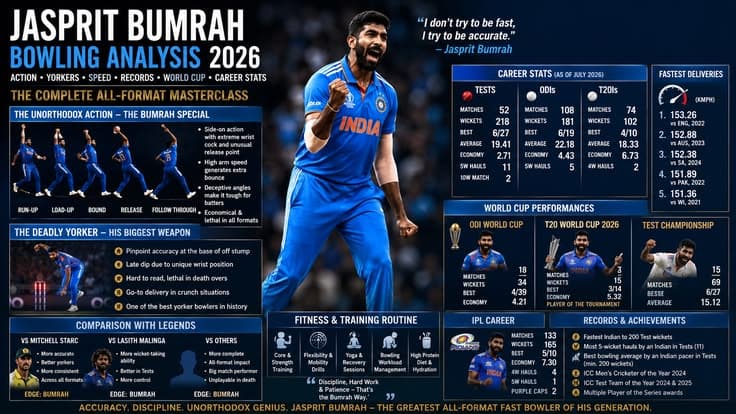
No discussion of Mitchell Starc's place in cricket history is complete without addressing the debate that divides cricket fans across the globe: Mitchell Starc vs Jasprit Bumrah — who is the better fast bowler? Both are generational talents. Both have dominated world cricket across formats. But they do so in vastly different ways.
Head-to-Head Stats Comparison (Test Cricket)
| Statistic | Mitchell Starc | Jasprit Bumrah |
|---|---|---|
| Test Matches | 105 | ~47 (as of mid-2026) |
| Test Wickets | 433 | ~234 |
| Test Average | 26.51 | ~19.8 |
| Test Economy | 3.44 | 2.77 |
| Best Bowling (Test) | 7/58 | 6/27 |
| 5-Wicket Hauls (Test) | 18 | ~10 |
| Test Catches | 46 | 17 |
Bowling Style Comparison
| Attribute | Mitchell Starc | Jasprit Bumrah |
|---|---|---|
| Bowling Arm | Left-arm | Right-arm |
| Primary Weapon | Inswinging yorker + raw pace | Unorthodox action + pinpoint yorker |
| Pace Range | 145–160 km/h | 140–155 km/h |
| Economy Rate | Moderate (better in Tests) | Outstanding across all formats |
| Death Bowling | Elite (World Cup specialist) | World's best (most consistent) |
| Swing Type | Conventional + Reverse swing | Seam movement + variations |
| New Ball | Highly dangerous (swing + pace) | Extremely difficult (length + bounce) |
| World Cup Impact | All-time record wicket-taker | Excellent, especially 2023 Final |
| ICC Trophy Wins | ODI WC x2, T20 WC, WTC | T20 WC 2024, WTC 2023 |
| Big Match Bowler | Legendary (WC Finals performer) | Elite (best under pressure globally) |
The verdict among cricket experts is nuanced. Bumrah edges Starc in terms of consistency across all conditions and economy — his ability to keep batsmen scoreless while taking wickets on any surface in the world is arguably unmatched in the history of the sport. But Starc's World Cup record is simply untouchable. No bowler — not McGrath, not Warne, not Malinga — has ever dominated the biggest stage of one-day cricket the way Starc has. His ability to produce match-defining, tournament-altering performances when the stakes are highest defines his greatness.
Mitchell Starc vs Other World-Class Fast Bowlers
| Bowler | Country | Style | Test Wickets | ODI Wickets | Specialty |
|---|---|---|---|---|---|
| Mitchell Starc | Australia | Left-arm Fast | 433 | 247 | Inswing yorker, World Cup record |
| Jasprit Bumrah | India | Right-arm Fast | 234+ | 185+ | Accuracy, economy, all-condition |
| Shaheen Shah Afridi | Pakistan | Left-arm Fast | 140+ | 130+ | Left-arm swing, new ball |
| Trent Boult | New Zealand | Left-arm Fast | 317 | 169 | Swing both ways, powerplay |
| Kagiso Rabada | South Africa | Right-arm Fast | 310+ | 175+ | Pace, bounce, aggression |
| Pat Cummins | Australia | Right-arm Fast | 270+ | 180+ | Control, consistency, leadership |
Mitchell Starc's IPL Career: From Record-Breaker to Champion
Mitchell Starc's relationship with the Indian Premier League (IPL) is one of the most fascinating sub-stories within his wider career narrative. Unlike many elite international cricketers who embrace franchise cricket fully, Starc made a deliberate choice throughout most of his career to prioritize international duty — particularly Test cricket — over the financial rewards of the IPL.
He burst onto the IPL scene in 2014 with Royal Challengers Bangalore (RCB), where his pace and yorker mastery proved highly effective in T20 conditions. He returned in 2015 and was again a key performer, helping RCB reach the playoffs. But then came a nine-year gap — a conscious decision to manage his bowling workload and focus on representing Australia across all three formats.
That absence made his return in 2024 all the more spectacular. Acquired by the Kolkata Knight Riders at the IPL auction for a then-record price of INR 24.75 Crore (approximately USD 3 million), Starc became the most expensive player in IPL auction history at that time. The weight of expectation was enormous. He responded by playing a key role in KKR's title-winning campaign, producing match-winning performances in the qualifier and final to help the franchise claim their third IPL title.
IPL Career Salary History
| Year | Franchise | Salary (INR) | Salary (USD approx.) | Result |
|---|---|---|---|---|
| 2014 | Royal Challengers Bangalore (RCB) | 5.00 Crore | ~$600K | Playoffs |
| 2015 | Royal Challengers Bangalore (RCB) | 5.00 Crore | ~$600K | Playoffs |
| 2018 | Kolkata Knight Riders (KKR) | 9.40 Crore | ~$1.1M | Injured — missed tournament |
| 2024 | Kolkata Knight Riders (KKR) | 24.75 Crore | ~$3M | 🏆 IPL Champions — Player of the Match (Final) |
| 2025 | Delhi Capitals (DC) | 11.75 Crore | ~$1.4M | Tournament player |
| 2026 | Delhi Capitals (DC) | 11.75 Crore | ~$1.4M | Retained |
His total IPL career earnings across all seasons amount to approximately INR 67.65 Crore — a remarkable sum that reflects both his elite status and the selective, targeted approach he has taken to franchise cricket.
IPL Career Bowling Stats
| Stat | Figure |
|---|---|
| IPL Matches | 58 |
| IPL Wickets | 76 |
| Best Figures | 5/35 |
| Bowling Average | 22.7 |
| Economy Rate | 8.79 |
| Strike Rate | 15.5 |
| 5-Wicket Hauls | 1 |
Mitchell Starc's Legacy and Impact on Modern Cricket
Few cricketers have had as profound an impact on the shape of fast bowling in the 21st century as Mitchell Starc. His influence can be felt at multiple levels — from the way left-arm pace bowlers are now developed and deployed around the world, to the tactical evolution of death bowling in white-ball cricket, to the standards by which fast bowling fitness and workload management are now judged.
The White-Ball Revolution: Starc proved definitively that a left-arm fast bowler could be the most destructive weapon in limited-overs cricket — more dangerous than spinners at the death, more valuable than medium-pacers in the powerplay, and more fearsome in knockout matches than virtually any other bowling type. His World Cup record — the most wickets in the competition's entire history — is the ultimate evidence of this.
Redefining Yorker Bowling: Before Starc, the yorker was considered primarily a weapon for right-arm bowlers like Waqar Younis and Lasith Malinga. Starc demonstrated that the left-arm inswinging yorker — angled across the body of right-handed batsmen and aimed at the base of off stump — is in fact the most lethal variation of the delivery. His execution has influenced a generation of left-arm fast bowlers globally.
The Art of Selective Participation: By regularly opting out of IPL editions to preserve his body for international cricket and the Test format in particular, Starc modeled a form of professional self-management that has become increasingly accepted and even admired in modern cricket. He showed that longevity — not short-term financial gain — defines a fast bowler's true legacy.
Australia's Pace Trio: For over a decade, the combination of Starc, Pat Cummins, and Josh Hazlewood formed arguably the greatest pace bowling trio in Test cricket history. Each complemented the others perfectly: Starc provided hostility and swing, Hazlewood offered relentless line and length, and Cummins delivered pace with control. Together they propelled Australia to the top of the ICC Test rankings and back to the World Test Championship throne.
10 Interesting Facts About Mitchell Starc
- 1. Mitchell Starc started his cricket life as a wicket-keeper, not a bowler — he didn't transition to fast bowling until his mid-teens.
- 2. His brother Brandon Starc is an Olympic high jumper — making the Starc household arguably Australia's most decorated multi-sport family.
- 3. Starc and his wife Alyssa Healy met at age NINE at a junior cricket coaching clinic — both were there as wicket-keepers.
- 4. In 2020, Starc flew home early from an international tour to South Africa specifically to watch Alyssa play in the Women's T20 World Cup Final — one of the most celebrated sporting gestures in recent cricket history.
- 5. His first Test wicket was Brendon McCullum — the same batter he would famously bowl in the 2015 World Cup Final with an inswinging yorker on the fifth ball of the match.
- 6. He holds the Guinness World Record for the fastest delivery ever bowled in a Test match: 160.4 km/h against New Zealand in Perth, 2015.
- 7. He was the most expensive player in IPL auction history when KKR signed him for INR 24.75 Crore ahead of IPL 2024.
- 8. Starc has scored 13 half-centuries in Test cricket — remarkable for a number-nine or ten batsman — and came agonizingly close to a maiden Test century, finishing on 99 not out.
- 9. He is one of only FIVE players in cricket history to have won an ICC trophy across all three formats (Test/ODI/T20).
- 10. During his time at the Berala Sports Cricket Club in Sydney, young Mitchell Starc would both bowl AND keep wickets in the same innings — a rare display of all-round enthusiasm rarely seen in any cricketer.
Mitchell Starc and Alyssa Healy: Cricket's Power Couple
The love story of Mitchell Starc and Alyssa Healy reads like something from a cricket fairytale. The two met at age nine during a junior cricket wicket-keeping clinic in Sydney. Decades later, they are married — and both are champions at the highest level of the sport.
Alyssa Healy is the niece of legendary Australian wicket-keeper Ian Healy. She is a ferocious opening batter and wicket-keeper for the Australian women's team, and she has been one of the most destructive batswomen in the history of women's cricket. Together, Mitchell and Alyssa make history as only the third married couple ever to both play Test cricket.
Their mutual support has been one of the defining narratives of both their careers. Most memorably, in 2020, Starc flew home from Australia's tour to South Africa — mid-series — to be in Melbourne and personally witness Alyssa and the Australian women's team compete in the Women's T20 World Cup Final at the MCG in front of a record crowd of 86,174 people. The gesture was widely praised across the cricket world as a beautiful demonstration of the kind of partnership that sustains careers under intense pressure.
Frequently Asked Questions About Mitchell Starc
How many total international wickets does Mitchell Starc have?
Mitchell Starc has taken a combined total of 759 international wickets across all three formats: 433 in Tests, 247 in ODIs, and 79 in T20Is.
What is Mitchell Starc's fastest bowling speed?
His officially recorded fastest delivery is 160.4 km/h (99.66 mph), bowled during the Perth Test against New Zealand in November 2015 — the fastest delivery ever recorded in Test cricket history according to Guinness World Records.
How many World Cups has Mitchell Starc won?
Starc has won three ICC World Cups: the 2015 ODI World Cup (where he was Player of the Tournament), the 2021 ICC T20 World Cup, and the 2023 ODI World Cup in India.
Who is Mitchell Starc's wife?
Mitchell Starc is married to Alyssa Healy, niece of Australian cricket legend Ian Healy and one of the greatest female cricketers in history. They married in April 2016 and are the third married couple ever to both play Test cricket.
What is Mitchell Starc's IPL salary?
His highest IPL salary was INR 24.75 Crore paid by Kolkata Knight Riders in 2024 — at the time the most expensive single player sale in IPL auction history. He plays for Delhi Capitals in 2025–26 at INR 11.75 Crore per season.
Who is better — Starc or Bumrah?
Most cricket analysts give Bumrah the edge for overall consistency and economy across all conditions. However, Starc's World Cup record — the most wickets in ODI World Cup history — and his ability to deliver in finals make him the arguable superior on the biggest stages. Both are indisputably among the top five fast bowlers of their generation.
What is Mitchell Starc's best bowling figure?
In Tests: 7/58. In ODIs: 6/28 (vs New Zealand in the 2015 World Cup). In T20Is: 4/20. In First Class cricket: 8/73.
Conclusion: The Enduring Greatness of Mitchell Starc
Mitchell Aaron Starc's career is not merely a statistical achievement — it is a story of sporting artistry. He is a bowler who makes cricket beautiful and terrifying at the same time, who turns a cricket ball into something that behaves like it has its own agenda, that curves and dips and reverses and explodes off the pitch in ways that seem to defy physics.
With 759+ international wickets, three ICC World Cup medals, a Guinness World Record for pace, the all-time ODI World Cup wicket-taking record, a love story for the ages with Alyssa Healy, and a legacy of transforming the role of left-arm fast bowling forever, Mitchell Starc stands as one of the most complete, most impactful, and most compelling cricketers of the modern era.
When the history of 21st-century cricket is written, his name will appear in every chapter that matters: World Cups won, records shattered, and the art of fast bowling elevated to new heights. There will only ever be one Mitchell Starc — and cricket is richer, more exciting, and more thrilling for having him.
Mitchell Starc in Test Cricket: The Red-Ball Destroyer
While Mitchell Starc's white-ball exploits have captured global headlines, his Test cricket record is equally extraordinary and perhaps the truest measure of his all-time greatness. Playing in the longest and most demanding format of the game, Starc has been a relentless force across 105 Test matches spanning 15 years — from his debut in 2011 to his last Test appearance against England in January 2026.
Test cricket rewards patience, skill, and consistency above all else. Batsmen have time to read bowlers, pitch conditions level over sessions, and the margins between good and great become microscopically thin. In this environment, Mitchell Starc has taken 433 wickets at an average of 26.51 — numbers that place him fourth on Australia's all-time Test wicket-taking list and firmly among the global all-time greats of fast bowling.
His 18 five-wicket hauls in Tests — each one a performance that single-handedly changes the course of a match — speak to his ability not just to take wickets in clusters, but to decimate batting lineups on his day. His best bowling figures of 7/58 represent what happens when everything — pace, swing, yorkers, reverse swing, pitch assistance — comes together in perfect alignment.
In day-night Test matches with the pink ball, Starc has been particularly devastating. The Kookaburra pink ball swings more under artificial lighting, and Starc's natural ability to generate late movement transforms him from a dangerous fast bowler into an almost unstoppable force. He has claimed multiple five-wicket hauls in day-night Tests and is widely considered the best pink-ball bowler in the history of the format.
Mitchell Starc's Notable Test Series Performances
| Series | Year | Opponent | Wickets | Best Figures | Notable Moment |
|---|---|---|---|---|---|
| The Ashes | 2013–14 | England | 16 | 5/42 | First Ashes appearance — announced arrival at highest level |
| India in Australia | 2014–15 | India | 20 | 6/50 | Dismantled India's vaunted batting lineup on home soil |
| The Ashes | 2015 | England | 19 | 6/28 | Bowled at top speed through English summer conditions |
| Day-Night Test vs NZ | 2015 | New Zealand | 11 | 5/30 | Extraordinary pink-ball display in inaugural D/N Test |
| The Ashes | 2021–22 | England | 24 | 5/57 | Bowled Rory Burns on first ball of the entire Ashes series |
| WTC Final | 2023 | India | 6 | 3/48 | 🏆 Australia won the World Test Championship |
| Australia vs Pakistan | 2023–24 | Pakistan | 16 | 6/56 | Dominant series at home on flat Australian pitches |
One of the most iconic moments of Starc's Ashes career came on the very first ball of the 2021–22 series in Brisbane. Rory Burns, England's opening batsman and an established Test cricketer, was bowled by a devastating inswinger that nipped back sharply off the pitch and crashed into his stumps before he could adjust. The image of Burns' stumps scattered and the Gabba crowd erupting became one of the defining moments of that Ashes series — and cemented Starc's reputation as the ultimate big-match bowler.
Mitchell Starc's Bowling Action: A Technical Breakdown
Mitchell Starc's bowling action is one of the most aesthetically pleasing and technically efficient in world cricket. Unlike some fast bowlers who rely on brute strength or irregular mechanics to generate pace, Starc's action is a masterclass in rhythm, coordination, and biomechanical efficiency. Understanding it helps explain why he has been able to maintain such high pace over such a long career.
The Run-Up: Starc uses a long, rhythmic run-up of approximately 25–30 paces. His approach is smooth and accelerating — he does not sprint into the crease but rather builds momentum progressively, allowing his whole body to function as a single unit of kinetic energy transfer. This run-up preserves energy while maximizing the catapult effect at the point of delivery.
The Load-Up: At the crease, Starc coils his body powerfully — his bowling shoulder drops back while his front arm reaches high, creating a counter-rotation that generates explosive torque. His height (197 cm) allows him to maintain a near-perfectly upright position, which is crucial for generating steep bounce.
The Release Point: Starc releases the ball from a very high point directly above his head, his arm close to the vertical. This high release point is the primary source of his steep trajectory — balls that appear to be driving into the batter's body at waist height suddenly arrive at much higher pace than anticipated because of the angle of descent.
The Follow-Through: His follow-through is full and natural, completing the arc of motion begun at the start of his delivery stride. A complete follow-through protects the shoulder joint, reduces injury risk, and ensures maximum pace transfer from body to ball.
Left-Arm Angle: The unique advantage of Starc's left-arm action is the angle it creates relative to a right-handed batsman. The ball naturally angles across the body of a right-hander, creating the potential for both inswing (attacking the stumps) and away movement (taking the outside edge). This duality makes it impossible for right-handed batsmen to commit to a defensive line — they must constantly adjust to a ball that can go either way at 150+ km/h.
Mitchell Starc in the Ashes: Australian Cricket's Greatest Rivalry
The Ashes — the oldest and most fiercely contested rivalry in cricket, fought between Australia and England — has been the stage for some of Mitchell Starc's finest hours. Since his first Ashes series in 2013–14, he has been a consistent thorn in England's batting lineup, taking wickets in clusters and generating the kind of hostile, express pace that the English batsmen of recent generations have found extraordinarily difficult to handle.
In the 2013–14 Ashes on home soil, Starc announced himself on the biggest domestic stage, contributing to Australia's comprehensive 5–0 series whitewash of England. In subsequent series he continued to build his Ashes record, though injury curtailed some of his most anticipated campaigns.
But it was the 2021–22 Ashes that will forever be associated with one of Starc's most theatrical moments: that very first delivery of the series at Brisbane's Gabba — an unstoppable left-arm inswinger that clattered into Rory Burns' stumps before the English opener had time to blink. In that single delivery, Starc had set the tone for an Ashes series that Australia would go on to win 4–0, reclaiming the urn in commanding style.
Mitchell Starc's Batting: More Than Just a Tail-Ender
It is easy to overlook Mitchell Starc's batting when discussing his legacy, given the extraordinary feats he has achieved with the ball. But to do so would be to miss a genuinely important dimension of his cricket. Starc is emphatically not a typical fast-bowling tail-ender who can be dismissed as a non-batting threat. He is a genuine lower-order weapon.
His Test batting average of 20.47 is exceptional for a player who bats at nine or ten. He has scored 13 half-centuries in Test cricket — a remarkable total that speaks to his ability to contribute meaningful runs in pressure situations. Perhaps most tantalizing of all is his highest Test score of 99 not out — an innings that came agonizingly close to making him only the handful of number-nine or lower batsmen in history to score a Test century.
With the bat, Starc employs the same aggressive philosophy as with the ball: he attacks, he hits hard, and he aims to score quickly. His left-handed batting stance and long reach make him a threat to drive straight and through the covers, and he has cleared the boundary on numerous occasions when the situation demanded quick runs. In ODI cricket, he has contributed a half-century (52 not out) and regularly provides useful lower-order runs in tight match situations.
Mitchell Starc's Awards and Honors
| Award | Year | Details |
|---|---|---|
| ICC Cricket World Cup Player of the Tournament | 2015 | 22 wickets at 10.18 average — dominant performance |
| Leading Wicket-taker — ICC ODI World Cup | 2015 | 22 wickets — shared record at the time |
| Leading Wicket-taker — ICC ODI World Cup | 2019 | 27 wickets — all-time single-edition record |
| ICC Cricket World Cup Winner | 2015 | Australia defeated New Zealand in the Final |
| ICC T20 World Cup Winner | 2021 | Australia defeated New Zealand in the Final (UAE) |
| ICC Cricket World Cup Winner | 2023 | Australia defeated India in the Final |
| ICC World Test Championship Winner | 2023 | Australia defeated India in the WTC Final at The Oval |
| All-Time ODI World Cup Leading Wicket-taker | 2023 | Surpassed Lasith Malinga's record during the 2023 tournament |
| Fastest ODI 150 wickets | ~2016 | Reached milestone in just 77 matches |
| Fastest ODI 200 wickets | ~2018 | Reached milestone in just 102 matches |
| Guinness World Record — Fastest Test Delivery | 2015 | 160.4 km/h vs New Zealand at WACA, Perth |
| IPL Champion — KKR | 2024 | Player of the Match in IPL Final |
Mitchell Starc's Career Timeline: From Debut to Legend
| Year | Milestone |
|---|---|
| 1990 | Born January 30 in Baulkham Hills, Sydney, Australia |
| 1999 | Begins playing cricket for Northern Districts at age 9 — as a wicket-keeper |
| 2008–09 | Earns rookie contract with New South Wales; makes First Class debut |
| 2010 | Makes ODI debut vs India (October 20) — first international appearance |
| 2011 | Makes Test debut vs New Zealand (December 1) — takes Brendon McCullum as maiden wicket |
| 2012 | Makes T20I debut vs Pakistan (September 7) |
| 2013–14 | First Ashes series — Australia whitewash England 5–0; Starc takes 16 wickets |
| 2014 | First IPL stint with Royal Challengers Bangalore |
| 2015 | 🏆 ICC Cricket World Cup winner — Player of the Tournament — 22 wickets at 10.18 |
| 2015 | Bowls 160.4 km/h — sets Guinness World Record for fastest Test delivery |
| 2016 | Marries Alyssa Healy (April 2016) |
| 2019 | 27 wickets in 2019 ODI World Cup — all-time single-edition record |
| 2021 | 🏆 ICC T20 World Cup winner — Australia defeat New Zealand in Final |
| 2021–22 | Bowls Rory Burns with first ball of the Ashes series at the Gabba |
| 2023 | 🏆 ICC Cricket World Cup winner — Australia defeat India in Mumbai Final |
| 2023 | 🏆 ICC World Test Championship winner — Australia defeat India at The Oval |
| 2023 | Becomes all-time leading wicket-taker in ODI World Cup history |
| 2024 | Signs with KKR for record INR 24.75 Crore; wins IPL title; named Player of the Match in Final |
| 2025–26 | Retained by Delhi Capitals for IPL; continues international career |
The Future: Mitchell Starc's Place in Cricket's Pantheon
As Mitchell Starc moves through his mid-30s in 2026, questions naturally arise about the twilight of his career and what the final chapter of his story will look like. At 36, he remains an active force in international cricket — playing Tests for Australia as recently as January 2026 — and his body, carefully managed through selective participation in franchise cricket and strategic rest periods, shows few signs of the dramatic decline that cuts short so many fast bowling careers.
The records he holds may stand for generations. The all-time ODI World Cup wicket-taking record, for instance, would require a future bowler to not only perform at Starc's extraordinary level of consistency in major tournaments but also remain fit and selected across multiple World Cup cycles — a combination of talent, durability, and fortune that is almost impossibly rare.
His influence on the next generation of left-arm fast bowlers is already profound. Young left-arm pace bowlers from Australia, Pakistan, South Africa, and across the cricketing world have studied his action, analyzed his yorker grip, and attempted to replicate the specific inswing angle that makes him so dangerous to right-handed batsmen. He has, in short, become a template for the left-arm fast bowling of the future.
When his career eventually concludes — whether in a year, two years, or beyond — Mitchell Aaron Starc will retire as one of the five greatest fast bowlers in the history of cricket, alongside names like Glenn McGrath, Wasim Akram, Malcolm Marshall, and Dale Steyn. The boy from Baulkham Hills who started his journey as a wicket-keeper will be remembered forever as the King of World Cup Bowling — a fast bowling machine who dominated world cricket for a generation and left the sport transformed.
Mitchell Starc's Mental Toughness: The Psychological Edge
Physical ability explains only part of Mitchell Starc's extraordinary success. Behind the raw pace and the perfect yorkers lies a mental framework that has allowed him to perform at his absolute best when the pressure is at its most intense. Fast bowling at the international level is as much a psychological battle as it is a physical one — and Starc has consistently won that battle throughout his career.
Consider the context of his greatest performances. Bowling the first over of a World Cup Final in front of 90,000 people. Delivering the first ball of an Ashes series at the Gabba against an England team desperate to end Australia's home dominance. Defending 12 runs in the last over of a T20 match with the game on the line. These are moments where most bowlers' hands tremble and their pace drops by 5–10 km/h. Starc's tends to go up.
Psychologists and sports performance coaches who have observed Starc closely note several key traits that define his mental approach to high-pressure situations:
Process Focus: Rather than thinking about the match situation, the scoreboard, or the batsman's reputation, Starc has described focusing exclusively on his target — the base of the stumps — during his delivery stride. This single-point focus eliminates external noise and allows muscle memory to execute the delivery the body already knows how to bowl.
Competitive Joy: Multiple teammates have described Starc as a bowler who genuinely thrives on pressure rather than being burdened by it. The bigger the occasion, the more energized he appears. This is an extraordinarily rare trait in any elite athlete.
Short-Term Memory: Elite fast bowlers get hit. Batsmen occasionally smash their best deliveries for six. The ability to immediately forget a bad delivery — to reset and execute the next one with full confidence — is one of Starc's defining mental strengths. He has never been a bowler who visibly wilts after being punished.
Adaptability: Throughout his career, Starc has shown the intelligence to adapt his approach mid-match and even mid-series when initial plans are not working. He varies his pace, changes his line, introduces the wobble-seam delivery, or alters his length based on real-time feedback from pitch and batter behavior. This tactical flexibility separates good bowlers from great ones.
Mitchell Starc and Australia's Pace Bowling Legacy
Australia has produced some of the greatest fast bowlers in cricket history: Ray Lindwall, Keith Miller, Dennis Lillee, Jeff Thomson, Craig McDermott, Merv Hughes, Glenn McGrath, Brett Lee, Jason Gillespie, Mitchell Johnson. It is a lineage of sustained pace bowling excellence without parallel in any other nation. Mitchell Starc is the latest — and one of the most accomplished — inheritors of that tradition.
What makes Australia's pace bowling legacy so extraordinary is not just the individual brilliance of these bowlers, but the culture of fast bowling that Australian cricket has built over generations — a culture that values aggression, persistence, and the ability to take wickets on any surface in any conditions. Starc grew up steeped in this tradition and has embodied it completely throughout his career.
His partnership with Pat Cummins (right-arm fast, relentless accuracy) and Josh Hazlewood (right-arm fast-medium, impeccable line and length) has formed arguably the greatest three-pronged pace attack in Test cricket history. Between them, these three bowlers have contributed hundreds of wickets to Australia's dominant Test record of the 2010s and 2020s, exploiting each other's contrasting angles and styles to create a bowling attack that functions as greater than the sum of its parts.
Starc's left-arm angle has been particularly valuable within this trio. Hazlewood and Cummins both operate from the right arm, meaning batsmen who have settled into a rhythm against them must completely recalibrate their footwork and defensive technique when Starc comes on. The mental disruption this causes has resulted in countless wickets that might never have been taken by a third right-arm option.
Mitchell Starc's Social Media and Public Image
In an era when cricketers are global celebrities, Mitchell Starc has maintained a grounded, private persona that contrasts with some of the more openly commercial players of his generation. He is active on Instagram and other platforms but rarely uses them for anything other than sharing cricket highlights, family moments, and charitable causes.
His most celebrated social media moments tend to involve Alyssa Healy — posts congratulating her on milestones, sharing photos from their travels, or documenting their shared cricket experiences. Together they represent one of the most genuinely beloved couples in international sport — admired not just for their on-field achievements but for the authentic warmth of their relationship.
Off the field, Starc has been involved in various community and charity initiatives, particularly those focused on youth cricket development in Australia. He remains connected to his roots in suburban Sydney cricket and has spoken in interviews about the importance of grassroots programs in developing the next generation of Australian fast bowlers.
His image is one of the cleanest in international cricket — he has never been involved in controversy, match-fixing allegations, or off-field scandals. He represents the game with dignity and professionalism, which has made him an extremely popular brand ambassador and spokesperson for cricket in Australia and globally.
What Batsmen Say About Facing Mitchell Starc
Perhaps the most eloquent testimony to Mitchell Starc's greatness comes from the batsmen who have faced him throughout his career. Across generations of great international batters — from Virat Kohli to Joe Root, from Kane Williamson to Rohit Sharma — the response to questions about facing Starc follows a remarkably consistent pattern: the combination of pace, swing, and the ever-present threat of the inswinging yorker makes him uniquely difficult to face.
On the new ball: Batsmen describe the particular challenge of facing Starc with a new, hard cricket ball that retains its shine and seam perfectly. In these conditions — which he typically receives in the opening overs of a match — the ball swings prodigiously at high speed. There is almost no margin for a batsman to play across the line; any misjudgment of length or movement results in either an inside edge onto the stumps or a pad-bat combination that triggers LBW appeals.
On the death overs: Multiple batsmen have described the specific nightmare of facing Starc in the final overs of a limited-overs match when a big total is required. The knowledge that he will bowl yorkers — and that those yorkers will arrive at 145+ km/h with late inswing — fundamentally limits a batter's options. Going over the top risks being caught; trying to work it through the leg side risks the yorker hitting the stumps. The pre-delivery tension of facing Starc in these moments is described as uniquely draining.
The mental element: Several international batsmen have acknowledged in interviews that facing Starc with the first over of an innings — particularly in big matches — requires a specific mental preparation. His ability to take wickets in his very first over, in his first spell, at the top of the batting order has created a fear factor that follows him into every match he plays. Batsmen know they must be perfectly focused from literally the first delivery.
Cricket Analysts on Starc's Greatness
Cricket analysts, commentators, and former players have been near-unanimous in their assessment of Mitchell Starc's stature in the game. Some of the most respected voices in cricket have offered their perspective:
Former fast bowlers who have played against and watched Starc closely consistently highlight two qualities above all others: his ability to swing the ball at express pace (a combination most fast bowlers can achieve one or the other of but rarely both simultaneously), and his clutch performances in high-pressure tournament situations.
Statisticians have noted that Starc's bowling average in knockout matches and finals is significantly lower than his overall career average — a remarkable finding that inverts the usual pattern whereby bowlers perform worse under the additional pressure of elimination matches. For Starc, the bigger the stage, the better the numbers.
Batting coaches around the world have been reported to include specific sessions on "how to face Mitchell Starc" in their preparations for tours to Australia or matches against the Australian team. The fact that a single bowler warrants dedicated preparation sessions is a telling mark of the respect — and fear — he commands across the global cricketing community.